💼 Agriculture Budget 2026-27: Key Highlights for IBPS AFO, NABARD & Agri Exams
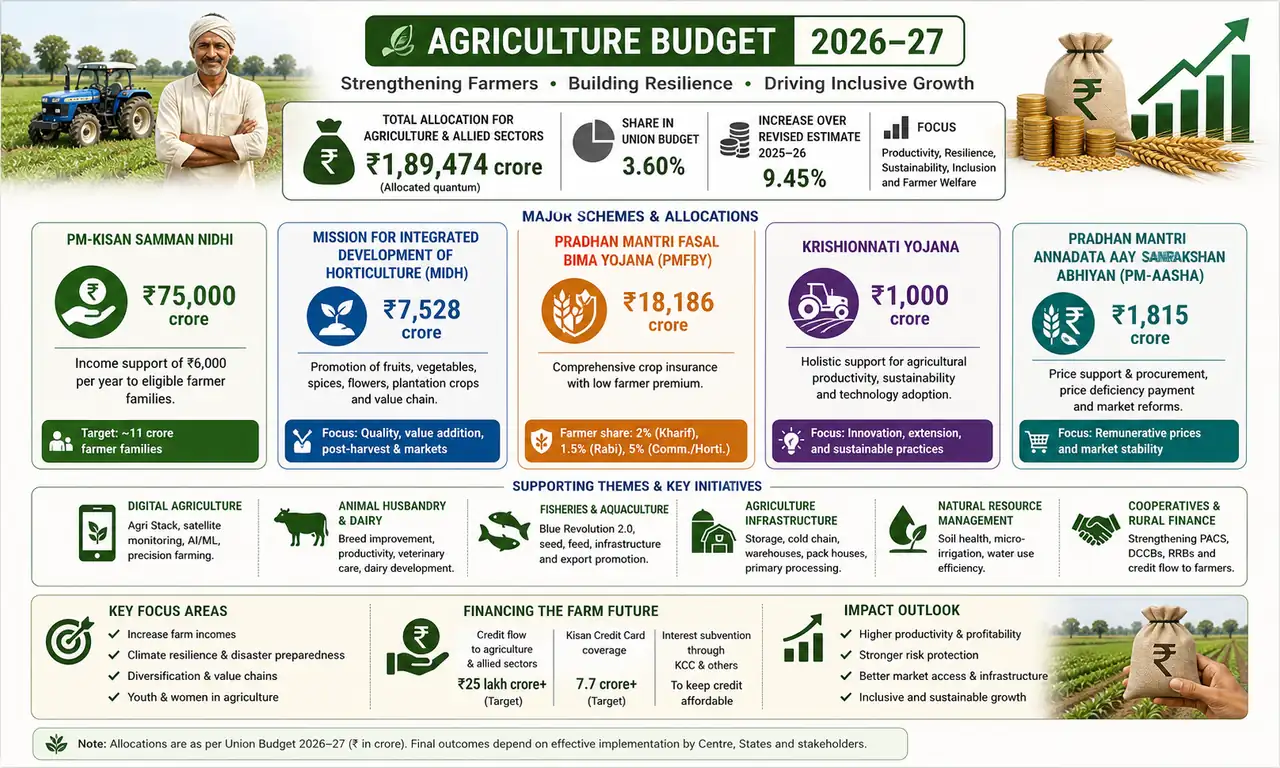
Complete agriculture budget 2026-27 highlights — ₹1.40L Cr ministry allocation, PM-KISAN, Krishionnati Yojana (64% increase), Namo Drone Didi, Bharat-VISTAAR AI tool, animal husbandry ₹6,153 Cr, fisheries ₹2,762 Cr, VB-GRAM G (MGNREGA renamed, 125 days), KCC limit hike & fertilizer subsidy ₹1.71L Cr.
Budget — Constitutional Framework
| Concept | Detail |
|---|---|
| Prepared by | Budget Division, Department of Economic Affairs, Ministry of Finance |
| Constitutional term | Annual Financial Statement (not "Budget") |
| Key article | Article 266 — Parliamentary approval needed to withdraw from Consolidated Fund of India |
| Financial articles | Articles 112 to 117 |
| Appropriation Bill | Article 114(3) — no withdrawal without enactment of law |
TIP
Exam mnemonic — "112-114-266": Budget procedure starts at Art 112, spending needs Appropriation Bill (Art 114), funds come from Consolidated Fund (Art 266).
Overview
The Union Budget 2026-27 was the first budget prepared in Kartavya Bhawan, guided by three core duties (Kartavyas): accelerating economic growth, fulfilling people's aspirations, and the vision of Sabka Sath, Sabka Vikas. With a focus on Poor, Youth, Women, and Farmers, the budget positions agriculture not merely as a welfare sector but as an investment-led growth engine aimed at innovation, competitiveness, and climate-resilient growth.
Pro Content Locked
Upgrade to Pro to access this lesson and all other premium content.
₹99 charged monthly · Cancel anytime
- All Agriculture & Banking Courses
- AI Lesson Questions (100/day)
- AI Doubt Solver (50/day)
- Glows & Grows Feedback (30/day)
- AI Section Quiz (20/day)
- 22-Language Translation (100/day)
- Recall Questions (20/day)
- AI Quiz (15/day)
- AI Quiz Paper Analysis (100/day)
- AI Step-by-Step Explanations (100/day)
- Spaced Repetition Recall (FSRS)
- AI Tutor
- Immersive Text Questions
- Audio Lessons — Hindi & English
- Mock Tests & Previous Year Papers
- Summary & Mind Maps
- XP, Levels, Leaderboard & Badges
- Generate New Classrooms
- Voice AI Teacher (AgriDots Live)
- AI Revision Assistant
- Knowledge Gap Analysis
- Interactive Revision (LangGraph)
🔒 Secure via Razorpay · Cancel anytime · No hidden fees
Budget — Constitutional Framework
| Concept | Detail |
|---|---|
| Prepared by | Budget Division, Department of Economic Affairs, Ministry of Finance |
| Constitutional term | Annual Financial Statement (not "Budget") |
| Key article | Article 266 — Parliamentary approval needed to withdraw from Consolidated Fund of India |
| Financial articles | Articles 112 to 117 |
| Appropriation Bill | Article 114(3) — no withdrawal without enactment of law |
TIP
Exam mnemonic — "112-114-266": Budget procedure starts at Art 112, spending needs Appropriation Bill (Art 114), funds come from Consolidated Fund (Art 266).
Overview
The Union Budget 2026-27 was the first budget prepared in Kartavya Bhawan, guided by three core duties (Kartavyas): accelerating economic growth, fulfilling people's aspirations, and the vision of Sabka Sath, Sabka Vikas. With a focus on Poor, Youth, Women, and Farmers, the budget positions agriculture not merely as a welfare sector but as an investment-led growth engine aimed at innovation, competitiveness, and climate-resilient growth.
IMPORTANT
The total allocation for the Ministry of Agriculture and Farmers Welfare in 2026-27 stands at ₹1,40,529 crore — a 5.4% increase over 2025-26 revised estimates. The overall agriculture & allied activities budget is approximately ₹1,62,671 crore (7% increase).
NOTE
The Fertilizer Subsidy of approximately ₹1,70,944 crore falls under the Ministry of Chemicals & Fertilizers (Department of Fertilizers), not the Agriculture Ministry. However, it directly impacts farmer input costs and is frequently asked in exams alongside agriculture budget figures.
Key Macroeconomic Indicators (Budget 2026-27)
| Indicator | Value |
|---|---|
| GDP Growth Rate | ~7% |
| Fiscal Deficit (BE 2026-27) | 4.3% of GDP |
| Revenue Deficit (BE 2026-27) | 0.3% of GDP |
| Debt-to-GDP Target (by 2030) | 50±1% |
| Public Capital Expenditure | ₹12.2 lakh crore |
| Total Transfer to States | ₹26.2 lakh crore |
| 16th Finance Commission — Vertical Devolution | 41% |
TIP
Exam Tip: The Economic Survey 2025-26 highlighted that growth in the agriculture sector has been primarily driven by livestock and fisheries, rather than traditional crops. This context explains why the budget has record allocations for allied sectors.
Major Agricultural Scheme Allocations (FY 2026-27)
The budget earmarked record allocations for key agricultural schemes:
| Scheme | Full Form | Allocation (₹ Crore) | Purpose |
|---|---|---|---|
| PM-KISAN | Pradhan Mantri Kisan Samman Nidhi | 63,500 | Income support of ₹6,000/year to farmers |
| MISS | Modified Interest Subvention Scheme | 22,600 | Subsidized short-term crop loans |
| PMFBY | Pradhan Mantri Fasal Bima Yojana | 12,200 | Crop Insurance |
| Krishionnati Yojana | Green Revolution — Krishionnati Yojana | 11,200 | Umbrella scheme (horticulture, soil health, mechanization) |
| PM-AASHA | Pradhan Mantri Annadata Aay SanraksHan Abhiyan | 7,200 | Price support & deficiency payments |
| AIF | Agriculture Infrastructure Fund | 910 | Post-harvest infrastructure |
| Namo Drone Didi | — | 677 | Drones for women SHGs |
| High-Value Agriculture | — | 350 | Crop diversification |
| Digital Agriculture | Bharat-VISTAAR | 150 | Multilingual AI advisory |
Key Observations
-
PM-KISAN remains unchanged at ₹63,500 Cr — effectively treated as a basic farmer entitlement. Since inception in 2019, over 10 crore beneficiaries have received >₹3.7 lakh crore in direct transfers. Target for FY27: 9.5 crore eligible farmers.
-
PMFBY at ₹12,200 Cr is its lowest allocation in 8 years — a 15.7% reduction vs actual expenditure of ₹14,473 Cr in FY25. Despite this, crop insurance coverage is expected to reach 4 crore farmers. A new Fund for Innovation and Adoption of Technology (FIAT) supports tech initiatives like YES-TECH and WINDS under PMFBY.
-
Krishionnati Yojana received a massive 64% increase over FY26 revised estimates. It subsumes schemes for: agricultural marketing, National Food Security Mission, National Mission on Horticulture, Soil Health & Fertility, agricultural mechanization, crop diversification, and rainfed area development.
IMPORTANT
Critical Exam Fact: Several missions announced in Budget 2025-26 — the Cotton Technology Mission, Mission for Pulses, Mission for Vegetables & Fruits, and National Mission on Hybrid Seeds — received no separate funds in the 2026-27 budget. They may have been subsumed under the Krishionnati Yojana umbrella or discontinued.
TIP
Exam Tip: PM-KISAN at ₹63,500 Cr is the single largest scheme under the agriculture ministry. Remember the top 5 allocations: PM-KISAN > MISS > PMFBY > Krishionnati > PM-AASHA.
High-Value Agriculture Mission
Allocation: ₹350 Crore
A major new initiative aimed at shifting farmers from traditional low-value crops to high-value alternatives to boost income and diversify India's export basket.
Target Crops by Region
| Region | Target Crops | Key Initiative |
|---|---|---|
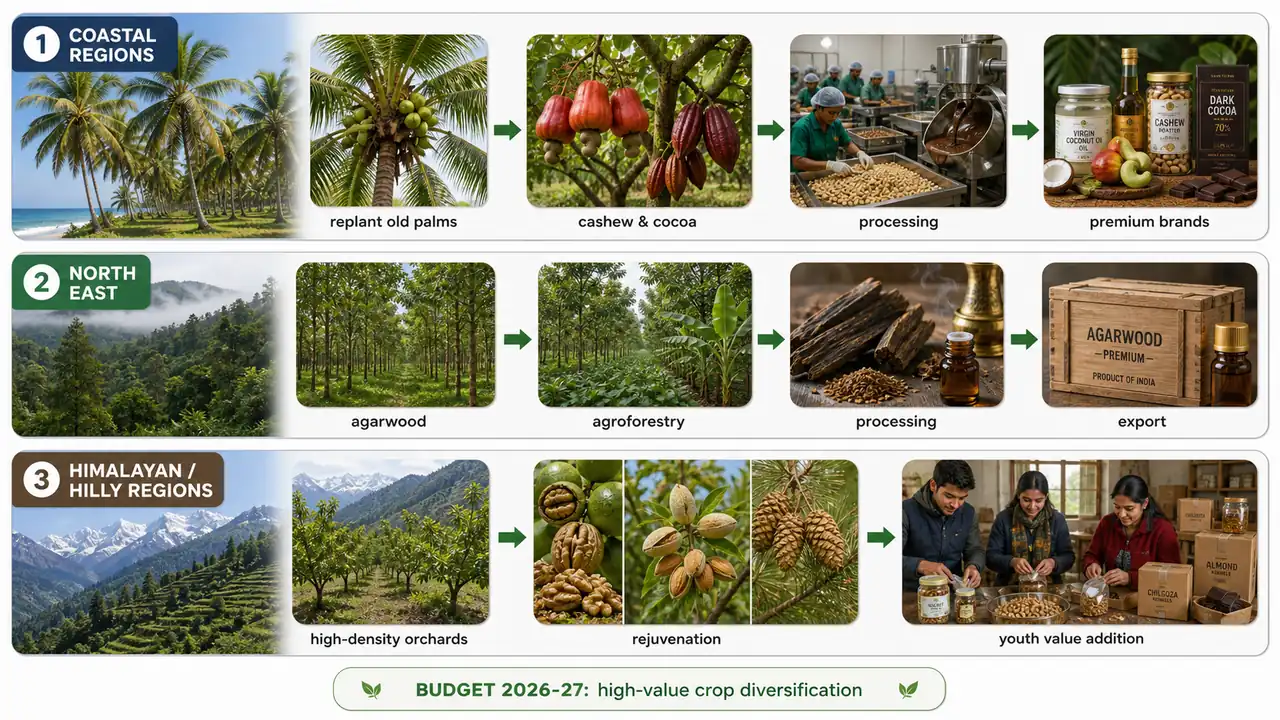
| Coastal Areas | Coconut, Cashew, Cocoa | Coconut Promotion Scheme: Replace old, unproductive trees with high-yielding varieties. Indian Cashew & Cocoa programmes to create premium global brands by 2030 |
| Hilly Regions | Walnuts, Almonds, Pine Nuts | Focus on temperate nut crops suited to cold climate |
| North East | Agarwood (Oud) | High-value aromatic wood — good quality agarwood can fetch up to ₹70 lakh/kg |
| Pan-India | Sandalwood | Collaboration with state governments for focused cultivation and post-harvest processing |
Why the Budget Is Pushing High-Value Crops
The background logic is broader than one ₹350 crore line item. The diversification push reflects a structural shift inside Indian agriculture toward horticulture-led value growth. As highlighted in the policy background document Accelerating India’s High Value Crop Diversification, horticulture now contributes roughly 37% of the Gross Value Output (GVO) of the crop sub-sector, and total horticulture output has risen from 277.35 million tonnes in 2013-14 to 370.74 million tonnes in 2024-25.
NOTE
This is why the budget treats high-value crops as an income strategy, not merely a production programme. These crops usually generate higher value per unit of land, support processing, and connect more directly with exports than staple cereals.
The same document also shows why the policy is becoming more regionally targeted:
- India ranks second globally in production of fruits, vegetables, and potato
- Fruits account for roughly 9.18% of global production and vegetables around 8.18%
- High-value crops fit naturally into coastal, North Eastern, and hilly agro-climatic zones where crop specialization can create a stronger income multiplier than a cereal-only strategy
Crop-wise Economic Logic Behind the Announcement
1. Coconut
- The coconut economy supports about 30 million people, including nearly 10 million farmers
- India produced about 13.97 million tonnes of coconut in 2024-25 from 2.19 million hectares
- Coconut and coconut-based exports reached about USD 513 million in 2024-25, rising around 25% over the previous year
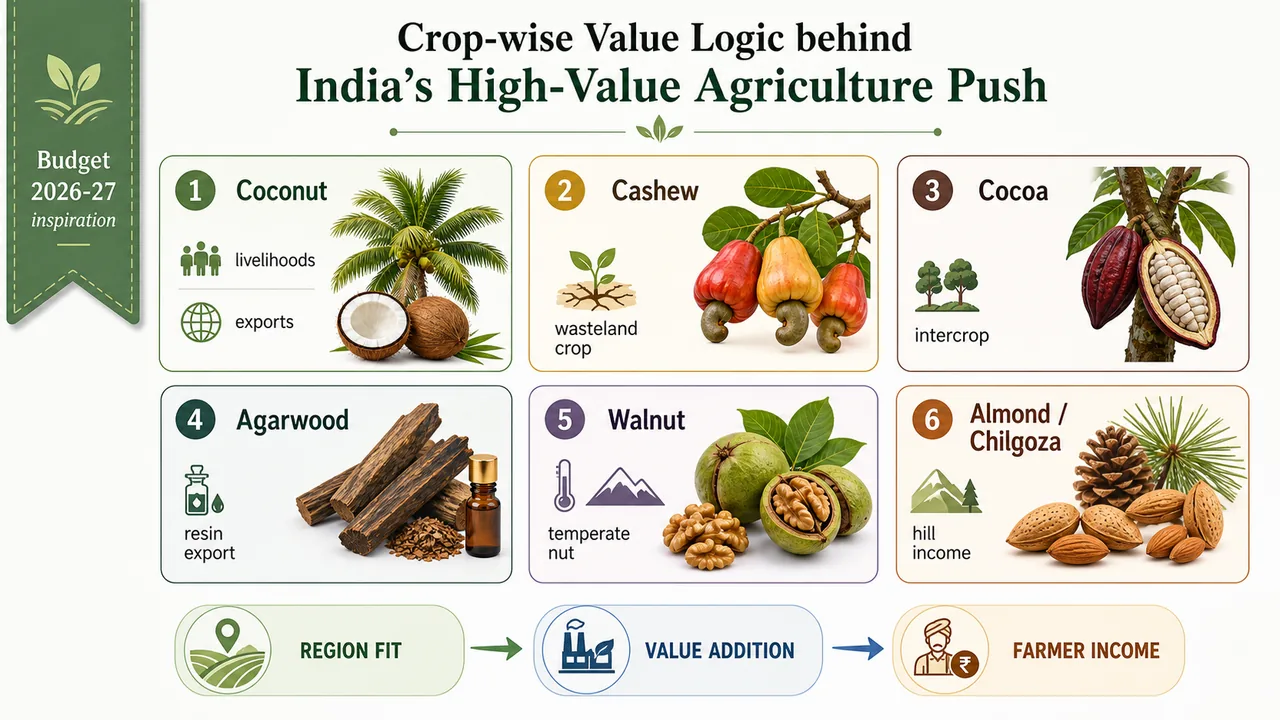
This explains why the budget does not treat coconut as a routine plantation crop. It is simultaneously a livelihood crop, a processing crop, and an export crop. The Coconut Promotion Scheme focuses on replacing senile, low-yielding palms with better planting material, so exam answers should connect the announcement to productivity improvement, not just area expansion.
2. Cashew and Cocoa
- Cashew is often described as a profitable crop for degraded or wasteland-type conditions, which is why it is called the “gold mine of wasteland” in extension literature
- India’s cashew exports stood at about USD 369.17 million in 2024-25
- India’s cocoa production was about 32.91 thousand metric tonnes in 2024-25
- Cocoa exports were about USD 295.58 million in the same year
The policy logic here is different from coconut. Cashew is attractive because it combines resilience, land rehabilitation, and export potential. Cocoa matters because it works as an intercrop, especially under coconut and arecanut, which means the same farm can support vertical diversification rather than land expansion.
TIP
Exam framing: Coconut = replanting + productivity. Cashew = wasteland + export. Cocoa = intercrop + value addition.
3. Agarwood in the North East
- India has nearly 150 million agarwood trees as of January 2026
- About 90% of them are located in the North Eastern states
- Tripura alone is estimated to have an annual market turnover potential of around ₹2,000 crore
Agarwood is not a mass-volume crop like coconut. It is a premium aromatic-value crop linked to resin extraction, processing, and export. That is why the budget’s emphasis is on expanding cultivation, processing capacity, and export readiness rather than simple production tonnage.
4. Walnut, Almond, and Chilgoza in Hilly Regions
- Walnut production reached around 3.22 lakh tonnes in 2024-25
- Walnut exports were worth about USD 7.80 million in FY 2024-25
- Almond production was around 13.94 thousand metric tonnes in 2024-25
- Chilgoza remains especially important for tribal livelihoods in arid Himalayan valleys
The hilly-region strategy is orchard-oriented. The budget emphasis is on high-density planting, rejuvenation of old orchards, and value addition through rural youth participation. In exam language, hill crops are being linked to income enhancement through orchard modernization, not to broad-acre foodgrain expansion.
Coconut — Key Facts for Exams
- India is the world's largest producer of coconuts
- Approximately 30 million people are dependent on the coconut economy
- The new scheme aims to replace old trees and improve yield per tree
- Major producing states: Kerala, Karnataka, Tamil Nadu, Andhra Pradesh, Goa
IMPORTANT
The High-Value Agriculture Mission represents a strategic shift from production-oriented subsidies to income-oriented diversification. However, experts note that vegetables, fruits, and spices — which form a large part of horticultural output — received less attention.
Digital Agriculture: Bharat-VISTAAR
Allocation: ₹150 Crore
- Bharat-VISTAAR stands for Virtually Integrated System To Access Agricultural Resources
- A multilingual AI tool designed to integrate AgriStack portals and the ICAR (Indian Council of Agricultural Research) package on agricultural practices with AI systems
- Makes knowledge accessible to farmers in their native languages
- Provides real-time, data-driven advisory services — customized to local conditions
- Bridges the gap between research (ICAR) and field-level implementation
Additional Digital Agriculture Initiatives
- Boosted Digital Agriculture Mission continues with AgriStack development: Farmers' database, crop sown registry, geo-referenced land records
- eNAM (Electronic National Agriculture Market): 1,656 mandis integrated across 23 states and 4 UTs. Over 1.80 crore farmers and 2.72 lakh traders registered. Cumulative trade value: ₹4.82 lakh crore since inception. Government provides up to ₹75 lakh per mandi for integration.
TIP
Exam Tip: eNAM stats are a frequently tested topic. Remember: 1,656 mandis, 1.80 Cr farmers, ₹4.82L Cr trade value.
Namo Drone Didi Scheme
Allocation: ₹677 Crore
- Launched: November 2024
- Beneficiaries: Women Self Help Groups (SHGs)
- Purpose: Provide drones for agricultural use — applying fertilizers, pesticides, and crop monitoring
- Subsidy: Up to 80% of drone cost, capped at ₹8 lakh per SHG
- Target: 14,500 Women SHGs to receive drones
- Total Scheme Outlay (2023-26): ₹1,261 crore
- Women earn income by providing drone-as-a-service to neighboring farmers
TIP
Exam Tip: Namo Drone Didi combines 3 key themes: women empowerment (SHGs), technology adoption (drones), and precision agriculture (efficient fertilizer/pesticide application). The 80% subsidy cap of ₹8 lakh is frequently asked.
Animal Husbandry — Highest-Ever Support
Allocation: ₹6,153 Crore — a 21% increase over the previous year and the sector's highest-ever budgetary support.
The broader Ministry of Fisheries, Animal Husbandry, and Dairying has been allocated ₹8,915 crore in total.
New Veterinary Infrastructure
A Credit-linked Capital Subsidy Scheme for private players (including collaboration with foreign institutions) to set up:
- Veterinary & Para-vet colleges
- Veterinary Hospitals & Diagnostic Labs
- Mobile Veterinary Units
- Breeding Facilities
Target: Increase veterinary professionals by 20,000+
Key Scheme Allocations
| Scheme | Allocation |
|---|---|
| Rashtriya Gokul Mission | ₹800 Cr (breed improvement) |
| Entrepreneurship Development | ₹500 Cr (FPOs & startups in livestock) |
| AHIDF (Animal Husbandry Infra Dev Fund) | Extended till March 2026 (total outlay: ₹29,610 Cr) |
KCC Limit Doubled
- KCC (Kisan Credit Card) loan limit for Animal Husbandry farmers increased from ₹3 lakh to ₹5 lakh
- The subsidized interest rate (effective 4% for prompt repayers) continues at the higher limit
- Collateral-free credit limit under KCC raised to ₹2 lakh per borrower
- KCC was expanded in 2019 to cover Animal Husbandry, Dairying, and Fisheries
IMPORTANT
The KCC limit doubling from ₹3 lakh to ₹5 lakh is one of the most impactful announcements. The collateral-free limit is ₹2 lakh. For exam purposes, remember the trifecta: limit doubled (₹5L) + collateral-free (₹2L) + effective rate (4%).
Fisheries — Highest-Ever Annual Support
Allocation: ₹2,762 Crore (of which PMMSY: ₹2,500 Crore)
This is the highest-ever annual budgetary support for the fisheries sector.
Reservoir Development
- Integrated development of 500 Reservoirs and Amrit Sarovars to create fisheries hubs
- Targeted conversion of existing water bodies into productive fisheries zones
Value Chain Strengthening
- Strengthening coastal fisheries value chains and market linkages
- Special focus on Fish FPOs, startups, and women-led groups
- Support for approximately 200 fisheries startups
Export Boost
- Duty-free imports for inputs used in seafood processing increased from 1% to 3% of export turnover (FOB value)
- Tax Exemption: Fish caught by Indian fishing vessels in EEZ (Exclusive Economic Zone) or on the High Seas are now exempt from customs duties
- Landing of such fish on a foreign port to be treated as export of goods
- This dual provision boosts both domestic processing and export earnings
TIP
Exam Tip: The fish in EEZ/High Seas provision has dual impact — it exempts customs duty AND treats foreign port landing as exports. Also note: 200 fisheries startups to be supported — linking entrepreneurship with blue economy.
Rural Employment: VB-GRAM G (Renamed MGNREGS)
MGNREGA (Mahatma Gandhi National Rural Employment Guarantee Act) has been renamed as VB-GRAM G — Viksit Bharat – Guarantee for Rozgar and Ajeevika Mission (Gramin) Act, 2025. It is not a separate scheme — it is the successor law that replaces MGNREGA, effective 1st April 2026.
Allocation: ₹95,692 crore (for VB-GRAM G) + ₹30,000 crore (residual MGNREGS allocation)
Key Changes: MGNREGS → VB-GRAM G
| Parameter | MGNREGS (Old) | VB-GRAM G (New) |
|---|---|---|
| Employment Guarantee | 100 days per household/year | 125 days per household/year |
| Funding Pattern | Centre bore full cost of unskilled wages | 60:40 (Centre:State) for most states |
| NE & Himalayan States | — | 90:10 (Centre:State) |
| UTs without Legislature | — | 100% Central funding |
| Focus | Demand-driven employment guarantee | Budget-capped, supply-driven — asset creation, water security, rural infra |
| Farming Season | No pause provision | Work paused for 60 days during sowing & harvesting seasons |
| Vision | Rights-based employment | Aligned with Viksit Bharat @2047 — climate resilience & rural infra |
IMPORTANT
Critical Exam Points:
- VB-GRAM G is a renaming of MGNREGA — not a new scheme alongside it
- Days increased: 100 → 125 days per household per year
- Funding is now shared with states (60:40) — unlike MGNREGA where Centre paid full unskilled wages
- 60-day pause during farming season — new provision to avoid labour conflict with agriculture
- MGNREGS allocation reduced to ₹30,000 Cr (for transitional period) while VB-GRAM G gets ₹95,692 Cr
Agricultural Tax Proposals
Key tax reforms specifically impacting the agriculture sector:
| Reform | Detail |
|---|---|
| Fish in EEZ/High Seas | Customs duty exemption + treated as exports |
| Cooperative — Cattle Feed/Cotton Seed | Deduction allowed to primary cooperative society for supply of cattle feed & cotton seed produced by members |
| Inter-Cooperative Dividend | Dividend income from inter-cooperative investments allowed as deduction under the new tax regime (only if distributed to members) |
| National Cooperative Federation | Exemption on dividend from company investments (up to 31.3.2026) for 3 years — only if distributed to member cooperatives |
| Courier Export Cap Removed | ₹10 lakh per consignment cap on courier exports removed — benefits small agri exporters |
| Seafood Export Inputs | Duty-free import limit for seafood processing: 1% → 3% of FOB turnover |
IMPORTANT
These tax reforms specifically strengthen cooperatives in the agricultural sector — a frequently tested topic. Note the three separate cooperative-related tax concessions.
Irrigation & Water Strategy
The budget signals a shift in irrigation policy — from large-scale canal projects to cost reduction through technology:
- KUSUM (Kisan Urja Suraksha evam Utthaan Mahabhiyan) scheme — solar pumps to reduce irrigation costs
- Energy and water management linked closely
- Focus on service reliability and cost control rather than new infrastructure
- This approach reduces farmers' dependency on expensive diesel pumps
Key Reforms at a Glance
| Reform / Announcement | Key Detail | Value / Target |
|---|---|---|
| Ministry of Agriculture (Total) | 5.4% increase over RE | ₹1,40,529 Cr |
| Fertilizer Subsidy (Min. of Chemicals) | Input cost support (separate ministry) | ₹1,70,944 Cr |
| PM-KISAN | Income support (unchanged) | ₹63,500 Cr |
| MISS | Crop loan subsidy | ₹22,600 Cr |
| PMFBY | 8-year low allocation | ₹12,200 Cr |
| Krishionnati Yojana | 64% jump — umbrella scheme | ₹11,200 Cr |
| VB-GRAM G | MGNREGA renamed; 125 days (up from 100) | ₹95,692 Cr |
| PM-AASHA | Price support | ₹7,200 Cr |
| Animal Husbandry | 21% increase, highest-ever | ₹6,153 Cr |
| Fisheries (PMMSY: ₹2,500 Cr) | Highest-ever annual support | ₹2,762 Cr |
| AIF | Post-harvest infra | ₹910 Cr |
| Rashtriya Gokul Mission | Breed improvement | ₹800 Cr |
| Namo Drone Didi | Drones for women SHGs | ₹677 Cr |
| High-Value Agriculture | Crop diversification | ₹350 Cr |
| Bharat-VISTAAR | AI advisory | ₹150 Cr |
| KCC Limit (Animal Husb.) | Doubled | ₹3L → ₹5L |
| eNAM | Mandis integrated | 1,656 |
| 500 Reservoirs | Fisheries hubs | 500 |
| Fisheries Startups | New support | 200 |
| New Vet Professionals | Target increase | 20,000+ |
| Women SHG Drones | Target SHGs | 14,500 |
IMPORTANT
Budget 2026-27 marks three major shifts:
- Technology-led agriculture — Bharat-VISTAAR (AI), Namo Drone Didi, eNAM expansion
- Allied sectors over traditional crops — Record support for Animal Husbandry + Fisheries (combined ₹8,915 Cr), while several crop-specific missions from 2025-26 received no funds
- Income enhancement over production — High-value crop diversification, cooperative tax reforms, KCC enhancement
Summary Cheat Sheet
| Concept / Topic | Key Details / Explanation |
|---|---|
| Budget constitutional basis | Annual Financial Statement; Articles 112–117; Appropriation Bill Art 114(3); Consolidated Fund Art 266 |
| Budget prepared in | Kartavya Bhawan (first time) |
| Budget 2026-27 core duties | Accelerate economic growth, fulfil aspirations, Sabka Sath Sabka Vikas |
| Ministry of Agriculture total | ₹1,40,529 crore — 5.4% increase over 2025-26 RE |
| Overall agri & allied budget | ~₹1,62,671 crore (7% increase) |
| Fertilizer subsidy | ₹1,70,944 crore (under Ministry of Chemicals & Fertilizers — separate) |
| GDP growth target | ~7% |
| Fiscal deficit (BE 2026-27) | 4.3% of GDP |
| PM-KISAN allocation | ₹63,500 crore (unchanged); 9.5 crore eligible farmers; >10 crore beneficiaries since 2019 |
| MISS allocation | ₹22,600 crore |
| PMFBY allocation | ₹12,200 crore — 8-year low (15.7% reduction); ~4 crore farmers covered |
| PMFBY tech fund | FIAT (Fund for Innovation and Adoption of Technology) — supports YES-TECH, WINDS |
| Krishionnati Yojana | ₹11,200 crore — 64% jump; umbrella scheme subsuming marketing, NFSM, horticulture, soil health, mechanization |
| PM-AASHA allocation | ₹7,200 crore |
| Top 5 allocations (agri ministry) | PM-KISAN > MISS > PMFBY > Krishionnati > PM-AASHA |
| High-Value Agriculture Mission | ₹350 crore — coconut, cashew, cocoa (coastal); walnuts/almonds (hilly); agarwood (NE); sandalwood (pan-India) |
| Agarwood value | Good quality can fetch ₹70 lakh/kg |
| India coconut production rank | World's largest producer |
| Bharat-VISTAAR | ₹150 crore; multilingual AI tool integrating AgriStack + ICAR knowledge |
| Bharat-VISTAAR full form | Virtually Integrated System To Access Agricultural Resources |
| eNAM (Budget 2026-27 stats) | 1,656 mandis, 1.80 crore farmers, 2.72 lakh traders, ₹4.82 lakh crore cumulative trade; govt provides ₹75 lakh/mandi |
| Namo Drone Didi | ₹677 crore; launched November 2024; 80% subsidy capped at ₹8 lakh/SHG; target 14,500 women SHGs |
| Animal Husbandry allocation | ₹6,153 crore — 21% increase, highest-ever |
| Ministry of Fisheries, AH & Dairying | Total: ₹8,915 crore |
| Rashtriya Gokul Mission | ₹800 crore (breed improvement) |
| AHIDF total outlay | ₹29,610 crore (extended till March 2026) |
| KCC limit enhanced | Animal Husbandry: ₹3 lakh → ₹5 lakh; collateral-free raised to ₹2 lakh |
| Fisheries allocation | ₹2,762 crore (PMMSY: ₹2,500 crore) — highest-ever annual support |
| Fisheries – 500 reservoirs | Integrated development as fisheries hubs |
| Fisheries startups | 200 startups to be supported |
| EEZ/High Seas fish | Customs duty exempt; landing at foreign port treated as export of goods |
| Seafood processing input limit | Duty-free imports raised from 1% → 3% of export turnover (FOB) |
| VB-GRAM G | MGNREGA renamed; 125 days (up from 100); effective 1 April 2026 |
| VB-GRAM G funding | 60:40 (Centre:State); NE/Himalayan: 90:10; UTs without legislature: 100% central |
| VB-GRAM G farming pause | Work paused for 60 days during sowing and harvesting seasons |
| VB-GRAM G allocation | ₹95,692 crore + ₹30,000 crore (residual MGNREGS) |
| Cooperative tax reforms | 3 provisions: cattle feed/cotton seed deduction; inter-cooperative dividend deduction; National Cooperative Federation exemption |
| Courier export cap | ₹10 lakh/consignment cap removed — benefits small agri exporters |
| New vet professionals target | 20,000+ (via Credit-linked Capital Subsidy Scheme for private vet infrastructure) |
References
6 sources • [1] [2] [3] [4] [5] [6]
References
Used for: Full text of FM Nirmala Sitharaman's budget speech with all agriculture sector announcements
Used for: Ministry-wise expenditure statements including Dept. of Agriculture, Animal Husbandry, and Fisheries
Used for: Official PIB release on Union Budget 2026-27 covering sustainable economic growth and all key announcements
Used for: PIB release: 500 reservoir development, EEZ fish duty-free, seafood processing input limit raised to 3%
Used for: Fiscal deficit at 4.3% of GDP, total expenditure ₹50.65L Cr, capital expenditure ₹11.2L Cr
Used for: PRS analysis of ₹1,40,529 Cr allocation — PM-KISAN, Krishionnati Yojana, PMFBY scheme-wise breakdowns
Lesson Doubts
Ask questions, get expert answers