🌂 Types of Market: 12 Dimensions of Classification
Understand the 12 dimensions used to classify agricultural markets -- from location and competition to commodities and public intervention -- with examples and exam tips.
A farmer selling tomatoes at a village haat, a trader bidding for wheat at a district mandi, and an exporter shipping basmati rice from a sea-port -- each operates in a different type of market. Markets can be classified along 12 dimensions, and any single market can be described using all twelve simultaneously.
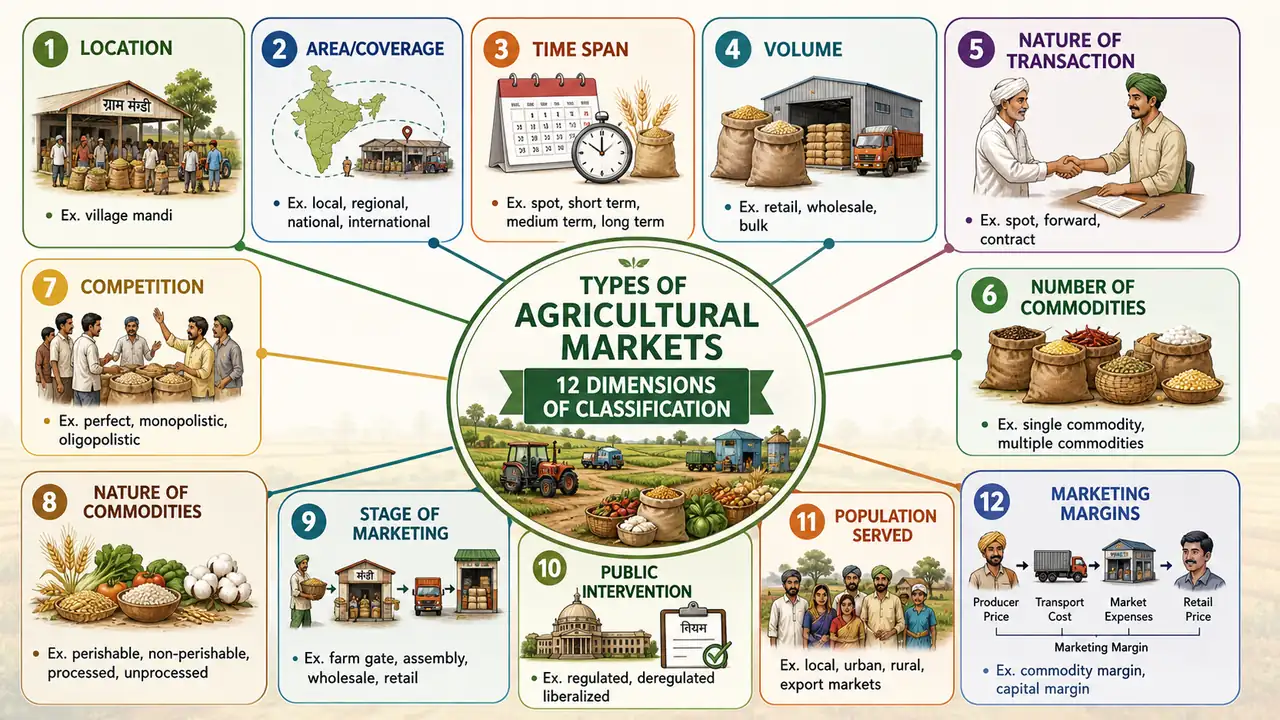
The 12 Dimensions of a Market
| # | Dimension | What It Classifies |
|---|---|---|
| 1 | Location | Where the market operates |
| 2 | Area / Coverage | Geographic reach of buyers and sellers |
| 3 | Time span | How long the market operates |
| 4 | Volume of transactions | Bulk vs small-lot trading |
| 5 | Nature of transactions | Spot vs forward trading |
| 6 | Number of commodities | General vs specialized |
| 7 | Degree of competition | Perfect to monopoly |
| 8 | Nature of commodities | Physical goods vs financial instruments |
| 9 | Stage of marketing | Producing vs consuming end |
| 10 | Extent of public intervention | Regulated vs unregulated |
| 11 | Type of population served | Urban vs rural |
| 12 | Accrual of marketing margins | Private trade vs cooperatives |
Market Types by Place, Reach, and Duration
1. On the Basis of Location
| Type | Location | Key Feature | Agricultural Example |
|---|---|---|---|
| Village market | Small village | Small quantities, local buyers and sellers | Weekly haat where farmers sell vegetables |
| Primary wholesale market | Big towns near production centres | Farmers sell directly to traders; first point of aggregation | Azadpur Mandi (Delhi) for fruits and vegetables |
| Secondary wholesale market | District HQs, railway junctions | Produce arrives from other markets; handled in large quantities by specialized agencies (commission agents, brokers) | Grain mandi at a district headquarter |
| Terminal market | Metropolitan cities, sea-ports | Final disposal to consumers, processors, or exporters; commodity exchanges for forward trading | Mumbai cotton exchange, Kolkata jute market |
| Seaboard market | Near seashore | Meant for import and/or export | Mumbai, Chennai, Kolkata ports for agri-exports |
TIP
Pro Content Locked
Upgrade to Pro to access this lesson and all other premium content.
₹99 charged monthly · Cancel anytime
- All Agriculture & Banking Courses
- AI Lesson Questions (100/day)
- AI Doubt Solver (50/day)
- Glows & Grows Feedback (30/day)
- AI Section Quiz (20/day)
- 22-Language Translation (100/day)
- Recall Questions (20/day)
- AI Quiz (15/day)
- AI Quiz Paper Analysis (100/day)
- AI Step-by-Step Explanations (100/day)
- Spaced Repetition Recall (FSRS)
- AI Tutor
- Immersive Text Questions
- Audio Lessons — Hindi & English
- Mock Tests & Previous Year Papers
- Summary & Mind Maps
- XP, Levels, Leaderboard & Badges
- Generate New Classrooms
- Voice AI Teacher (AgriDots Live)
- AI Revision Assistant
- Knowledge Gap Analysis
- Interactive Revision (LangGraph)
🔒 Secure via Razorpay · Cancel anytime · No hidden fees

A farmer selling tomatoes at a village haat, a trader bidding for wheat at a district mandi, and an exporter shipping basmati rice from a sea-port -- each operates in a different type of market. Markets can be classified along 12 dimensions, and any single market can be described using all twelve simultaneously.
The 12 Dimensions of a Market
| # | Dimension | What It Classifies |
|---|---|---|
| 1 | Location | Where the market operates |
| 2 | Area / Coverage | Geographic reach of buyers and sellers |
| 3 | Time span | How long the market operates |
| 4 | Volume of transactions | Bulk vs small-lot trading |
| 5 | Nature of transactions | Spot vs forward trading |
| 6 | Number of commodities | General vs specialized |
| 7 | Degree of competition | Perfect to monopoly |
| 8 | Nature of commodities | Physical goods vs financial instruments |
| 9 | Stage of marketing | Producing vs consuming end |
| 10 | Extent of public intervention | Regulated vs unregulated |
| 11 | Type of population served | Urban vs rural |
| 12 | Accrual of marketing margins | Private trade vs cooperatives |
Market Types by Place, Reach, and Duration
1. On the Basis of Location
| Type | Location | Key Feature | Agricultural Example |
|---|---|---|---|
| Village market | Small village | Small quantities, local buyers and sellers | Weekly haat where farmers sell vegetables |
| Primary wholesale market | Big towns near production centres | Farmers sell directly to traders; first point of aggregation | Azadpur Mandi (Delhi) for fruits and vegetables |
| Secondary wholesale market | District HQs, railway junctions | Produce arrives from other markets; handled in large quantities by specialized agencies (commission agents, brokers) | Grain mandi at a district headquarter |
| Terminal market | Metropolitan cities, sea-ports | Final disposal to consumers, processors, or exporters; commodity exchanges for forward trading | Mumbai cotton exchange, Kolkata jute market |
| Seaboard market | Near seashore | Meant for import and/or export | Mumbai, Chennai, Kolkata ports for agri-exports |
TIP
Mnemonic for location-based markets (simple to complex): "V-P-S-T-Sea" -- Village, Primary, Secondary, Terminal, Seaboard.
2. On the Basis of Area / Coverage
| Type | Coverage | Typical Commodities | Example |
|---|---|---|---|
| Local / Village market | Same village or nearby villages | Perishable goods in small lots | Village milk market, local vegetable market |
| Regional market | State or multi-district area | Food grains | Rice market covering Tamil Nadu |
| National market | Entire country | Durable goods | Jute and tea markets across India |
| World market | Whole world | Commodities with global demand/supply | Coffee, raw cotton, sugar, gold |
3. On the Basis of Time Span
| Type | Duration | Products | Price Determined By | Example |
|---|---|---|---|---|
| Short-period market | Few hours | Highly perishable | Mainly demand (supply is fixed in short run) | Fish market, fresh vegetable market, liquid milk |
| Long-period market | Days to months | Less perishable, storable | Both supply and demand | Food grain market, oilseed market |
| Secular market | Permanent / continuous | Durable goods | Supply and demand over long term | Machinery market, tractor market |
TIP
Key insight: In short-period markets, supply is fixed so demand dominates pricing. In long-period markets, storage allows sellers to hold produce, making supply an active factor.
Market Types by Trading Pattern and Product Scope
4. On the Basis of Volume of Transactions
| Type | Transaction Size | Participants | Role in Chain |
|---|---|---|---|
| Wholesale market | Large lots / bulk | Trader to trader | Aggregates produce and distributes in bulk to retailers and processors |
| Retail market | Small lots as per consumer need | Retailer to consumer | Final link -- nearest to the consumer |
Agricultural example: A rice wholesaler at Koyambedu market (Chennai) sells 100-quintal lots to retailers, who then sell 1-5 kg packets to households.
5. On the Basis of Nature of Transactions
| Type | When Exchange Happens | Payment | Agricultural Example |
|---|---|---|---|
| Spot / Cash market | Immediately after sale | On the spot | Farmer sells wheat at mandi and receives cash same day |
| Forward market | At a future date (t + 1) | On the future date; sometimes only price difference is settled | Cotton futures on MCX; soybean forward contracts on NCDEX |
Forward markets serve as instruments of price risk management for agricultural commodities.
6. On the Basis of Number of Commodities
| Type | Commodities Traded | Where Found | Example |
|---|---|---|---|
| General market | All types -- grains, oilseeds, fibre crops, gur, etc. | Smaller towns where volume does not justify separate markets | A general mandi trading in wheat, mustard, and gram together |
| Specialized market | Only one or two commodities | Areas of concentrated production or high demand | Onion mandi of Lasalgaon (Nashik); Muzaffarnagar sugarcane market |
7. On the Basis of Degree of Competition
This is among the most important classifications for exams. Markets range from perfectly competitive to pure monopoly.
Perfect Market (Theoretical Ideal)
A perfect market requires:
- Large number of buyers and sellers -- no single participant influences price
- Perfect knowledge of demand, supply, and prices among all participants
- Price uniformity across geography (adjusted for transport cost)
- Price uniformity over time (adjusted for storage cost)
- Price uniformity across product forms (adjusted for processing cost)
Imperfect Markets (Real-World)
| Type | No. of Sellers | No. of Buyers | Key Feature | Agricultural Example |
|---|---|---|---|---|
| Monopoly | 1 | Many | Sole control over quantity or price; prices are higher | Government as sole electricity supplier for irrigation |
| Monopsony | Many | 1 | Single buyer dictates terms | Government procurement agency as sole buyer of wheat in some areas |
| Duopoly | 2 | Many | Two sellers may agree on a common higher price | Rare in agriculture |
| Duopsony | Many | 2 | Two buyers dominate | Two large sugar mills in a taluka competing for sugarcane |
| Oligopoly | Few (>2) | Many | Strategic behaviour -- price wars or tacit agreements | A few large rice millers dominating a district's paddy procurement |
| Oligopsony | Many | Few (>2) | Few buyers control the market | Few traders controlling purchase of coffee in a region |
| Monopolistic competition | Many | Many | Differentiated/heterogeneous products; brand competition | Farmers choosing between various brands of fertilizers, insecticides, or pumpsets |
IMPORTANT
No. of Sellers: Monopoly < Duopoly < Oligopoly < Monopolistic Competition < Perfect Competition UPPSC-2021
Market Types by Commodity, Stage, and Regulation
8. On the Basis of Nature of Commodities
| Type | What Is Traded | Example |
|---|---|---|
| Commodity market | Physical goods and raw materials | Wheat, cotton, fertilizer, seed markets |
| Capital market | Bonds, shares, securities, financial instruments | Share market (BSE/NSE), money market |
9. On the Basis of Stage of Marketing
| Type | Function | Location | Example |
|---|---|---|---|
| Producing market | Assembles commodity for further distribution | Near production areas | Mango assembling market in Malihabad (Lucknow) |
| Consuming market | Collects produce for final disposal to consumers | Urban centres or production-deficit areas | Vegetable market in Mumbai or Delhi |
10. On the Basis of Extent of Public Intervention
| Type | Rules | Key Feature | Impact on Farmers |
|---|---|---|---|
| Regulated market | Rules framed by statutory market organization | Standardized costs, transparent practices, fair weighing, prompt payment | Protects farmers from exploitation |
| Unregulated market | No set rules; traders frame their own rules | Unstandardized charges, price manipulation, delayed payments | Farmers often face exploitation |
Agricultural example: APMC mandis are regulated markets. Roadside sale of vegetables without any oversight is an unregulated market.
Market Types by Consumer Base and Margin Flow
11. On the Basis of Type of Population Served
| Type | Consumer Base | Demand Characteristics |
|---|---|---|
| Urban market | Urban population | More processed, packaged, and branded agricultural products |
| Rural market | Rural population | Unprocessed or minimally processed goods in smaller quantities |
12. On the Basis of Accrual of Marketing Margins
| Type | Who Gets Margins | Example |
|---|---|---|
| Private trade | Middlemen and private traders retain profits | Traditional mandi system |
| Cooperative marketing | Margins shared among members or kept negligible | Amul (milk), IFFCO (fertilizers), sugar cooperatives in Maharashtra |
In cooperatives, profits that would normally go to middlemen are redistributed to farmer-members, making the system more equitable.
Summary Cheat Sheet
| Concept / Topic | Key Details / Explanation |
|---|---|
| 12 Dimensions of market classification | Location, area, time span, volume, nature of transaction, number of commodities, competition, nature of commodity, stage, public intervention, population, marketing margins |
| Location-based (V-P-S-T-Sea) | Village → Primary wholesale (near production) → Secondary wholesale (district HQ) → Terminal (metro/seaport, commodity exchanges) → Seaboard (import/export) |
| Area-based | Local (perishables) → Regional (state) → National (durables) → World (global demand commodities) |
| Time span | Short-period (perishables, demand dominates pricing) → Long-period (storable, supply + demand) → Secular (permanent, durable goods) |
| Volume | Wholesale (bulk, trader-to-trader) vs Retail (small lots, retailer-to-consumer) |
| Nature of transaction | Spot/Cash (immediate exchange) vs Forward (future date, price risk management) |
| Number of commodities | General (multiple commodities) vs Specialized (one/two commodities, e.g., Lasalgaon onion market) |
| Perfect Market conditions | Large number of buyers-sellers, perfect knowledge, price uniformity across geography, time, and form |
| Monopoly | 1 seller, many buyers; prices higher than competitive level |
| Monopsony | Many sellers, 1 buyer dictates terms (e.g., govt. procurement agency) |
| Duopoly / Duopsony | 2 sellers / 2 buyers dominating |
| Oligopoly / Oligopsony | Few (>2) sellers / buyers; strategic behaviour |
| Monopolistic competition | Many sellers, differentiated products, brand competition |
| Seller count order | Monopoly < Duopoly < Oligopoly < Monopolistic < Perfect Competition |
| Commodity vs Capital market | Physical goods vs bonds/shares/securities |
| Producing vs Consuming market | Near production areas (assembling) vs urban centres (final disposal) |
| Regulated vs Unregulated | APMC mandis (transparent) vs no rules (farmer exploitation) |
| Urban vs Rural market | Processed/packaged goods vs unprocessed/small quantities |
| Private trade vs Cooperative | Middlemen retain profits vs margins redistributed to farmer-members |
| Key exam point | Any single market can be described using all 12 dimensions simultaneously |