🧑🏼🦯 Marketing Channels, Efficiency, Costs & Margins
Understand marketing channels, factors in channel selection, marketing efficiency (Kohls-Uhl and Shepherd formulas), marketing costs, margins, price spread, and producer's share in consumer's rupee.
When a mango farmer in Malihabad (Lucknow) sells his harvest, the fruit may pass through a village trader, a commission agent at a wholesale mandi, a retailer in Delhi, and finally reach a consumer. Each stop in this journey is part of the marketing channel. The number of stops determines how much the farmer earns and how much the consumer pays.
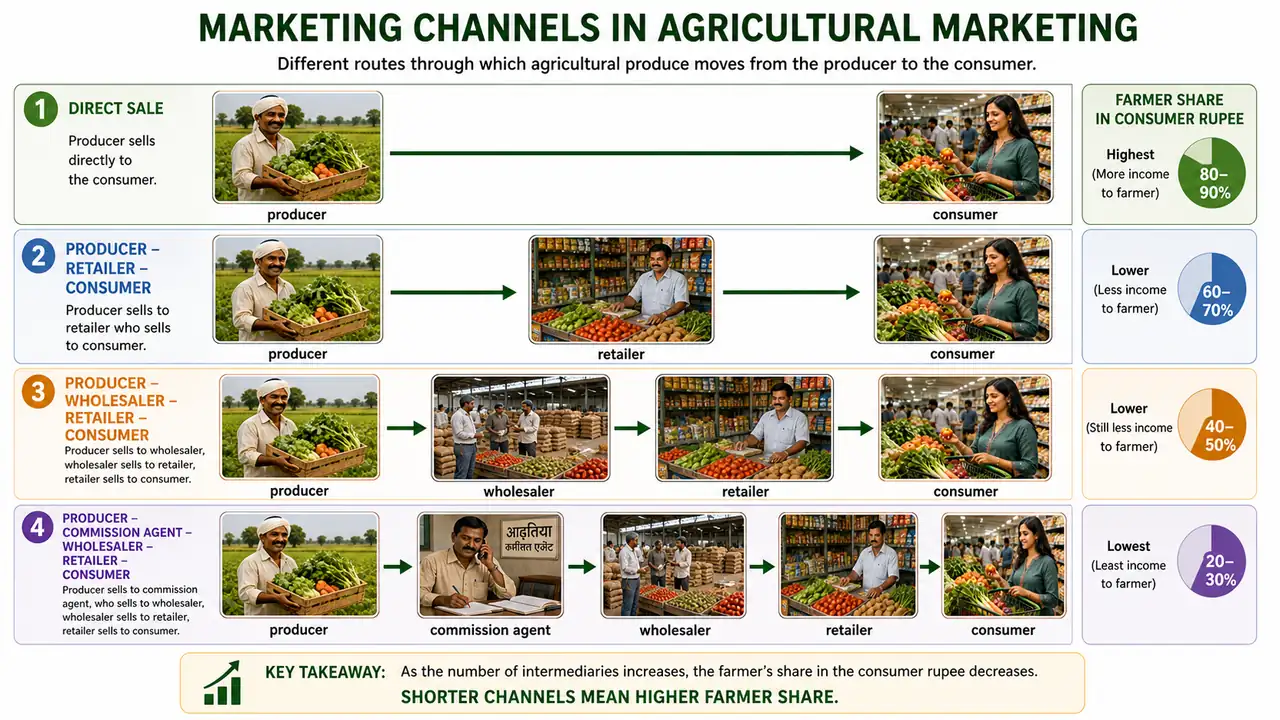
What is a Marketing Channel?
A marketing channel is the route taken by a product from its first owner (the producer) to the last owner (the ultimate consumer). It describes the actual path of ownership transfer from farm to fork.
Definitions
| Scholar | Definition |
|---|---|
| Moore et al. | "The chain of intermediaries through whom the various food grains pass from producers to consumers constitutes their marketing channels." |
| Kohls and Uhl | Marketing channels are alternative routes of product flows from producers to consumers. |
Channel Design and Selection
Common Marketing Channels
| Channel | No. of Intermediaries | Example |
|---|---|---|
| Producer → Consumer | 0 (direct sale) | Farmer selling vegetables at farm gate or through FPO outlet |
| Producer → Retailer → Consumer | 1 | Farmer selling milk to local dairy shop |
| Producer → Wholesaler → Retailer → Consumer | 2 | Wheat from Punjab farmer → Azadpur mandi wholesaler → neighbourhood ration shop → consumer |
| Producer → Commission Agent → Wholesaler → Retailer → Consumer | 3 | Cotton farmer → commission agent at APMC mandi → wholesaler → retailer |
The wholesaler is the most important functionary in the distribution chain -- he aggregates produce from multiple sources and distributes it to retailers.
Pro Content Locked
Upgrade to Pro to access this lesson and all other premium content.
₹99 charged monthly · Cancel anytime
- All Agriculture & Banking Courses
- AI Lesson Questions (100/day)
- AI Doubt Solver (50/day)
- Glows & Grows Feedback (30/day)
- AI Section Quiz (20/day)
- 22-Language Translation (100/day)
- Recall Questions (20/day)
- AI Quiz (15/day)
- AI Quiz Paper Analysis (100/day)
- AI Step-by-Step Explanations (100/day)
- Spaced Repetition Recall (FSRS)
- AI Tutor
- Immersive Text Questions
- Audio Lessons — Hindi & English
- Mock Tests & Previous Year Papers
- Summary & Mind Maps
- XP, Levels, Leaderboard & Badges
- Generate New Classrooms
- Voice AI Teacher (AgriDots Live)
- AI Revision Assistant
- Knowledge Gap Analysis
- Interactive Revision (LangGraph)
🔒 Secure via Razorpay · Cancel anytime · No hidden fees
When a mango farmer in Malihabad (Lucknow) sells his harvest, the fruit may pass through a village trader, a commission agent at a wholesale mandi, a retailer in Delhi, and finally reach a consumer. Each stop in this journey is part of the marketing channel. The number of stops determines how much the farmer earns and how much the consumer pays.
What is a Marketing Channel?
A marketing channel is the route taken by a product from its first owner (the producer) to the last owner (the ultimate consumer). It describes the actual path of ownership transfer from farm to fork.
Definitions
| Scholar | Definition |
|---|---|
| Moore et al. | "The chain of intermediaries through whom the various food grains pass from producers to consumers constitutes their marketing channels." |
| Kohls and Uhl | Marketing channels are alternative routes of product flows from producers to consumers. |
Channel Design and Selection
Common Marketing Channels
| Channel | No. of Intermediaries | Example |
|---|---|---|
| Producer → Consumer | 0 (direct sale) | Farmer selling vegetables at farm gate or through FPO outlet |
| Producer → Retailer → Consumer | 1 | Farmer selling milk to local dairy shop |
| Producer → Wholesaler → Retailer → Consumer | 2 | Wheat from Punjab farmer → Azadpur mandi wholesaler → neighbourhood ration shop → consumer |
| Producer → Commission Agent → Wholesaler → Retailer → Consumer | 3 | Cotton farmer → commission agent at APMC mandi → wholesaler → retailer |
The wholesaler is the most important functionary in the distribution chain -- he aggregates produce from multiple sources and distributes it to retailers.
TIP
Shorter channels mean fewer intermediaries, lower marketing costs, and a higher share of the consumer's rupee reaching the farmer.
Factors in Choosing a Marketing Channel
| Factor | Shorter Channel Preferred When | Longer Channel Preferred When |
|---|---|---|
| Nature of product | Perishable (fruits, vegetables, milk) | Durable (grains, oilseeds, cotton) |
| Price of product | High-value (saffron, exotic fruits) | Low-value (common vegetables) |
| Units of sale | Large institutional orders | Small household quantities |
| User characteristics | Industrial buyer (oil mill, sugar factory) | Individual household consumer |
| Type of service | Public utilities (electricity, water) sold directly | Mass-market consumer goods need wide retail network |
Measuring Marketing Efficiency
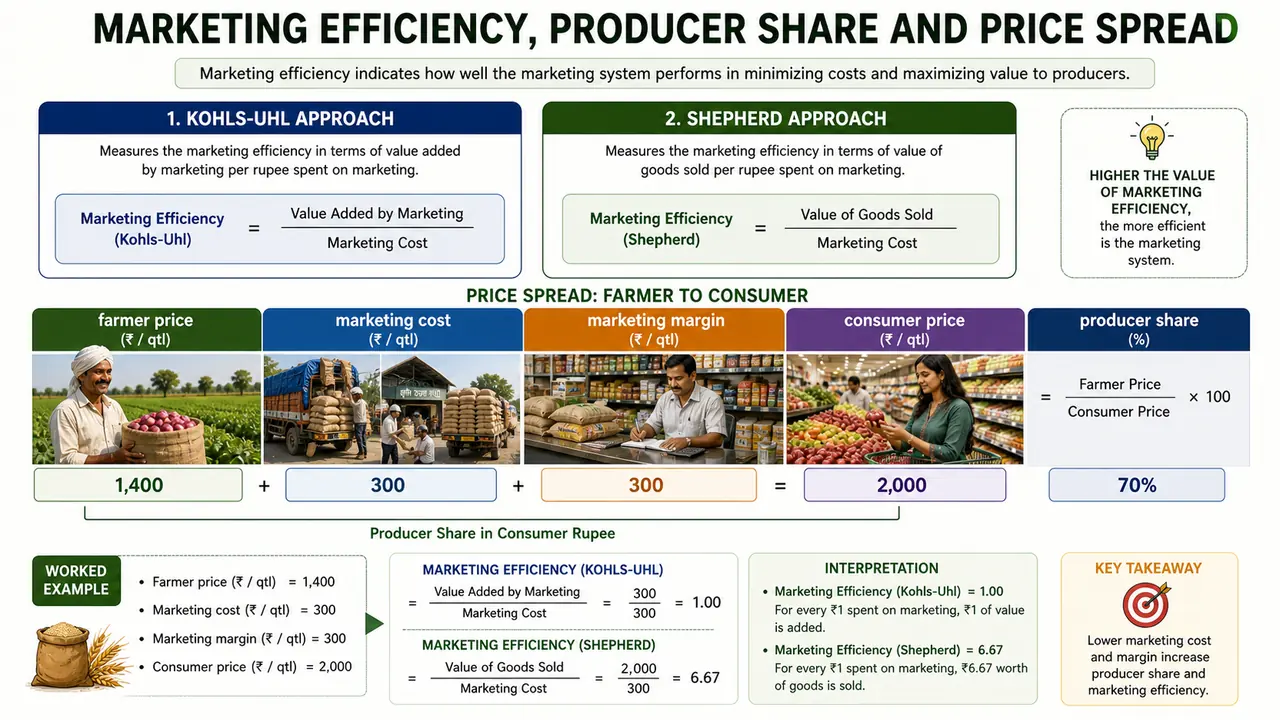
Marketing efficiency measures how well the marketing system converts inputs (costs) into outputs (consumer satisfaction). It is the degree of market performance.
Formula:
Marketing Efficiency = Market Output (Satisfaction) / Marketing Input (Cost of Resources)
An increase in this ratio means improved efficiency.
Components of Marketing Efficiency
| Component | What It Measures |
|---|---|
| Effectiveness | Whether the marketing service achieves its intended outcome |
| Cost | The expense at which the service is provided |
| Combined effect | How cost and method of service affect both production and consumption |
Two Types of Efficiency
| Type | Also Called | What It Measures | Agricultural Example |
|---|---|---|---|
| Technical efficiency | Physical / Operational efficiency | Cost of performing a function per unit of output. Reduced cost = higher efficiency. | Cold storage reduces potato spoilage from 15% to 3% |
| Pricing efficiency | Allocative efficiency | Whether products are allocated so that no other allocation would make producers and consumers better off (Pareto optimality). Sellers get true value; consumers get true worth. | e-NAM enables transparent price discovery across states |
These two types are mutually reinforcing -- operational improvements lower costs, which improve price signals.
Empirical Formulas for Marketing Efficiency
1. Kohls and Uhl Formula
A reduction in cost for the same satisfaction, or an increase in satisfaction at the same cost, means improved efficiency.
| Symbol | Meaning |
|---|---|
| E | Level of efficiency |
| O | Value added by the marketing system |
| I | Real cost of marketing |
2. Shepherd's Formula
| Symbol | Meaning |
|---|---|
| ME | Index of marketing efficiency |
| V | Value of goods sold (retail price paid by consumer) |
| I | Total marketing cost |
Shepherd's formula is simpler and more practical because it uses readily available price data and eliminates the problem of measuring value added.
IMPORTANT
Exam Tip: Know both formulas. Kohls-Uhl uses value added / cost (E = O/I). Shepherd uses retail price / marketing cost (ME = V/I). Shepherd is considered more practical.
Cost, Margin, and Price Spread Logic
Marketing Costs
Marketing costs are the costs, taxes, and cess incurred in moving products from producers to consumers. They vary with the channel -- longer channels with more intermediaries generally mean higher costs.
What Marketing Costs Include
| Cost Component | Example |
|---|---|
| Handling charges at local point | Loading grain into bags at the farm |
| Assembling charges | Collecting produce from scattered farms to one point |
| Transport and storage costs | Truck freight from village to mandi; warehouse rent |
| Wholesaler and retailer charges | Commission, handling fees passed to customers |
| Secondary services | Financing (interest), risk-taking (insurance), market intelligence |
| Profit margins | Margins of commission agents, wholesalers, and retailers |
Producer's Share in Consumer's Rupee
This is a key measure of marketing efficiency. The higher the producer's share, the more efficient the system.
| Symbol | Meaning |
|---|---|
| Ps | Producer's share (%) |
| PF | Price received by the farmer |
| Pr | Retail price paid by the consumer |
Example: If a farmer sells wheat at Rs 2,000/quintal and the consumer pays Rs 3,200/quintal, the producer's share = (2000/3200) x 100 = 62.5%.
Market Margins
A margin is the difference between the price paid and price received by a marketing agency. It compensates intermediaries for services, risks, and investments.
| Term | Formula | Base |
|---|---|---|
| Absolute margin | Selling price - Buying price | Expressed in rupees |
| Percentage margin | (Absolute margin / Selling price) x 100 | Based on selling price |
| Mark-up | (Absolute margin / Buying price) x 100 | Based on buying price |
TIP
Percentage margin uses selling price as the denominator. Mark-up uses buying price. They look similar but give different values. For example: Buy at Rs 80, sell at Rs 100. Absolute margin = Rs 20. Percentage margin = 20%. Mark-up = 25%.
Methods of Estimating Marketing Margins
| Method | How It Works | When to Use |
|---|---|---|
| Concurrent margin method | Compares prices at successive stages on the same day (cross-sectional snapshot) | Quick assessment; works well for commodities sold and resold rapidly |
| Lagged margin method | Accounts for time elapsed between buying and selling; factors in storage costs, interest, and price changes | More realistic for stored commodities like grains and oilseeds |
Price Spread
The price spread is the difference between the price paid by the consumer and the price received by the farmer. It includes all costs and margins of intermediaries.
| Narrow Price Spread | Wide Price Spread |
|---|---|
| Efficient marketing system | Inefficient system or excessive intermediation |
| Fewer intermediaries | Many middlemen taking margins |
| Farmer gets a larger share | Farmer gets a smaller share |
Reducing the price spread -- without compromising marketing service quality -- is a key objective of agricultural marketing reforms in India (e.g., e-NAM, direct marketing, FPOs).
Summary Cheat Sheet
| Concept / Topic | Key Details / Explanation |
|---|---|
| Marketing Channel | Route of ownership transfer from producer to consumer; defined by Moore et al. and Kohls & Uhl |
| Zero-level channel | Producer → Consumer (direct sale, e.g., farm gate, FPO outlet) |
| One-level channel | Producer → Retailer → Consumer |
| Two-level channel | Producer → Wholesaler → Retailer → Consumer |
| Three-level channel | Producer → Commission Agent → Wholesaler → Retailer → Consumer |
| Wholesaler | Most important functionary in the distribution chain |
| Shorter channel = better | Fewer intermediaries → lower costs → higher producer's share |
| Channel selection factors | Nature of product, price, units of sale, user characteristics, type of service |
| Perishable products | Prefer shorter channels (fruits, vegetables, milk) |
| Marketing Efficiency | Output (satisfaction) / Input (cost); increase in ratio = improved efficiency |
| Technical Efficiency | Also called physical/operational efficiency; cost per unit of output |
| Pricing Efficiency | Also called allocative efficiency; Pareto optimality in product allocation |
| Kohls-Uhl Formula | E = O / I (value added / marketing cost) |
| Shepherd's Formula | ME = V / I (retail price / marketing cost); more practical |
| Marketing Costs | All costs, taxes, cess in moving product farm → consumer; longer channels = higher costs |
| Producer's Share | Ps = (PF / Pr) × 100; PF = farmer price, Pr = retail price; higher share = more efficient |
| Absolute Margin | Selling price − Buying price (in rupees) |
| Percentage Margin | Absolute margin / Selling price × 100 |
| Mark-up | Absolute margin / Buying price × 100 |
| Concurrent Margin | Prices compared at same point in time (cross-sectional) |
| Lagged Margin | Accounts for time elapsed; factors storage costs, interest; more realistic for stored goods |
| Price Spread | Consumer price − Farmer price; narrow = efficient system |
| Reducing price spread | Key objective of reforms — e-NAM, direct marketing, FPOs |