🌿 APEDA & India's Agricultural Exports
APEDA establishment, functions, Agri Export Zones, agricultural export performance 2026-25, top export commodities and destinations
APEDA – Agricultural and Processed Food Products Export Development Authority
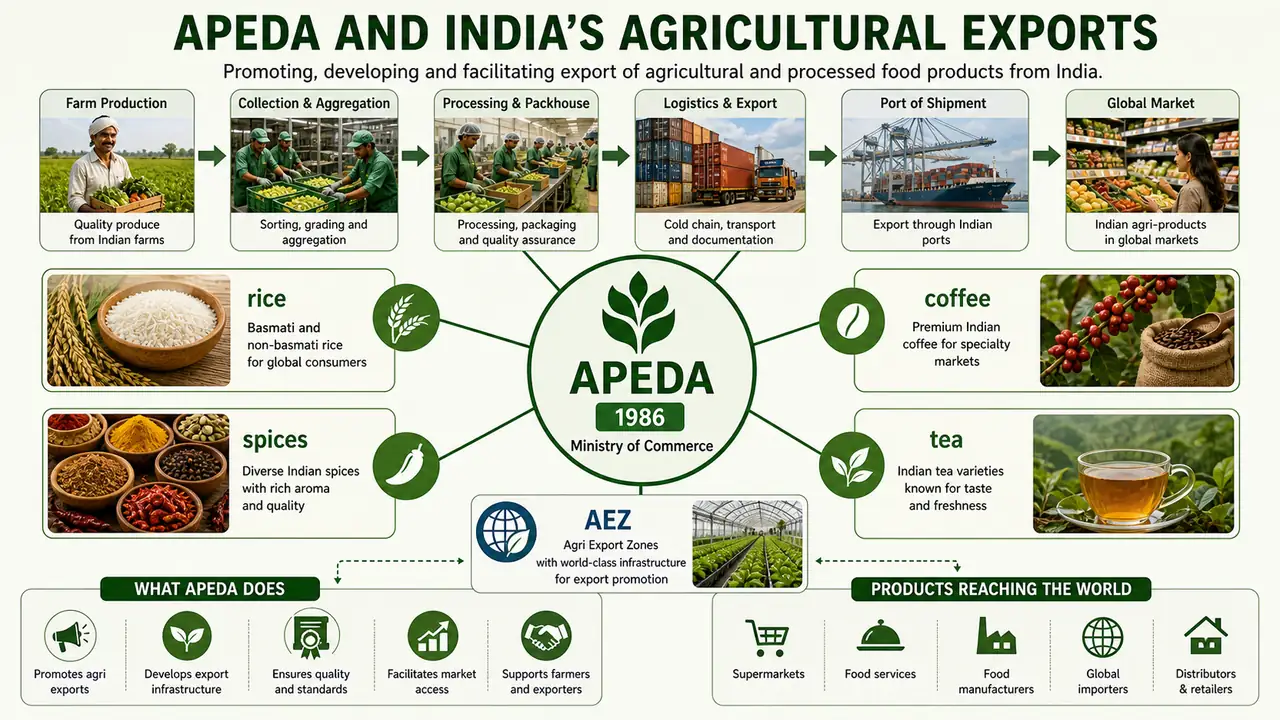
APEDA was established under the APEDA Act, passed in December 1985 (Act No. 2 of 1986). The Act came into effect on 13 February 1986. APEDA functions under the Ministry of Commerce and Industry.
Key Functions of APEDA
- Development of industries relating to scheduled products for export
- Registration of exporters of scheduled products
- Fixing of standards and specifications for scheduled products
- Carrying out inspection of meat and meat products
- Improving packaging and marketing of agricultural products
- Promotion of export-oriented production and development of scheduled products
IMPORTANT
APEDA is under the Ministry of Commerce, not Ministry of Agriculture. This is a commonly tested distinction in exams.
Why APEDA Matters in Agricultural Marketing
APEDA connects the farm sector to export markets by doing the institutional work that individual farmers or small firms usually cannot do alone: export registration, quality standards, packaging improvement, and market promotion. In exam terms, APEDA is the bridge between domestic agricultural production and organized export expansion.
Pro Content Locked
Upgrade to Pro to access this lesson and all other premium content.
₹99 charged monthly · Cancel anytime
- All Agriculture & Banking Courses
- AI Lesson Questions (100/day)
- AI Doubt Solver (50/day)
- Glows & Grows Feedback (30/day)
- AI Section Quiz (20/day)
- 22-Language Translation (100/day)
- Recall Questions (20/day)
- AI Quiz (15/day)
- AI Quiz Paper Analysis (100/day)
- AI Step-by-Step Explanations (100/day)
- Spaced Repetition Recall (FSRS)
- AI Tutor
- Immersive Text Questions
- Audio Lessons — Hindi & English
- Mock Tests & Previous Year Papers
- Summary & Mind Maps
- XP, Levels, Leaderboard & Badges
- Generate New Classrooms
- Voice AI Teacher (AgriDots Live)
- AI Revision Assistant
- Knowledge Gap Analysis
- Interactive Revision (LangGraph)
🔒 Secure via Razorpay · Cancel anytime · No hidden fees
APEDA – Agricultural and Processed Food Products Export Development Authority
APEDA was established under the APEDA Act, passed in December 1985 (Act No. 2 of 1986). The Act came into effect on 13 February 1986. APEDA functions under the Ministry of Commerce and Industry.
Key Functions of APEDA
- Development of industries relating to scheduled products for export
- Registration of exporters of scheduled products
- Fixing of standards and specifications for scheduled products
- Carrying out inspection of meat and meat products
- Improving packaging and marketing of agricultural products
- Promotion of export-oriented production and development of scheduled products
IMPORTANT
APEDA is under the Ministry of Commerce, not Ministry of Agriculture. This is a commonly tested distinction in exams.
Why APEDA Matters in Agricultural Marketing
APEDA connects the farm sector to export markets by doing the institutional work that individual farmers or small firms usually cannot do alone: export registration, quality standards, packaging improvement, and market promotion. In exam terms, APEDA is the bridge between domestic agricultural production and organized export expansion.
India's Agricultural Export Performance
Latest Export Data (2024-25)
| Parameter | Value |
|---|---|
| Agri & allied exports (2024-25) | US$ 51.9 billion (+6.4% over 2023-24)[1] |
| Agri exports (2023-24) | US$ 48.8 billion |
| APEDA growth since inception | US 51.9 billion (2024-25)[2] |
TIP
Exam fact: India's agri exports crossed **US0.6 billion in 1987-88, an 86x increase over ~37 years.
Top Export Commodities (2024-25)
| Rank | Commodity | Value (US$ Billion) | Change |
|---|---|---|---|
| 1 | Rice | 12.5 | Record high (up from $10.4B)[3] |
| 2 | Spices | 4.45 | Up from $4.25B |
| 3 | Coffee | 1.81 | Up from $1.29B |
| 4 | Tea | 0.92 | Up from $0.83B |
TIP
Rice alone contributes nearly 25% of India's total agri exports. Coffee registered the sharpest growth (+40%).
What the Export Basket Shows
The export basket shows that India's strength lies in a mix of bulk staples like rice and high-value differentiated products like spices, coffee, and tea. This is why export policy questions often connect APEDA with value addition, branding, and logistics rather than only with raw commodity movement.
Historical Comparison
| Year | Agri Exports (US$ Billion) |
|---|---|
| 1987-88 | 0.6 |
| 2017-18 | 38.74 |
| 2022-23 | 53.2 (previous record) |
| 2023-24 | 48.8 |
| 2024-25 | 51.9 |
Agricultural Export Policy
- India's first-ever dedicated Agricultural Export Policy was unveiled in 2017-18
- Original export target: US$ 60 billion by 2022
Key Objectives
| Objective | Example |
|---|---|
| Diversify export basket | Move beyond rice and spices to processed foods and organic products |
| Promote value-added exports | Exporting mango pulp instead of raw mangoes |
| Improve institutional framework | Streamline certifications (FSSAI, APEDA, phytosanitary) |
| Create export-ready supply chains | Cold chain from farm to port for grapes and pomegranates |
| Boost farmer income | Linking GI-tagged products to premium international buyers |
Agri Export Zones (AEZs)
APEDA has established 60 Agri Export Zones across 20 states. These zones concentrate farmers, processors, exporters, and government agencies for seamless export pipelines.
Why AEZs Matter
AEZs matter because exports do not depend only on production. They also depend on grading, cold chain, processing, certification, and port linkage. The AEZ approach tries to organize all of these functions around a commodity cluster so farmers can participate in more reliable export chains.
State-wise AEZ Distribution
| State | No. of AEZs | Key Products |
|---|---|---|
| Maharashtra | 8 | Grape, Mango, Onion, Pomegranate, Banana, Oranges |
| West Bengal | 6 | Pineapple, Lychee, Potato, Darjeeling Tea |
| Andhra Pradesh | 5 | Mango Pulp, Grapes, Gherkins, Chilli |
| Madhya Pradesh | 5 | Potato/Onion/Garlic, Seed Spices, Wheat, Lentils |
| Karnataka | 4 | Gherkins, Rose Onion, Flowers, Vanilla |
| Tamil Nadu | 4 | Cut Flowers, Mangoes, Cashewnut |
| J&K | 2 | Apples, Walnut |
| Sikkim | 2 | Flowers/Cherry Pepper, Ginger |
| Rajasthan | 2 | Coriander, Cumin |
| Kerala | 2 | Horticulture Products, Medicinal Plants |
TIP
Maharashtra has the highest AEZs (8), followed by West Bengal (6). AEZs are identified by State Governments, not central government. Total: 60 AEZs across 20 states.
Summary Cheat Sheet
| Concept / Topic | Key Details / Explanation |
|---|---|
| APEDA established | Under APEDA Act, December 1985 (Act No. 2 of 1986); effective 13 February 1986 |
| APEDA ministry | Ministry of Commerce and Industry (NOT Ministry of Agriculture) |
| APEDA functions | Export promotion of scheduled agri & processed food products; standards, inspection, packaging |
| Agri exports (2024-25) | **US50B for the first time |
| Rice exports (2024-25) | US$ 12.5 billion — record high, ~25% of total agri exports |
| Spices exports (2024-25) | US$ 4.45 billion |
| Coffee exports (2024-25) | US$ 1.81 billion (+40%, sharpest growth) |
| Tea exports (2024-25) | US$ 0.92 billion |
| APEDA growth | From US 51.9 billion (2024-25) — 86x increase |
| Agricultural Export Policy | India's first-ever dedicated agri export policy; unveiled 2017-18 |
| Export target | US$ 60 billion by 2022 (aspirational) |
| Agri Export Zones (AEZs) | 60 AEZs across 20 states; identified by State Governments |
| State with most AEZs | Maharashtra — 8 AEZs |
| 2nd most AEZs | West Bengal — 6 AEZs |
References
3 sources • [1] [2] [3]
References
Used for: Agri & allied exports US$ 51.9 billion in 2024-25; APEDA schemes for export promotion
Used for: APEDA's historic export growth trajectory since FY 1987-88
Used for: Product-wise export data: rice US$ 12.5B, spices US$ 4.45B, coffee US$ 1.81B, tea US$ 0.92B
Lesson Doubts
Ask questions, get expert answers