National Mission on Natural Farming (NMNF)
National Mission on Natural Farming scheme facts, objectives, funding pattern, clusters, certification, progress updates, and current-affairs relevance for IBPS AFO and NABARD.
This lesson takes the natural-farming ideas from the previous chapter and turns them into a scheme-focused current-affairs note. For exam purposes, this is the policy layer that sits above ZBNF / natural farming practice.
Use it when the paper shifts from "how natural farming works" to "how the government is scaling natural farming across real fields."
Why NMNF Matters
The National Mission on Natural Farming (NMNF) is the government's mission-mode framework for scaling natural farming. That makes it important for two reasons:
- it converts agroecological ideas into a national scheme with targets, funding, and implementation architecture
- it connects natural farming with current-affairs themes such as input cost, soil health, resilience, and fertilizer dependence
So this is not just an ecology topic. It is also a scheme-and-extension topic.
What Exactly Is NMNF?
The Union Cabinet approved NMNF on 25 November 2024 as a standalone Centrally Sponsored Scheme under the Ministry of Agriculture & Farmers Welfare. The scheme runs till the 15th Finance Commission period (2025-26) and is the mission-scale successor to the earlier Bharatiya Prakritik Krishi Paddhati (BPKP) that functioned under PKVY.
Pro Content Locked
Upgrade to Pro to access this lesson and all other premium content.
₹99 charged monthly · Cancel anytime
- All Agriculture & Banking Courses
- AI Lesson Questions (100/day)
- AI Doubt Solver (50/day)
- Glows & Grows Feedback (30/day)
- AI Section Quiz (20/day)
- 22-Language Translation (100/day)
- Recall Questions (20/day)
- AI Quiz (15/day)
- AI Quiz Paper Analysis (100/day)
- AI Step-by-Step Explanations (100/day)
- Spaced Repetition Recall (FSRS)
- AI Tutor
- Immersive Text Questions
- Audio Lessons — Hindi & English
- Mock Tests & Previous Year Papers
- Summary & Mind Maps
- XP, Levels, Leaderboard & Badges
- Generate New Classrooms
- Voice AI Teacher (AgriDots Live)
- AI Revision Assistant
- Knowledge Gap Analysis
- Interactive Revision (LangGraph)
🔒 Secure via Razorpay · Cancel anytime · No hidden fees
This lesson takes the natural-farming ideas from the previous chapter and turns them into a scheme-focused current-affairs note. For exam purposes, this is the policy layer that sits above ZBNF / natural farming practice.
Use it when the paper shifts from "how natural farming works" to "how the government is scaling natural farming across real fields."
Why NMNF Matters
The National Mission on Natural Farming (NMNF) is the government's mission-mode framework for scaling natural farming. That makes it important for two reasons:
- it converts agroecological ideas into a national scheme with targets, funding, and implementation architecture
- it connects natural farming with current-affairs themes such as input cost, soil health, resilience, and fertilizer dependence
So this is not just an ecology topic. It is also a scheme-and-extension topic.
What Exactly Is NMNF?
The Union Cabinet approved NMNF on 25 November 2024 as a standalone Centrally Sponsored Scheme under the Ministry of Agriculture & Farmers Welfare. The scheme runs till the 15th Finance Commission period (2025-26) and is the mission-scale successor to the earlier Bharatiya Prakritik Krishi Paddhati (BPKP) that functioned under PKVY.
This marks a major policy shift:
- natural farming is no longer treated only as a sub-component inside a broader scheme
- it is now treated as a separate national mission
- it has its own cluster design, support structure, certification pathway, and branding logic
That shift is exam-relevant because it shows that natural farming is now being presented as a national delivery strategy, not only as an ideal production philosophy.
Policy Direction Behind NMNF
NMNF aims:
- to promote nature-based sustainable systems of farming
- to increase use of on-farm natural bio-inputs
- to reduce dependence on externally purchased inputs
- to lower input cost
- to improve soil health
- to popularise livestock-integrated farming models
- to strengthen agroecological research and extension capacity through ICAR, KVKs, and agricultural universities
- to build easy certification standards and promote a single national brand for naturally grown produce
So if an exam asks for the policy intent of NMNF, the answer is broader than "chemical-free farming." The mission tries to combine sustainability, input self-reliance, local bio-input preparation, livestock integration, scientific extension, certification, and market support.
Core Scheme Facts
| Item | Detail |
|---|---|
| Approval date | 25 November 2024 |
| Scheme type | Standalone Centrally Sponsored Scheme |
| Total outlay | ₹2,481 crore |
| Outlay split | ₹1,584 crore Centre + ₹897 crore States |
| General funding pattern | 60:40 (Centre:State) |
| Hilly / NE funding pattern | 90:10 |
| Target area | 7.5 lakh ha |
| Target clusters | 15,000 clusters |
| Farmer outreach | 1 crore farmers |
| Cluster size | about 50 ha per cluster |
| Indicative farmers per cluster | about 125 farmers |
| Farmer incentive | ₹4,000 per acre per year for 2 years, up to 1 acre per farmer |
IMPORTANT
Memory anchor: PKVY is to organic farming what NMNF is to natural farming.
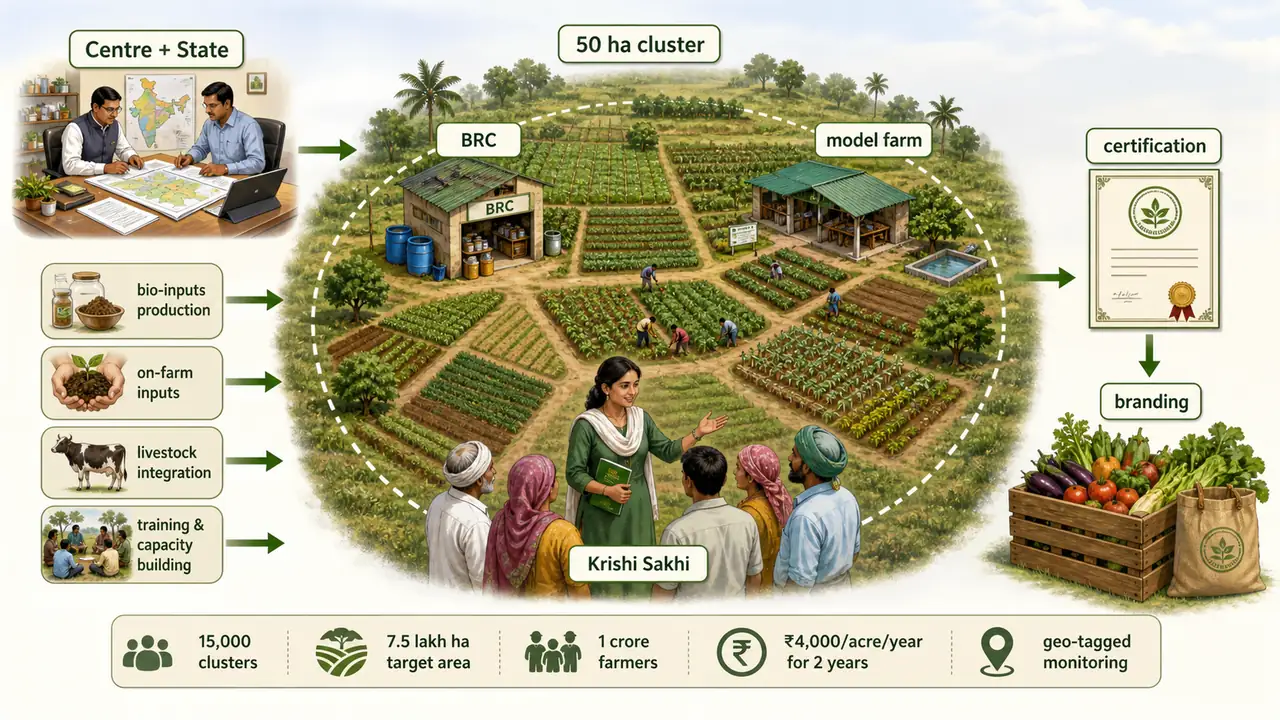
Support Architecture Under NMNF
NMNF is backed by a visible delivery structure:
- 10,000 need-based Bio-input Resource Centres (BRCs) for ready-to-use natural farming inputs
- about 2,000 model demonstration farms at KVKs, agricultural universities, and farmers' fields
- 30,000 Krishi Sakhis / CRPs planned for mobilisation and handholding
- 18.75 lakh trained willing farmers expected to prepare bio-inputs like Jeevamrit and Beejamrit
- simple certification system, common branding, and geo-tagged online monitoring
This shows the preferred delivery model:
- cluster approach instead of isolated farms
- local input preparation instead of purchased external dependency
- community resource persons and Krishi Sakhis instead of only top-down extension
- demonstration-led adoption through KVKs and universities
- certification and branding so natural produce can move beyond niche status
Progress Updates to Memorise
Status reported on 28 March 2025
- scheme guidelines circulated on 26 December 2024
- 33 States/UTs had approved Annual Action Plans
- ₹177.78 lakh released during FY 2024-25
- 70,021 Krishi Sakhis already trained on soil health and natural farming
Status reported on 13 August 2025
- 10 lakh+ farmers enrolled
- 1,100 model farms developed
- 806 training institutions engaged
Status reported on 13 February 2026
- Natural Farming Certification System (NFCS) started in 2025-26 under PGS-INDIA NATURAL
- certification support: ₹2,100 per hectare for two years
- as on 4 February 2026, the certification-focused progress note reported:
- 11,86,382 registered farmers
- 9,56,489.03 ha area covered
- 4,72,646 certificates issued
Status reported on 13 March 2026
- a later progress update reported broader mission-enrolment figures as on 9 February 2026
- 17.45 lakh farmers enrolled
- 8.57 lakh hectares covered
This is important for exams because the 13 February 2026 figures are tied to the certification update, while the 13 March 2026 figures are a later mission-progress snapshot using a different reporting frame. Students should not mix these two data sets blindly.
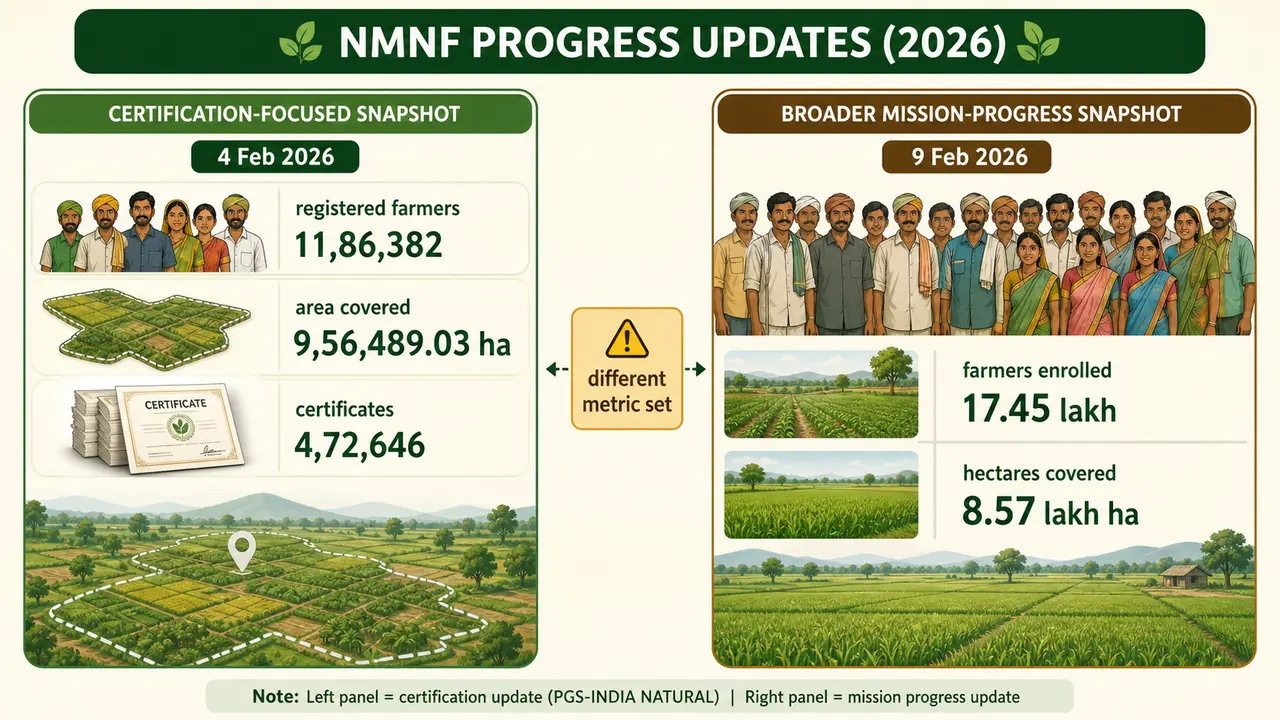
Why NMNF Is Strong Current Affairs
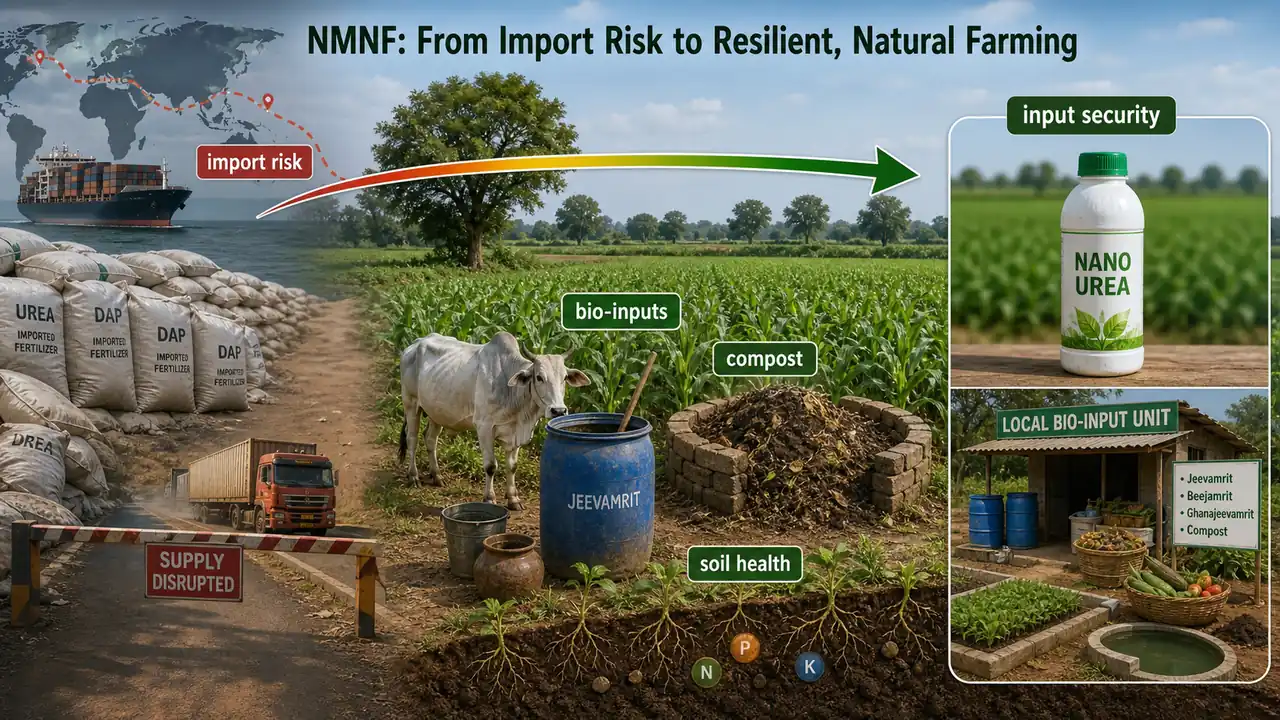
NMNF is important not only because of sustainability and soil health, but also because of input security and import dependence.
During discussions in March 2026 on the West Asia crisis, farmer protection was linked with:
- higher domestic fertilizer production
- diversification of fertilizer imports
- Made-in-India nano urea
- and the push towards natural farming
So natural farming becomes a current-affairs topic for a second reason: it is increasingly seen as part of India's risk-reduction strategy when global fertilizer supply chains become uncertain.
That logic became clearer again in an April 2026 fertilizer self-reliance discussion. The main policy message was:
- reducing fertilizer import dependence is important
- soil health and balanced nutrient use remain central to sustainable agriculture
- the West Asia situation should not be seen only as a short-term fertilizer supply shock
- the response should also include biologicals, composting, soil microbiome use, crop diversification, residue recycling, and integration of fertilizers with organics
In exam language:
- organic farming focuses more on standards and market assurance
- natural farming focuses more on low-cost, local-input, agroecological practice
- NMNF turns natural farming into a mission tied to soil health, resilience, and lower external input dependence
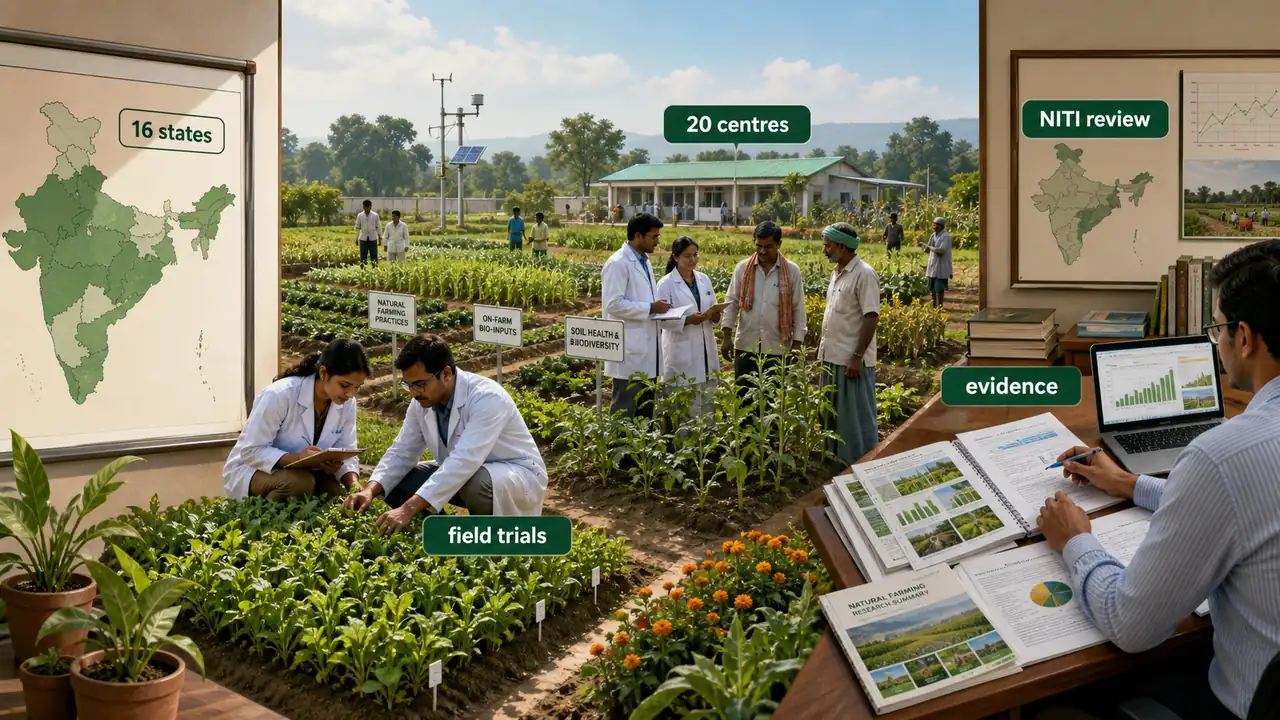
Another March 2026 policy update added a stronger scientific-validation angle. It highlighted that natural farming is being examined through ICAR-backed research cooperation across 20 centres in 16 states, and it also referred to NITI Aayog evaluation findings. This matters because NMNF is no longer presented only as a traditional or ideological model; it is increasingly framed as a mission that the government wants to back with organised research, field evidence, and measurable outcomes.
ZBNF / Natural Farming Concept vs NMNF Programme
| Basis | Concept lesson view | NMNF programme view |
|---|---|---|
| Focus | How natural farming works | How government scales it |
| Core unit | Farm practice | Cluster + mission architecture |
| Key inputs | Jeevamrit, Beejamrit, mulching, local ecology | incentive, BRCs, Krishi Sakhis, model farms, certification |
| Exam angle | principles and practices | scheme facts, dates, funding, targets |
Summary Cheat Sheet
| Concept / Topic | Key Details / Explanation |
|---|---|
| NMNF approval | 25 November 2024; standalone Centrally Sponsored Scheme under Ministry of Agriculture & Farmers Welfare |
| NMNF outlay | ₹2,481 crore = ₹1,584 crore Centre + ₹897 crore States |
| NMNF target | 15,000 clusters, 7.5 lakh ha, 1 crore farmers |
| NMNF farmer incentive | ₹4,000/acre/year for 2 years, up to 1 acre per farmer |
| NMNF support system | 10,000 BRCs, about 2,000 model farms, 30,000 Krishi Sakhis/CRPs planned |
| NMNF policy direction | promote nature-based sustainable farming, on-farm bio-inputs, livestock integration, low-cost cultivation, certification, and a single national brand |
| NMNF 28 Mar 2025 status | guidelines on 26 Dec 2024; 33 States/UTs AAP approved; ₹177.78 lakh released; 70,021 Krishi Sakhis trained |
| NMNF 13 Aug 2025 status | 10 lakh+ farmers enrolled, 1,100 model farms, 806 training institutions |
| NMNF certification update (13 Feb 2026) | NFCS / PGS-INDIA NATURAL from 2025-26; ₹2,100/ha for 2 years certification support |
| NMNF certification snapshot (4 Feb 2026) | 11,86,382 registered farmers, 9,56,489.03 ha, 4,72,646 certificates |
| NMNF mission-progress snapshot (9 Feb 2026 / reported 13 Mar 2026) | 17.45 lakh farmers enrolled and 8.57 lakh hectares covered |
| NMNF scientific-validation update (24 Mar 2026) | ICAR-linked work across 20 cooperation centres in 16 states plus NITI Aayog evaluation findings strengthened the evidence-based framing |
| Current-affairs linkage | NMNF matters for sustainability, soil health, low-cost cultivation, and input security when fertilizer supply becomes uncertain |
References
9 sources • [1] [2] [3] [4] [5] [6] [7] [8] [9]
References
Used for: NMNF approval on 25 November 2024 with ₹2,481 crore outlay, 15,000 clusters, 7.5 lakh ha target, 10,000 BRCs, and 30,000 Krishi Sakhis / CRPs planned.
Used for: Guidelines circulated on 26 December 2024; AAPs of 33 States/UTs approved; ₹177.78 lakh released in FY 2024-25; 70,021 Krishi Sakhis trained.
Used for: Summarises the BPKP-to-NMNF shift and lists 10 lakh+ enrolled farmers, 1,100 model farms, and 806 training institutions as of July 2025.
Used for: NFCS / PGS-INDIA NATURAL started in 2025-26; certification support ₹2,100/ha for two years; as on 4 February 2026: 11,86,382 registered farmers, 9,56,489.03 ha, 4,72,646 certificates.
Used for: Mission objectives include nature-based farming, on-farm bio-inputs, lower external input dependence and cost, livestock integration, research-extension strengthening, easy certification, and a single national brand.
Used for: Reported 17.45 lakh farmers enrolled and 8.57 lakh hectares covered under NMNF as on 9 February 2026.
Used for: Farmer protection was linked with domestic fertilizer capacity expansion, diversified imports, nano urea, and encouragement towards natural farming.
Used for: Highlighted ICAR-linked work across 20 cooperation centres in 16 states and referred to NITI Aayog evaluation findings for natural farming.
Used for: Reducing fertilizer import dependence was emphasised along with biologicals, composting, soil-health restoration, diversification, and integration of fertilizers with organics.