🫥 Body Organisation of Nematodes
Basic body plan, tube-within-a-tube structure, body shape, size, posture, symmetry, and colour of plant parasitic nematodes
In the previous lesson, we traced the history of nematology -- from Needham's 1743 discovery to India's AICRP programme. Now we move from history to biology, examining how the nematode body is built.
When a nematologist examines a wheat root under the microscope and spots a pear-shaped female Meloidogyne embedded inside -- while nearby a vermiform (worm-shaped) male moves freely -- the question arises: how can two organisms of the same species look so different? The answer lies in their remarkable body organisation.
This lesson covers:
- Basic features -- the formal nematode definition and what each term means
- Tube-within-a-tube -- the fundamental body architecture
- Body shape -- sexual dimorphism in sedentary nematodes
- Body size, posture, symmetry, and colour -- taxonomic characters
Basic Features -- The Nematode Definition
Despite occupying nearly every habitat on earth, nematodes share a remarkably consistent body plan. The scientific definition captures all key characteristics and is a frequent exam question.
Pro Content Locked
Upgrade to Pro to access this lesson and all other premium content.
₹99 charged monthly · Cancel anytime
- All Agriculture & Banking Courses
- AI Lesson Questions (100/day)
- AI Doubt Solver (50/day)
- Glows & Grows Feedback (30/day)
- AI Section Quiz (20/day)
- 22-Language Translation (100/day)
- Recall Questions (20/day)
- AI Quiz (15/day)
- AI Quiz Paper Analysis (100/day)
- AI Step-by-Step Explanations (100/day)
- Spaced Repetition Recall (FSRS)
- AI Tutor
- Immersive Text Questions
- Audio Lessons — Hindi & English
- Mock Tests & Previous Year Papers
- Summary & Mind Maps
- XP, Levels, Leaderboard & Badges
- Generate New Classrooms
- Voice AI Teacher (AgriDots Live)
- AI Revision Assistant
- Knowledge Gap Analysis
- Interactive Revision (LangGraph)
🔒 Secure via Razorpay · Cancel anytime · No hidden fees
In the previous lesson, we traced the history of nematology -- from Needham's 1743 discovery to India's AICRP programme. Now we move from history to biology, examining how the nematode body is built.
When a nematologist examines a wheat root under the microscope and spots a pear-shaped female Meloidogyne embedded inside -- while nearby a vermiform (worm-shaped) male moves freely -- the question arises: how can two organisms of the same species look so different? The answer lies in their remarkable body organisation.
This lesson covers:
- Basic features -- the formal nematode definition and what each term means
- Tube-within-a-tube -- the fundamental body architecture
- Body shape -- sexual dimorphism in sedentary nematodes
- Body size, posture, symmetry, and colour -- taxonomic characters
Basic Features -- The Nematode Definition
Despite occupying nearly every habitat on earth, nematodes share a remarkably consistent body plan. The scientific definition captures all key characteristics and is a frequent exam question.
Despite occupying nearly every habitat on earth, nematodes share a remarkably consistent body plan. The scientific definition captures all key characteristics:
Nematodes are aciliated, non-segmented, pseudocoelomic, bilaterally symmetrical, triploblastic, microscopic, vermiform metazoan of lower invertebrates having well-developed digestive, reproductive, and nervous systems, a poorly developed excretory system, and lacking respiratory and circulatory systems. They show serpentine movement on the dorso-ventral plane, and both sexes are present.
IMPORTANT
This definition is a high-yield exam point. Memorise: aciliated, non-segmented, pseudocoelomic, bilaterally symmetrical, triploblastic -- and that nematodes lack respiratory and circulatory systems.
Let us examine each term in detail.
Aciliated
Nematodes lack ciliated epithelium. They do not have cilia (tiny hair-like structures) on their body surface. Instead, they rely entirely on body muscles for locomotion.
Non-Segmented
The nematode body has no true segmentation or partition. Unlike earthworms or insects with distinct body segments, the nematode body is a continuous, unsegmented tube. Surface markings (annulations) sometimes visible are merely cuticular markings, not true segments.
Pseudocoelomic
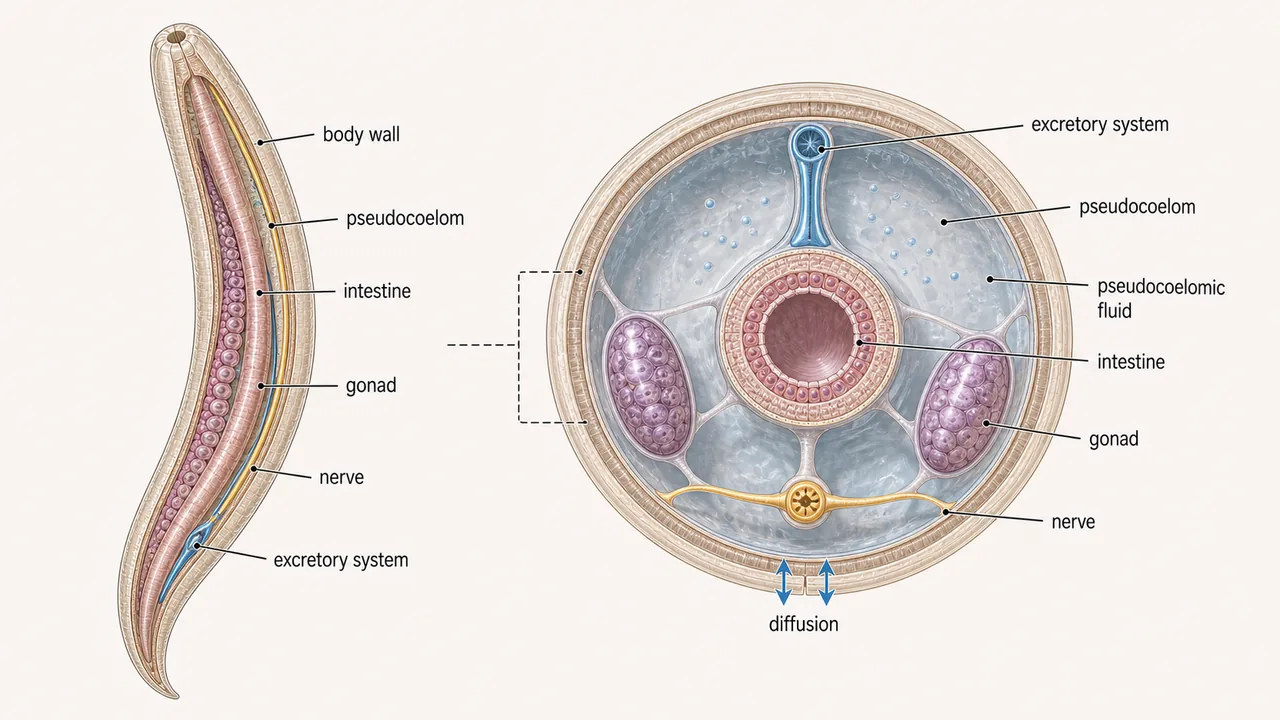
The nematode body cavity is a false cavity (pseudocoelom) -- it lacks the mesodermal epithelial lining found in true coelomates like earthworms. Key points:
- The pseudocoelom is filled with fluid that serves as a hydrostatic skeleton, maintaining body shape and aiding movement.
- Only the ectoderm is lined with mesoderm; the endoderm (alimentary canal) lacks this lining.
Bilaterally Symmetrical
The nematode body is a mirror image along its midline -- left and right halves are essentially identical.
Triploblastic
The nematode body possesses three germinal layers:
| Layer | Gives Rise To |
|---|---|
| Ectoderm | Outer body wall, nervous system |
| Mesoderm | Muscles |
| Endoderm | Digestive tract lining |
Vermiform
The nematode body is long, slender, and cylindrical, tapering at both ends. The word literally means "worm-shaped." This streamlined form is well-adapted for moving through soil pores and plant tissues.
Dorsoventral Plane of Movement
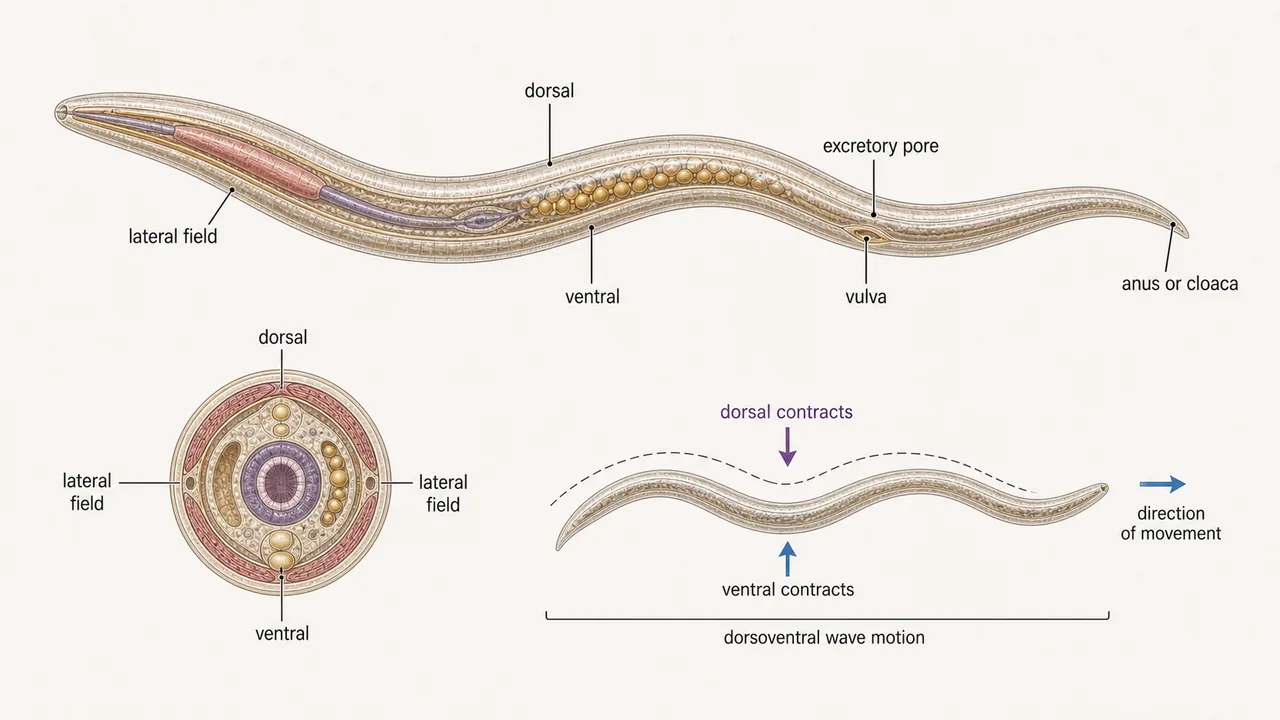
Nematodes move by alternately contracting dorsal and ventral muscles, creating a characteristic sinusoidal (S-shaped) wave motion. They cannot move laterally because they lack circular muscles.
Body Organisation -- Tube-Within-a-Tube
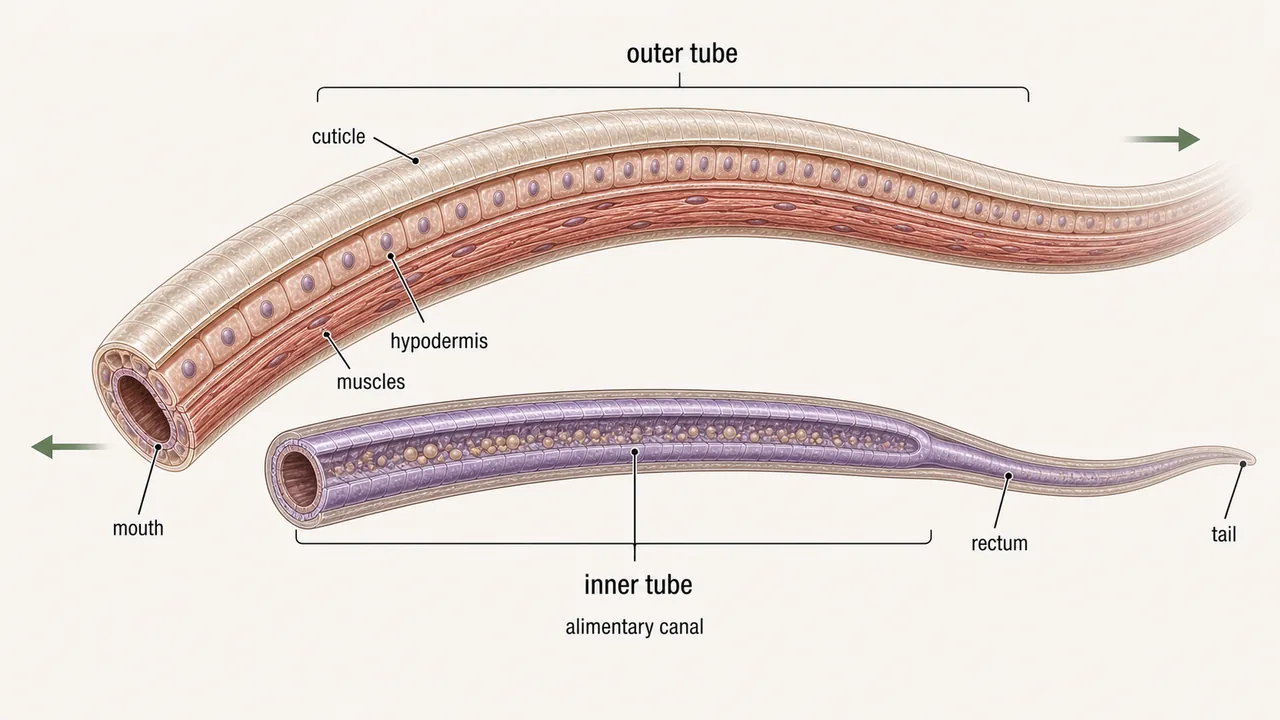
The nematode body is organised as two concentric tubes:
| Tube | Comprises | Function |
|---|---|---|
| Outer tube (wider) | Cuticle, hypodermis, somatic muscles | Body wall -- protection and movement |
| Inner tube (narrower) | Alimentary canal / digestive system | Digestion and nutrient absorption |
How the Tubes Connect
- Anteriorly: Both tubes join at the cephalic region, opening to the oral aperture (mouth).
- Posteriorly: They connect through the rectum, which opens as the anus in females and the cloaca (shared digestive + reproductive opening) in males.
- The tail extends beyond the anus/cloaca.
The Pseudocoelom
The space between the two tubes is filled with pseudocoelomic fluid, forming the pseudocoelom. Suspended within it are the reproductive, nervous, and secretory-excretory systems.
- Nematodes lack respiratory and circulatory systems -- these functions are performed entirely by the pseudocoelomic fluid through diffusion.
Four Body Zones
The nematode body is longitudinally divisible into four sides:
| Side | Identifying Feature |
|---|---|
| Ventral | Contains natural openings: excretory pore, vulva (gonopore), anus/cloaca |
| Dorsal | Devoid of natural openings |
| Two lateral sides | Bear the lateral fields (important diagnostic features) |
Body Shape -- Sexual Dimorphism
Both sexes usually look alike (vermiform), but in several sedentary nematode genera, the adult female changes shape dramatically. This is called sexual dimorphism.
Female Body Shapes of Sedentary Nematodes
| Nematode | Female Shape |
|---|---|
| Meloidogyne (Root-knot) | Pyriform / Saccate (pear-shaped) |
| Heterodera (Cyst) | Lemon-shaped |
| Globodera (Golden Cyst) | Spherical |
| Tylenchulus (Citrus) | Swollen / Obese |
| Rotylenchulus (Reniform) | Kidney-shaped |
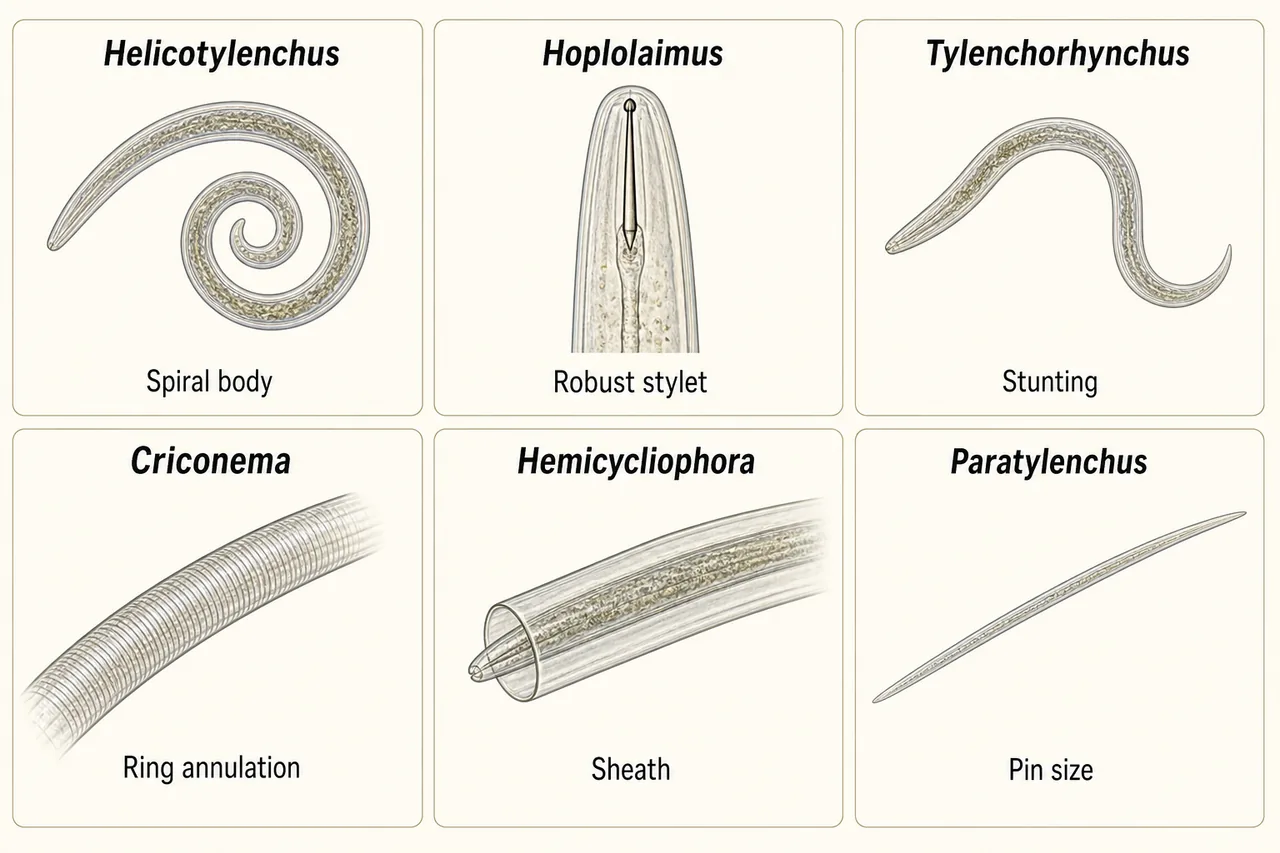
Body Size
| Feature | Range |
|---|---|
| Body length | 0.2 mm (Paratylenchus -- smallest) to 11 mm (Paralongidorus maximus -- longest plant parasitic) |
| Body width | 0.01 to 0.05 mm |
| Largest nematode overall | Placentonema gigantissima -- 8 m long (parasitises blue whale placenta) |
- Free-living and plant parasitic nematodes are microscopic.
- Animal parasitic nematodes are larger and often visible to the naked eye.
Body Posture
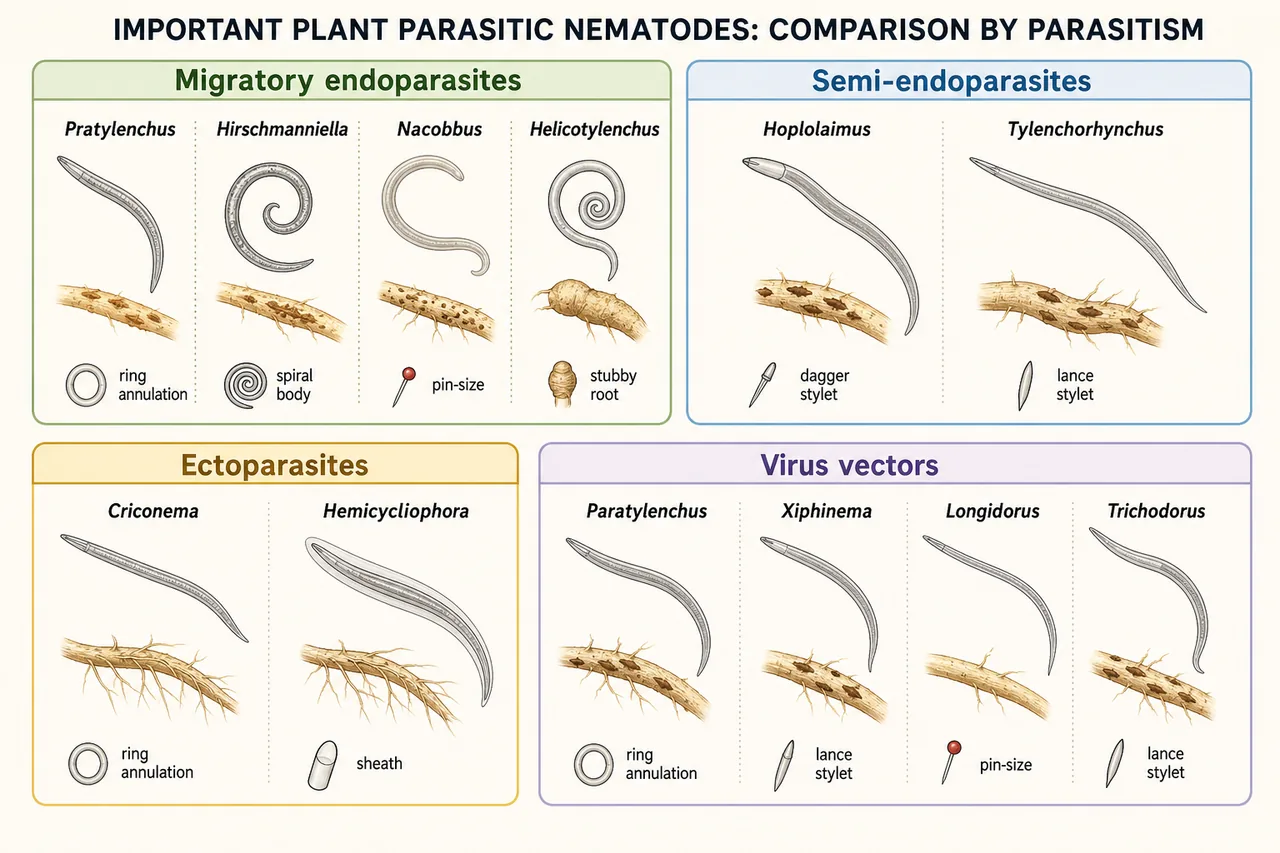
Generally, nematodes curve towards the ventral side due to the presence of internal muscles associated with natural openings. However, body posture serves as a taxonomic character:
| Nematode | Body Posture |
|---|---|
| Pratylenchus (Lesion nematode) | Curved in 'C' shape |
| Helicotylenchus (Spiral nematode) | Tight spiral |
| Dorsella dorsata | Curves dorsally (exception to the rule) |
Therefore, most nematode bodies curve towards the ventral side, except Dorsella, which curves dorsally.
Body Symmetry
The nematode body shows three types of symmetry at different structural levels:
| Structure | Type of Symmetry |
|---|---|
| Overall body | Bilateral (mirror image) |
| Stylet knobs and oesophageal glands | Triradiate (3-fold) |
| Lips (oral aperture) | Hexaradiate (6-fold) |
Body Colour
Nematodes are generally colourless or have a slight yellowish tint depending on cuticle composition. Their microscopic size and lack of colour make them extremely difficult to detect in soil without specialised extraction techniques.
Summary Table
| Feature | Details |
|---|---|
| Body plan | Tube-within-a-tube (outer body wall + inner digestive tube) |
| Body cavity | Pseudocoelom (false cavity with hydrostatic fluid) |
| Systems present | Digestive, reproductive, nervous, excretory (poorly developed) |
| Systems absent | Respiratory and circulatory |
| Symmetry | Bilateral (body), Triradiate (stylet), Hexaradiate (lips) |
| Germinal layers | Triploblastic (ectoderm, mesoderm, endoderm) |
| Movement | Sinusoidal on dorso-ventral plane |
| Smallest nematode | Paratylenchus (0.2 mm) |
| Longest PPN | Paralongidorus maximus (11 mm) |
| Largest nematode | Placentonema gigantissima (8 m, blue whale) |
| Body posture | Ventral curve (except Dorsella -- dorsal) |
| Sexual dimorphism | Seen in Meloidogyne, Heterodera, Tylenchulus, Rotylenchulus |
TIP
Exam mnemonic -- "A NP BT V" for the nematode definition: Aciliated, Non-segmented, Pseudocoelomic, Bilaterally symmetrical, Triploblastic, Vermiform.
References
- Dasgupta, M. K. (1998). Phytonematology. Nayaprakash, Calcutta.
- Walia, R. K and Bajaj, H. K (2014). Textbook of Introductory Plant Nematology. Directorate of Knowledge Management in Agriculture, ICAR, New Delhi.
- Ravichandra, N. G. (2019). Plant Nematology. I. K. International Publishing House Pvt. Ltd., New Delhi.
- Dropkin, V. H. (1996). Introduction to Plant Nematology, Academic Press, New York.
Summary Cheat Sheet
| Concept / Topic | Key Details |
|---|---|
| Body plan | Tube-within-a-tube (outer body wall + inner digestive tube) |
| Body cavity | Pseudocoelom (false cavity with hydrostatic fluid) |
| Systems present | Digestive, reproductive, nervous, excretory (poorly developed) |
| Systems absent | Respiratory and circulatory |
| Symmetry | Bilateral (body), Triradiate (stylet), Hexaradiate (lips) |
| Germinal layers | Triploblastic (ectoderm, mesoderm, endoderm) |
| Movement | Sinusoidal on dorso-ventral plane |
| Smallest nematode | Paratylenchus (0.2 mm) |
| Longest PPN | Paralongidorus maximus (11 mm) |
| Largest nematode | Placentonema gigantissima (8 m, blue whale) |
| Body posture | Ventral curve (except Dorsella -- dorsal) |
| Sexual dimorphism | Seen in Meloidogyne, Heterodera, Tylenchulus, Rotylenchulus |
TIP
Next: Lesson 04 zooms into the outer body structure (morphology) -- cuticle, hypodermis, somatic muscles, and sensory structures like amphids and phasmids.