🐣 Biology -- Life Cycle and Voltinism
Six stages of the nematode life cycle, moulting (ecdysis), hatching, and voltinism (univoltine vs multivoltine generations)
In the previous lesson, we classified nematodes by taxonomy and feeding habits. Now we examine how nematodes develop -- the life cycle stages, moulting process, and generation patterns that determine how fast populations build up.
Consider two fields side by side -- one infested with the cyst nematode Heterodera avenae (one generation per year) and the other with root-knot nematode Meloidogyne incognita (7--8 generations per year). By the end of the season, the root-knot population has exploded while the cyst population has grown only modestly. This difference in reproductive rate (voltinism) is critical for planning management strategies.
Practical impact of voltinism:
| Nematode | Generations/Year | Population Growth | Management Urgency |
|---|---|---|---|
| Root-knot (Meloidogyne) | 7-8 | Explosive — minor → severe in one season | Act immediately; don't wait for next season |
| Cyst (Heterodera) | 1 | Slow — but cysts survive 3-4 years | Crop rotation for 3+ years needed |
| Seed-gall (Anguina) | 1 | Slow — but galls survive 32 years | Clean seed is critical; one-time contamination persists decades |
Key insight: Multivoltine nematodes (many generations/year) need immediate, aggressive management. Univoltine nematodes (one generation/year) need long-term, patient rotation strategies.
Pro Content Locked
Upgrade to Pro to access this lesson and all other premium content.
₹99 charged monthly · Cancel anytime
- All Agriculture & Banking Courses
- AI Lesson Questions (100/day)
- AI Doubt Solver (50/day)
- Glows & Grows Feedback (30/day)
- AI Section Quiz (20/day)
- 22-Language Translation (100/day)
- Recall Questions (20/day)
- AI Quiz (15/day)
- AI Quiz Paper Analysis (100/day)
- AI Step-by-Step Explanations (100/day)
- Spaced Repetition Recall (FSRS)
- AI Tutor
- Immersive Text Questions
- Audio Lessons — Hindi & English
- Mock Tests & Previous Year Papers
- Summary & Mind Maps
- XP, Levels, Leaderboard & Badges
- Generate New Classrooms
- Voice AI Teacher (AgriDots Live)
- AI Revision Assistant
- Knowledge Gap Analysis
- Interactive Revision (LangGraph)
🔒 Secure via Razorpay · Cancel anytime · No hidden fees
In the previous lesson, we classified nematodes by taxonomy and feeding habits. Now we examine how nematodes develop -- the life cycle stages, moulting process, and generation patterns that determine how fast populations build up.
Consider two fields side by side -- one infested with the cyst nematode Heterodera avenae (one generation per year) and the other with root-knot nematode Meloidogyne incognita (7--8 generations per year). By the end of the season, the root-knot population has exploded while the cyst population has grown only modestly. This difference in reproductive rate (voltinism) is critical for planning management strategies.
Practical impact of voltinism:
| Nematode | Generations/Year | Population Growth | Management Urgency |
|---|---|---|---|
| Root-knot (Meloidogyne) | 7-8 | Explosive — minor → severe in one season | Act immediately; don't wait for next season |
| Cyst (Heterodera) | 1 | Slow — but cysts survive 3-4 years | Crop rotation for 3+ years needed |
| Seed-gall (Anguina) | 1 | Slow — but galls survive 32 years | Clean seed is critical; one-time contamination persists decades |
Key insight: Multivoltine nematodes (many generations/year) need immediate, aggressive management. Univoltine nematodes (one generation/year) need long-term, patient rotation strategies.
This lesson covers:
- Life cycle stages -- the six stages from egg to adult
- Hatching -- host-dependent vs free hatching
- Moulting (ecdysis) -- four moults, five stages
- Voltinism -- univoltine vs multivoltine and its management implications
Life Cycle Stages
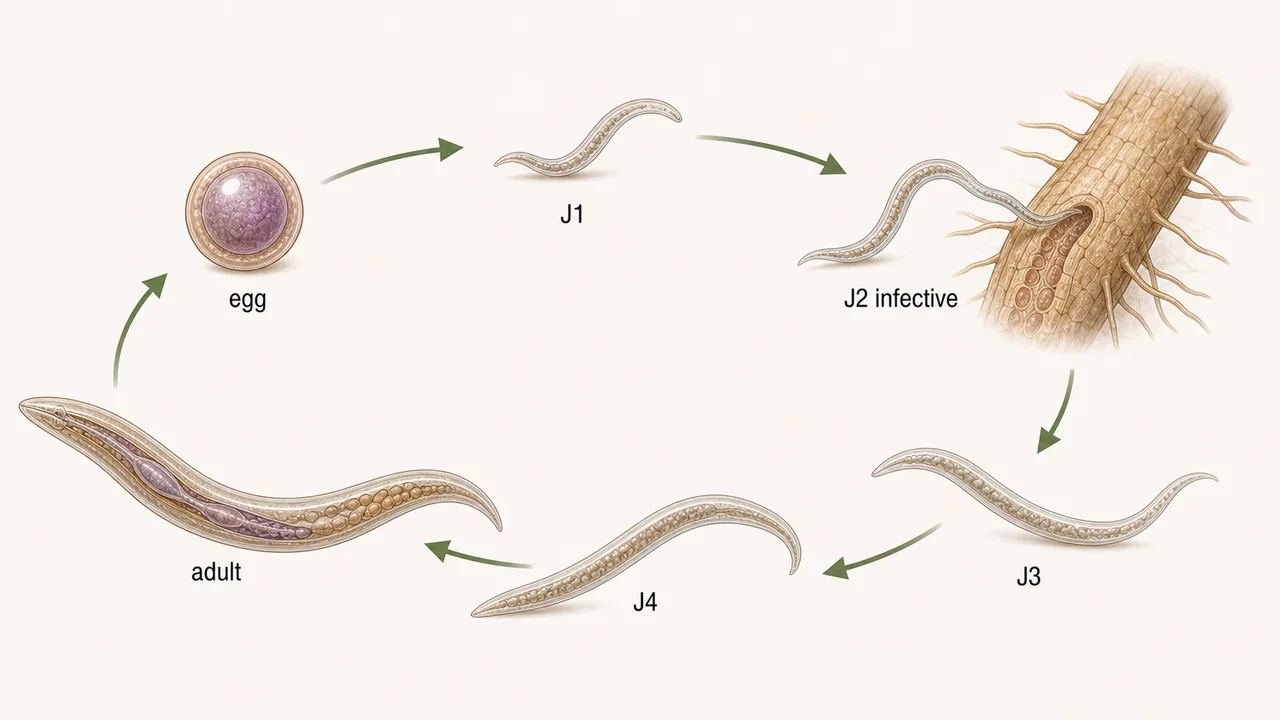
The nematode life cycle has six stages:
| Stage | Name | Key Feature |
|---|---|---|
| 1 | Egg | Laid singly or in groups as egg mass; often the most resistant stage to environmental stress |
| 2 | J1 (First-stage juvenile) | Typically develops inside the egg |
| 3 | J2 (Second-stage juvenile) | In most PPNs, this is the infective stage that hatches and invades host tissue |
| 4 | J3 (Third-stage juvenile) | Continues growth inside or outside the root |
| 5 | J4 (Fourth-stage juvenile) | Final juvenile stage before adult |
| 6 | Adult | Sexually mature; capable of reproduction |
NOTE
The term juvenile is preferred over "larva" in nematology because nematode young closely resemble adults -- they do not undergo the dramatic metamorphosis seen in insects.
Hatching
Hatching is the emergence of the juvenile from the egg. It occurs in two ways depending on the nematode species:
| Trigger | Nematode Type | Example |
|---|---|---|
| Host root exudates (chemical stimulus) | Cyst nematodes -- highly host-specific; hatch only when the correct host is present | Heterodera avenae |
| Normal soil conditions (temperature, moisture) | Root-knot nematodes -- hatch freely without specific host signal | Meloidogyne incognita |
This difference in hatching behaviour explains why cyst nematodes are highly host-specific while root-knot nematodes have a wide host range.
Moulting (Ecdysis)
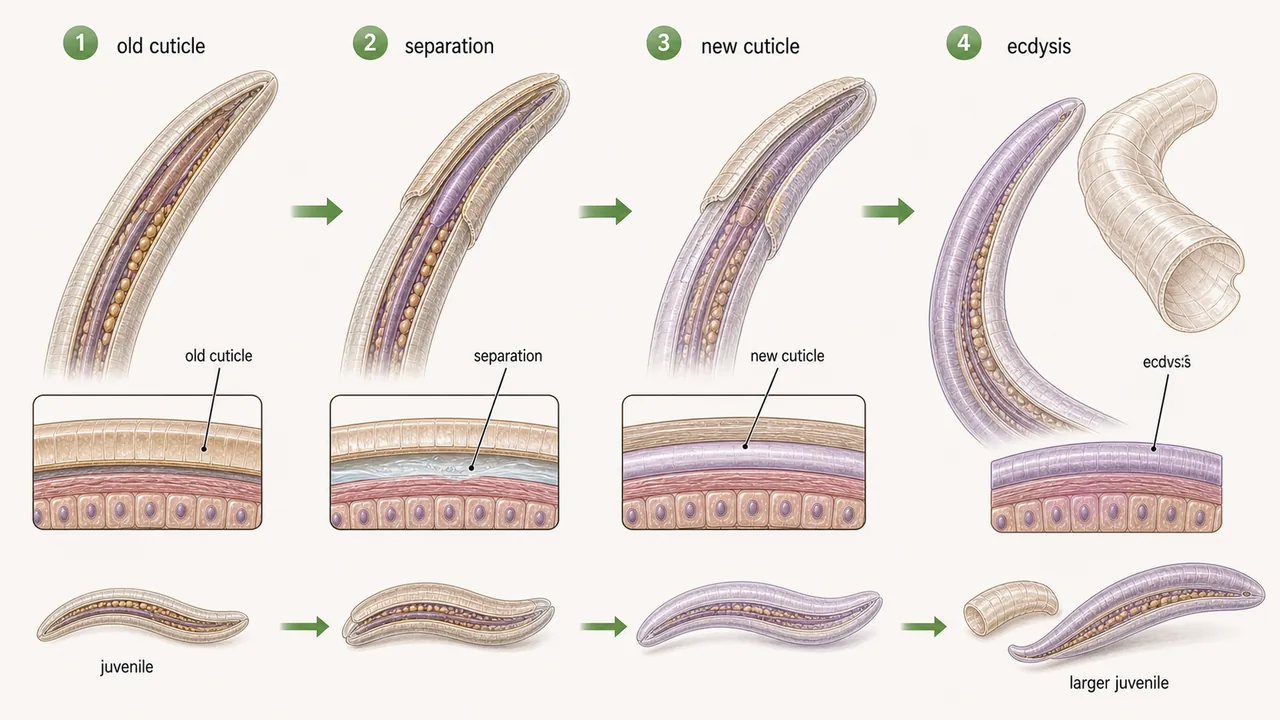
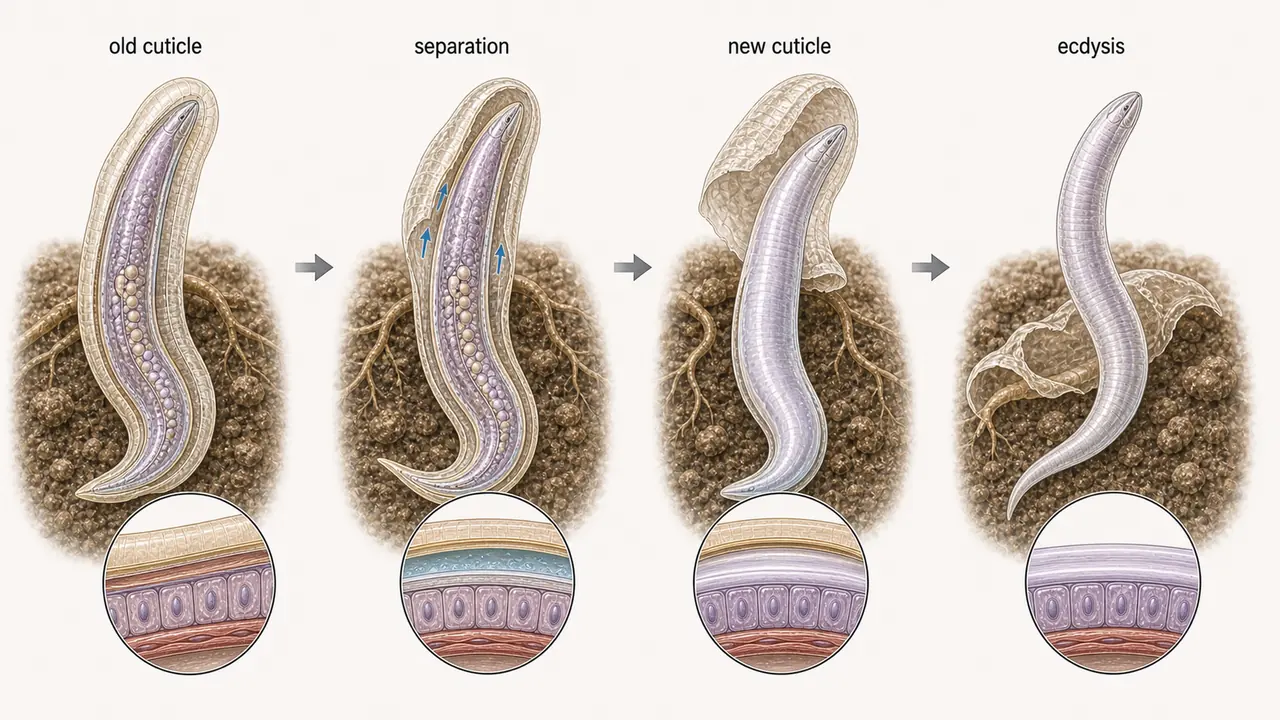
Growth in nematodes is associated with moulting -- shedding the old cuticle and forming a new, larger one. This is the only way nematodes can increase in body size because the cuticle does not stretch.
| Feature | Details |
|---|---|
| Number of moults | Four (from J1 to adult) |
| Number of stages | Five (4 juvenile + 1 adult) |
| Process name | Ecdysis |
| How it works | Old cuticle is shed; new cuticle is secreted by the hypodermis underneath |
IMPORTANT
Do not confuse: Ecdysis = the process of moulting (shedding cuticle). Voltinism = the number of generations per year. Exams often test this distinction.
Voltinism -- Generations per Year
Voltinism describes how many complete generations a nematode completes in one year. This directly determines how fast populations build up.
| Type | Generations/Year | Examples | Agricultural Impact |
|---|---|---|---|
| Univoltine | One generation | Anguina tritici (seed-gall), Heterodera sp. (cyst) | Populations build up gradually over years; cyst stage persists in soil for many years |
| Multivoltine | Many generations | Meloidogyne incognita (root-knot), Tylenchulus sp., Pratylenchus, Rotylenchulus | Rapid population explosions within a single growing season |
TIP
Root-knot nematode (Meloidogyne incognita) can complete 7--8 generations per year under favourable conditions (25--30 degrees C), which is why it causes the most devastating damage among all PPNs.
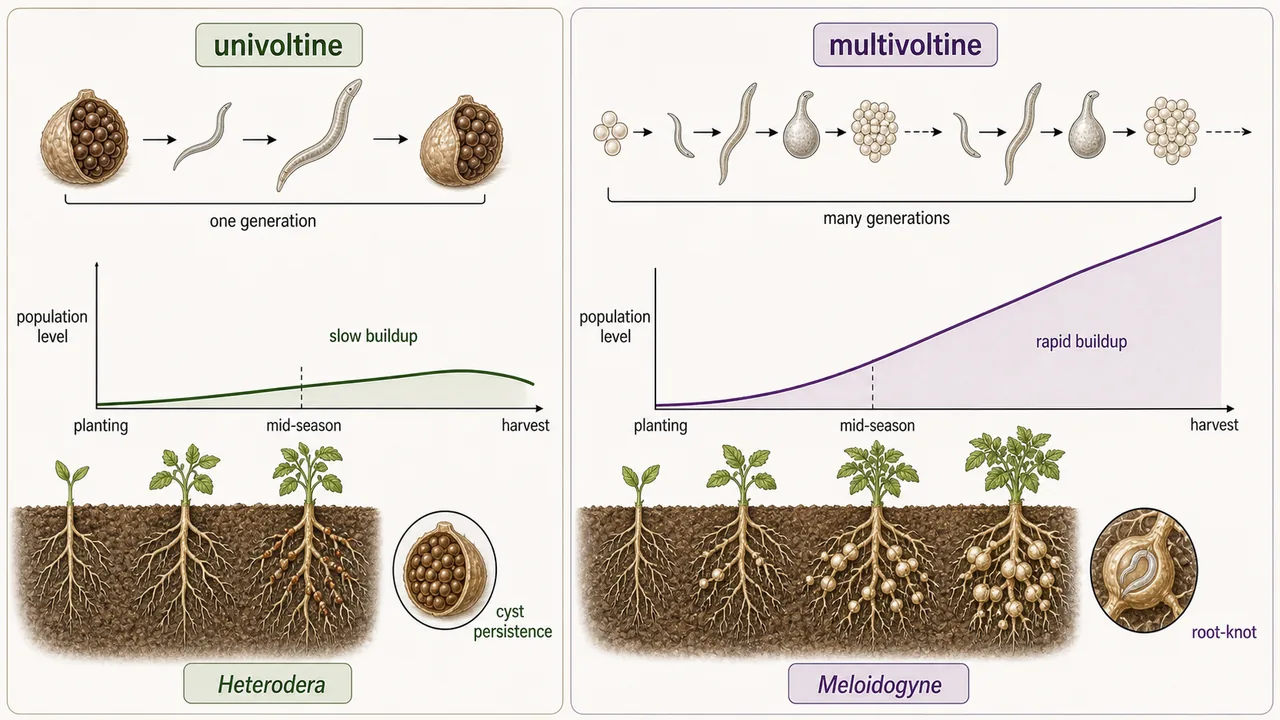
Comparison: Univoltine vs Multivoltine
| Feature | Univoltine | Multivoltine |
|---|---|---|
| Generations per year | One | Many (7--8 in Meloidogyne) |
| Population buildup | Slow, over years | Rapid, within one season |
| Survival strategy | Resistant stages (cysts, galls) persist for years | High reproduction rate overwhelms hosts |
| Management timing | Long-term rotation effective | Must act early in the season |
| Examples | Heterodera avenae, Anguina tritici | Meloidogyne incognita, Pratylenchus sp. |
Summary Table
| Concept | Key Fact |
|---|---|
| Life cycle stages | Six: Egg, J1, J2, J3, J4, Adult |
| Infective stage (most PPNs) | J2 (second-stage juvenile) |
| Number of moults | Four (J1 to adult) |
| Number of stages | Five (4 juvenile + 1 adult) |
| Moulting process | Ecdysis -- old cuticle shed, new cuticle secreted by hypodermis |
| Hatching trigger (cyst nematodes) | Root exudates from host plant |
| Hatching trigger (root-knot) | Normal soil temperature and moisture |
| Univoltine | One generation/year (Heterodera, Anguina) |
| Multivoltine | Many generations/year (Meloidogyne, Pratylenchus) |
| Fastest reproducer | M. incognita -- 25 days per cycle at 25--30 degrees C |
TIP
Exam mnemonic -- "4 Moults, 5 Stages, 6 Total": 4 moults occur, creating 5 stages (J1--J4 + adult), for a 6-stage life cycle (including egg).
References
- Dropkin, V.H. 1980. Introduction to plant nematology. John Wiley and sons, INC. New York.
- Singh, R.S and Sitaramaiah, K. 1994. Plant pathogens. The plant parasitic nematodes. Oxford & IBH Pub. Co. Pvt. Ltd. New Delhi.
- Parvata Reddy, P. 1983. Plant nematology. Agricole Pub. Co., New Delhi.
- Southey, J. F. Laboratory methods for work with plant and soil nematodes Tech.
- Bull. Min. Agric. Fish. Food. Her Majesty's Stationary Office, London.
- Walia, R. K and Bajaj, H. K (2014). Textbook of Introductory Plant Nematology. Directorate of Knowledge Management in Agriculture, ICAR, New Delhi.
- Kumar, V., Khan, M.R. & Walia, R.K. Crop Loss Estimations due to Plant-Parasitic Nematodes in Major Crops in India. Natl. Acad. Sci. Lett. 43, 409-412 (2020). https://doi.org/10.1007/s40009-020-00895-2
Summary Cheat Sheet
| Concept / Topic | Key Details |
|---|---|
| Life cycle stages | Six: Egg, J1, J2, J3, J4, Adult |
| Infective stage (most PPNs) | J2 (second-stage juvenile) |
| Number of moults | Four (J1 to adult) |
| Number of stages | Five (4 juvenile + 1 adult) |
| Moulting process | Ecdysis -- old cuticle shed, new cuticle secreted by hypodermis |
| Hatching trigger (cyst nematodes) | Root exudates from host plant |
| Hatching trigger (root-knot) | Normal soil temperature and moisture |
| Univoltine | One generation/year (Heterodera, Anguina) |
| Multivoltine | Many generations/year (Meloidogyne, Pratylenchus) |
| Fastest reproducer | M. incognita -- 25 days per cycle at 25--30 degrees C |
TIP
Next: Lesson 09 covers ecology -- how nematodes interact with fungi, bacteria, and viruses, plus entomopathogenic nematodes (EPNs) used in biological control.