In the previous lessons, we covered the major nematode groups in detail -- root-knot, cyst, seed-gall, citrus, aphelenchid, burrowing, reniform, and Ditylenchus. This final lesson provides a quick reference to twelve additional nematode genera that are frequently encountered in Indian agricultural soils and commonly tested in exams.
A coffee planter in South India dealing with lesion nematodes, a rice farmer in eastern India battling the rice root nematode, or a grape grower whose vines are declining due to the dagger nematode -- each faces a distinct challenge. This lesson covers their common names, key identifying features, and agricultural significance.
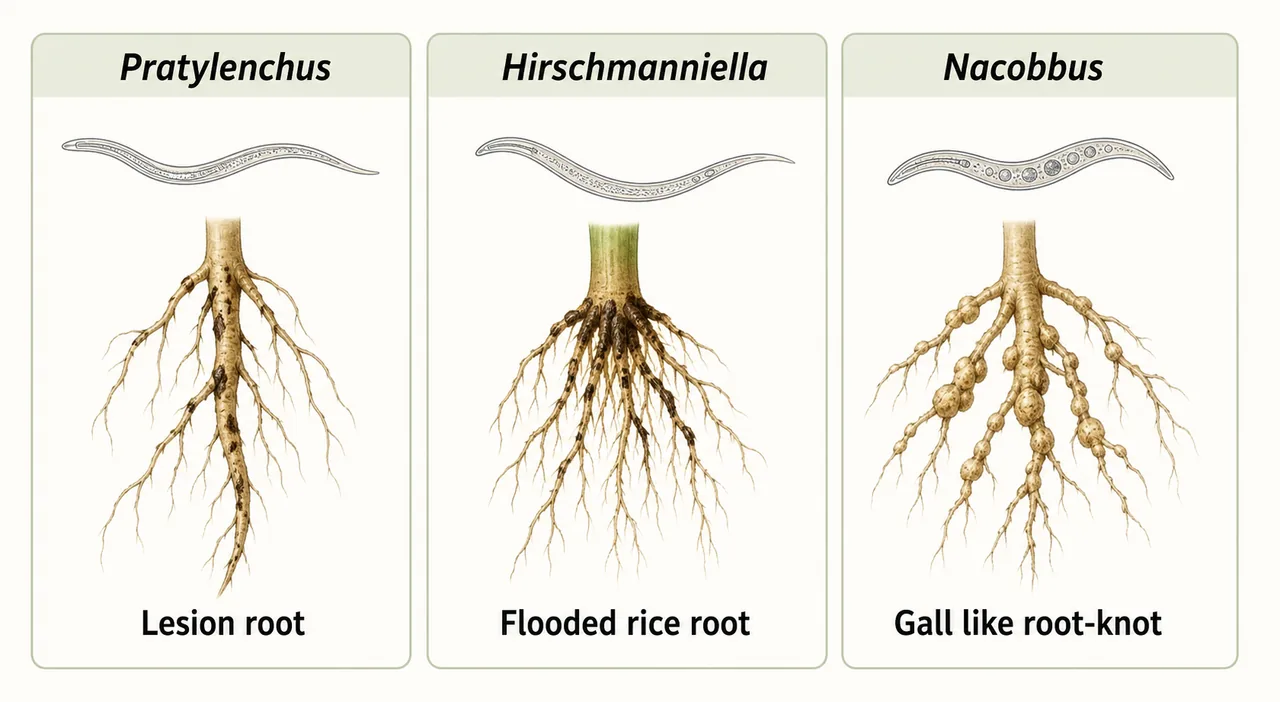
Produces galls resembling true root-knot (Meloidogyne) galls through hypertrophy
Key difference
Galls are indistinguishable in the field -- accurate identification requires laboratory examination of the nematode
The first exam split is by root symptom: lesions point toward Pratylenchus, flooded-rice hollowing points toward Hirschmanniella, and root-knot-like galls raise the Nacobbus trap.
Spiral Nematode -- Helicotylenchus sp.
Feature
Details
Etymology
Helix (coil) + Tylenchus
Identifying feature
Body naturally coils into a tight spiral when killed -- the defining morphological character
Lance Nematode -- Hoplolaimus sp.
Feature
Details
Etymology
Hoplo (arming) + laimos (throat)
Common name origin
"Lance" refers to its robust, heavily sclerotised stylet resembling a lance/spear
Capability
Strong stylet can penetrate even thick-walled cortical cells
Stunt Nematode -- Tylenchorhynchus sp.
Feature
Details
Etymology
Tylos (knob) + enchos (spear) + rhynchos (snout) = knobbed spear with a snout
Common name origin
Causes pronounced growth reduction (stunting) in infected plants, particularly tobacco
Ring Nematode -- Criconema sp.
Feature
Details
Identifying feature
Large, prominent ring-like annulations covering the body surface
Distinction
Rings are much more pronounced than fine annulations on other nematodes
Sheath Nematode -- Hemicycliophora sp.
Feature
Details
Etymology
Hemi (half) + cyclio (rounded) + phora (bearing)
Common name origin
Females and juveniles have a loose outer cuticle (sheath) -- the retained cuticle from a previous moult
Other feature
Sickle-shaped spicules in males
Pin Nematode -- Paratylenchus sp.
Feature
Details
Size
Smallest plant parasitic nematode (< 0.5 mm)
Feeding type
Ectoparasitic
Note
Despite tiny size, can reach very high population densities and cause measurable root damage
These six are easiest to sort by one field clue each: spiral coiling, robust stylet, stunting, ring annulation, sheath, and extremely small pin-size habit.
Dagger Nematode -- Xiphinema sp.
Feature
Details
Etymology
Xiphidion (sword) + nema
Stylet type
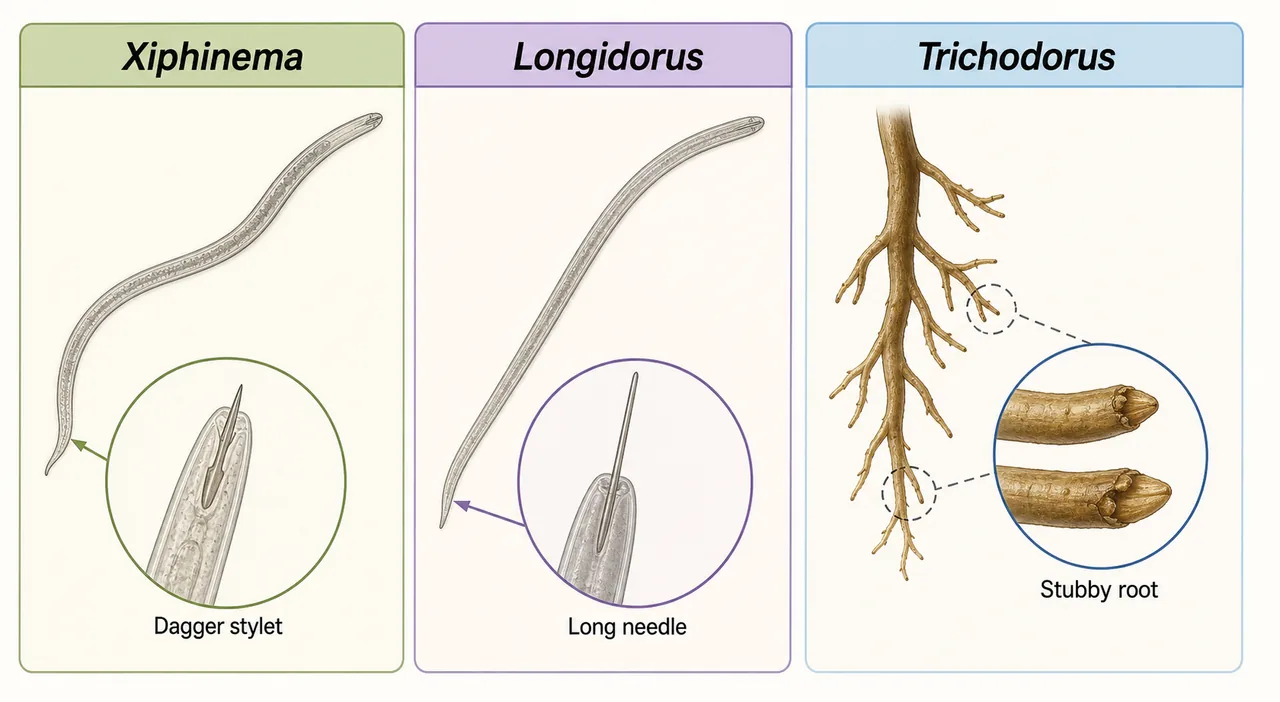
Odontostyle -- one of the longest among PPNs
Key species
Xiphinema index transmits Grapevine Fan Leaf Virus
Among the largest soil-inhabiting PPNs -- some species exceed 5 mm
Stylet
Long hypodermal needle-like stylet for deep root feeding
Virus transmission
Transmits NEPO viruses (ring spot viruses)
Stubby-Root Nematode -- Trichodorus and Paratrichodorus sp.
Feature
Details
Common name origin
Infected roots become abnormally short, thickened, and blunt-tipped ("stubby")
Damage mechanism
Feeds on and destroys the root meristem (growing point), stopping root elongation
Parasitism
Ectoparasites feeding on root tips
Virus transmission
Vectors of NETU (Tobacco Rattle) viruses
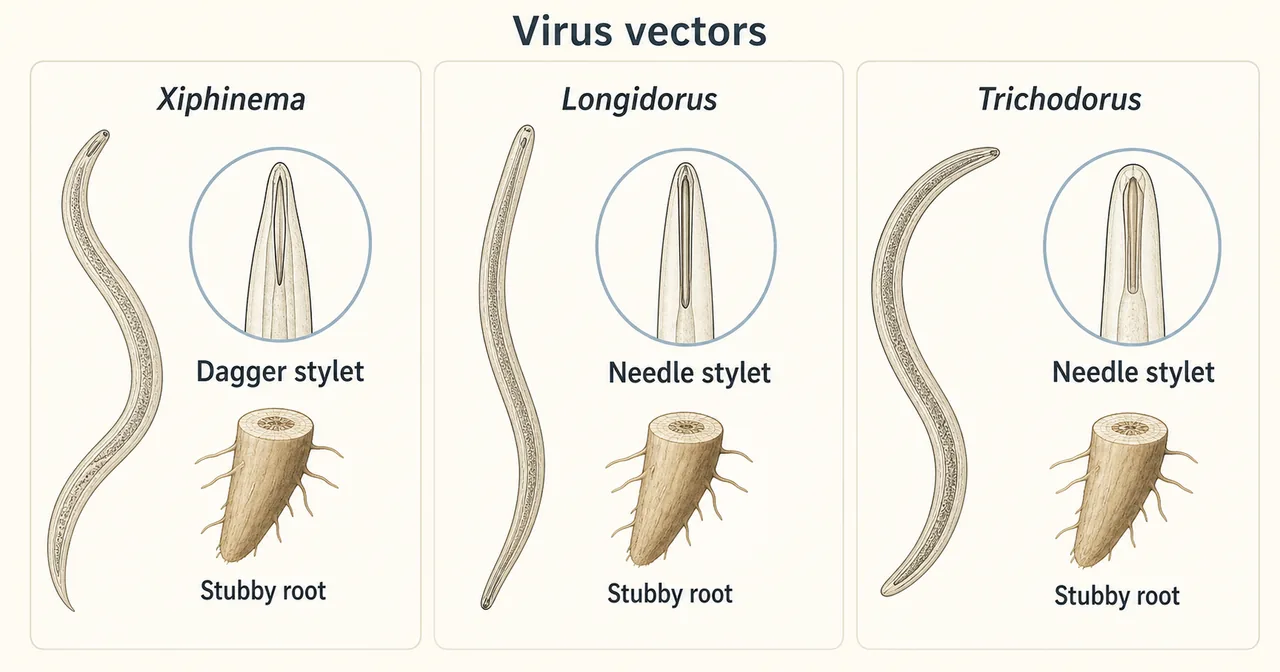
For virus vectors, remember the trio by cue: Xiphinema has the dagger image, Longidorus the long needle image, and Trichodorus the stubby-root symptom.
Master Comparison Table
Nematode
Common Name
Parasitism
Key Feature
Crops/Significance
Pratylenchus
Lesion / Meadow
Migratory endoparasite
Dark necrotic root lesions
Coffee (South India); Top 3 genus
Hirschmanniella
Rice root
Migratory endoparasite
Hollow roots in flooded fields
Mentek disease of rice
Nacobbus
False root-knot
Endoparasite
Galls like Meloidogyne
Lab ID needed to distinguish
Helicotylenchus
Spiral
Semi-endoparasite
Body coils in tight spiral
Wide range of crops
Hoplolaimus
Lance
Ecto/Endoparasite
Robust stylet like a lance
Various crops
Tylenchorhynchus
Stunt
Ectoparasite
Causes stunting (notably tobacco)
Tobacco and other crops
Criconema
Ring
Ectoparasite
Prominent ring-like annulations
Various crops
Hemicycliophora
Sheath
Ectoparasite
Loose outer cuticle sheath
Various crops
Paratylenchus
Pin
Ectoparasite
Smallest PPN (< 0.5 mm)
Various crops
Xiphinema
Dagger
Ectoparasite
Longest stylet; transmits NEPO viruses
Grapes (Fan Leaf Virus)
Longidorus
Needle
Ectoparasite
Largest soil PPN; needle-like stylet
Transmits NEPO viruses
Trichodorus/Paratrichodorus
Stubby-root
Ectoparasite
Destroys root tip; stubby roots
Transmits NETU viruses
TIP
🔐
Pro Content Locked
Upgrade to Pro to access this lesson and all other premium content.
Pro
PopularSave ₹100/mo
₹99/mo
₹199
Launch prices slashed to nearly half
₹99 charged monthly · Cancel anytime
All Agriculture & Banking Courses
AI Lesson Questions (100/day)
AI Doubt Solver (50/day)
Glows & Grows Feedback (30/day)
AI Section Quiz (20/day)
22-Language Translation (100/day)
Recall Questions (20/day)
AI Quiz (15/day)
AI Quiz Paper Analysis (100/day)
AI Step-by-Step Explanations (100/day)
Spaced Repetition Recall (FSRS)
AI Tutor
Immersive Text Questions
Audio Lessons — Hindi & English
Mock Tests & Previous Year Papers
Summary & Mind Maps
XP, Levels, Leaderboard & Badges
Generate New Classrooms
Voice AI Teacher (AgriDots Live)
AI Revision Assistant
Knowledge Gap Analysis
Interactive Revision (LangGraph)
🔒 Secure via Razorpay · Cancel anytime · No hidden fees
Mind Map: Other Important Nematodes
In the previous lessons, we covered the major nematode groups in detail -- root-knot, cyst, seed-gall, citrus, aphelenchid, burrowing, reniform, and Ditylenchus. This final lesson provides a quick reference to twelve additional nematode genera that are frequently encountered in Indian agricultural soils and commonly tested in exams.
A coffee planter in South India dealing with lesion nematodes, a rice farmer in eastern India battling the rice root nematode, or a grape grower whose vines are declining due to the dagger nematode -- each faces a distinct challenge. This lesson covers their common names, key identifying features, and agricultural significance.
Produces galls resembling true root-knot (Meloidogyne) galls through hypertrophy
Key difference
Galls are indistinguishable in the field -- accurate identification requires laboratory examination of the nematode
The first exam split is by root symptom: lesions point toward Pratylenchus, flooded-rice hollowing points toward Hirschmanniella, and root-knot-like galls raise the Nacobbus trap.
Spiral Nematode -- Helicotylenchus sp.
Feature
Details
Etymology
Helix (coil) + Tylenchus
Identifying feature
Body naturally coils into a tight spiral when killed -- the defining morphological character
Lance Nematode -- Hoplolaimus sp.
Feature
Details
Etymology
Hoplo (arming) + laimos (throat)
Common name origin
"Lance" refers to its robust, heavily sclerotised stylet resembling a lance/spear
Capability
Strong stylet can penetrate even thick-walled cortical cells
Stunt Nematode -- Tylenchorhynchus sp.
Feature
Details
Etymology
Tylos (knob) + enchos (spear) + rhynchos (snout) = knobbed spear with a snout
Common name origin
Causes pronounced growth reduction (stunting) in infected plants, particularly tobacco
Ring Nematode -- Criconema sp.
Feature
Details
Identifying feature
Large, prominent ring-like annulations covering the body surface
Distinction
Rings are much more pronounced than fine annulations on other nematodes
Sheath Nematode -- Hemicycliophora sp.
Feature
Details
Etymology
Hemi (half) + cyclio (rounded) + phora (bearing)
Common name origin
Females and juveniles have a loose outer cuticle (sheath) -- the retained cuticle from a previous moult
Other feature
Sickle-shaped spicules in males
Pin Nematode -- Paratylenchus sp.
Feature
Details
Size
Smallest plant parasitic nematode (< 0.5 mm)
Feeding type
Ectoparasitic
Note
Despite tiny size, can reach very high population densities and cause measurable root damage
These six are easiest to sort by one field clue each: spiral coiling, robust stylet, stunting, ring annulation, sheath, and extremely small pin-size habit.
Dagger Nematode -- Xiphinema sp.
Feature
Details
Etymology
Xiphidion (sword) + nema
Stylet type
Odontostyle -- one of the longest among PPNs
Key species
Xiphinema index transmits Grapevine Fan Leaf Virus
Among the largest soil-inhabiting PPNs -- some species exceed 5 mm
Stylet
Long hypodermal needle-like stylet for deep root feeding
Virus transmission
Transmits NEPO viruses (ring spot viruses)
Stubby-Root Nematode -- Trichodorus and Paratrichodorus sp.
Feature
Details
Common name origin
Infected roots become abnormally short, thickened, and blunt-tipped ("stubby")
Damage mechanism
Feeds on and destroys the root meristem (growing point), stopping root elongation
Parasitism
Ectoparasites feeding on root tips
Virus transmission
Vectors of NETU (Tobacco Rattle) viruses
For virus vectors, remember the trio by cue: Xiphinema has the dagger image, Longidorus the long needle image, and Trichodorus the stubby-root symptom.
- Dropkin, V.H. 1980. Introduction to plant nematology. John Wiley and sons, INC. New York.
- Singh, R.S and Sitaramaiah, K. 1994. Plant pathogens. The plant parasitic nematodes. Oxford & IBH Pub. Co. Pvt. Ltd. New Delhi.
- Parvata Reddy, P. 1983. Plant nematology. Agricole Pub. Co., New Delhi.
- Walia, R. K and Bajaj, H. K (2014). Textbook of Introductory Plant Nematology. Directorate of Knowledge Management in Agriculture, ICAR, New Delhi.
- Kumar, V., Khan, M.R. & Walia, R.K. Crop Loss Estimations due to Plant-Parasitic Nematodes in Major Crops in India. Natl. Acad. Sci. Lett. 43, 409-412 (2020).
- Figure 1: Source: A: Maggenti, 1981, B-E: Franklin, 1973
Master Field Identification Guide: All Major Nematodes
AFO officer's guide — when you suspect nematode damage, check roots and match symptoms:
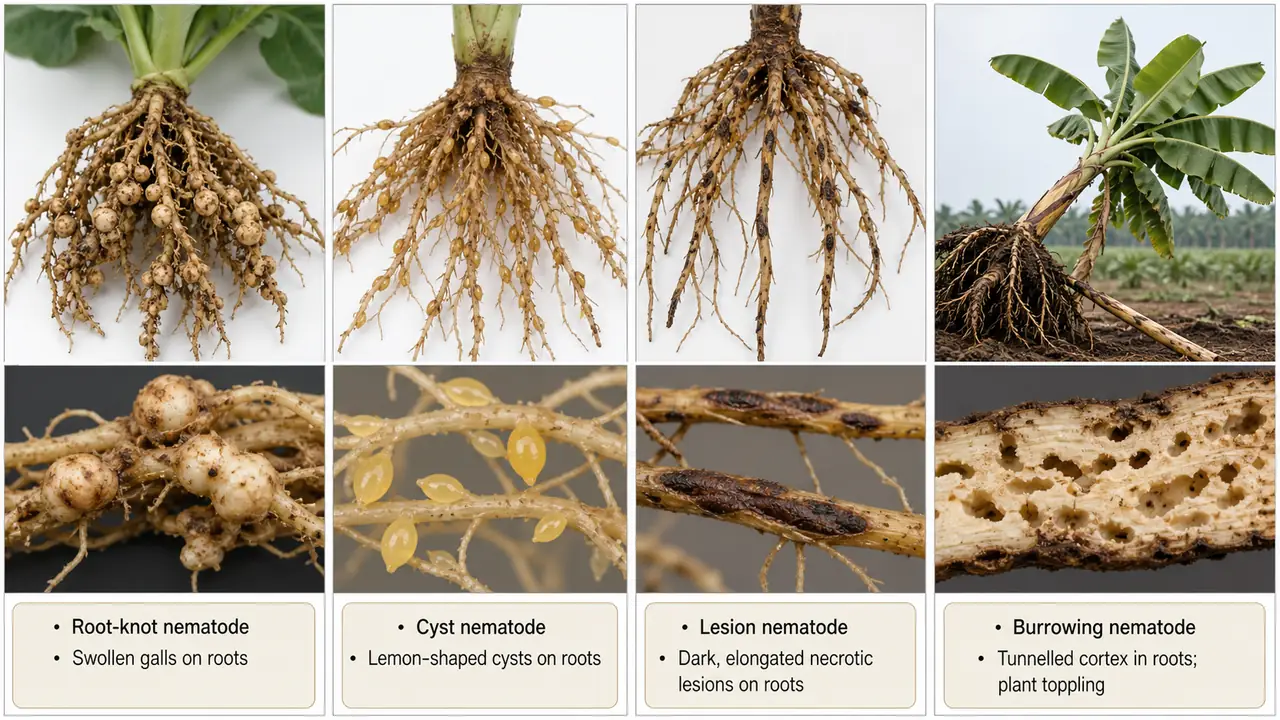
This quick board anchors four high-yield field patterns: galled roots suggest root-knot, lemon-like cysts suggest cyst nematodes, dark lesions suggest Pratylenchus, and tunnelled banana roots with collapse suggest burrowing nematodes.
Root/Plant Symptom
Likely Nematode
Confirm By
Crops Most Affected
Yield Loss (India)
Swollen galls/knots on roots
Root-knot (Meloidogyne)
Cut gall open — pearly white female inside
Tomato, brinjal, okra, cucurbits
20-80%
Tiny lemon-shaped cysts on roots
Cyst (Heterodera/Globodera)
Cysts visible with hand lens; persist in soil 3-4 years
Wheat (Molya), potato, sugarbeet
15-40%
Galls replacing seeds in wheat ear
Seed-gall (Anguina tritici)
Brine flotation — galled seeds float
Wheat
10-30%
Dark feeder roots + slow tree decline
Citrus (Tylenchulus)
Dirty roots with soil particles adhering
Citrus (Nagpur orange)
10-30%
Dark necrotic lesions on roots
Lesion (Pratylenchus)
Root cortex discoloured brown/black
Coffee, banana, cereals
15-40%
Toppling/collapse of banana plants
Burrowing (Radopholus)
Root cortex tunnelled; weak anchorage
Banana, black pepper
30-50%
Wilting + no galls, no visible symptoms
Reniform (Rotylenchulus)
Lab extraction needed; kidney-shaped female
Cotton, castor, pulses
10-25%
Hollow roots in flooded rice
Rice root (Hirschmanniella)
Nematodes inside root tissue
Rice (eastern India)
10-25%
Stunted vines + declining yield
Dagger (Xiphinema)
Lab ID; vector of fan leaf virus
Grape, fruit trees
Virus damage > direct
Key economic fact: Nematodes cause estimated ₹24,000 crore/year crop losses in India (~14% average yield reduction). Root-knot nematode alone affects >3,000 plant species — it is the world's most polyphagous plant pathogen.
Why farmers miss nematodes: Unlike insects, nematodes are invisible (microscopic, soil-dwelling). Symptoms (wilting, yellowing, stunting) mimic nutrient deficiency or water stress. AFO officers should recommend soil + root sampling whenever unexplained decline persists despite good agronomic practices.
Summary Cheat Sheet
Concept / Topic
Key Details
Pratylenchus — Lesion / Meadow
Migratory endoparasite; Dark necrotic root lesions; Coffee (South India); Top 3 genus
Hirschmanniella — Rice root
Migratory endoparasite; Hollow roots in flooded fields; Mentek disease of rice
Nacobbus — False root-knot
Endoparasite; Galls like Meloidogyne; Lab ID needed to distinguish
Helicotylenchus — Spiral
Semi-endoparasite; Body coils in tight spiral; Wide range of crops
Hoplolaimus — Lance
Ecto/Endoparasite; Robust stylet like a lance; Various crops
Tylenchorhynchus — Stunt
Ectoparasite; Causes stunting (notably tobacco); Tobacco and other crops
Criconema — Ring
Ectoparasite; Prominent ring-like annulations; Various crops
Hemicycliophora — Sheath
Ectoparasite; Loose outer cuticle sheath; Various crops
Paratylenchus — Pin
Ectoparasite; Smallest PPN (< 0.5 mm); Various crops