🛰️ Sustainable and Precision Agriculture
Learn organic farming, natural farming, precision agriculture tools, and sustainable crop-management approaches.
The previous lessons covered the foundations of agronomy, India's agro-climatic zones, production data, tillage systems, and cropping patterns. All of these rely heavily on conventional intensive farming — the Green Revolution model that transformed India's food security but brought environmental costs: soil degradation, water depletion, chemical residues, and farmer debt.
This lesson explores three alternative paths forward:
- Sustainable agriculture and LEISA — the philosophy of farming within ecological limits
- Organic farming — principles, certification, India's status, and the PKVY scheme
- Zero Budget Natural Farming (ZBNF) — Subhash Palekar's cost-free alternative
- Precision farming — GPS, GIS, Remote Sensing, and Variable Rate Application
All sections are high-yield for exams, FCI, and exams.
From Intensive to Sustainable
Conventional intensive farming transformed India's food security (Green Revolution), but brought environmental costs: soil degradation, water depletion, chemical residues, and farmer debt. This lesson explores the three alternative paths outlined above.
Sustainable Agriculture
"Meeting the food and fuel needs of the present generation without endangering the resource base for the future."
Pro Content Locked
Upgrade to Pro to access this lesson and all other premium content.
₹99 charged monthly · Cancel anytime
- All Agriculture & Banking Courses
- AI Lesson Questions (100/day)
- AI Doubt Solver (50/day)
- Glows & Grows Feedback (30/day)
- AI Section Quiz (20/day)
- 22-Language Translation (100/day)
- Recall Questions (20/day)
- AI Quiz (15/day)
- AI Quiz Paper Analysis (100/day)
- AI Step-by-Step Explanations (100/day)
- Spaced Repetition Recall (FSRS)
- AI Tutor
- Immersive Text Questions
- Audio Lessons — Hindi & English
- Mock Tests & Previous Year Papers
- Summary & Mind Maps
- XP, Levels, Leaderboard & Badges
- Generate New Classrooms
- Voice AI Teacher (AgriDots Live)
- AI Revision Assistant
- Knowledge Gap Analysis
- Interactive Revision (LangGraph)
🔒 Secure via Razorpay · Cancel anytime · No hidden fees
The previous lessons covered the foundations of agronomy, India's agro-climatic zones, production data, tillage systems, and cropping patterns. All of these rely heavily on conventional intensive farming — the Green Revolution model that transformed India's food security but brought environmental costs: soil degradation, water depletion, chemical residues, and farmer debt.
This lesson explores three alternative paths forward:
- Sustainable agriculture and LEISA — the philosophy of farming within ecological limits
- Organic farming — principles, certification, India's status, and the PKVY scheme
- Zero Budget Natural Farming (ZBNF) — Subhash Palekar's cost-free alternative
- Precision farming — GPS, GIS, Remote Sensing, and Variable Rate Application
All sections are high-yield for exams, FCI, and exams.
From Intensive to Sustainable
Conventional intensive farming transformed India's food security (Green Revolution), but brought environmental costs: soil degradation, water depletion, chemical residues, and farmer debt. This lesson explores the three alternative paths outlined above.
Sustainable Agriculture
"Meeting the food and fuel needs of the present generation without endangering the resource base for the future."
Objectives
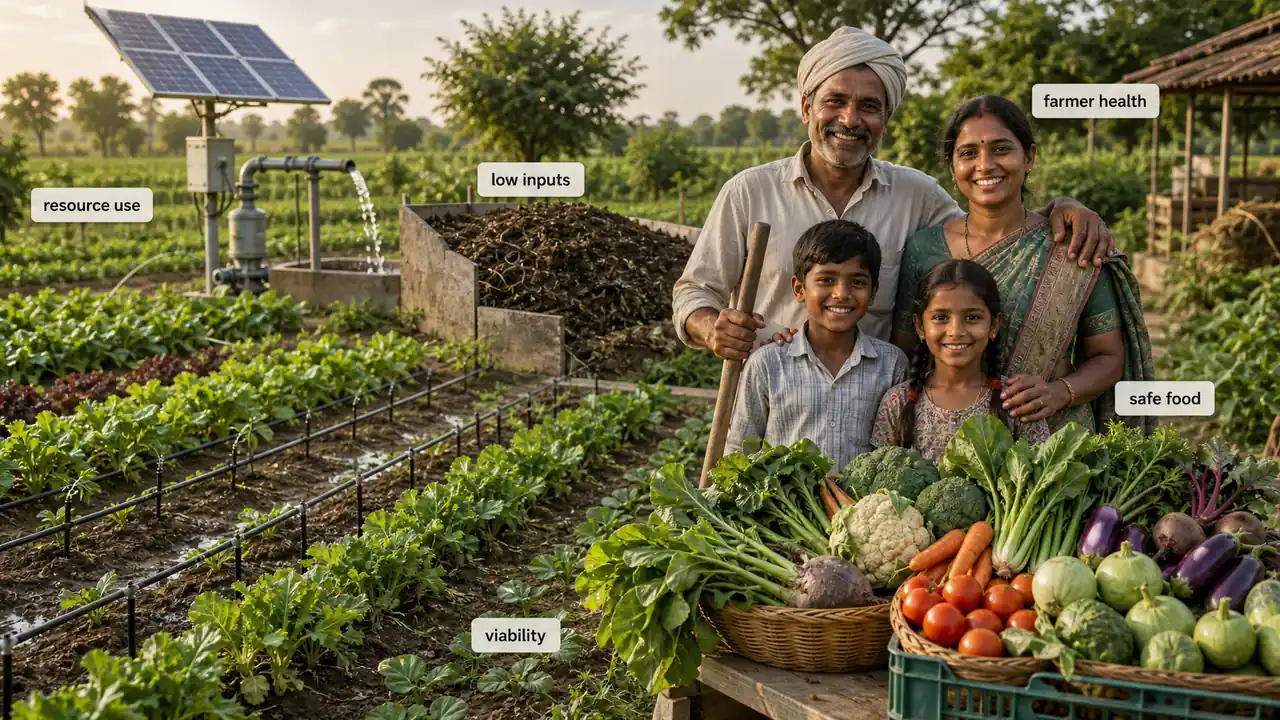
- Best use of available resources
- Minimise non-renewable resource use
- Protect farmer health and environment
- Maintain economic viability
- Produce sufficient, high-quality, safe food
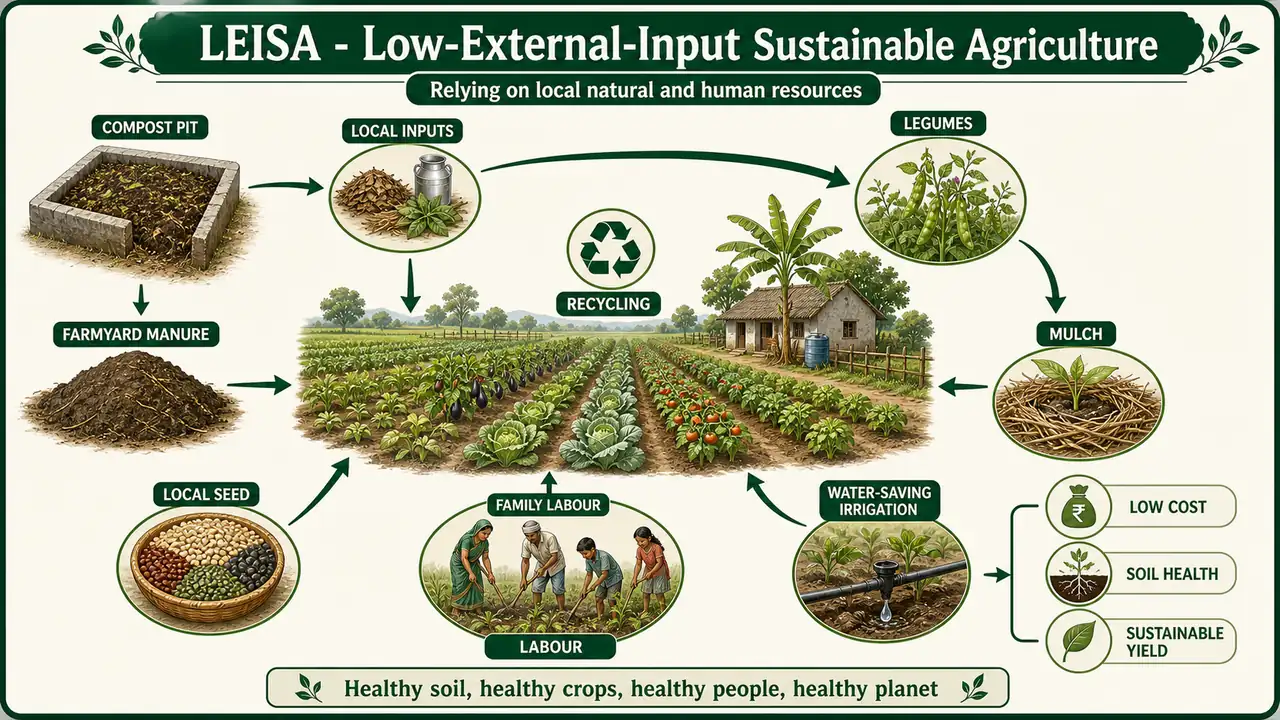
LEISA (Low-External-Input Sustainable Agriculture)
Optimal use of locally available natural and human resources -- economically feasible, ecologically sound, culturally adapted, socially just. Especially relevant for resource-poor smallholders.
Organic Farming
Organic farming is the most established alternative to conventional agriculture. It replaces synthetic inputs with biological processes — crop rotation for fertility, biological agents for pest control, and composting for nutrient supply. India's organic farming statistics are heavily tested in exams.
IMPORTANT
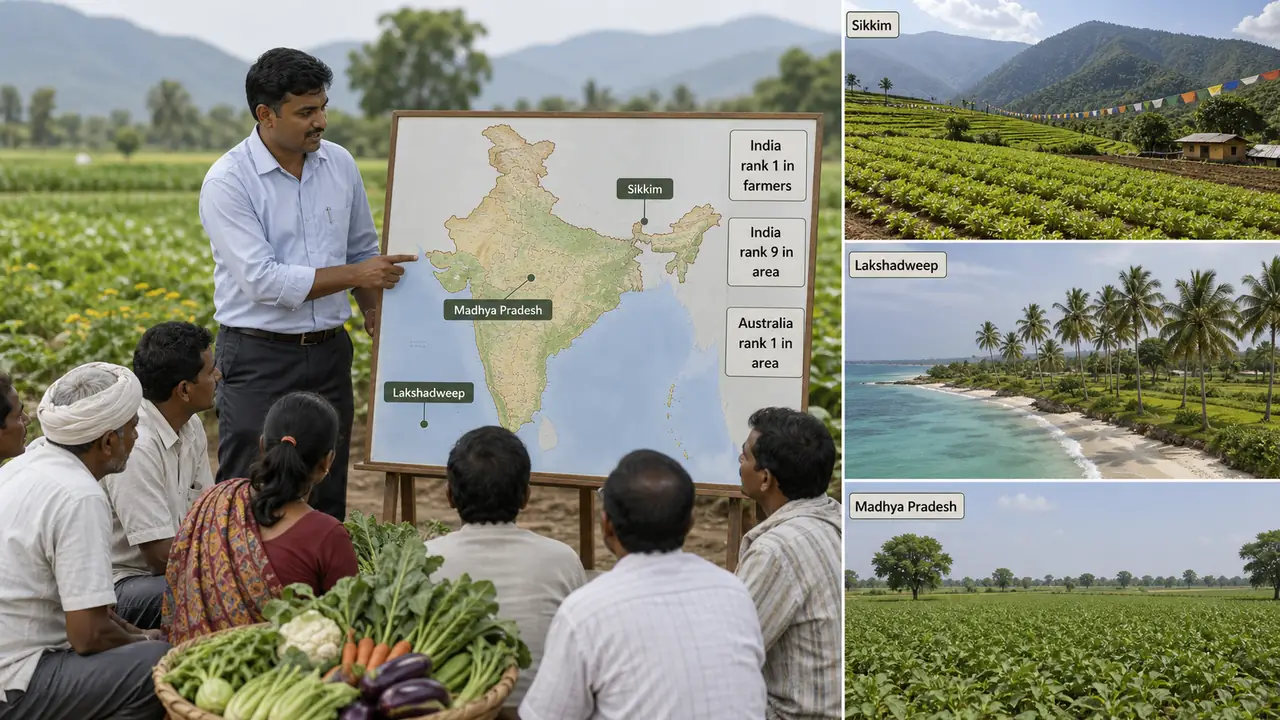
Key facts: Sikkim = first fully organic state. Lakshadweep = first fully organic UT. India ranks 1st in organic farmers, 9th in area. Australia ranks 1st in area.
Definition
"An agricultural production system which avoids or largely excludes synthetic fertilizers, pesticides, growth regulators, and livestock feed additives. It relies on crop rotations, animal manure, legumes, green manure, mechanical cultivation, mineral-bearing rocks, and biological pest control to maintain soil productivity and supply plant nutrients." (USDA, 1980)
The central concept: treating soil as a living ecosystem that must be fed in ways that support beneficial organisms, nutrient recycling, and humus formation.
Synonyms: Eco-farming, Biological farming, Bio-dynamic farming, Macrobiotic agriculture.
Principles of Organic Farming (IFOAM, 1972)
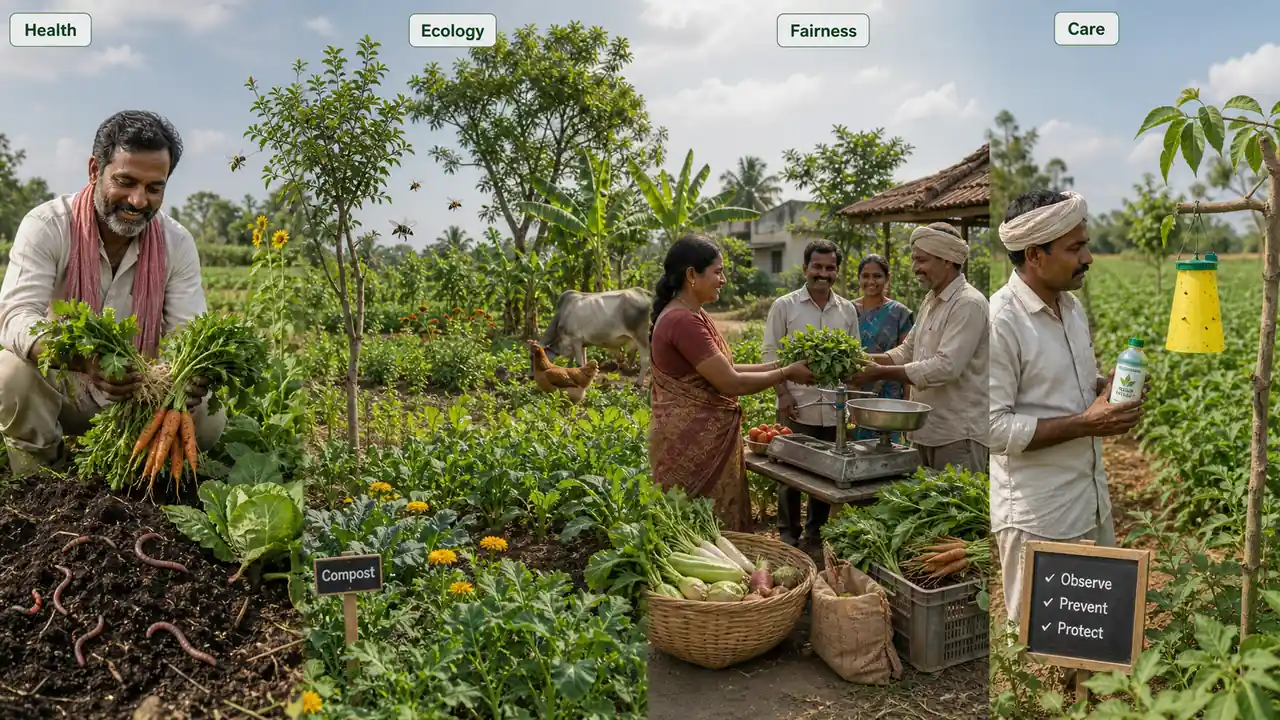
| Principle | Core Idea | Agricultural Example |
|---|---|---|
| Health | Soil, plant, animal, human health are interconnected | Healthy soil produces nutrient-rich crops |
| Ecology | Farm should mimic natural ecosystems | Diverse crop rotations, nutrient recycling |
| Fairness | Equity, respect, justice for all living beings | Fair prices to organic farmers |
| Care | Precautionary approach -- err on the side of caution | Avoid uncertain technologies (GMO) |
Components of Organic Farming
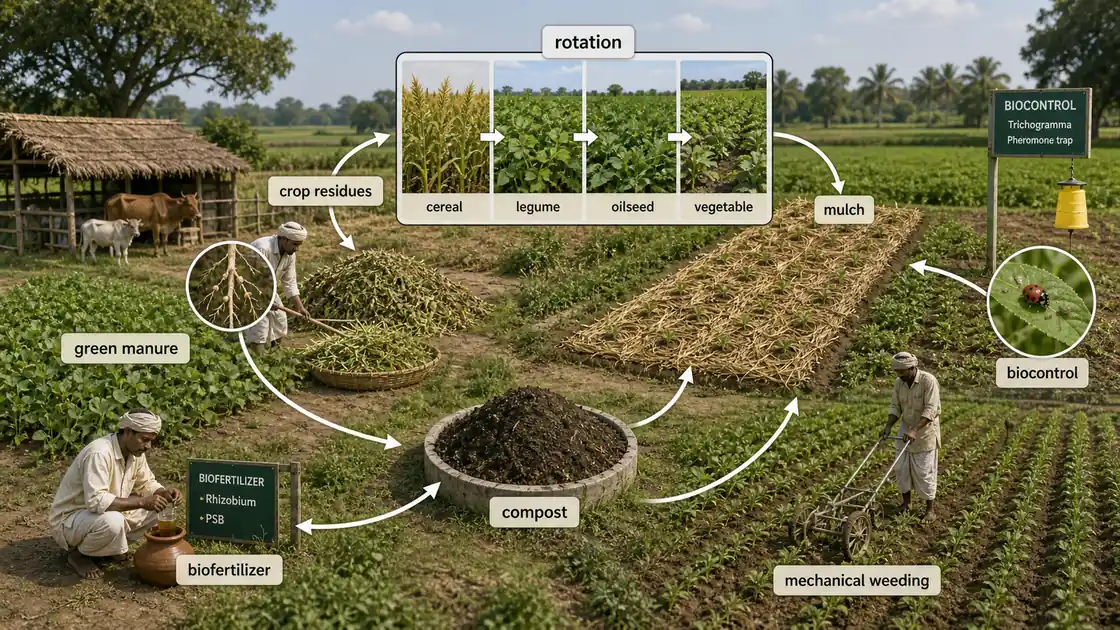
1. Diverse Crop Rotations
- Yield stability, disease/pest reduction, improved weed control, erosion reduction.
- Nitrogen-fixing legumes are the cornerstone -- they replace synthetic N fertilizers.

2. Soil Fertility Management
Organic manures (FYM, vermicompost), crop residues, green manuring, biofertilizers (Rhizobium, Azotobacter, PSB, BGA, Azolla, VAM), biogas slurry. Goal: work within a closed nutrient system.
TIP
Green Manure — a crop grown and ploughed under before flowering to add organic matter and fix atmospheric nitrogen. Key green manure crops: Dhaincha (Sesbania aculeata) and Sunnhemp (Crotalaria juncea) fix 60-80 kg N/ha. Sesbania rostrata (stem-nodulating) can fix 100-250 kg N/ha in 45-55 days — the highest among green manure crops.
3. Weed Control (No Herbicides)
Deep summer ploughing, harrowing, mechanical hoeing, mulching, soil solarization, timely sowing, line sowing, crop rotation, smother crops, intercropping.
4. Natural Pest and Disease Control
| Method | Example |
|---|---|
| Crop rotation | Break pest life cycles |
| Biological control | Bacillus thuringiensis against Heliothis; Trichoderma viride against vegetable diseases |
| Trap crops and pheromones | Attract and trap specific pests |
| Plant-based pesticides | Neem oil, nicotine (short-lasting) |
5. Integrated Nutrient Management
Conjunctive use of organics + biofertilizers + legumes in rotation + green manuring. Chemical fertilizers used only as last resort and in minimal amounts.
Relative Characteristics: Modern vs Organic
| Production Factor | Modern | Organic |
|---|---|---|
| Productivity | High | High |
| Sustainability | Low | High |
| Farming system | Simple | Complex |
| Bio-diversity | Uniform | Diverse |
| Production orientation | Market | Subsistence/Market |
| Usage of external inputs | High | Low |
| Fertilization | Inorganic | Organic |
| Plant protection | Curative & inorganic | Preventive & organic |
| Energy balance | Negative | Positive |
Advantages and Disadvantages
| Advantages | Disadvantages |
|---|---|
| Superior mineral content, poison-free | Lower initial productivity |
| Food tastes better, keeps longer | More labour-intensive (especially weeding) |
| Disease/pest resistance through healthy plants | Requires considerable skill |
| Lower input costs (no chemicals) | Management less convenient than chemical methods |
| Drought resistance; more profitable (premium prices) | -- |
Organic Farming Area in India
| Fact | Detail |
|---|---|
| Total area under organic certification (2019) | 72.3 million ha (26% cultivable, 74% forest/wild) |
| Largest area under organic certification | Madhya Pradesh, followed by Rajasthan, Maharashtra, UP |
| First fully organic state | Sikkim (76,000+ ha, 2016) Exams |
| First fully organic UT | Lakshadweep |
| First state with Organic Agriculture Act | Uttarakhand |
| India's global ranking -- farmers | 1st (30% of world's organic farmers) |
| India's global ranking -- area | 9th (1.5 Mha = 2.59% of global) |
| World's largest organic area | Australia (12.2 Mha) |
Organic Certification
| Stage | Purpose |
|---|---|
| Inspection | On-site verification that operations meet organic standards |
| Certification | Written confirmation of compliance; certificate granted |
| Labelling | Easy recognition of organic quality; helps achieve premium price |
- Trademark: India Organic -- based on compliance with National Standards for Organic Production (NSOP), established 2000.
- Certification by APEDA-accredited testing centres Exams.
- Transition period: No chemical inputs for 2-3 years before marketing as organic. Exams
- GMO products cannot get organic certification -- totally prohibited.
- Accreditation renewal: every 3 years.

NPOP International Recognition
| Country/Region | Status |
|---|---|
| European Union | Equivalence agreement |
| Switzerland | Equivalence agreement |
| USA | NPOP conformity assessment accepted (no re-certification needed) |
Grower Group Certification
- For producer groups, cooperatives, and small-scale processors.
- 25 to 500 members; farms in geographic proximity with similar production systems.
- Cost-effective for India's smallholders.
PKVY — Paramparagat Krishi Vikas Yojana
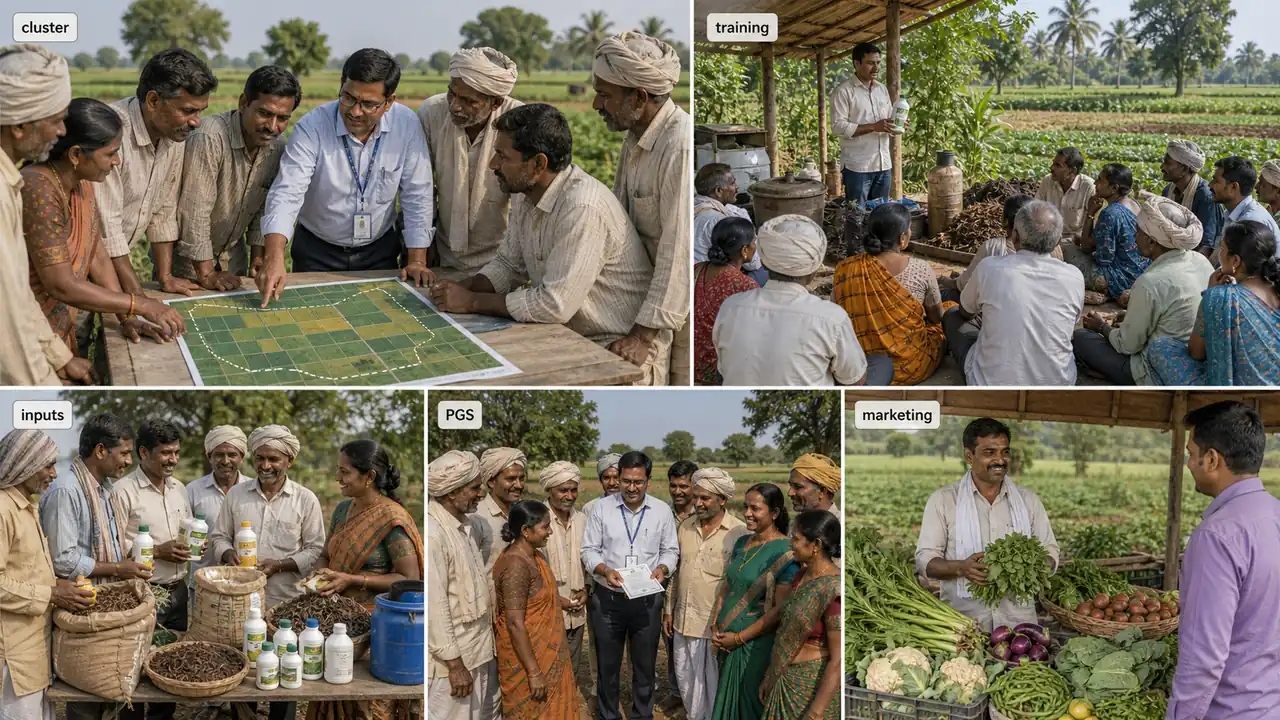
Paramparagat Krishi Vikas Yojana (PKVY) is a flagship scheme launched in 2015 to promote organic farming in India. It is a sub-component of the National Mission on Sustainable Agriculture (NMSA).
| Feature | Detail |
|---|---|
| Launch | 2015 |
| Parent scheme | NMSA (National Mission on Sustainable Agriculture) |
| Approach | Cluster-based — minimum cluster size: 50 acres (~20 ha) |
| Target | 5 lakh acres through 10,000 clusters of 50 acres each |
| Financial assistance | Rs 50,000 per hectare for 3 years |
| Certification | PGS (Participatory Guarantee System) — farmers inspect and certify each other |
| Cost to farmer | Nil — entire cost borne by government |
Breakup of Rs 50,000/ha Assistance
| Component | Amount |
|---|---|
| Organic inputs, seeds, bio-fertilizers | Rs 31,000 |
| Value addition and marketing | Rs 8,800 |
| Capacity building, training, certification | Remaining |
PKVY Achievements
- Under PKVY, 52,289 clusters covering 14.99 lakh hectares and 25.30 lakh farmers have been mobilised.[1]
TIP
Exam numbers for PKVY: 50 acres minimum cluster, Rs 50,000/ha for 3 years, under NMSA. PGS = domestic market certification; NPOP = export market certification.
NPOP — National Programme for Organic Production
NPOP is India's national standard for organic production, accreditation, and certification. It is the export-facing counterpart of PKVY's domestic PGS system.
| Feature | Detail |
|---|---|
| Implementing body | Ministry of Commerce and Industry via APEDA |
| Certification type | Third-party certification (accredited agencies inspect farms) |
| Target market | Export market |
| Logo | "India Organic" |
| Cost | Borne by farmer/exporter |
NPOP International Recognition
| Country/Region | Status |
|---|---|
| European Union | Equivalence agreement |
| Switzerland | Equivalence agreement |
| USA (USDA) | Conformity assessment accepted (no re-certification needed) |
IMPORTANT
NPOP recognition by EU, Switzerland, and USA means Indian organic products certified under NPOP can be exported directly without re-certification — a major competitive advantage.
PKVY vs NPOP — Key Differences
| Parameter | PKVY (PGS) | NPOP |
|---|---|---|
| Certification | Participatory Guarantee System (farmers certify each other) | Third-party certification (accredited agencies) |
| Ministry | Agriculture & Farmers Welfare | Commerce & Industry |
| Target market | Domestic | Export |
| Cost to farmer | Free (government funded) | Farmer/exporter bears cost |
| Implementing body | State governments via NMSA | APEDA |
| Logo | PGS India | India Organic |
TIP
Exam shortcut: PKVY = People certify (PGS, domestic, free). NPOP = National standard for exports (third-party, paid, APEDA). Both promote organic farming but target different markets.
Zero Budget Natural Farming (ZBNF)
While organic farming still allows some purchased inputs (biofertilizers, neem-based products), ZBNF aims to eliminate all external costs. It is India's indigenous alternative farming philosophy and is heavily promoted by several states and NITI Aayog.
- Chemical-free agriculture based on traditional Indian practices.
- Promoted by Subhash Palekar (Padma Shri) in the mid-1990s as alternative to Green Revolution methods.
- "Zero budget" = no need for costly external inputs, breaking the farmer debt cycle.
Core Components of ZBNF
| Component | Description |
|---|---|
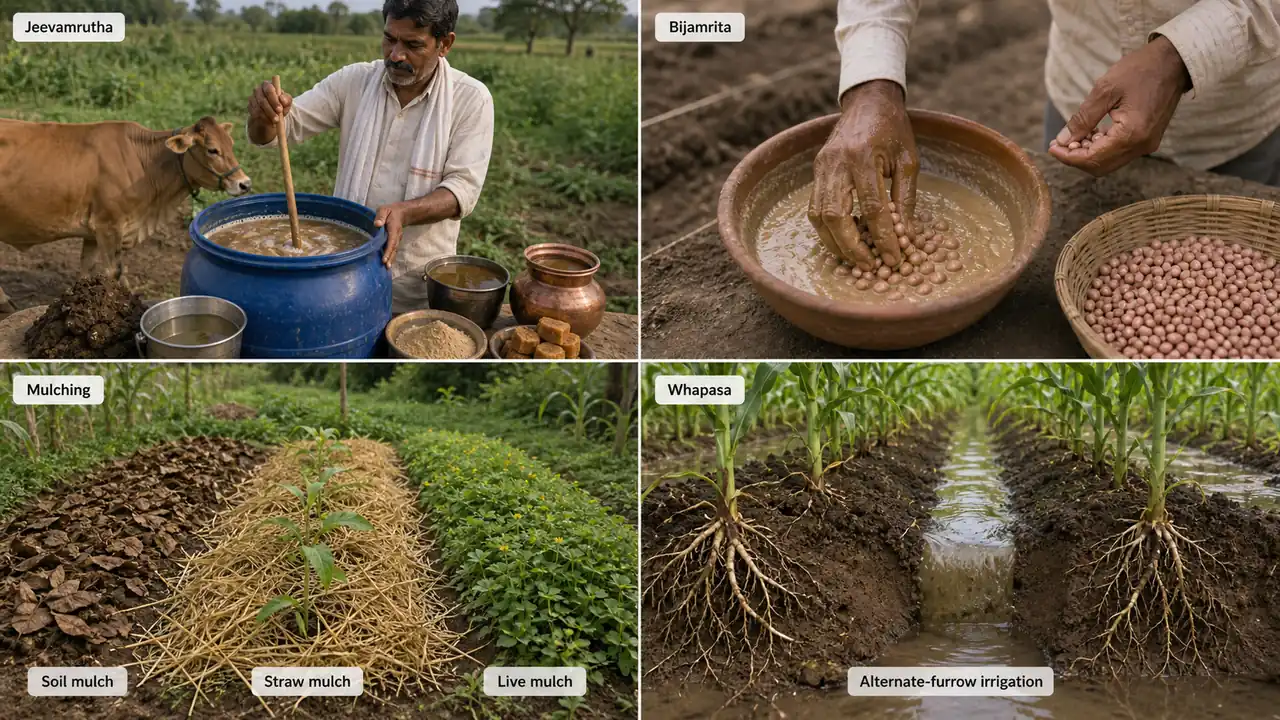
| Jeevamrutha | Fermented microbial culture (desi cow dung + urine + jaggery + pulse flour + water + soil). Catalytic agent for soil microorganisms. Needed only first 3 years. |
| Bijamrita / Beejamrutha | Seed/seedling treatment (similar ingredients + lime). Protects roots from fungus and soil/seed-borne diseases. |
| Acchadana (Mulching) | Three types: Soil mulch, Straw mulch, Live mulch |
| Whapasa (Moisture) | Condition where both air and water molecules are present in soil. Encourages reduced irrigation -- irrigate at noon, alternate furrows. |
Three Types of Mulching (Acchadana)
| Type | Material | Purpose |
|---|---|---|
| Soil Mulch | Undisturbed top soil | Aeration, water retention; avoid deep ploughing |
| Straw Mulch | Dried biomass of previous crops | Decomposes into humus through microbial activity |
| Live Mulch | Intercrops of monocots + dicots | Legumes fix N; monocots supply K, P, S |
Key Points
- Only local (desi) cow breeds used -- believed to have richer microbial diversity in dung/urine.
- Palekar is against vermicomposting (European red wiggler worms).
- Pest management: neem leaves, tobacco, green chilli concoctions.
- Promoted by several states (Andhra Pradesh, Himachal Pradesh) and NITI Aayog.
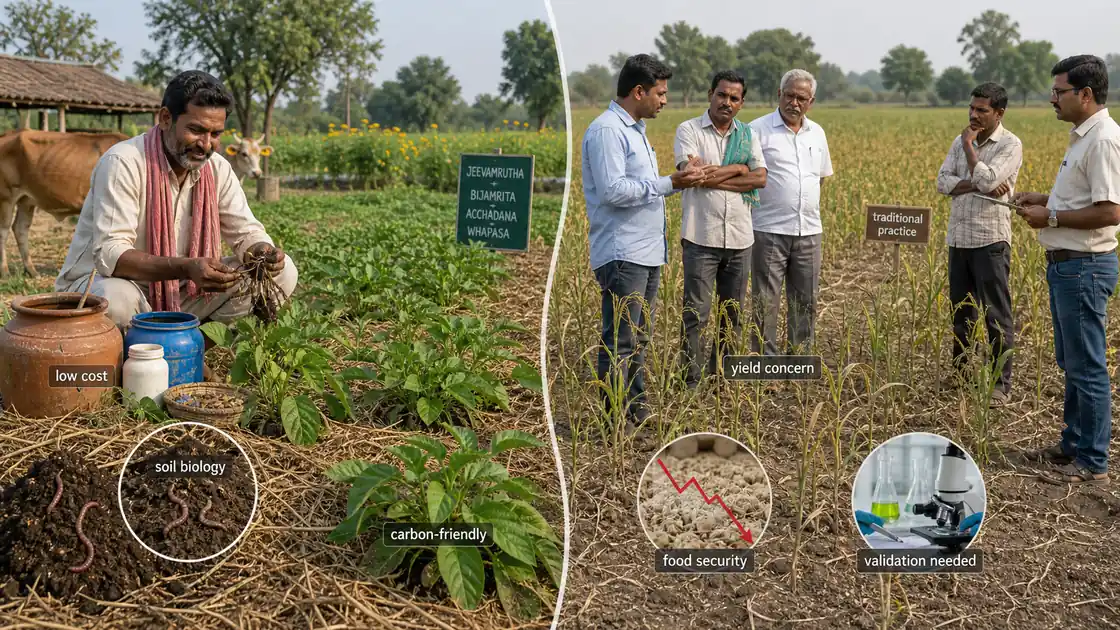
Effectiveness Debate
| Supporters | Critics |
|---|---|
| Reduces input costs; breaks debt cycle | India needs Green Revolution model for food security |
| Improves soil biology over time | Sikkim saw yield decline after organic conversion |
| Carbon-friendly farming | Multi-location scientific validation still needed |
TIP
Cross-reference: Palekar's 'Whapasa' concept connects to the 50:50 pore ratio from the tillage lesson. His 'Acchadana' (mulching) maps to conservation tillage's 30% residue threshold.
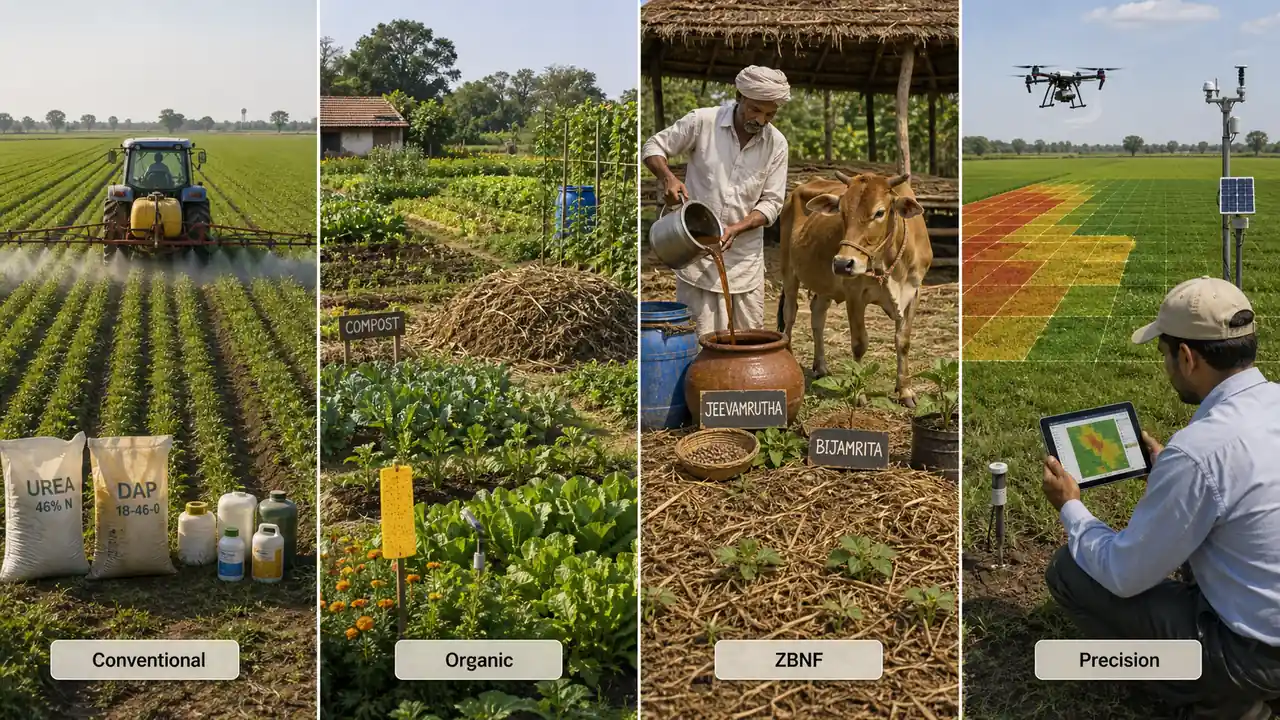
Comparing Farming Paradigms
| Parameter | Conventional | Organic | ZBNF | Precision |
|---|---|---|---|---|
| Input level | High (synthetic) | Low (natural) | Near-zero (on-farm) | Variable (data-driven) |
| Output | High yield | Moderate (initially lower) | Debated; improving over time | High (optimised) |
| Environmental cost | High (pollution, degradation) | Low | Very low | Moderate (reduced waste) |
| Economic model | Subsidised inputs | Premium price | Zero external cost | High tech investment |
| Key limitation | Sustainability | Scale-up, transition period | Scientific validation | Cost, farm size |
Precision Farming
While organic and ZBNF reduce or eliminate inputs, precision farming takes the opposite approach — it optimises inputs using technology so that each square metre of a field receives exactly what it needs. This data-driven approach is the future of large-scale agriculture, though India's small farm sizes pose adoption challenges.
Precision farming is a site-specific crop management approach that uses data-driven technology to apply inputs economically and in an environmentally sound manner. exams 2021
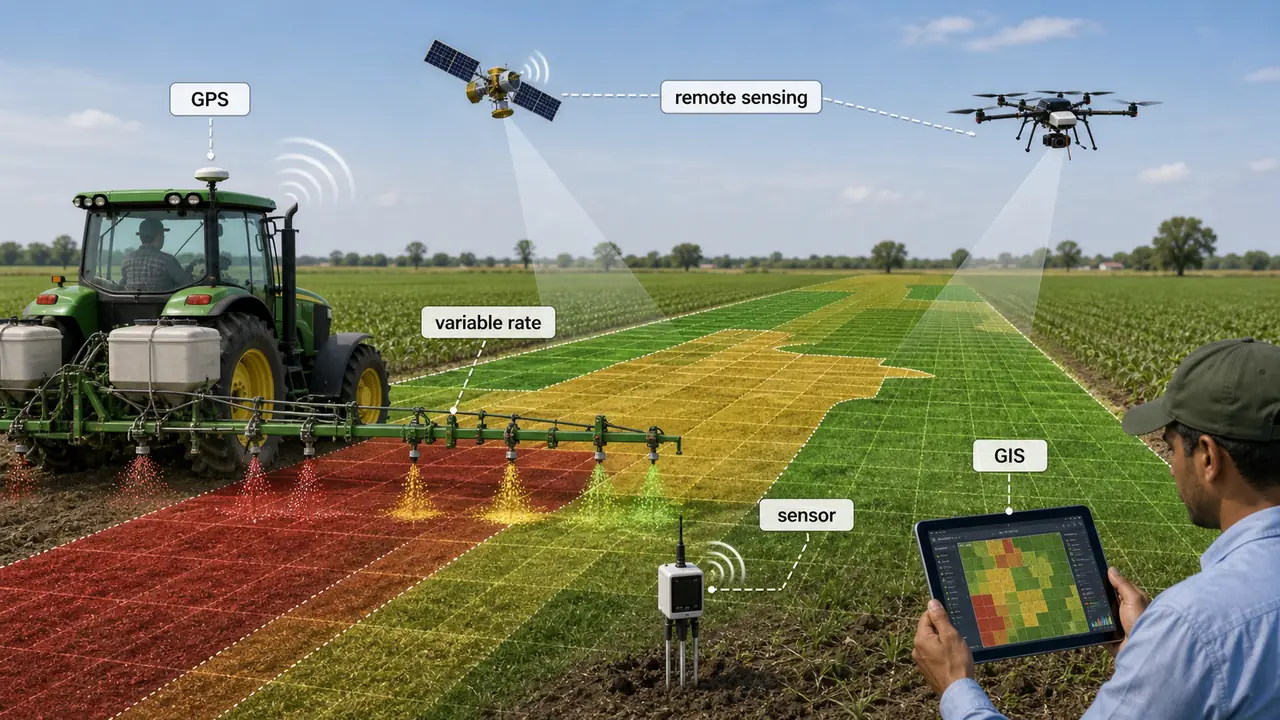
Core Technologies
| Technology | Function | Agricultural Application |
|---|---|---|
| GPS (Global Positioning System) | Real-time 3D positioning using 24+ satellites | Tractor guidance, field mapping, yield mapping |
| GIS (Geographic Information System) | Computerised storage, retrieval, and analysis of spatial data | Integrating soil maps, yield records, and pest data |
| Remote Sensing (RS) | Measuring reflected/emitted radiation from distance | Crop yield modelling, pest/disease detection, soil moisture estimation |
| IoT / 5G sensors | Real-time field monitoring | Continuous soil moisture, temperature, humidity tracking |
Uses of Precision Farming
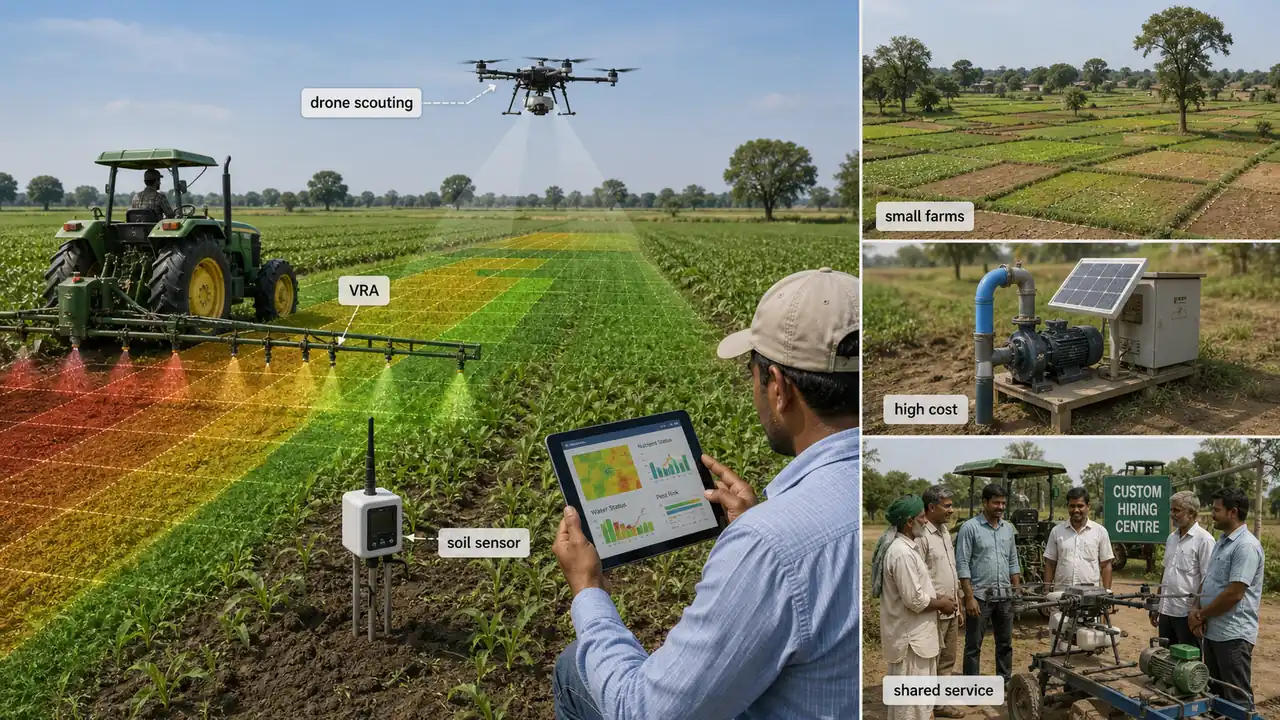
- Better fertilizer management through Variable Rate Application (VRA) -- different amounts applied to different parts of the same field based on actual need.
- Nutrient and water management determination.
- Pest and disease detection using infra-red narrow band sensors.
- Works even during low visibility (rain, dust, fog, darkness).
Challenges in India
- Average farm size < 1.08 ha (land fragmentation).
- Lack of sophisticated technical centres.
- Poor economic condition of most farmers.
- Solution: Cooperative and community-based technology sharing.
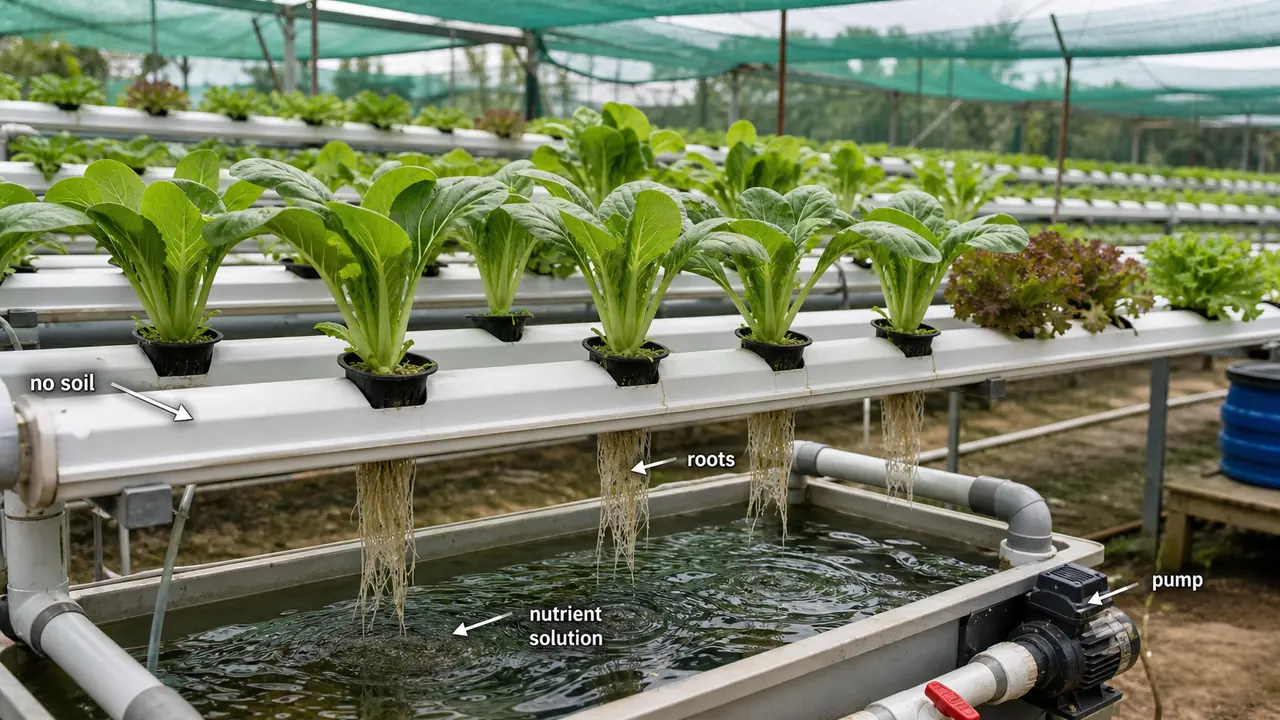
Nutroponics
Cultivation in nutrients -- a soilless cultivation technique where plants grow in a nutrient-rich solution. UPPSC 2021
Summary Cheat Sheet
| Concept / Topic | Key Details / Explanation |
|---|---|
| Sustainable Agriculture | Meeting present food/fuel needs without endangering the resource base for future generations |
| LEISA | Low-External-Input Sustainable Agriculture — optimal use of locally available natural and human resources |
| Organic Farming (USDA, 1980) | Avoids synthetic fertilizers, pesticides, growth regulators; relies on crop rotation, manures, biological pest control |
| Organic Farming Synonyms | Eco-farming, Biological farming, Bio-dynamic farming, Macrobiotic agriculture |
| IFOAM (1972) — 4 Principles | Health (interconnected), Ecology (mimic ecosystems), Fairness (equity), Care (precautionary — no GMO) |
| Organic Components | Diverse crop rotations, soil fertility management (FYM, vermicompost, green manure, biofertilizers), mechanical weed control, biological pest control, INM |
| Green Manure | Crop ploughed under before flowering; Dhaincha + Sunnhemp fix 60–80 kg N/ha; Sesbania rostrata fixes 100–250 kg N/ha (highest) |
| First fully organic state | Sikkim (76,000+ ha, 2016) |
| First fully organic UT | Lakshadweep |
| First state with Organic Agriculture Act | Uttarakhand |
| India rank — organic farmers | 1st globally (30% of world's organic farmers) |
| India rank — organic area | 9th globally (1.5 Mha = 2.59% of global) |
| Largest organic area (world) | Australia (12.2 Mha) |
| Largest organic area (India) | Madhya Pradesh, followed by Rajasthan, Maharashtra, UP |
| India Organic trademark | Based on NSOP (National Standards for Organic Production, est. 2000); certified by APEDA-accredited centres |
| Organic transition period | 2–3 years chemical-free before marketing as organic |
| GMO & organic | GMO products cannot get organic certification — totally prohibited |
| Organic certification renewal | Every 3 years |
| NPOP international recognition | Equivalence with EU and Switzerland; conformity assessment accepted by USA |
| Grower Group Certification | 25–500 members; geographic proximity; cost-effective for smallholders |
| PKVY (2015) | Promotes organic via cluster approach + PGS certification; target: 5 lakh acres through 10,000 clusters of 50 acres each |
| PKVY parent scheme | Sub-component of NMSA (National Mission on Sustainable Agriculture) |
| PKVY financial assistance | Rs 50,000/ha for 3 years (Rs 31,000 inputs + Rs 8,800 marketing + rest for training) |
| PKVY cost to farmer | Nil — entire cost borne by government |
| PKVY achievements | 52,289 clusters, 14.99 lakh hectares, 25.30 lakh farmers mobilised |
| NPOP | National Programme for Organic Production — national standard for organic export certification |
| NPOP implementing body | Ministry of Commerce via APEDA |
| NPOP certification | Third-party (accredited agencies); farmer/exporter bears cost |
| NPOP target market | Export market; logo: "India Organic" |
| NPOP international recognition | Equivalence with EU, Switzerland; conformity accepted by USA (USDA) |
| PKVY vs NPOP | PKVY = domestic/PGS/free/Agriculture Ministry; NPOP = export/third-party/paid/Commerce Ministry |
| ZBNF | Chemical-free farming based on traditional Indian practices; "zero budget" = no costly external inputs |
| ZBNF promoter | Subhash Palekar (Padma Shri), mid-1990s |
| Jeevamrutha | Fermented microbial culture (desi cow dung + urine + jaggery + pulse flour + water + soil); needed first 3 years |
| Bijamrita / Beejamrutha | Seed/seedling treatment (similar + lime); protects from fungal/soil-borne diseases |
| Acchadana (Mulching) | Soil mulch (undisturbed topsoil), Straw mulch (dried biomass → humus), Live mulch (legume + monocot intercrops) |
| Whapasa (Moisture) | Condition where both air and water molecules present in soil; alternate furrow irrigation at noon |
| ZBNF key rules | Only desi cow breeds; Palekar is against vermicomposting; neem/tobacco/chilli for pest management |
| Precision Farming | Site-specific crop management using data-driven tech for economic and environmentally sound input application |
| GPS | Real-time 3D positioning (24+ satellites); tractor guidance, field mapping, yield mapping |
| GIS | Computerised storage and analysis of spatial data; integrates soil maps, yield records, pest data |
| Remote Sensing (RS) | Measuring reflected/emitted radiation; crop yield modelling, pest/disease detection, soil moisture estimation |
| Variable Rate Application (VRA) | Different input amounts applied to different parts of same field based on actual need |
| Precision farming challenges (India) | Average farm size < 1.08 ha; lack of tech centres; poor farmer economics → cooperative sharing needed |
| Nutroponics | Soilless cultivation technique; plants grow in a nutrient-rich solution |
TIP
Exam tip: "Sikkim = 1st organic state", "India = 1st in organic farmers, 9th in area", "Subhash Palekar = ZBNF", "IFOAM = 4 principles (Health, Ecology, Fairness, Care)" -- these are direct one-liners frequently asked in NABARD, FCI, and IBPS exams.
References
1 source • [1]
References
Used for: PKVY: 52,289 clusters, 14.99 lakh hectares, 25.30 lakh farmers mobilised; MOVCDNER: 434 FPCs in NE region