Percentage Increase & Decrease — The Ratio Method
The fastest way to handle percentage changes: convert to I:F ratios and multiply directly
Percentage Increase & Decrease — The Ratio Method
This is the single most powerful technique for percentage calculations in exams. Instead of computing percentages the classical way, convert the percentage to a fraction, build the Initial:Final (I:F) ratio, and multiply.
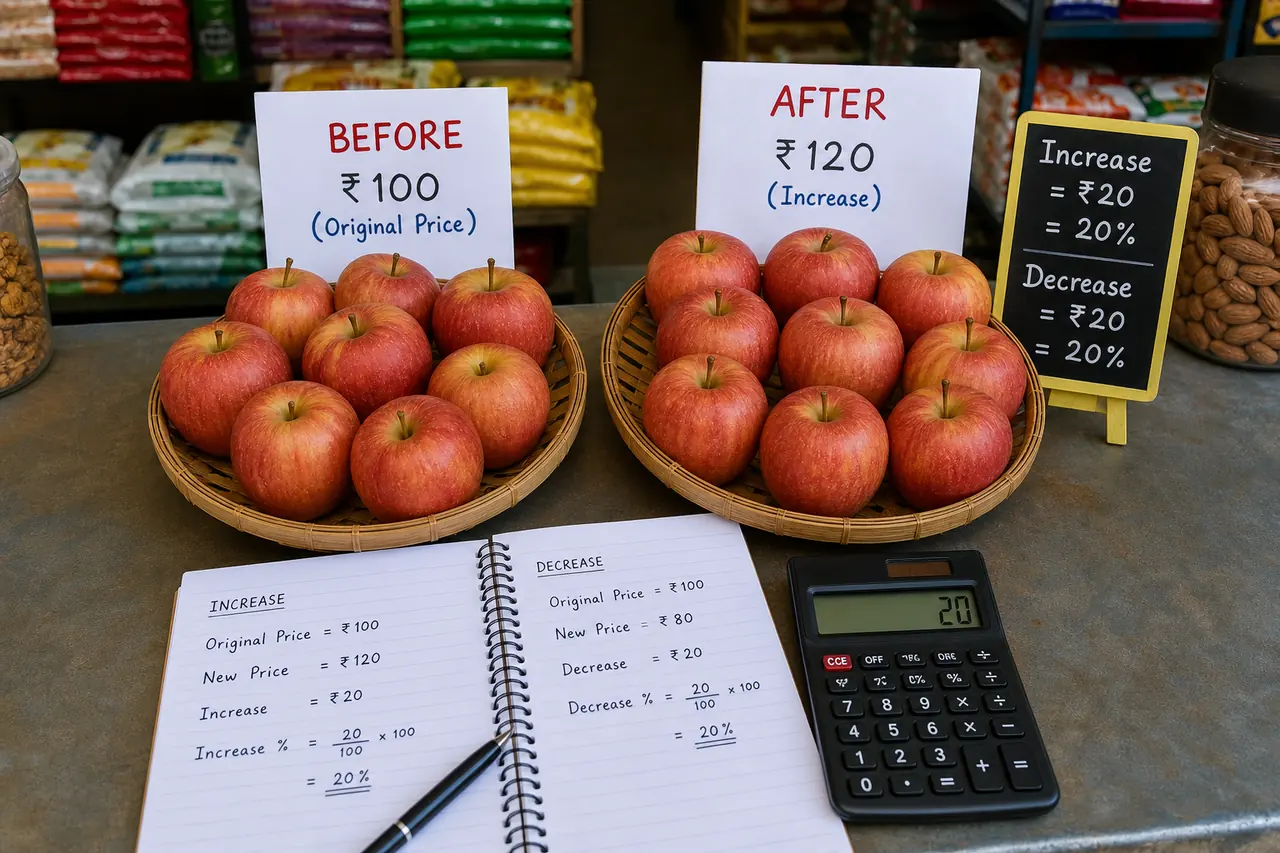
The Core Idea
When a number changes by a percentage, the Initial and Final values form a simple ratio.
Increase by 20%
- 20% = 1/5
- If Initial = 100, New = 120
- I : F = 5 : 6 (base is 5, add 1)
- So: F = I × 6/5
Increase by 50%
- 50% = 1/2
- I : F = 2 : 3 (base is 2, add 1)
- So: F = I × 3/2
Increase by 37.5%
- 37.5% = 3/8
- I : F = 8 : 11 (base is 8, add 3)
- So: F = I × 11/8
Increase by 36.36%
- 36.36% = 4/11
- I : F = 11 : 15 (base is 11, add 4)
- So: F = I × 15/11
The Rule
For a percentage = n/d (where d is the base):
- Increase by n/d → I : F = d : (d+n) → F = I × (d+n)/d
- Decrease by n/d → I : F = d : (d−n) → F = I × (d−n)/d
Complete I:F Ratio Table
Increase (+)
| % Change | Fraction | I : F | Multiplier |
|---|---|---|---|
| +6.25% | 1/16 | 16 : 17 | × 17/16 |
| +6.67% | 1/15 | 15 : 16 | × 16/15 |
| +9.09% | 1/11 | 11 : 12 | × 12/11 |
| +10% | 1/10 | 10 : 11 | × 11/10 |
| +11.11% | 1/9 | 9 : 10 | × 10/9 |
| +12.5% | 1/8 | 8 : 9 | × 9/8 |
| +14.28% | 1/7 | 7 : 8 | × 8/7 |
| +16.67% | 1/6 | 6 : 7 | × 7/6 |
| +20% | 1/5 | 5 : 6 | × 6/5 |
| +25% | 1/4 | 4 : 5 | × 5/4 |
| +28.56% | 2/7 | 7 : 9 | × 9/7 |
| +33.33% | 1/3 | 3 : 4 | × 4/3 |
| +50% | 1/2 | 2 : 3 | × 3/2 |
Decrease (−)
| % Change | Fraction | I : F | Multiplier |
|---|---|---|---|
| −6.25% | 1/16 | 16 : 15 | × 15/16 |
| −6.67% | 1/15 | 15 : 14 | × 14/15 |
| −9.09% | 1/11 | 11 : 10 | × 10/11 |
| −10% | 1/10 | 10 : 9 | × 9/10 |
| −11.11% | 1/9 | 9 : 8 | × 8/9 |
| −12.5% | 1/8 | 8 : 7 | × 7/8 |
| −14.28% | 1/7 | 7 : 6 | × 6/7 |
| −16.67% | 1/6 | 6 : 5 | × 5/6 |
| −20% | 1/5 | 5 : 4 | × 4/5 |
| −25% | 1/4 | 4 : 3 | × 3/4 |
| −28.56% | 2/7 | 7 : 5 | × 5/7 |
| −33.33% | 1/3 | 3 : 2 | × 2/3 |
| −50% | 1/2 | 2 : 1 | × 1/2 |
The Percentage-to-Multiplier Shortcut
Instead of ratios, you can think in terms of a single multiplier:
| Change | Multiplier as % | Multiplier as fraction |
|---|---|---|
| +20% | 120% | 6/5 |
| +10% | 110% | 11/10 |
| +30% | 130% | 13/10 |
| +25% | 125% | 5/4 |
| −20% | 80% | 4/5 |
| −10% | 90% | 9/10 |
| −30% | 70% | 7/10 |
| −25% | 75% | 3/4 |
Worked Examples
Example 1: Increase 480 by 25%
- 25% = 1/4, I:F = 4:5
- Method 1: 480 + (480/4) = 480 + 120 = 600
- Method 2: 480 × 5/4 = 600
- Method 3: I:F = 4:5, multiply both by 120 → 480 : 600
Example 2: Decrease a pen's price from 40 by 10%
- 10% = 1/10, I:F = 10:9
- 40 × 9/10 = 36
Example 3: Increase 880 by 12.5%
- 12.5% = 1/8, I:F = 8:9
- 880 × 9/8 = 990
Example 4: Increase 666 by 16.66%
- 16.66% = 1/6, I:F = 6:7
- 666 × 7/6 = 777
Example 5: Student scored 160 marks. Decreased by 12.5%. New marks?
- 12.5% = 1/8, I:F = 8:7
- 160 × 7/8 = 140
Finding Percentage Change from Two Values
Increase: 48 → 60
- Change = +12
- Method 1: (12/48) × 100 = 25%
- Method 2: 48:60 = 4:5. Difference = 1, base = 4. So 1/4 × 100 = 25%
Decrease: 96 → 84
- Change = −12
- Method 1: (12/96) × 100 = 12.5%
- Method 2: 96:84 = 8:7. Difference = 1, base = 8. So 1/8 × 100 = 12.5%
Decrease: 360 → 300
- 360:300 = 6:5. Difference = 1, base = 6. So 1/6 × 100 = 16.67%
Remember: For percentage change, the base is always the original (initial) value, not the new value.
Lesson Doubts
Ask questions, get expert answers