✂️ Vegetative Propagation Methods
Cutting, budding, grafting, layering, tissue culture, specialised organs, and crop-wise vegetative propagation methods.
Plant propagation is the process of creating new plants. This lesson focuses on vegetative propagation, where new plants are produced from plant parts such as stem, root, leaf, buds, or modified organs rather than by seed.
The sequence here moves from the most common nursery methods like cuttings, budding, grafting, and layering to specialized methods such as tissue culture and propagation through natural storage organs.
IMPORTANT
Asexual propagation produces plants that are genetically identical (clones) to the parent plant, ensuring true-to-type progeny. This is the primary reason it is preferred in commercial horticulture.
A. Cutting
A cutting is a vegetative plant part that is severed from the parent plant and induced to form roots and shoots under favorable conditions.
1. Stem Cutting
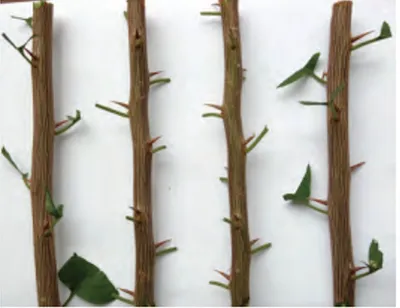
Stem cuttings are the most common type. They are classified by the maturity of the wood:
| Type | Age of Wood | Length | Examples |
|---|---|---|---|
| Hardwood cutting | 1 year old (dormant, leafless) | 10–45 cm | Pomegranate, Rose, Grape, Fig, Pear |
| Semi-hardwood cutting | 4–9 months (partially mature) | 7–20 cm | Mango, Guava, Lemon, Jackfruit, Aonla |
| Softwood cutting | 2–3 months (current season growth) | 10–15 cm | Apple, Peach, Guava |
| Herbaceous cutting | 1–2 months (succulent, non-woody) | Variable | Alternanthera, Coleus, Chrysanthemum |
TIP
- A quick recall set for hardwood cuttings is "PROFiG".
- Pomegranate, Rose, Fig, and Grape are the core examples.
2. Root Cutting
Roots pieces are used to regenerate new plants. Examples: Apple, Pear, Guava, Bael.
3. Leaf Cutting
Leaves with petiole or leaf pieces are used. The classic example is Begonia (leaf pieces with veins placed on moist sand produce new plantlets).
NOTE
IBA (Indole-3-Butyric Acid) is the most widely used auxin for promoting rooting in cuttings. NAA (Naphthalene Acetic Acid) is the second most common.
B. Budding
Budding is a method of vegetative propagation where a single bud (scion) is joined to a rootstock. The junction point where scion and rootstock unite is called the matrix.
IMPORTANT
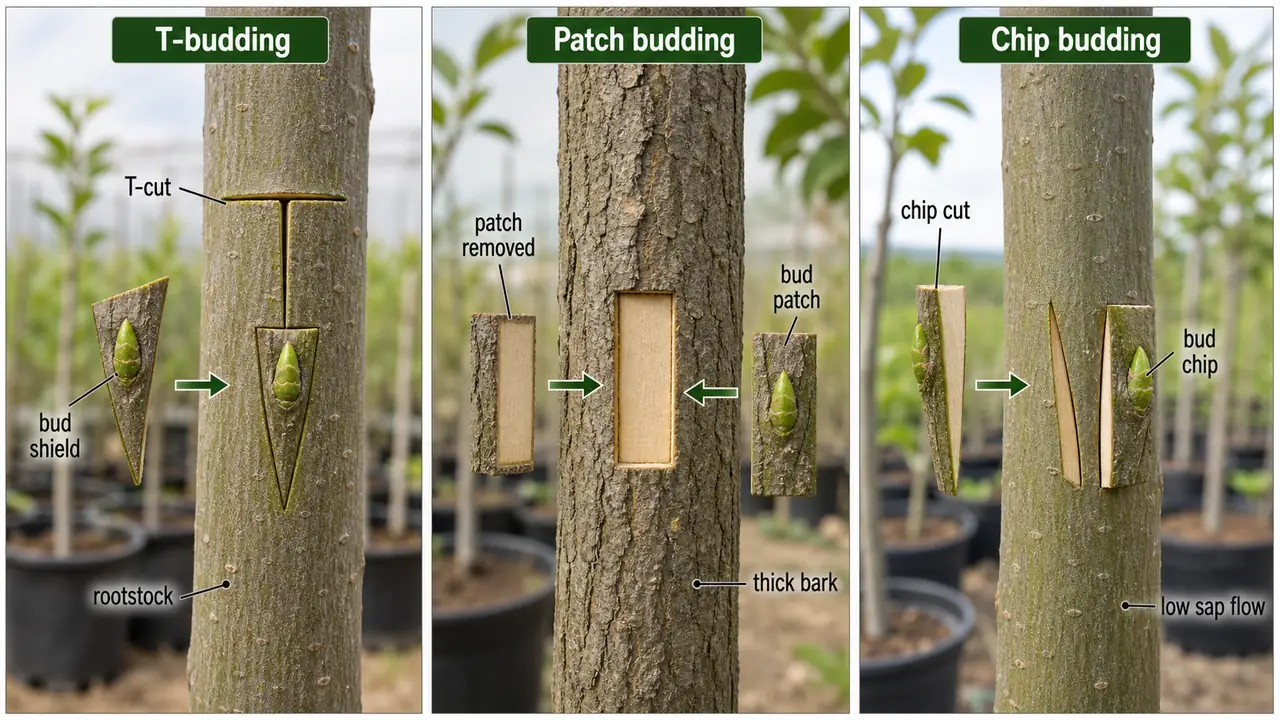
In budding, the scion consists of only one bud with a small piece of bark (bud shield/patch). This distinguishes it from grafting where the scion has more than one bud.
Types of Budding
| Type | Key Feature | Examples |
|---|---|---|
| Shield/T-budding | Most common; T-shaped cut on rootstock bark | Rose, Apple, Pear, Peach, Sweet Orange |
| Patch budding | Rectangular patch of bark removed; suited for thick-barked plants | Jackfruit, Aonla, Mango |
| Chip budding | Used when there is lack of sap flow (bark not slipping) | Apple, Pear, Grape |
| Ring budding | Complete ring of bark with bud removed and placed on rootstock | Ber, Peach, Mulberry |
| Modified ring budding | Variation of ring budding for difficult species | Guava, Ber, Walnut |
| Forkert budding | Designed for dry/arid climates; bark flap retained | Mango, Jackfruit, Cashewnut |
TIP
- T-budding is the most widely practiced budding method worldwide.
- It requires active cambial growth, so the bark should slip easily.
C. Grafting
Grafting is a method of vegetative propagation in which a scion stick (a piece of shoot with more than one bud) is connected to a rootstock so that the two grow together as a single plant.
IMPORTANT
Key difference: Budding uses a single bud as scion. Grafting uses a scion stick with multiple buds.
Types of Grafting
| Type | Key Feature | Examples |
|---|---|---|
| Veneer grafting | Shallow downward cut on rootstock side; most common for Mango | Mango (best time: May–September) |
| Whip grafting | Long sloping cut; scion and rootstock of same diameter | Apple, Walnut, Pear |
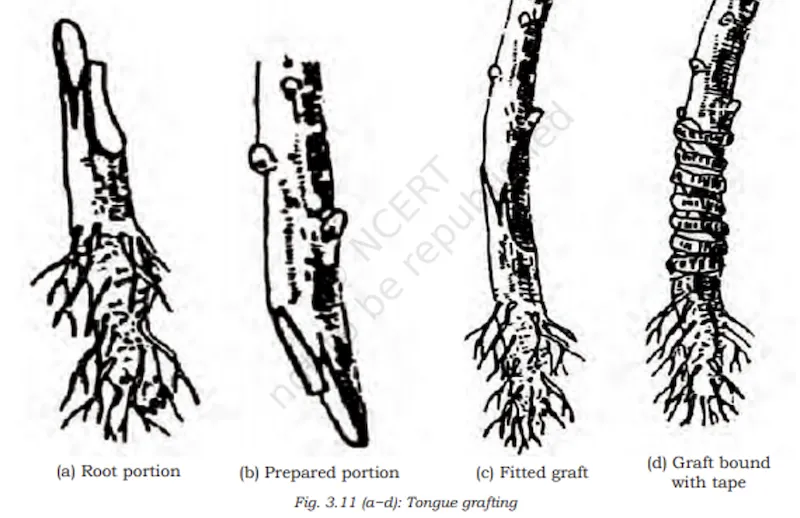
| Tongue grafting | Modified whip graft with interlocking tongue cuts for better cambium contact | Apple, Pear, Walnut |
| Cleft grafting | Oldest method of grafting; vertical split in rootstock | Mango, Grape |
| Wedge grafting | V-shaped scion inserted into rootstock; used for old trees | Old/rejuvenated trees |
| Bridge grafting | Repairs damaged collar/bark region; bridges the girdled area | Apple, Cherry, Pear, Walnut |
| Epicotyl/Stone grafting | Done on young seedlings (8–15 days old) with coppery-colored leaves | Mango (95% success, June–July) |
| Softwood grafting | Scion from current season's growth (soft, green) | Mango, Sapota, Tamarind |
| Inarching (Approach grafting) | Scion remains attached to mother plant until union forms | Mango, Sapota, Jackfruit, Loquat, Custard apple |
| Double working | Uses an interstock between scion and rootstock to overcome incompatibility | Pear (interstock: Beurre Hardy) |
| Top working | Grafting scions onto main branches of an established tree for rejuvenation/variety change | Old orchard conversion |
TIP
- Epicotyl (Stone) grafting in mango can give up to 95% success rate.
- It is done in June–July.
- The seedlings are usually 8–15 days old with coppery-coloured leaves.
ICAR Classification of Grafting
NOTE
ICAR classifies grafting based on the relationship between scion and rootstock during the grafting process.
I. Detached Scion Grafting (scion completely separated from mother plant before grafting):
| Placement | Sub-types |
|---|---|
| Apical (top of rootstock) | Whip, Tongue, Cleft, Wedge, Saddle, Four-flap |
| Side (side of rootstock) | Side-veneer, Side-tongue |
| Bark (under bark) | Bark/Rind grafting |
| Root (onto root piece) | Root grafting |
II. Approach Grafting (both scion and rootstock remain on their own roots during union):
- Spliced approach, Tongued approach, Inlay approach
III. Repair Grafting (to repair damaged plants):
- Inarching, Bridge grafting, Bracing
D. Layering
Layering is a method of vegetative propagation in which a branch (stem) is made to develop roots while still attached to the mother plant. Once rooted, the branch is separated to form an independent plant.
Types of Layering
| Type | Key Feature | Examples |
|---|---|---|
| Simple layering | A low-growing branch is bent to the ground and buried | Guava, Hazelnut |
| Compound/Serpentine layering | One-year-old branch alternately covered and exposed along its length | Jasmine, climbing plants |
| Continuous/Trench layering | Entire branch buried in a trench at 45° angle; suited for woody plants | Apple, Pear, Cherry |
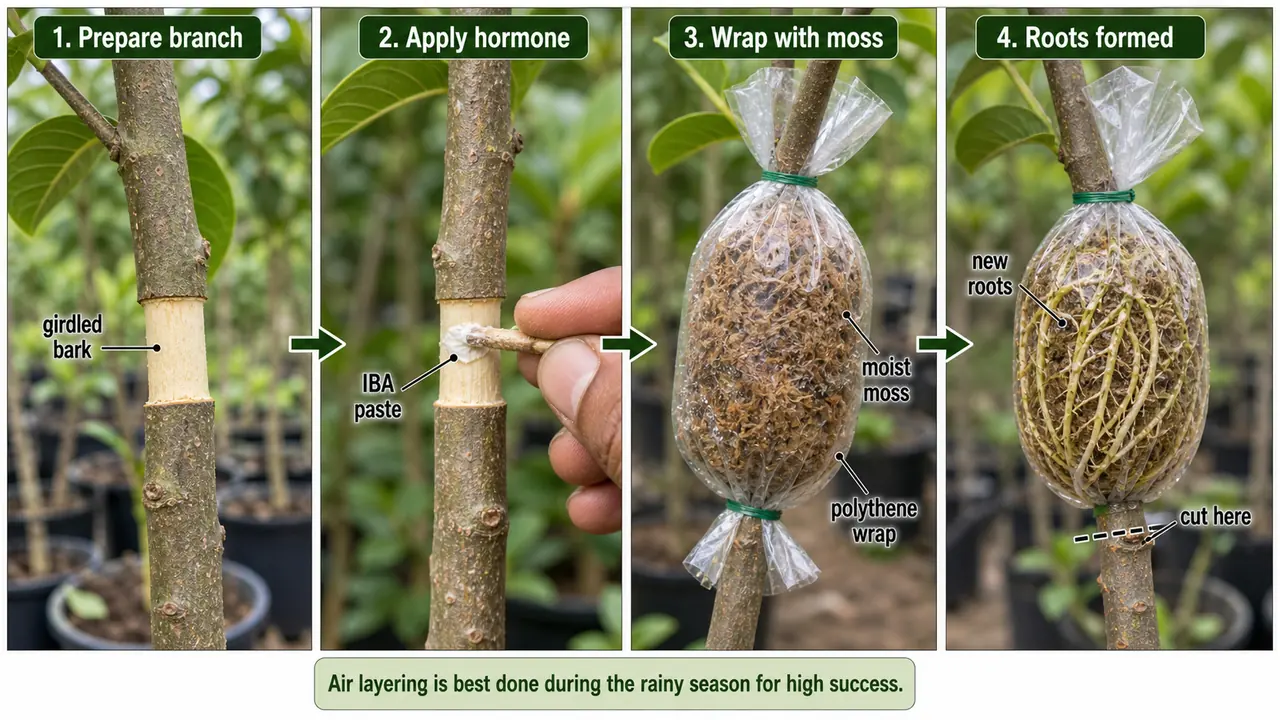
| Air layering (Marcottage/Gootee/Chinese layering) | Bark girdled on aerial branch, wrapped with moist sphagnum moss; introduced from China | Litchi, Guava, Mango |
| Mound/Stool layering | Mother plant cut back; soil mounded around new shoots | Apple, Pear, Quince, Gooseberry |
| Tip layering | Simplest method; shoot tip buried 5–10 cm deep; roots within a month | Raspberry, Blackberry |
IMPORTANT
Air Layering (Gootee) is the easiest layering method to anchor first:
- Also called Marcottage, Gootee, or Chinese layering
- Introduced from China
- IBA 3000–5000 ppm is applied to the girdled region to promote rooting
- Best time: July–August (rainy season)
- Most successful in: Litchi, Guava, Mango
NOTE
Mound/Stool layering: Also uses IBA 3000–5000 ppm. Roots develop in 30–40 days. Commonly used for clonal rootstock production in Apple and Pear.
E. Separation and Division
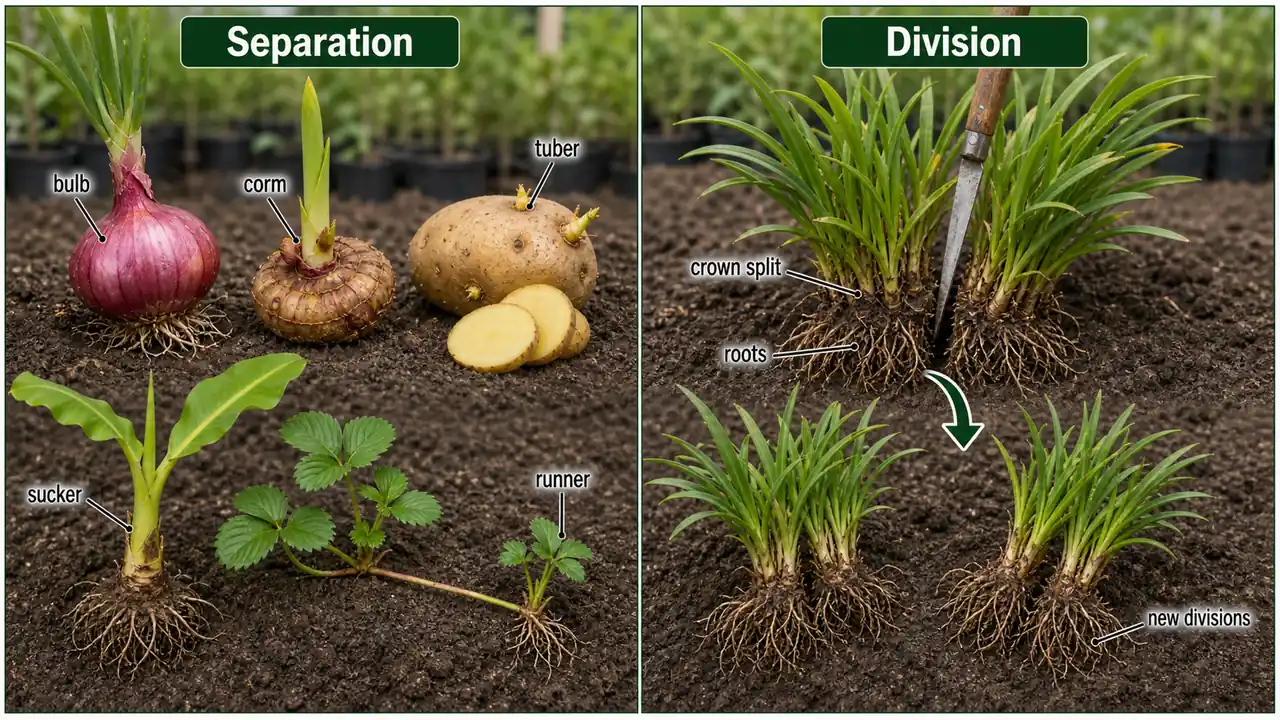
Separation
Plants that naturally produce bulbs, corms, tubers, or offsets can be propagated by separation — detaching the naturally formed propagules.
| Structure | Examples |
|---|---|
| Bulbs | Onion, Garlic, Tulip, Lily |
| Corms | Gladiolus, Saffron, Colocasia |
| Tubers | Potato, Dahlia |
| Offsets/Suckers | Banana, Pineapple, Date palm |
| Runners | Strawberry |
Division
The mother plant is physically divided into two or more parts, each with roots and shoots. Used in clump-forming plants.
Examples: Chrysanthemum, Gerbera, Bird of Paradise.
TIP
- In separation, natural propagules such as bulbs and corms are detached.
- In division, the plant crown is physically cut into parts.
Quick Reference: Propagation Methods × Fruit Crops
| Fruit Crop | Primary Propagation Method(s) |
|---|---|
| Mango | Veneer grafting, Epicotyl grafting, Softwood grafting, Inarching, Air layering |
| Apple | Whip/Tongue grafting, T-budding, Stool layering |
| Grape | Hardwood cutting, Chip budding |
| Guava | Air layering (Gootee), Softwood cutting, Simple layering |
| Litchi | Air layering (Gootee) |
| Pomegranate | Hardwood cutting |
| Rose | T-budding, Hardwood cutting |
| Fig | Hardwood cutting |
| Pear | Whip/Tongue grafting, Stool layering, Bridge grafting |
| Walnut | Whip grafting, Modified ring budding |
| Sapota | Inarching, Softwood grafting |
| Jackfruit | Patch budding, Forkert budding, Inarching |
| Aonla | Patch budding, Semi-hardwood cutting |
| Ber | Ring budding, Modified ring budding |
| Peach | T-budding, Softwood cutting |
| Citrus (Sweet Orange, Lemon) | T-budding, Semi-hardwood cutting |
| Cashewnut | Forkert budding, Softwood grafting |
| Banana | Suckers (separation), Tissue culture |
| Pineapple | Crown, Slip, Sucker (separation) |
| Strawberry | Runners (separation) |
| Custard Apple | Inarching |
| Loquat | Inarching |
| Tamarind | Softwood grafting |
| Cherry | Bridge grafting, Trench layering |
Tissue Culture (Micro propagation)
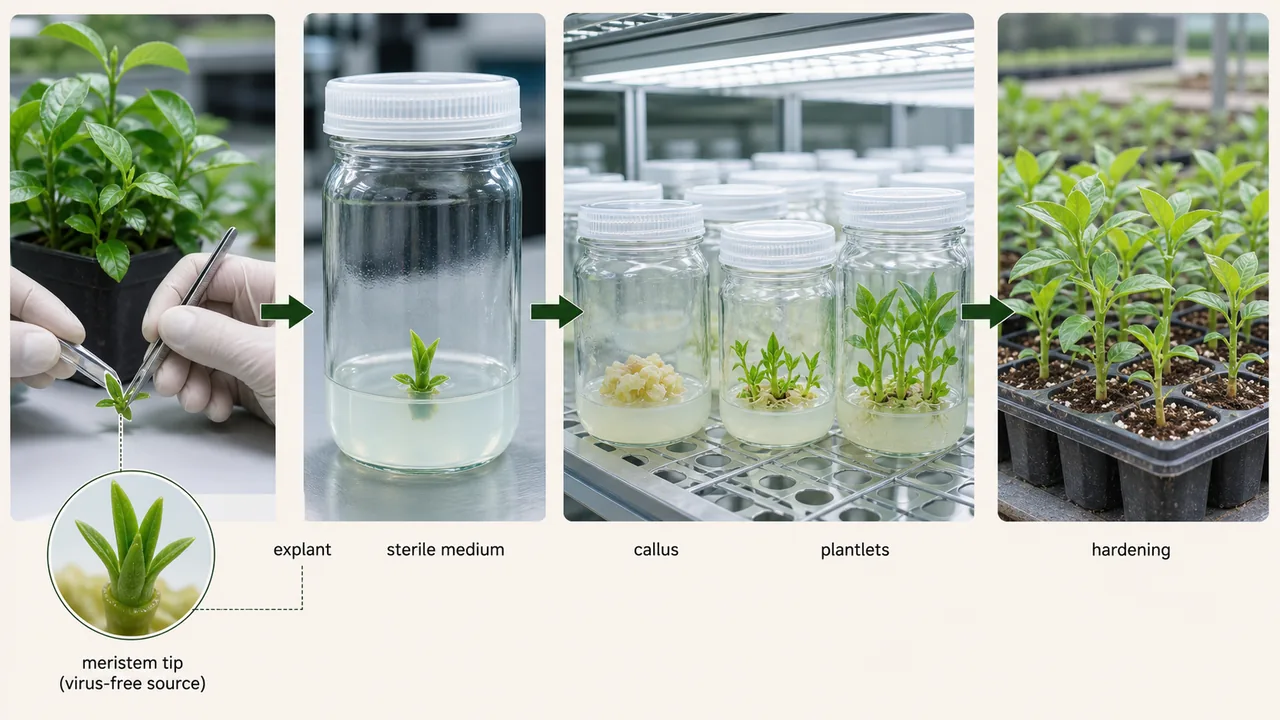
- It is a technique for growing plant tissues isolated from the parent plant in an artificial medium and controlled environment over a prolonged period under aseptic conditions. Tissue culture represents the most advanced form of vegetative propagation, allowing mass multiplication of plants in a laboratory setting.
- It is used on commercial scale in banana, gerbera, orchid, carnation, anthurium, etc. In banana, tissue culture has revolutionized the industry by enabling rapid production of millions of uniform, disease-free plantlets.
- It is based on the phenomenon of totipotency of a cell, which denotes the capacity of a plant cell to regenerate into a full-fledged plant having different organs. Totipotency means that every living plant cell contains the complete genetic information needed to develop into an entire organism.
- Callus is produced on explant in vitro due to wounding and growth substances, either endogenous or supplied exogenous in the medium. Callus is an undifferentiated mass of cells that can be induced to form shoots, roots, or embryos under appropriate hormonal stimulation.
- By using this technique, a large number of true-to-type virus-free saplings can be produced in a short span. This is one of the greatest advantages of tissue culture -- the ability to produce disease-free planting material through meristem culture.
- Types
- Callus culture
- Cell culture
- Meristem culture: Virus free plants are obtained. The meristematic tip (0.1-0.5 mm) of a shoot is too small to harbour viruses, so plants regenerated from it are virus-free. This is the primary method for producing virus-free stocks of crops like citrus, potato, and strawberry.
- Organ culture
- Protoplast culture
- Shoot tip culture technique produce female plant in Banana. This is commercially important because female banana plants are more productive.
- Micro Grafting: Citrus. Micro grafting involves grafting a tiny shoot tip onto a small seedling rootstock in vitro, combining the benefits of tissue culture (virus elimination) with grafting (rootstock advantages).
- Shoot tips and Micro-cuttings are highly suitable ex-plant for faster and disease free grape production.
Plant propagation by specialised organs
- Specialised organs are modified stems or roots, developing above the ground surface or underground, which may be used for multiplication of plants. These organs serve as natural storage structures that allow plants to survive adverse conditions and regenerate.
- In horticulture, bulbous ornamentals include bulbs, corms, tubers, tuberous roots and rhizomes. Each of these structures has a distinct morphology and growth pattern.
Bulb
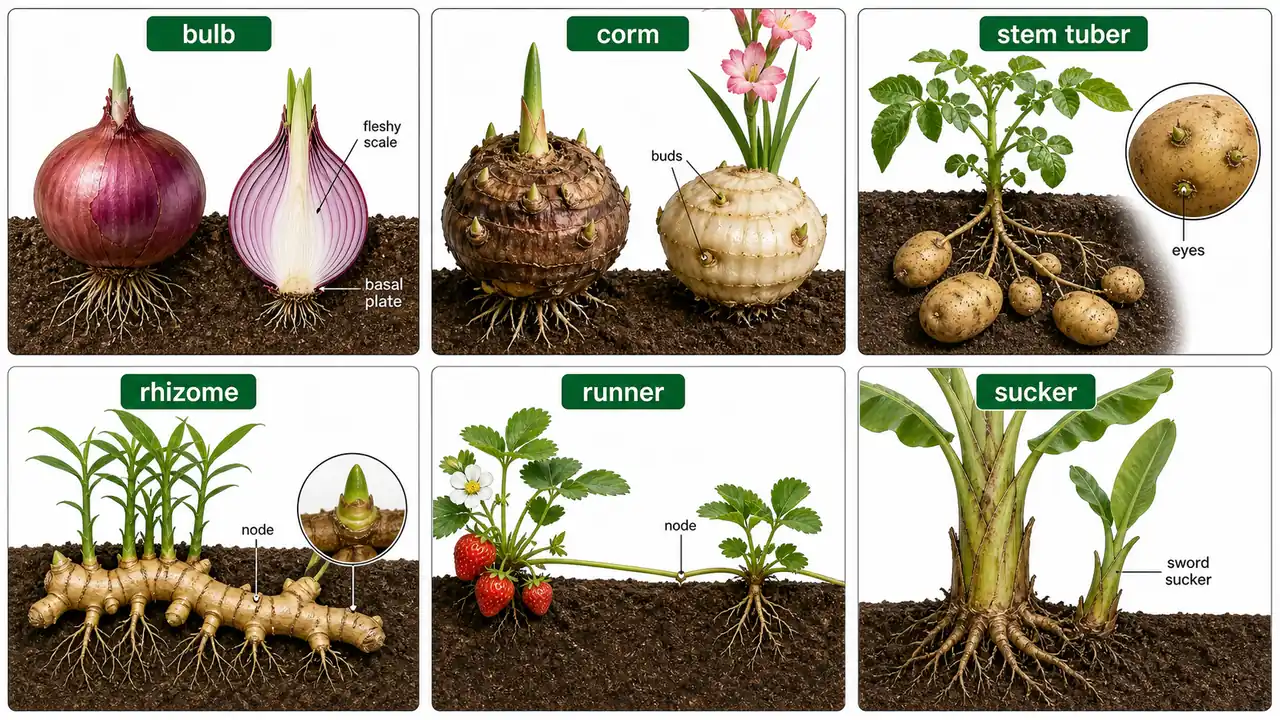
- Bulb is a specialised underground structure having a flat basal stem and surrounded by fleshy scales. The fleshy scales are modified leaves that store food reserves (primarily carbohydrates) to support new growth.
- E.g., Onion. Other examples include tulip, lily, and garlic. Bulbs can be tunicate (covered by a dry papery outer scale, like onion) or non-tunicate (without a covering, like lily).
Corm
- Corm is an underground modified solid or compressed stem oriented vertically in the side having nodes and buds. Unlike a bulb, a corm is a solid mass of stem tissue rather than layers of modified leaves. It stores food in the swollen stem itself.
- E.g. Gladiolus etc. Other examples include crocus and saffron. Corms produce small cormels at the base that can be separated and grown into new plants.
Tuber
- It is an underground storage organ having special swollen modified stem or roots. Tubers develop when underground stems or roots swell with stored starch and other carbohydrates.
- E.g.
- Root tuber like dahlia, caladium, dioscorea, Jerusalem artichoke, etc. and -- Root tubers are formed from swollen roots and have buds only at the proximal end (crown).
- Stem tuber like potato, begonia etc. -- Stem tubers develop from swollen stolons (underground stems) and have eyes (buds) distributed over the surface.
Rhizome
- A modified stem of some plant growing horizontally just below the ground surface. Rhizomes grow laterally through the soil, producing new shoots and roots at the nodes. They serve as both storage and propagation organs.
- E.g. ginger etc. Other examples include turmeric, banana (rhizome/corm), and canna.
Runner
- It is a modified stalk, which is creeping in nature, produced in the leaf axil and grows out from the parent plant. Runners are above-ground horizontal stems that spread along the soil surface.
- It grows horizontally along the ground, where roots are produced at the nodes, which can be used to produce new plants. Each node can develop into an independent plant once it establishes its own root system.
- E.g., Strawberry (typical example) doob grass, chlorophytum, etc. Strawberry is the classic example of runner propagation -- each mother plant can produce multiple runners, each giving rise to several new plants.
Sucker
- It is a special shoot arising from the root or stem portion of a plant below the ground level. Suckers develop from adventitious buds on roots or from buds on the underground stem base.
- E.g., Banana, chrysanthemum (stem), Clerodendron splendens (root suckers), anthurium, etc. In banana, suckers are the primary means of propagation. Two types of suckers are used: sword suckers (with narrow, sword-shaped leaves -- preferred) and water suckers (with broad leaves -- less preferred).
Offsets
- Date palm. An offset is a short, thick lateral shoot arising from the base of the mother plant. In date palm, offsets (also called suckers) are the primary method of propagation to maintain true-to-type varieties. Offsets weighing 10-15 kg and aged 3-5 years are preferred for planting.
Commercial propagation methods of major fruit crops
| Fruit Crop | Propagation Method |
|---|---|
| Citrus | Seed/Air layering |
| Grape | Hardwood cutting |
| Fig | Softwood cutting |
| Mango | Veneer grafting, Inarching, Softwood grafting |
| Pomegranate | Hardwood Cutting/Air layering |
| Litchi | Air layering/Gootee |
| Guava | Stooling/Mound layering |
| Sapota, Jackfruit, Loquat | Inarching |
| Banana | Sword sucker/Tissue Culture |
| Date palm | Offshoot/sucker |
| Pineapple | Suckers/slips |
| Strawberry | Runners |
| Aonla | Patch budding |
| Ber | Ring & T-budding |
| Custard apple | T-budding |
| Rose | Shield budding |
| Apple | Shield budding, Tongue Grafting |
| Papaya, Phalsa, Coffee, Jamun, Coconut, Arecanut, Acid lime, Passion Fruit | Seeds |
Knowing the commercial propagation method for each fruit crop helps connect theory with practical crop management.
Summary Cheat Sheet
| Concept / Topic | Key Details / Explanation |
|---|---|
| Propagation types | Plant propagation is sexual by seed or asexual by vegetative parts; commercial horticulture prefers asexual methods because they produce true-to-type clones. |
| Cutting basics | A cutting is a detached vegetative part induced to form roots and shoots; IBA is the main rooting hormone and NAA is another common auxin. |
| Stem cuttings | Hardwood cuttings use one-year dormant wood in pomegranate, rose, grape, fig, and pear; semi-hardwood cuttings are used in mango, guava, lemon, jackfruit, and aonla; softwood cuttings are used in apple, peach, and guava; herbaceous cuttings are used in crops like chrysanthemum and coleus. |
| Other cuttings | Root cuttings are used in apple, pear, guava, and bael, while leaf cuttings are classically associated with begonia. |
| Budding basics | In budding, the scion is a single bud; the union point is called the matrix, and T-budding is the most widely practiced method where bark slips easily. |
| Important budding methods | Shield or T-budding is common in rose, apple, pear, peach, and sweet orange; patch budding suits thick-barked crops like jackfruit, aonla, and mango; chip budding is used when sap flow is low; ring and modified ring budding are used in ber, peach, mulberry, guava, and walnut; Forkert budding is useful in mango, jackfruit, and cashew. |
| Grafting basics | Grafting uses a scion stick with more than one bud, unlike budding which uses only one bud. |
| Important grafting methods | Veneer grafting is the standard method for mango, whip and tongue grafting are common in apple, pear, and walnut, cleft grafting is one of the oldest methods, bridge grafting repairs damaged bark, and top working is used for rejuvenation or changing varieties in established trees. |
Summary Continued
| Concept / Topic | Key Details / Explanation |
|---|---|
| Mango grafting facts | Mango is especially important for veneer grafting, epicotyl or stone grafting, softwood grafting, and inarching; epicotyl grafting is done on 8-15 day seedlings with coppery leaves in June-July and may give about 95% success. |
| ICAR grafting classes | ICAR groups grafting into detached-scion grafting such as whip, tongue, cleft, wedge, and side veneer, approach grafting where both partners remain rooted during union, and repair grafting such as inarching and bridge grafting. |
| Layering basics | In layering, roots are induced on a branch while it remains attached to the mother plant, and the rooted part is cut later. |
| Important layering methods | Simple layering is used in guava and hazelnut, trench layering in apple, pear, and cherry, mound or stool layering in apple and pear rootstocks, and tip layering in raspberry and blackberry. |
| Air layering facts | Air layering is also called marcottage, gootee, or Chinese layering; it was introduced from China, commonly uses IBA 3000-5000 ppm, is best during July-August, and is important in litchi, guava, and mango. |
| Separation and division | Separation uses natural propagules like bulbs, corms, tubers, suckers, slips, crowns, offsets, and runners, while division physically splits a clump into rooted pieces. |
| Natural propagules | Onion and garlic are bulbs, gladiolus and saffron are corms, potato is a tuber, banana and pineapple use suckers or slips, and strawberry uses runners. |
| Crop-wise quick matching | Useful crop-wise anchors from this lesson are grape and pomegranate by hardwood cutting, litchi by air layering, apple by whip or tongue grafting plus stool layering, pear by whip or tongue grafting and bridge grafting, mango by veneer and epicotyl grafting, and citrus by T-budding. |
Summary Continued
| Concept / Topic | Key Details / Explanation |
|---|---|
| Tissue culture | Tissue culture is aseptic in vitro propagation on artificial medium, based on totipotency, and is used commercially in banana, gerbera, orchid, carnation, and anthurium for rapid multiplication of true-to-type, virus-free plants. |
| Tissue culture special points | Meristem culture gives virus-free plants, shoot tip culture is noted here for female banana plants, micro-grafting is important in citrus, and grape uses shoot tips and micro-cuttings for faster disease-free multiplication. |
| Specialized organs | Propagation may also use specialized organs such as bulbs, corms, tubers, rhizomes, runners, suckers, and offsets. |
| Key examples of specialized organs | Onion is a bulb, gladiolus a corm, potato a stem tuber, dahlia a root tuber, ginger a rhizome, strawberry a runner, banana a sucker, and date palm an offset. |
| Commercial propagation matches | Important matches here are grape by hardwood cutting, mango by veneer grafting or inarching, pomegranate by hardwood cutting or air layering, litchi by air layering or gootee, guava by stooling or mound layering, banana by sword sucker or tissue culture, apple by shield budding or tongue grafting, strawberry by runners, and papaya plus several crops like coffee, coconut, arecanut, acid lime, and passion fruit by seeds. |
Plant propagation is the process of creating new plants. This lesson focuses on vegetative propagation, where new plants are produced from plant parts such as stem, root, leaf, buds, or modified organs rather than by seed.
The sequence here moves from the most common nursery methods like cuttings, budding, grafting, and layering to specialized methods such as tissue culture and propagation through natural storage organs.
IMPORTANT
Asexual propagation produces plants that are genetically identical (clones) to the parent plant, ensuring true-to-type progeny. This is the primary reason it is preferred in commercial horticulture.
A. Cutting
A cutting is a vegetative plant part that is severed from the parent plant and induced to form roots and shoots under favorable conditions.
1. Stem Cutting
Stem cuttings are the most common type. They are classified by the maturity of the wood:
| Type | Age of Wood | Length | Examples |
|---|---|---|---|
| Hardwood cutting | 1 year old (dormant, leafless) | 10–45 cm | Pomegranate, Rose, Grape, Fig, Pear |
| Semi-hardwood cutting | 4–9 months (partially mature) | 7–20 cm | Mango, Guava, Lemon, Jackfruit, Aonla |
| Softwood cutting | 2–3 months (current season growth) | 10–15 cm | Apple, Peach, Guava |
| Herbaceous cutting | 1–2 months (succulent, non-woody) | Variable | Alternanthera, Coleus, Chrysanthemum |
TIP
- A quick recall set for hardwood cuttings is "PROFiG".
- Pomegranate, Rose, Fig, and Grape are the core examples.
2. Root Cutting
Roots pieces are used to regenerate new plants. Examples: Apple, Pear, Guava, Bael.
3. Leaf Cutting
Leaves with petiole or leaf pieces are used. The classic example is Begonia (leaf pieces with veins placed on moist sand produce new plantlets).
NOTE
IBA (Indole-3-Butyric Acid) is the most widely used auxin for promoting rooting in cuttings. NAA (Naphthalene Acetic Acid) is the second most common.
B. Budding
Budding is a method of vegetative propagation where a single bud (scion) is joined to a rootstock. The junction point where scion and rootstock unite is called the matrix.
IMPORTANT
In budding, the scion consists of only one bud with a small piece of bark (bud shield/patch). This distinguishes it from grafting where the scion has more than one bud.
Types of Budding
| Type | Key Feature | Examples |
|---|---|---|
| Shield/T-budding | Most common; T-shaped cut on rootstock bark | Rose, Apple, Pear, Peach, Sweet Orange |
| Patch budding | Rectangular patch of bark removed; suited for thick-barked plants | Jackfruit, Aonla, Mango |
| Chip budding | Used when there is lack of sap flow (bark not slipping) | Apple, Pear, Grape |
| Ring budding | Complete ring of bark with bud removed and placed on rootstock | Ber, Peach, Mulberry |
| Modified ring budding | Variation of ring budding for difficult species | Guava, Ber, Walnut |
| Forkert budding | Designed for dry/arid climates; bark flap retained | Mango, Jackfruit, Cashewnut |
TIP
- T-budding is the most widely practiced budding method worldwide.
- It requires active cambial growth, so the bark should slip easily.
C. Grafting
Grafting is a method of vegetative propagation in which a scion stick (a piece of shoot with more than one bud) is connected to a rootstock so that the two grow together as a single plant.
IMPORTANT
Key difference: Budding uses a single bud as scion. Grafting uses a scion stick with multiple buds.
Types of Grafting
| Type | Key Feature | Examples |
|---|---|---|
| Veneer grafting | Shallow downward cut on rootstock side; most common for Mango | Mango (best time: May–September) |
| Whip grafting | Long sloping cut; scion and rootstock of same diameter | Apple, Walnut, Pear |
| Tongue grafting | Modified whip graft with interlocking tongue cuts for better cambium contact | Apple, Pear, Walnut |
| Cleft grafting | Oldest method of grafting; vertical split in rootstock | Mango, Grape |
| Wedge grafting | V-shaped scion inserted into rootstock; used for old trees | Old/rejuvenated trees |
| Bridge grafting | Repairs damaged collar/bark region; bridges the girdled area | Apple, Cherry, Pear, Walnut |
| Epicotyl/Stone grafting | Done on young seedlings (8–15 days old) with coppery-colored leaves | Mango (95% success, June–July) |
| Softwood grafting | Scion from current season's growth (soft, green) | Mango, Sapota, Tamarind |
| Inarching (Approach grafting) | Scion remains attached to mother plant until union forms | Mango, Sapota, Jackfruit, Loquat, Custard apple |
| Double working | Uses an interstock between scion and rootstock to overcome incompatibility | Pear (interstock: Beurre Hardy) |
| Top working | Grafting scions onto main branches of an established tree for rejuvenation/variety change | Old orchard conversion |
TIP
- Epicotyl (Stone) grafting in mango can give up to 95% success rate.
- It is done in June–July.
- The seedlings are usually 8–15 days old with coppery-coloured leaves.
ICAR Classification of Grafting
NOTE
ICAR classifies grafting based on the relationship between scion and rootstock during the grafting process.
I. Detached Scion Grafting (scion completely separated from mother plant before grafting):
| Placement | Sub-types |
|---|---|
| Apical (top of rootstock) | Whip, Tongue, Cleft, Wedge, Saddle, Four-flap |
| Side (side of rootstock) | Side-veneer, Side-tongue |
| Bark (under bark) | Bark/Rind grafting |
| Root (onto root piece) | Root grafting |
II. Approach Grafting (both scion and rootstock remain on their own roots during union):
- Spliced approach, Tongued approach, Inlay approach
III. Repair Grafting (to repair damaged plants):
- Inarching, Bridge grafting, Bracing
D. Layering
Layering is a method of vegetative propagation in which a branch (stem) is made to develop roots while still attached to the mother plant. Once rooted, the branch is separated to form an independent plant.
Types of Layering
| Type | Key Feature | Examples |
|---|---|---|
| Simple layering | A low-growing branch is bent to the ground and buried | Guava, Hazelnut |
| Compound/Serpentine layering | One-year-old branch alternately covered and exposed along its length | Jasmine, climbing plants |
| Continuous/Trench layering | Entire branch buried in a trench at 45° angle; suited for woody plants | Apple, Pear, Cherry |
| Air layering (Marcottage/Gootee/Chinese layering) | Bark girdled on aerial branch, wrapped with moist sphagnum moss; introduced from China | Litchi, Guava, Mango |
| Mound/Stool layering | Mother plant cut back; soil mounded around new shoots | Apple, Pear, Quince, Gooseberry |
| Tip layering | Simplest method; shoot tip buried 5–10 cm deep; roots within a month | Raspberry, Blackberry |
IMPORTANT
Air Layering (Gootee) is the easiest layering method to anchor first:
- Also called Marcottage, Gootee, or Chinese layering
- Introduced from China
- IBA 3000–5000 ppm is applied to the girdled region to promote rooting
- Best time: July–August (rainy season)
- Most successful in: Litchi, Guava, Mango
NOTE
Mound/Stool layering: Also uses IBA 3000–5000 ppm. Roots develop in 30–40 days. Commonly used for clonal rootstock production in Apple and Pear.
E. Separation and Division
Separation
Plants that naturally produce bulbs, corms, tubers, or offsets can be propagated by separation — detaching the naturally formed propagules.
| Structure | Examples |
|---|---|
| Bulbs | Onion, Garlic, Tulip, Lily |
| Corms | Gladiolus, Saffron, Colocasia |
| Tubers | Potato, Dahlia |
| Offsets/Suckers | Banana, Pineapple, Date palm |
| Runners | Strawberry |
Division
The mother plant is physically divided into two or more parts, each with roots and shoots. Used in clump-forming plants.
Examples: Chrysanthemum, Gerbera, Bird of Paradise.
TIP
- In separation, natural propagules such as bulbs and corms are detached.
- In division, the plant crown is physically cut into parts.
Quick Reference: Propagation Methods × Fruit Crops
| Fruit Crop | Primary Propagation Method(s) |
|---|---|
| Mango | Veneer grafting, Epicotyl grafting, Softwood grafting, Inarching, Air layering |
| Apple | Whip/Tongue grafting, T-budding, Stool layering |
| Grape | Hardwood cutting, Chip budding |
| Guava | Air layering (Gootee), Softwood cutting, Simple layering |
| Litchi | Air layering (Gootee) |
| Pomegranate | Hardwood cutting |
| Rose | T-budding, Hardwood cutting |
| Fig | Hardwood cutting |
| Pear | Whip/Tongue grafting, Stool layering, Bridge grafting |
| Walnut | Whip grafting, Modified ring budding |
| Sapota | Inarching, Softwood grafting |
| Jackfruit | Patch budding, Forkert budding, Inarching |
| Aonla | Patch budding, Semi-hardwood cutting |
| Ber | Ring budding, Modified ring budding |
| Peach | T-budding, Softwood cutting |
| Citrus (Sweet Orange, Lemon) | T-budding, Semi-hardwood cutting |
| Cashewnut | Forkert budding, Softwood grafting |
| Banana | Suckers (separation), Tissue culture |
| Pineapple | Crown, Slip, Sucker (separation) |
| Strawberry | Runners (separation) |
| Custard Apple | Inarching |
| Loquat | Inarching |
| Tamarind | Softwood grafting |
| Cherry | Bridge grafting, Trench layering |
Tissue Culture (Micro propagation)
- It is a technique for growing plant tissues isolated from the parent plant in an artificial medium and controlled environment over a prolonged period under aseptic conditions. Tissue culture represents the most advanced form of vegetative propagation, allowing mass multiplication of plants in a laboratory setting.
- It is used on commercial scale in banana, gerbera, orchid, carnation, anthurium, etc. In banana, tissue culture has revolutionized the industry by enabling rapid production of millions of uniform, disease-free plantlets.
- It is based on the phenomenon of totipotency of a cell, which denotes the capacity of a plant cell to regenerate into a full-fledged plant having different organs. Totipotency means that every living plant cell contains the complete genetic information needed to develop into an entire organism.
- Callus is produced on explant in vitro due to wounding and growth substances, either endogenous or supplied exogenous in the medium. Callus is an undifferentiated mass of cells that can be induced to form shoots, roots, or embryos under appropriate hormonal stimulation.
- By using this technique, a large number of true-to-type virus-free saplings can be produced in a short span. This is one of the greatest advantages of tissue culture -- the ability to produce disease-free planting material through meristem culture.
- Types
- Callus culture
- Cell culture
- Meristem culture: Virus free plants are obtained. The meristematic tip (0.1-0.5 mm) of a shoot is too small to harbour viruses, so plants regenerated from it are virus-free. This is the primary method for producing virus-free stocks of crops like citrus, potato, and strawberry.
- Organ culture
- Protoplast culture
- Shoot tip culture technique produce female plant in Banana. This is commercially important because female banana plants are more productive.
- Micro Grafting: Citrus. Micro grafting involves grafting a tiny shoot tip onto a small seedling rootstock in vitro, combining the benefits of tissue culture (virus elimination) with grafting (rootstock advantages).
- Shoot tips and Micro-cuttings are highly suitable ex-plant for faster and disease free grape production.
Plant propagation by specialised organs
- Specialised organs are modified stems or roots, developing above the ground surface or underground, which may be used for multiplication of plants. These organs serve as natural storage structures that allow plants to survive adverse conditions and regenerate.
- In horticulture, bulbous ornamentals include bulbs, corms, tubers, tuberous roots and rhizomes. Each of these structures has a distinct morphology and growth pattern.
Bulb
- Bulb is a specialised underground structure having a flat basal stem and surrounded by fleshy scales. The fleshy scales are modified leaves that store food reserves (primarily carbohydrates) to support new growth.
- E.g., Onion. Other examples include tulip, lily, and garlic. Bulbs can be tunicate (covered by a dry papery outer scale, like onion) or non-tunicate (without a covering, like lily).
Corm
- Corm is an underground modified solid or compressed stem oriented vertically in the side having nodes and buds. Unlike a bulb, a corm is a solid mass of stem tissue rather than layers of modified leaves. It stores food in the swollen stem itself.
- E.g. Gladiolus etc. Other examples include crocus and saffron. Corms produce small cormels at the base that can be separated and grown into new plants.
Tuber
- It is an underground storage organ having special swollen modified stem or roots. Tubers develop when underground stems or roots swell with stored starch and other carbohydrates.
- E.g.
- Root tuber like dahlia, caladium, dioscorea, Jerusalem artichoke, etc. and -- Root tubers are formed from swollen roots and have buds only at the proximal end (crown).
- Stem tuber like potato, begonia etc. -- Stem tubers develop from swollen stolons (underground stems) and have eyes (buds) distributed over the surface.
Rhizome
- A modified stem of some plant growing horizontally just below the ground surface. Rhizomes grow laterally through the soil, producing new shoots and roots at the nodes. They serve as both storage and propagation organs.
- E.g. ginger etc. Other examples include turmeric, banana (rhizome/corm), and canna.
Runner
- It is a modified stalk, which is creeping in nature, produced in the leaf axil and grows out from the parent plant. Runners are above-ground horizontal stems that spread along the soil surface.
- It grows horizontally along the ground, where roots are produced at the nodes, which can be used to produce new plants. Each node can develop into an independent plant once it establishes its own root system.
- E.g., Strawberry (typical example) doob grass, chlorophytum, etc. Strawberry is the classic example of runner propagation -- each mother plant can produce multiple runners, each giving rise to several new plants.
Sucker
- It is a special shoot arising from the root or stem portion of a plant below the ground level. Suckers develop from adventitious buds on roots or from buds on the underground stem base.
- E.g., Banana, chrysanthemum (stem), Clerodendron splendens (root suckers), anthurium, etc. In banana, suckers are the primary means of propagation. Two types of suckers are used: sword suckers (with narrow, sword-shaped leaves -- preferred) and water suckers (with broad leaves -- less preferred).
Offsets
- Date palm. An offset is a short, thick lateral shoot arising from the base of the mother plant. In date palm, offsets (also called suckers) are the primary method of propagation to maintain true-to-type varieties. Offsets weighing 10-15 kg and aged 3-5 years are preferred for planting.
Commercial propagation methods of major fruit crops
| Fruit Crop | Propagation Method |
|---|---|
| Citrus | Seed/Air layering |
| Grape | Hardwood cutting |
| Fig | Softwood cutting |
| Mango | Veneer grafting, Inarching, Softwood grafting |
| Pomegranate | Hardwood Cutting/Air layering |
| Litchi | Air layering/Gootee |
| Guava | Stooling/Mound layering |
| Sapota, Jackfruit, Loquat | Inarching |
| Banana | Sword sucker/Tissue Culture |
| Date palm | Offshoot/sucker |
| Pineapple | Suckers/slips |
| Strawberry | Runners |
| Aonla | Patch budding |
| Ber | Ring & T-budding |
| Custard apple | T-budding |
| Rose | Shield budding |
| Apple | Shield budding, Tongue Grafting |
| Papaya, Phalsa, Coffee, Jamun, Coconut, Arecanut, Acid lime, Passion Fruit | Seeds |
Knowing the commercial propagation method for each fruit crop helps connect theory with practical crop management.
Summary Cheat Sheet
| Concept / Topic | Key Details / Explanation |
|---|---|
| Propagation types | Plant propagation is sexual by seed or asexual by vegetative parts; commercial horticulture prefers asexual methods because they produce true-to-type clones. |
| Cutting basics | A cutting is a detached vegetative part induced to form roots and shoots; IBA is the main rooting hormone and NAA is another common auxin. |
| Stem cuttings | Hardwood cuttings use one-year dormant wood in pomegranate, rose, grape, fig, and pear; semi-hardwood cuttings are used in mango, guava, lemon, jackfruit, and aonla; softwood cuttings are used in apple, peach, and guava; herbaceous cuttings are used in crops like chrysanthemum and coleus. |
| Other cuttings | Root cuttings are used in apple, pear, guava, and bael, while leaf cuttings are classically associated with begonia. |
| Budding basics | In budding, the scion is a single bud; the union point is called the matrix, and T-budding is the most widely practiced method where bark slips easily. |
| Important budding methods | Shield or T-budding is common in rose, apple, pear, peach, and sweet orange; patch budding suits thick-barked crops like jackfruit, aonla, and mango; chip budding is used when sap flow is low; ring and modified ring budding are used in ber, peach, mulberry, guava, and walnut; Forkert budding is useful in mango, jackfruit, and cashew. |
| Grafting basics | Grafting uses a scion stick with more than one bud, unlike budding which uses only one bud. |
| Important grafting methods | Veneer grafting is the standard method for mango, whip and tongue grafting are common in apple, pear, and walnut, cleft grafting is one of the oldest methods, bridge grafting repairs damaged bark, and top working is used for rejuvenation or changing varieties in established trees. |
Summary Continued
| Concept / Topic | Key Details / Explanation |
|---|---|
| Mango grafting facts | Mango is especially important for veneer grafting, epicotyl or stone grafting, softwood grafting, and inarching; epicotyl grafting is done on 8-15 day seedlings with coppery leaves in June-July and may give about 95% success. |
| ICAR grafting classes | ICAR groups grafting into detached-scion grafting such as whip, tongue, cleft, wedge, and side veneer, approach grafting where both partners remain rooted during union, and repair grafting such as inarching and bridge grafting. |
| Layering basics | In layering, roots are induced on a branch while it remains attached to the mother plant, and the rooted part is cut later. |
| Important layering methods | Simple layering is used in guava and hazelnut, trench layering in apple, pear, and cherry, mound or stool layering in apple and pear rootstocks, and tip layering in raspberry and blackberry. |
| Air layering facts | Air layering is also called marcottage, gootee, or Chinese layering; it was introduced from China, commonly uses IBA 3000-5000 ppm, is best during July-August, and is important in litchi, guava, and mango. |
| Separation and division | Separation uses natural propagules like bulbs, corms, tubers, suckers, slips, crowns, offsets, and runners, while division physically splits a clump into rooted pieces. |
| Natural propagules | Onion and garlic are bulbs, gladiolus and saffron are corms, potato is a tuber, banana and pineapple use suckers or slips, and strawberry uses runners. |
| Crop-wise quick matching | Useful crop-wise anchors from this lesson are grape and pomegranate by hardwood cutting, litchi by air layering, apple by whip or tongue grafting plus stool layering, pear by whip or tongue grafting and bridge grafting, mango by veneer and epicotyl grafting, and citrus by T-budding. |
Summary Continued
| Concept / Topic | Key Details / Explanation |
|---|---|
| Tissue culture | Tissue culture is aseptic in vitro propagation on artificial medium, based on totipotency, and is used commercially in banana, gerbera, orchid, carnation, and anthurium for rapid multiplication of true-to-type, virus-free plants. |
| Tissue culture special points | Meristem culture gives virus-free plants, shoot tip culture is noted here for female banana plants, micro-grafting is important in citrus, and grape uses shoot tips and micro-cuttings for faster disease-free multiplication. |
| Specialized organs | Propagation may also use specialized organs such as bulbs, corms, tubers, rhizomes, runners, suckers, and offsets. |
| Key examples of specialized organs | Onion is a bulb, gladiolus a corm, potato a stem tuber, dahlia a root tuber, ginger a rhizome, strawberry a runner, banana a sucker, and date palm an offset. |
| Commercial propagation matches | Important matches here are grape by hardwood cutting, mango by veneer grafting or inarching, pomegranate by hardwood cutting or air layering, litchi by air layering or gootee, guava by stooling or mound layering, banana by sword sucker or tissue culture, apple by shield budding or tongue grafting, strawberry by runners, and papaya plus several crops like coffee, coconut, arecanut, acid lime, and passion fruit by seeds. |
Pro Content Locked
Upgrade to Pro to access this lesson and all other premium content.
₹99 charged monthly · Cancel anytime
- All Agriculture & Banking Courses
- AI Lesson Questions (100/day)
- AI Doubt Solver (50/day)
- Glows & Grows Feedback (30/day)
- AI Section Quiz (20/day)
- 22-Language Translation (100/day)
- Recall Questions (20/day)
- AI Quiz (15/day)
- AI Quiz Paper Analysis (100/day)
- AI Step-by-Step Explanations (100/day)
- Spaced Repetition Recall (FSRS)
- AI Tutor
- Immersive Text Questions
- Audio Lessons — Hindi & English
- Mock Tests & Previous Year Papers
- Summary & Mind Maps
- XP, Levels, Leaderboard & Badges
- Generate New Classrooms
- Voice AI Teacher (AgriDots Live)
- AI Revision Assistant
- Knowledge Gap Analysis
- Interactive Revision (LangGraph)
🔒 Secure via Razorpay · Cancel anytime · No hidden fees
Lesson Doubts
Ask questions, get expert answers