🍪 Classification
Fruit morphology, Classification of fruits
Types of fruits
Fruit Morphology
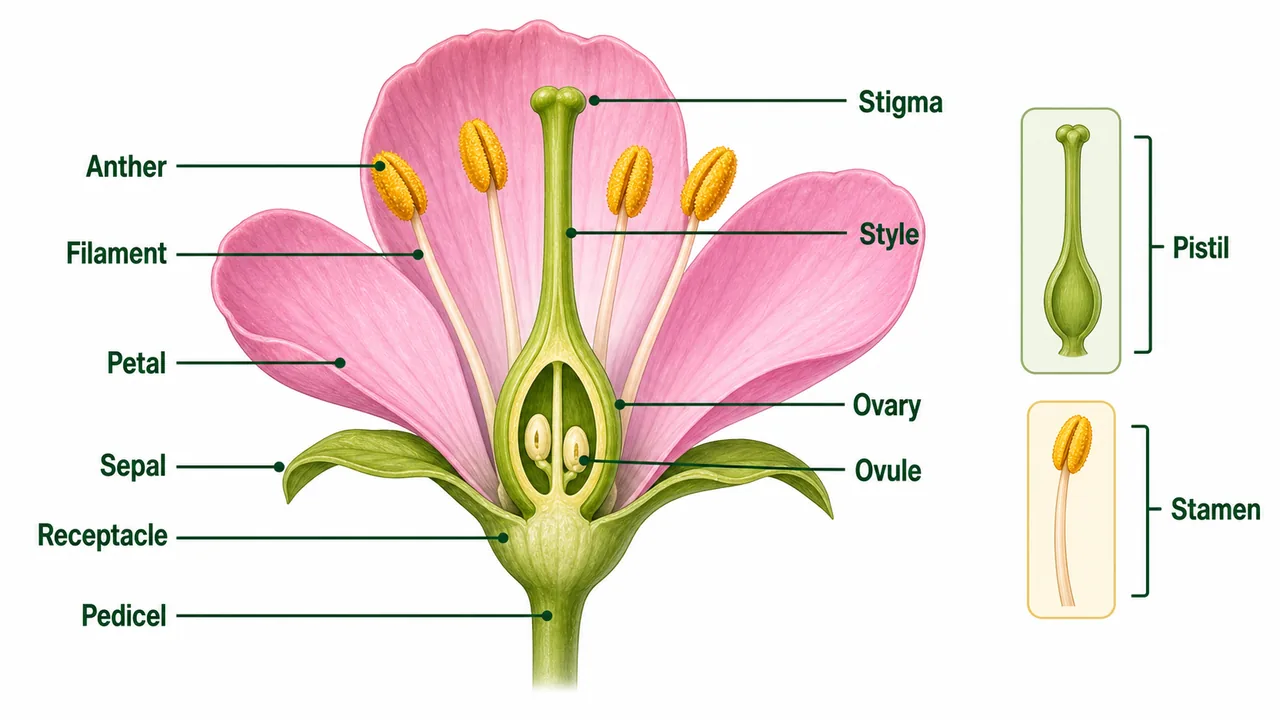
- A fruit consists of pericarp and seeds. Seeds are fertilized and ripened ovules. Understanding fruit morphology is essential for classifying fruits correctly, which is a frequently tested topic in competitive exams.
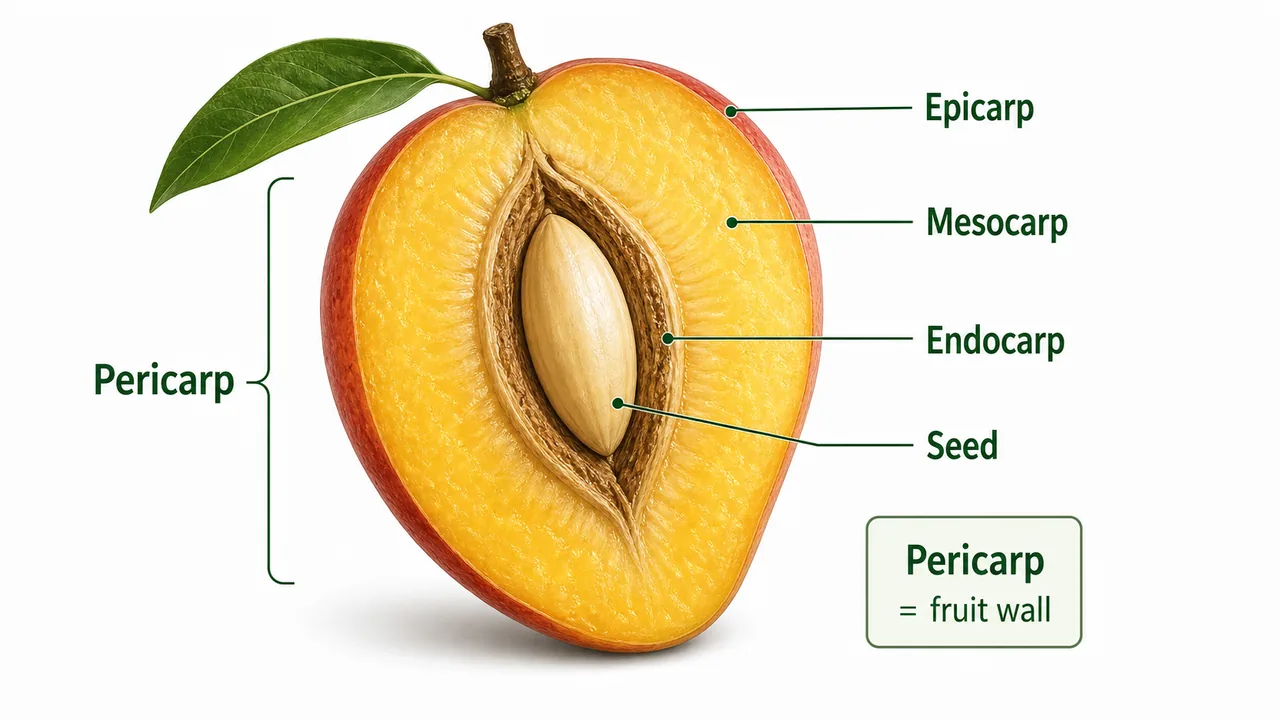
- The pericarp develops from the ovary wall and may be dry or fleshy. The pericarp is the wall of the fruit that surrounds the seed, and its nature (dry or fleshy) is one of the primary criteria for fruit classification.
- When fleshy, the pericarp is differentiated into outer epicarp, middle mesocarp and inner endocarp. The epicarp forms the outermost skin, the mesocarp is typically the edible fleshy portion, and the endocarp is the innermost layer which may be stony (as in drupe fruits) or soft.
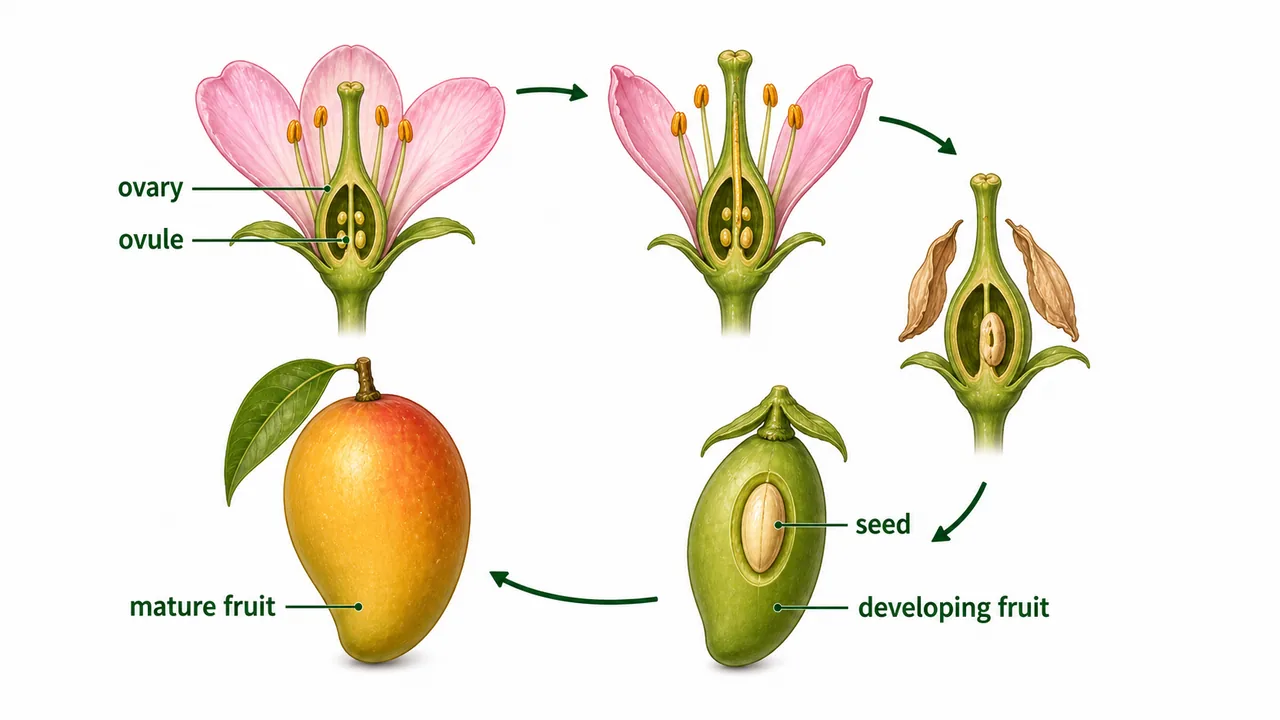
- So, most of the flowers are developed in the following way:
👉🏻 On the basis of the above-mentioned features, fruits are usually classified into 3 main groups:
Pro Content Locked
Upgrade to Pro to access this lesson and all other premium content.
₹99 charged monthly · Cancel anytime
- All Agriculture & Banking Courses
- AI Lesson Questions (100/day)
- AI Doubt Solver (50/day)
- Glows & Grows Feedback (30/day)
- AI Section Quiz (20/day)
- 22-Language Translation (100/day)
- Recall Questions (20/day)
- AI Quiz (15/day)
- AI Quiz Paper Analysis (100/day)
- AI Step-by-Step Explanations (100/day)
- Spaced Repetition Recall (FSRS)
- AI Tutor
- Immersive Text Questions
- Audio Lessons — Hindi & English
- Mock Tests & Previous Year Papers
- Summary & Mind Maps
- XP, Levels, Leaderboard & Badges
- Generate New Classrooms
- Voice AI Teacher (AgriDots Live)
- AI Revision Assistant
- Knowledge Gap Analysis
- Interactive Revision (LangGraph)
🔒 Secure via Razorpay · Cancel anytime · No hidden fees
Types of fruits
Fruit Morphology
- A fruit consists of pericarp and seeds. Seeds are fertilized and ripened ovules. Understanding fruit morphology is essential for classifying fruits correctly, which is a frequently tested topic in competitive exams.
- The pericarp develops from the ovary wall and may be dry or fleshy. The pericarp is the wall of the fruit that surrounds the seed, and its nature (dry or fleshy) is one of the primary criteria for fruit classification.
- When fleshy, the pericarp is differentiated into outer epicarp, middle mesocarp and inner endocarp. The epicarp forms the outermost skin, the mesocarp is typically the edible fleshy portion, and the endocarp is the innermost layer which may be stony (as in drupe fruits) or soft.
- So, most of the flowers are developed in the following way:
👉🏻 On the basis of the above-mentioned features, fruits are usually classified into 3 main groups:
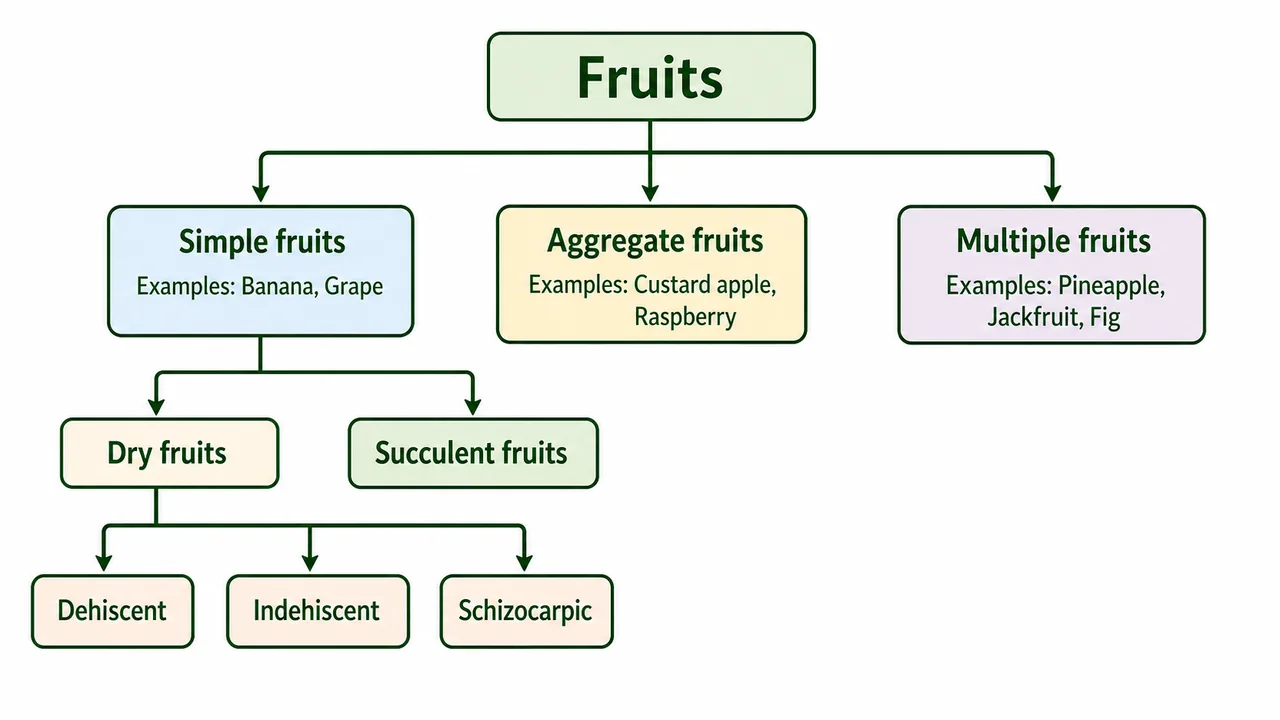
These three main groups are Simple fruits, Aggregate fruits, and Multiple (Composite) fruits. The classification depends on whether the fruit develops from a single ovary, multiple ovaries of one flower, or an entire inflorescence.
Simple fruits
- When a single fruit develops from a single ovary of a single flower, it is called a simple fruit. This is the most common type of fruit in nature and includes the majority of commercially important fruits.
- Examples: Banana, ⭐️ Grapes, Papaya, Avacado etc.
- Simple fruits are of two types:
- Dry Fruits
- Succulent fruits (fleshy fruits)
Dry fruits
- These fruits are not fleshy, and their pericarp (fruit wall) is not distinguished into three layers. In dry fruits, the pericarp becomes hard and papery at maturity, unlike fleshy fruits where it remains soft.
- Dry fruits classification:
- Dehiscent fruits (capsular fruits)
- Characteristic of these fruits is that their pericarp rupture after ripening and the seeds are disseminated. The term dehiscent means "to open" -- these fruits split open naturally to release their seeds. Examples include okra and cotton.
- Indehiscent fruits (Achenial fruits)
- As their name indicates, pericarp of such fruits does not rupture on ripening and the seeds remain inside. The seed is typically released only when the fruit wall decays or is broken mechanically. Examples include sunflower (achene) and rice (caryopsis).
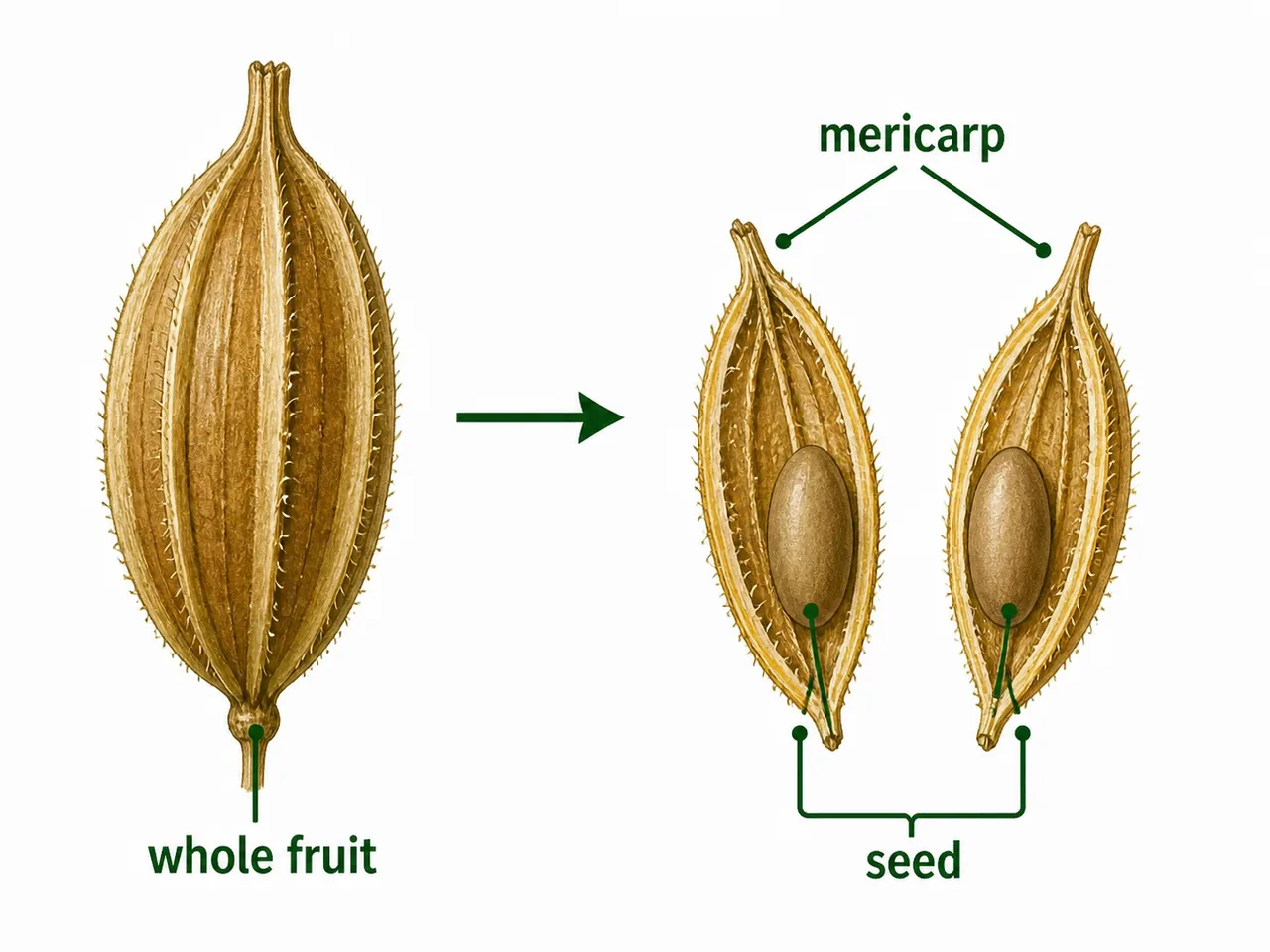
- Schizocarpic fruits (Splitting fruits)
- These fruits fall in between the above-mentioned two categories. Here, the fruit on ripening divides into one-seeded segments or mericarp; but the mericarps remain un-ruptured. They represent an intermediate type between dehiscent and indehiscent fruits. Examples include coriander and fennel.
- Dehiscent fruits (capsular fruits)
Succulent fruits (fleshy fruits)
- In these fruits pericarp is distinguished into pericarp, mesocarp and endocarp. The fleshy nature of these fruits makes them commercially important as they form the bulk of edible fruit crops.
- Mesocarp is fleshy or fibrous. In most edible fruits, the mesocarp is the part that we consume.
- These fruits are indehiscent, and seeds are liberated after the decay of the flesh. This means the fruit does not split open on its own; instead, the seeds are released when the fleshy part decomposes or is eaten by animals.
- Succulent fruits can be classified into Drupe, Pome and Berrie. Each type has a distinct internal structure that is important to understand.
Drupe
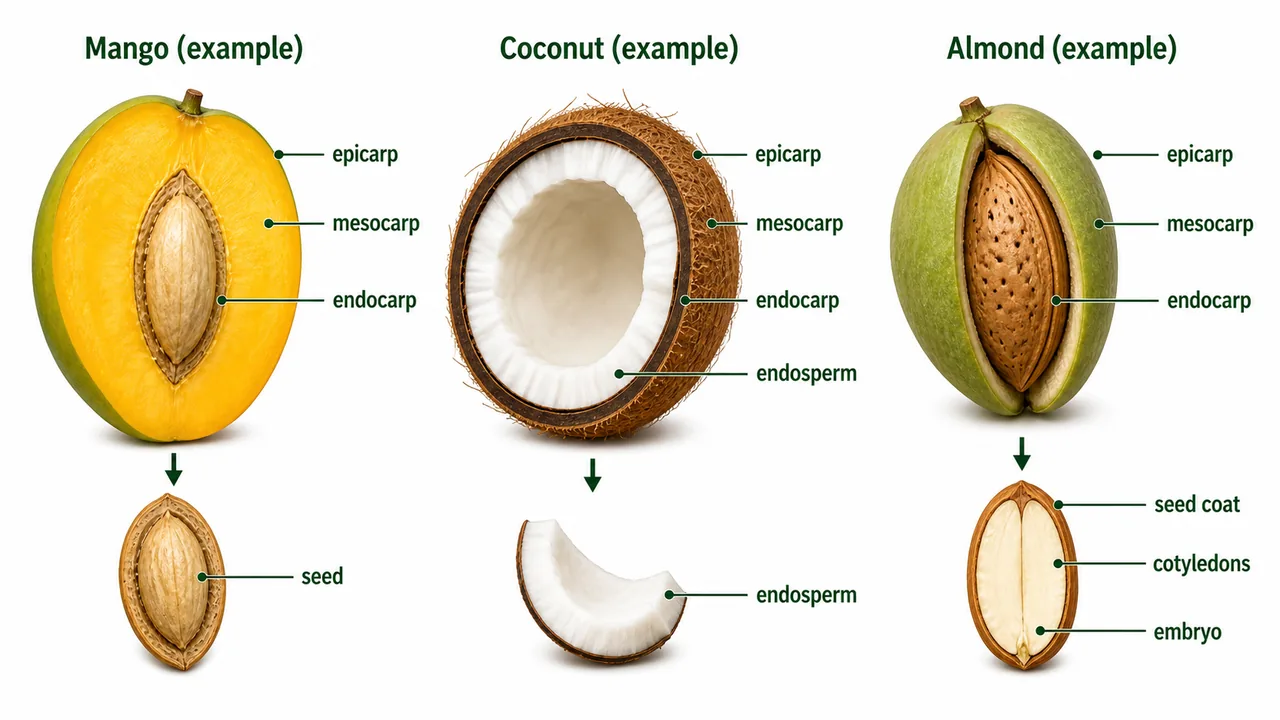
- The pericarp or fruit wall is differentiated into thin epicarp (skin), fleshy mesocarp and stony endocarp. The stony endocarp (also called the "pit" or "stone") is the defining feature of a drupe, which is why drupes are commonly called stone fruits.
- Hence it is also called as stone fruit, e.g. Mango, Jamun, Coffee, Coconut, Almond, Plum, Peach etc.
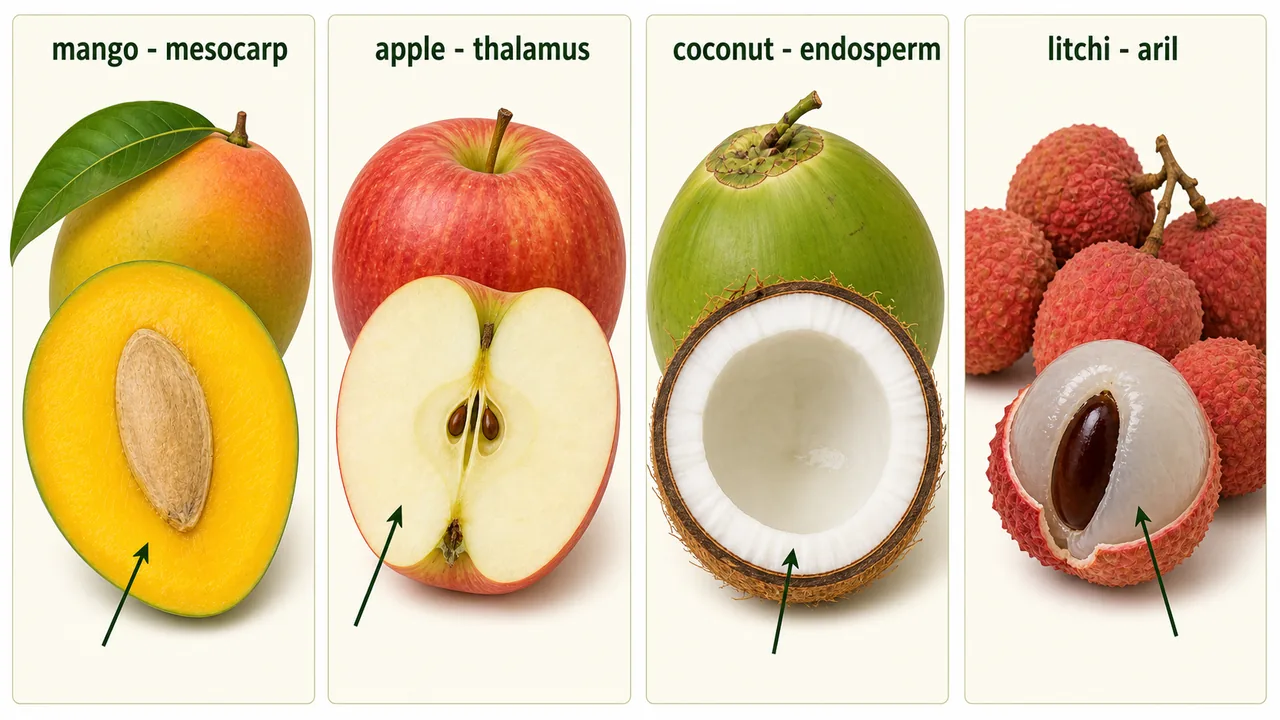
- In mango, mesocarp is juicy and edible. The thick, sweet, fleshy part of the mango that we eat is the mesocarp.
- In coconut mesocarp is fibrous and edible part is the endosperm. The nuclear endosperm which is suspended within the water of the coconut, develops and forms the edible coconut flesh. This is an important distinction -- while mango and coconut are both drupes, their edible parts are entirely different.
- In almond, epicarp and mesocarp get peeled off and only hard endocarp can be seen in marketed fruits. The edible part is cotyledons. In almond, what we eat is actually the seed (cotyledons) found inside the stony endocarp.
Pome
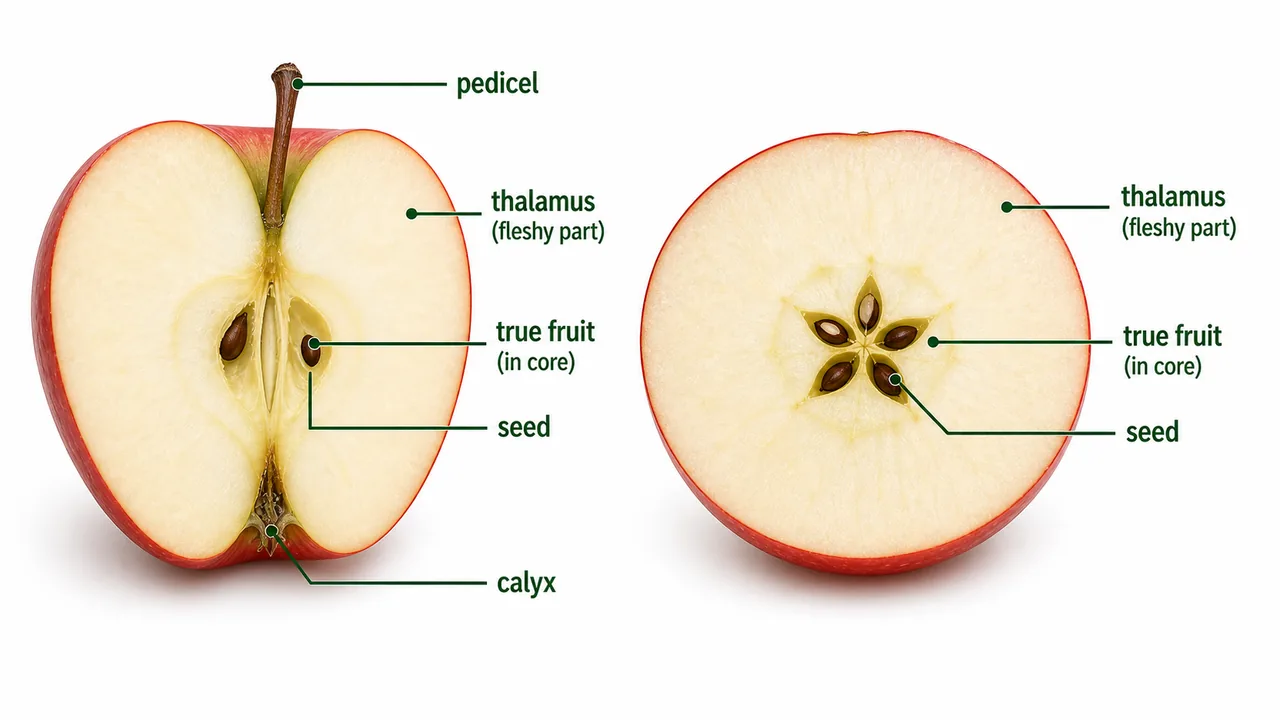
- It is a simple, fleshy but false fruit as it is surrounded by a fleshy thalamus which is edible while actual fruit lies within. A false fruit (also called pseudocarp) is one where the edible portion is not derived from the ovary but from an accessory part of the flower, in this case the thalamus (receptacle).
- E.g. Apple, Pear, Loquat etc. In apple, the fleshy part we eat is the thalamus, while the true fruit is the core containing seeds.
Berry
- Berry is a fleshy fruit in which there is no hard part except the seeds. This makes berries distinct from drupes, which have a stony endocarp.
- Pericarp may be differentiated into epicarp, mesocarp and endocarp. All three layers of the pericarp are typically soft and fleshy.
- One or other of these layers may form pulp in which seeds are embedded which generally gets detached from the placenta.
- Examples: Banana, Papaya, Grape, Date Palm, Arecanut and Guava. Note that botanically, banana and grape are true berries, even though common usage of the word "berry" would not include them.
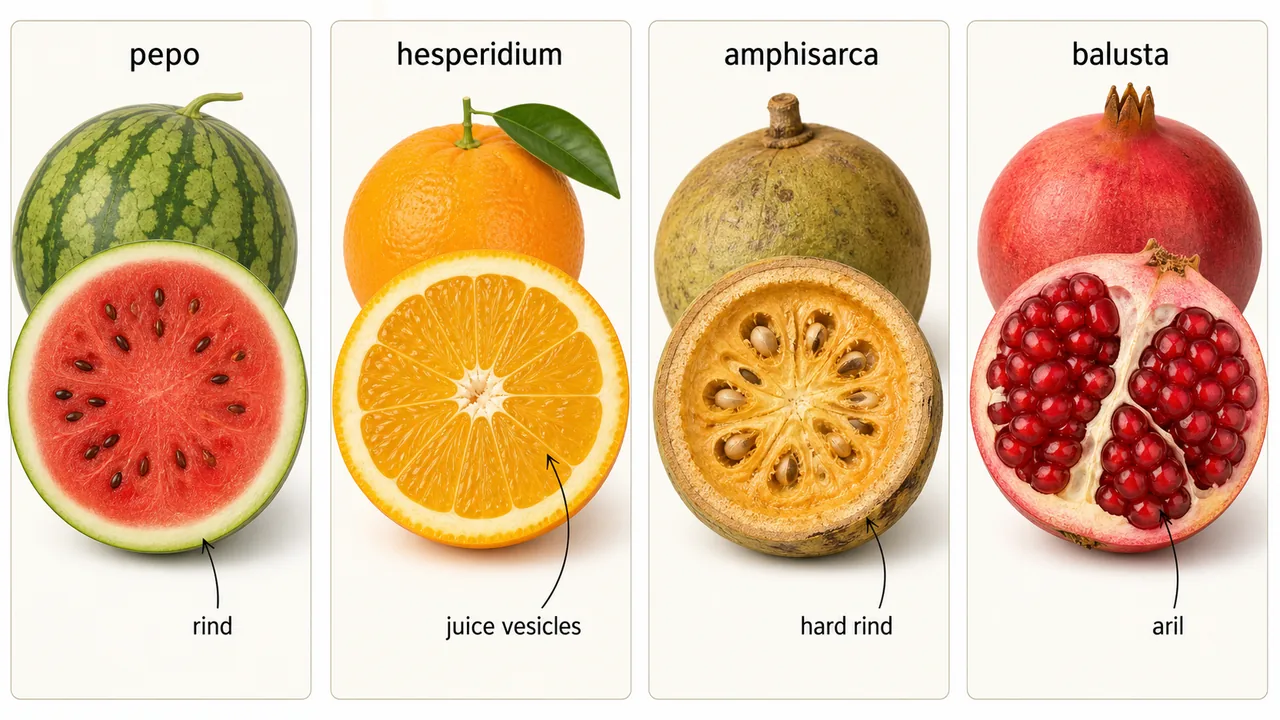
- The following are some fruits which show variations from the normal Berry: These are specialized types of berries with unique structural modifications:
- Pepo: Watermelon (Cucurbits) -- The outer rind is hard and derived from the receptacle, while the fleshy interior develops from the placenta.
- Hesperidium: Citrus fruits like oranges and lemons -- The rind contains oil glands, and the edible juice vesicles are actually endocarp outgrowths.
- Amphisarca: Bael -- A berry with a woody or hard rind (epicarp), distinguishing it from a typical berry.
- Balusta: Pomegranate -- The edible part is the fleshy seed coat (aril), and the fruit has a tough, leathery rind.
Aggregate fruits
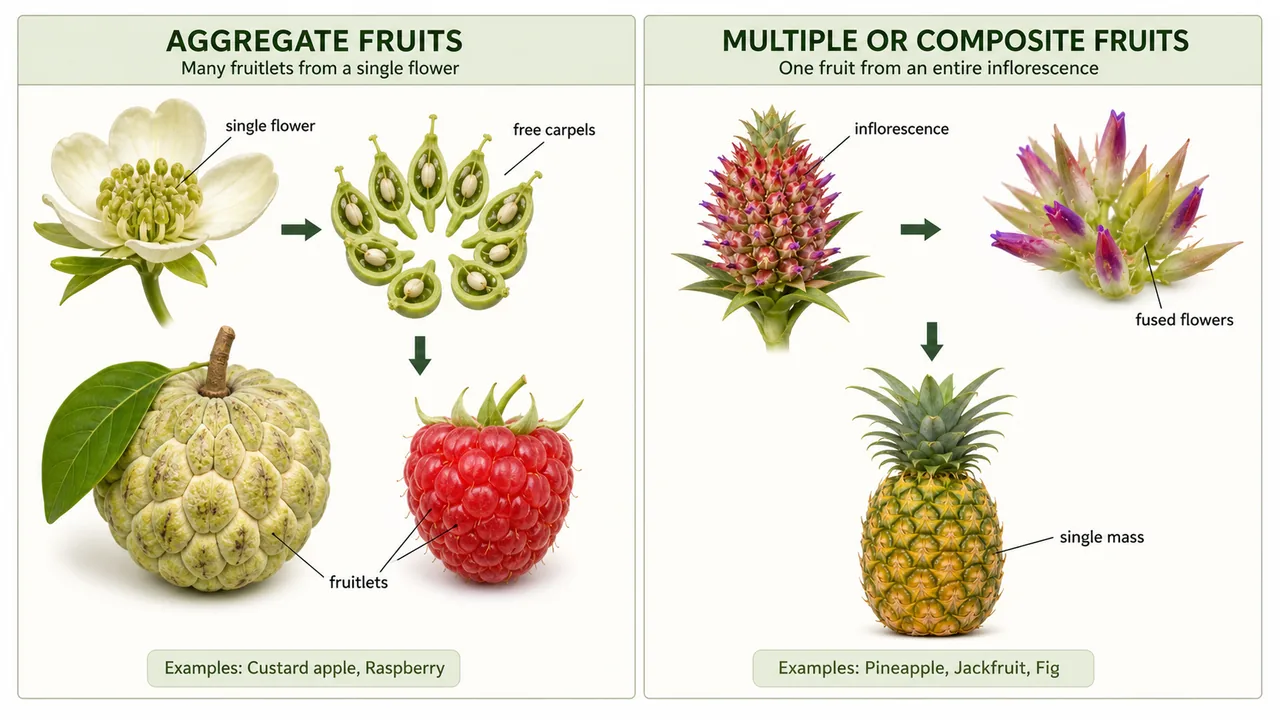
- They develop from the apocarpous ovaries of a single flower. Thus, from one flower, many fruits develop. An apocarpous ovary is one where the carpels are free (not fused together), so each carpel develops into a separate fruitlet. These individual fruitlets collectively form the aggregate fruit.
- Example: Eteario of berries, Custard Apple, Raspberry
Multiple or Composite Fruits
- A fruit developing from a complete inflorescence is called a multiple or a composite fruit. i.e. many flowers -- single fruit. In this type, an entire cluster of flowers fuses together during development to produce what appears to be a single fruit but is actually derived from many individual flowers.
- Examples: Pineapple (Sorosis) exams, Fig (Synconus), Jackfruit, Mulberry etc.
- In Sorosis (e.g., Pineapple, Jackfruit, Mulberry), the fruits develop from a spike or spadix type of inflorescence.
- In Synconus (e.g., Fig), the fruits develop inside a hollow, fleshy receptacle called a hypanthodium.
Others
- Nuts: Litchi & Cashew -- In Litchi, the edible part is the fleshy aril surrounding the seed. In Cashew, the edible "cashew apple" is actually the swollen pedicel (fruit stalk), while the true fruit is the kidney-shaped nut at the bottom.
- Capsule: Okra and Aonla -- A capsule is a dry dehiscent fruit that splits open along multiple seams to release seeds.
Ediable Part of Fruits
| Edible part | Fruit examples | Quick note |
|---|---|---|
| Pericarp | Ber, grape (with placenta), guava | The edible portion is mainly the fruit wall. |
| Mesocarp | Mango, banana, papaya | The fleshy middle layer is eaten. |
| Endosperm, cotyledon and embryo | Coconut | In standard pomology questions the usual answer is endosperm, including both coconut water and kernel; cotyledon and embryo become relevant mainly in germinated coconut. |
| Cotyledons | Almond | The edible portion is the seed leaves inside the hard endocarp. |
| Fleshy thalamus | Apple (pome), pear, strawberry | The edible portion is an accessory floral part rather than the ovary wall alone. |
| Fleshy receptacle | Fig (syconus) Exams | The edible fleshy structure encloses the true fruits. |
| Fleshy aril | Litchi | The juicy covering around the seed is eaten. |
| Juicy testa (seed coat) | Pomegranate (balusta) | The edible part is the fleshy seed coat around each seed. |
| Placenta | Bael (amphisarca) | The edible pulp is associated with the placental region. |
| Bracts | Pineapple (sorosis) | Much of the edible bulk develops from the fused inflorescence parts. |
| Juicy placental hairs / endocarpic juicy hairs | Citrus (hesperidium) | The edible juice vesicles are endocarp outgrowths. |
| Perianth | Mulberry | The outer floral parts become fleshy in the mature multiple fruit. |
Knowing the edible part of each fruit is a very commonly asked question in exams. Remember that different fruits have different edible parts -- for example, the edible part of mango is the mesocarp, apple is the thalamus, litchi is the aril, and coconut is the endosperm.
Commonly Known as
| Common title | Fruit crop |
|---|---|
| King of fruits | Mango |
| Queen of fruits | Litchi |
| King of temperate fruits | Apple |
| King of pulses | Gram |
| Queen of pulses | Pea |
| King of spices | Black pepper |
| Queen of spices | Cardamom |
| King of flowers | Rose |
| Queen of flowers | Gladiolus |
| Queen of beverage | Tea |
| Food of god | Cocoa |
| King of nut crops | Walnut |
| Apple of the poor | Guava |
| Butter fruit | Avocado |
| Miracle fruit | China kiwi fruit |
| King of arid fruits | Ber |
| Poor man's fruits | Ber |
| Kalpavriksha | Coconut |
| Adam's fig | Banana |
| Century plant | Date palm |
| White gold | Cotton |
| King of forest | Teak |
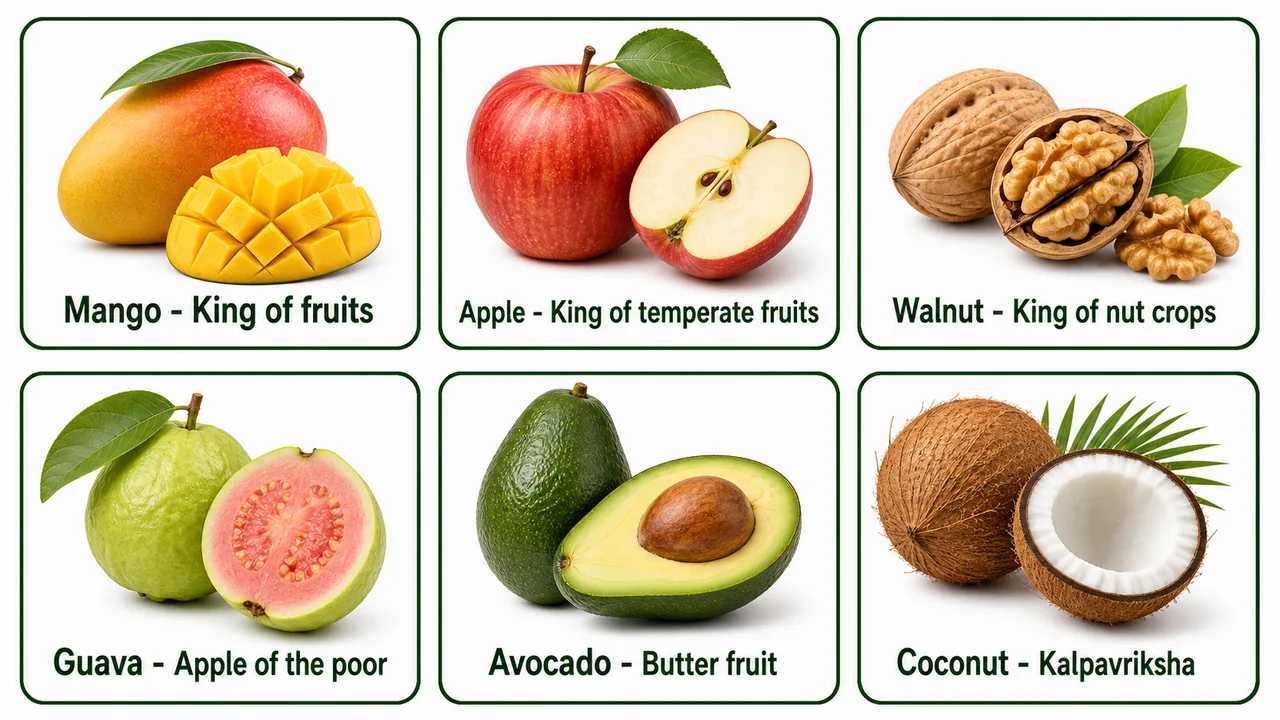
Many fruits are commonly referred to by descriptive names. For example, Mango is the King of Fruits, Apple is the King of Temperate Fruits, Walnut is the King of Nut Crops, and Guava is the Apple of the Poor. These names are frequently asked in competitive examinations.
Important families of fruit crops
| Family | Common name | Botanical name |
|---|---|---|
| Bromeliaceae | Pineapple | Ananas comosus |
| Anacardiaceae | Cashew | Anacardium occidentale |
| Annonaceae | Custard apple | Annona squamosa |
| Apocynaceae | Karonda | Carissa carandas |
| Lauraceae | Avocado | Persea americana |
| Moraceae | Fig | Ficus carica |
| Sapindaceae | Litchi | Litchi chinensis |
| Tiliaceae | Phalsa | Grewia subinaequalis |
| Rosaceae | Strawberry | Fragaria ananassa |
| Rubiaceae | Coffee | Coffea canephora |
| Rutaceae | Bael | Aegle marmelos |
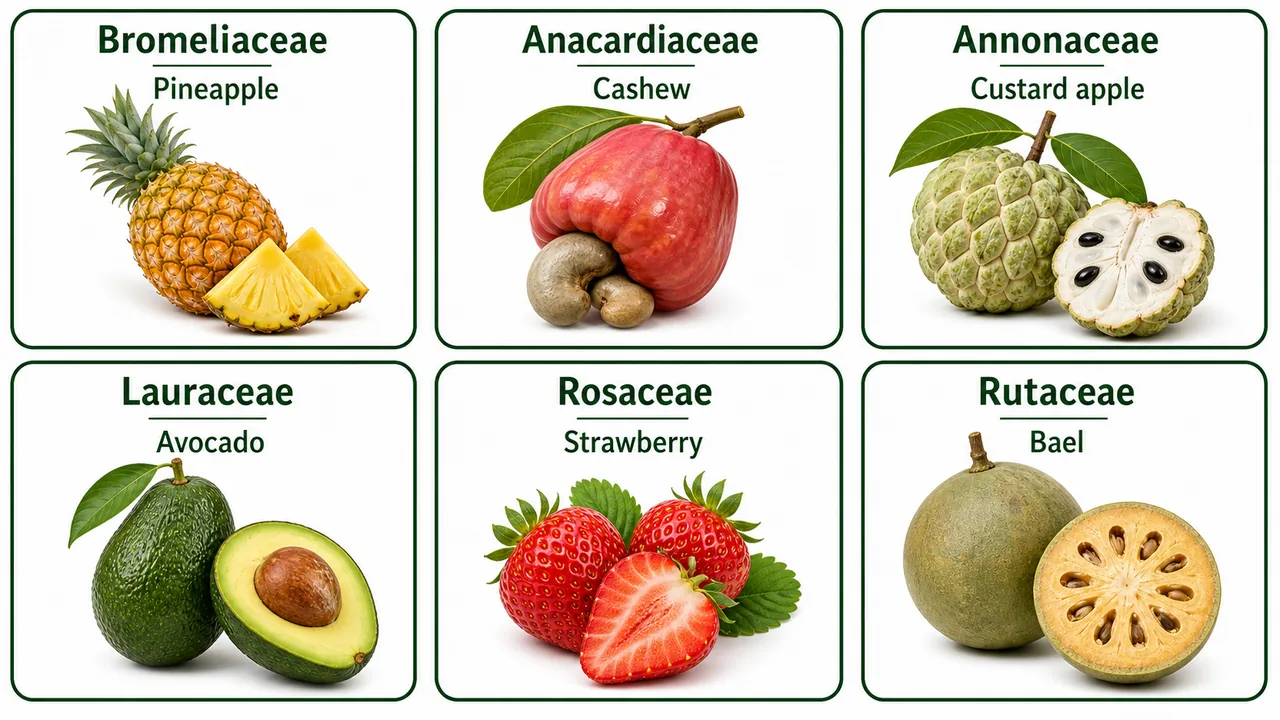
Understanding the botanical family to which a fruit crop belongs is important because crops in the same family share similar characteristics in terms of flower structure, fruit type, and often pest and disease susceptibility. For example, Rosaceae includes apple, pear, peach, plum, and strawberry, while Rutaceae includes all citrus fruits.
Fruiting Pattern
- Lateral bearing cultivars develop fruits on side small branches after three or four years of planting and bear heavily. Lateral bearing is generally more productive because a larger number of fruiting points are available on the side branches.
- Ex. Mango
- In comparison to lateral bearing, tip bearing plants develop fruit on tips of one year old shoots after six or more years and produces yield smaller than lateral bearing cultivars. Tip-bearing trees require more careful pruning to ensure that fruiting tips are not removed accidentally.
- Ex. Plum, Pear, Ber, Guava etc.
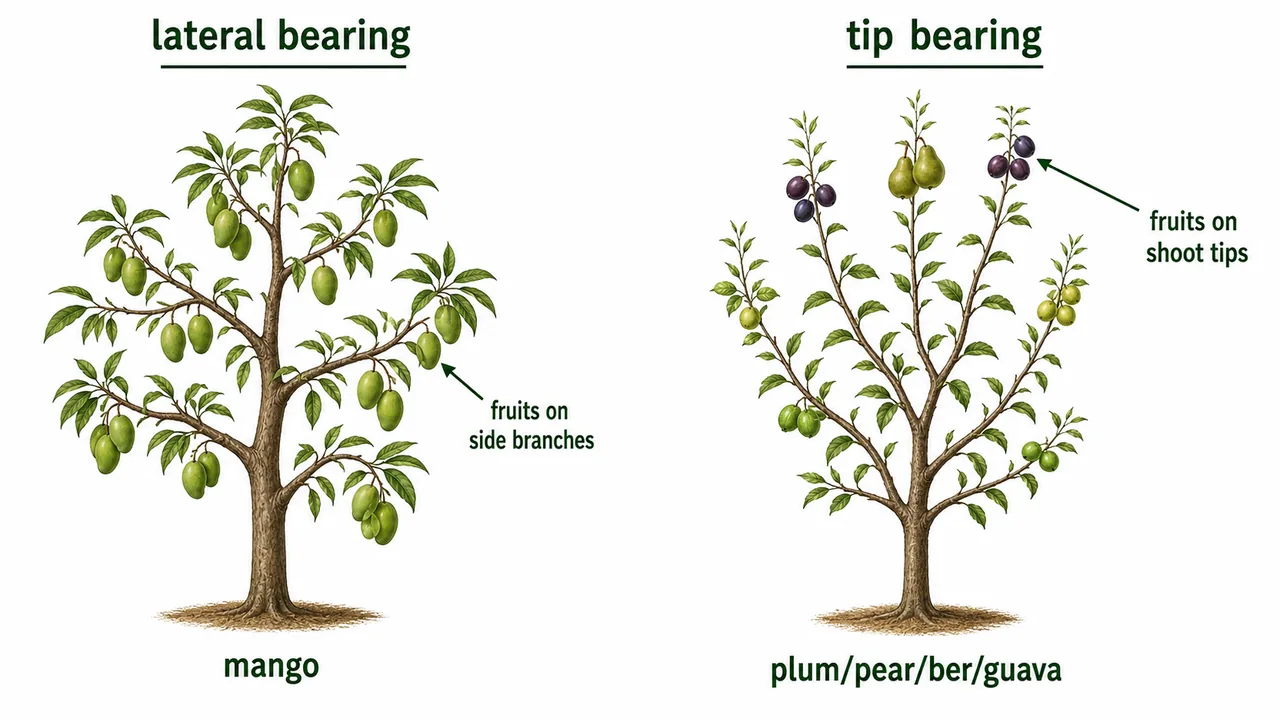
Understanding the fruiting pattern of a crop is crucial for deciding pruning strategies, training systems, and harvest management. Lateral bearers and tip bearers require fundamentally different approaches to pruning.
Summary Cheat Sheet
| Concept / Topic | Key Details / Explanation |
|---|---|
| Fruit morphology | A fruit consists of pericarp and seeds, and in fleshy fruits the pericarp is differentiated into epicarp, mesocarp, and endocarp. |
| Major fruit groups | On origin basis, fruits are grouped into simple fruits, aggregate fruits, and multiple or composite fruits. |
| Simple fruits | A simple fruit develops from the single ovary of one flower and may be dry or succulent. |
| Dry fruits | Dry fruits have a non-fleshy pericarp and are classified as dehiscent, indehiscent, or schizocarpic; schizocarpic fruits split into one-seeded mericarps without opening the individual segments. |
| Succulent fruits | Succulent or fleshy fruits are indehiscent and mainly classified here into drupe, pome, and berry. |
| Drupe | A drupe has thin epicarp, fleshy or fibrous mesocarp, and stony endocarp, so it is also called a stone fruit; examples given are mango, jamun, coffee, coconut, almond, plum, and peach. |
| Edible part in drupes | Mango is eaten for its mesocarp, coconut for its endosperm, and almond for its seed cotyledons inside the hard endocarp. |
| Pome | Pome is a false fruit in which the edible fleshy part is the thalamus and the true fruit lies inside; examples are apple, pear, and loquat. |
| Berry and modified berries | A berry has no hard stone and may include banana, papaya, grape, date palm, arecanut, and guava; important modified berry forms are pepo in watermelon, hesperidium in citrus, amphisarca in bael, and balusta in pomegranate. |
Summary Continued
| Concept / Topic | Key Details / Explanation |
|---|---|
| Aggregate fruits | Aggregate fruits develop from the free carpels of a single flower; examples listed are custard apple and raspberry. |
| Multiple fruits | Multiple or composite fruits develop from a whole inflorescence; pineapple and jackfruit are sorosis types, while fig is a syconus type. |
| Special fruit examples | Litchi is noted for its fleshy aril, cashew for its swollen pedicel called the cashew apple with the true nut below, and okra plus aonla are listed under capsule examples. |
| Important edible parts | This lesson especially highlights mesocarp in mango, thalamus in apple, aril in litchi, endosperm in coconut, and seed cotyledons in almond. |
| Common fruit titles | Common exam titles include mango as the king of fruits, apple as the king of temperate fruits, walnut as the king of nut crops, and guava as the apple of the poor. |
| Fruit families | Fruit families matter for revision because related crops share floral and fruit traits; the lesson points out Rosaceae for apple, pear, peach, plum, and strawberry, and Rutaceae for citrus. |
| Fruiting pattern | Lateral bearing plants fruit on side branches and usually bear earlier and more heavily, while tip bearers fruit on tips of one-year shoots and usually start later with lower yield. |
| Fruiting pattern examples | Mango is listed here as lateral bearing, while plum, pear, ber, and guava are listed as tip bearing. |