🏛️ APMC System and Marketing Agencies
Agricultural Produce Market Committee (APMC) system, types of marketing agencies — producers, merchant middlemen, agent middlemen, speculative middlemen, processors, and facilitative middlemen with agricultural examples
The Problem APMC Solves
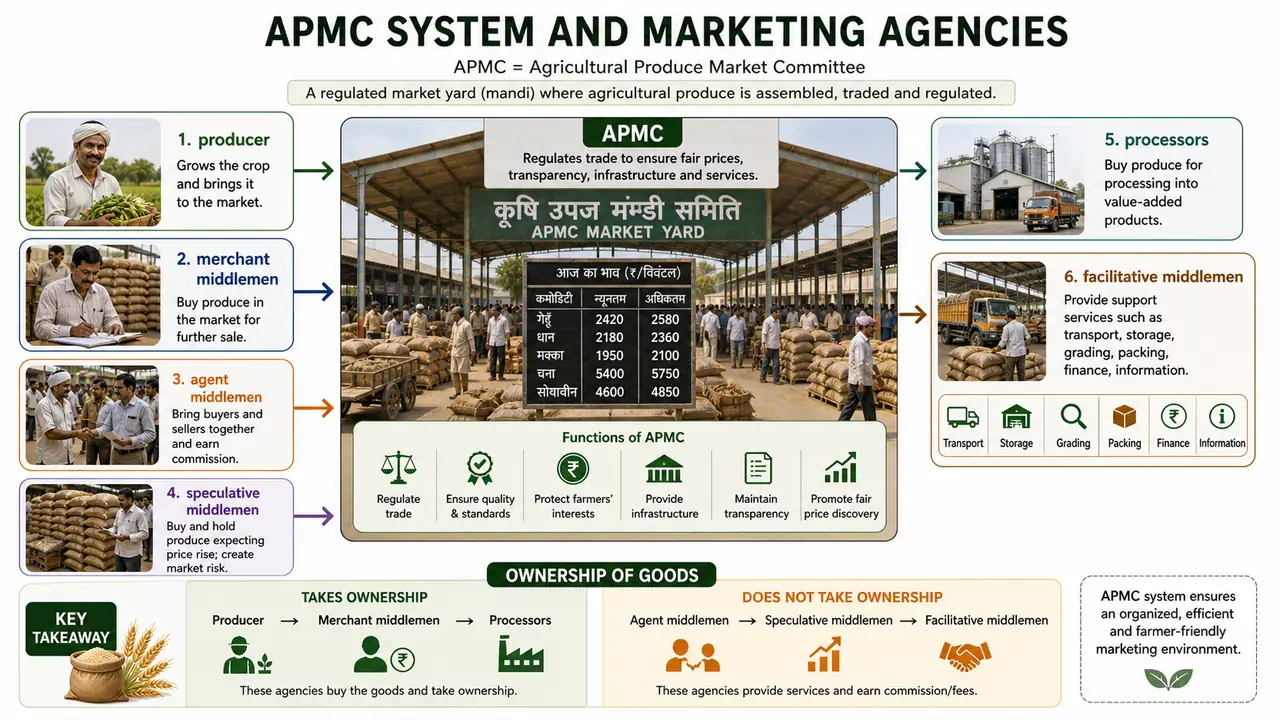
Imagine a small rice farmer in Bihar who harvests 50 quintals of paddy. Without a regulated market, local moneylenders and traders could force him to sell at rock-bottom prices to repay debts. This is called distress sale — and it was rampant across India before regulated markets came into existence. The APMC system was created precisely to prevent this exploitation and give farmers a fair, transparent marketplace.
APMC — Agricultural Produce Market Committee
- APMC operates under the State Government since agricultural marketing is a State subject under the Constitution
- Each APMC has designated Yards/Mandis in its market area that regulate the trading of notified agricultural produce and livestock
- The primary objective of APMC is to eliminate distress sale by protecting farmers from pressure by creditors and intermediaries
- APMC ensures fair prices and timely payments to farmers for their produce
- APMC is responsible for regulating agricultural trading practices including licensing of traders, market fee collection, and dispute resolution
Benefits of APMC
| Benefit | How It Helps Farmers |
|---|---|
| Eliminates unnecessary intermediaries | Farmer gets a larger share of the consumer's rupee |
| Reduces market charges | Lower transaction costs improve farmer income |
| Protects producer-seller interest | Transparent auction, licensed traders, and regulated fees |
| Provides market infrastructure | Weighing facilities, sheds, platforms, and storage |
TIP
Pro Content Locked
Upgrade to Pro to access this lesson and all other premium content.
₹99 charged monthly · Cancel anytime
- All Agriculture & Banking Courses
- AI Lesson Questions (100/day)
- AI Doubt Solver (50/day)
- Glows & Grows Feedback (30/day)
- AI Section Quiz (20/day)
- 22-Language Translation (100/day)
- Recall Questions (20/day)
- AI Quiz (15/day)
- AI Quiz Paper Analysis (100/day)
- AI Step-by-Step Explanations (100/day)
- Spaced Repetition Recall (FSRS)
- AI Tutor
- Immersive Text Questions
- Audio Lessons — Hindi & English
- Mock Tests & Previous Year Papers
- Summary & Mind Maps
- XP, Levels, Leaderboard & Badges
- Generate New Classrooms
- Voice AI Teacher (AgriDots Live)
- AI Revision Assistant
- Knowledge Gap Analysis
- Interactive Revision (LangGraph)
🔒 Secure via Razorpay · Cancel anytime · No hidden fees
The Problem APMC Solves
Imagine a small rice farmer in Bihar who harvests 50 quintals of paddy. Without a regulated market, local moneylenders and traders could force him to sell at rock-bottom prices to repay debts. This is called distress sale — and it was rampant across India before regulated markets came into existence. The APMC system was created precisely to prevent this exploitation and give farmers a fair, transparent marketplace.
APMC — Agricultural Produce Market Committee
- APMC operates under the State Government since agricultural marketing is a State subject under the Constitution
- Each APMC has designated Yards/Mandis in its market area that regulate the trading of notified agricultural produce and livestock
- The primary objective of APMC is to eliminate distress sale by protecting farmers from pressure by creditors and intermediaries
- APMC ensures fair prices and timely payments to farmers for their produce
- APMC is responsible for regulating agricultural trading practices including licensing of traders, market fee collection, and dispute resolution
Benefits of APMC
| Benefit | How It Helps Farmers |
|---|---|
| Eliminates unnecessary intermediaries | Farmer gets a larger share of the consumer's rupee |
| Reduces market charges | Lower transaction costs improve farmer income |
| Protects producer-seller interest | Transparent auction, licensed traders, and regulated fees |
| Provides market infrastructure | Weighing facilities, sheds, platforms, and storage |
TIP
Exam Tip: APMC is a State subject. This is why different states have different APMC Acts. The Model APMC Act 2003 was introduced by the Centre as a reform template, but adoption varies by state.
Marketing Agencies
The agricultural marketing chain involves several types of participants. Understanding who does what — and who takes ownership of the produce — is critical for exams.
1. Producers
The farmers who grow and bring their produce to the market. They are the starting point of every marketing channel. For example, a soybean farmer in Madhya Pradesh bringing his harvest to the local APMC mandi.
2. Middlemen
Middlemen connect producers to consumers. They are classified into five types based on their role, ownership, and function.
A. Merchant Middlemen (Take Ownership of Produce)
| Type | Role | Agricultural Example |
|---|---|---|
| Wholesalers | Buy and sell foodgrains in large quantities | A wheat wholesaler in Azadpur Mandi, Delhi buying 500 quintals |
| Retailers | Buy from wholesalers and sell to consumers in small quantities | A local kirana shop selling 5 kg bags of rice |
| Itinerant Traders / Village Merchants | Move village to village, directly purchase from cultivators | A trader visiting groundnut farms in Gujarat at harvest time |
| Mashakhores | Big retailers or small wholesalers dealing in fruits and vegetables | A fruit mashakhore at Mumbai's Crawford Market |
B. Agent Middlemen (Do NOT Take Ownership)
| Type | Role | Agricultural Example |
|---|---|---|
| Commission Agents / Arhatias | Earn income as a percentage of sales value; arrange sale on behalf of farmer | An arhatia in Ludhiana mandi selling a wheat farmer's produce for 2.5% commission |
| Brokers | Differ from commission agents by the limited services they offer; do not own or physically handle the commodity | A spice broker in Kochi connecting a pepper farmer to an exporter |
C. Speculative Middlemen
- Take title to the product with the aim of making profit from price changes
- Not regular buyers or sellers of produce
- Buy at low prices when market arrivals are high (post-harvest), sell in the off-season when prices rise
- Do minimum handling of goods — they profit from timing, not from adding value
- Example: A trader buying large quantities of onion in November (peak season, low prices) and storing them to sell in April-May (lean season, high prices)
D. Processors
Those who transform raw agricultural produce into finished or semi-finished products.
| Raw Produce | Processor | Output |
|---|---|---|
| Sugarcane | Sugar mill | Sugar, molasses, ethanol |
| Paddy | Rice mill | Milled rice, bran, husk |
| Groundnut | Oil mill | Groundnut oil, oil cake |
| Wheat | Flour mill | Atta, maida, suji |
E. Facilitative Middlemen
These middlemen do not buy or sell produce but assist in the marketing process.
| Type | Function | Agricultural Example |
|---|---|---|
| Hamals / Labourers | Loading and unloading | Carrying wheat bags in mandi |
| Weighmen | Weighing produce | Operating electronic weighbridge for cotton bales |
| Graders | Sorting and grading | Grading mangoes as A/B/C by size and ripeness |
| Transport Agency | Movement of goods | Trucking potatoes from Agra to Delhi |
| Advertising Agency | Promotion and demand creation | Marketing GI-tagged Alphonso Mangoes |
| Auctioneers | Conducting auctions | Running open auction of vegetables in APMC mandi |
Key Distinction — Ownership of Produce
| Agency Type | Takes Ownership? | Earns From |
|---|---|---|
| Merchant Middlemen | Yes | Profit on resale (buy low, sell high) |
| Agent Middlemen | No | Commission or brokerage fee |
| Speculative Middlemen | Yes (temporarily) | Price difference over time |
| Processors | Yes | Value addition (raw to processed) |
| Facilitative Middlemen | No | Service charges |
IMPORTANT
Critical exam distinction: Merchant middlemen take ownership (wholesalers, retailers). Agent middlemen do NOT take ownership (commission agents, brokers). Speculative middlemen buy only to profit from price changes, not to add value. This classification is frequently tested in AFO exams.
Exam Tips
- APMC is a State subject — remember this whenever reform questions come up
- Arhatia/Commission Agent earns a percentage of sale value; Broker earns a flat fee and offers fewer services
- Mashakhore is specific to fruits and vegetables — the term itself is a giveaway
- If the question mentions "does not take ownership," the answer is either agent middlemen or facilitative middlemen
APMC and Agency Quick Revision
| Concept / Topic | Key Details / Explanation |
|---|---|
| APMC | Agricultural Produce Market Committee; operates under State Government (agriculture marketing is a State subject) |
| APMC purpose | Eliminate distress sale; ensure fair prices and timely payments; regulate trading practices |
| APMC benefits | Eliminates unnecessary intermediaries, reduces market charges, protects producer-seller, provides infrastructure |
| Model APMC Act | 2003 — reform template by Centre; adoption varies by state |
| Producers | Farmers who grow and bring produce to market; starting point of every channel |
| Merchant Middlemen | Take ownership of produce; earn from profit on resale |
| Wholesalers | Buy and sell in large quantities (most important in distribution) |
| Retailers | Buy from wholesalers, sell to consumers in small quantities |
| Itinerant Traders | Move village to village, purchase directly from cultivators |
| Mashakhores | Big retailers / small wholesalers dealing in fruits and vegetables |
| Agent Middlemen | Do NOT take ownership; earn commission or brokerage fee |
| Commission Agents / Arhatias | Earn income as a percentage of sales value; arrange sale on farmer's behalf |
| Brokers | Offer limited services; do not physically handle commodity; earn flat fee |
| Speculative Middlemen | Take title temporarily; buy low (post-harvest), sell high (off-season); minimum handling; profit from timing |
| Processors | Transform raw produce into finished/semi-finished products (sugar mills, rice mills, oil mills, flour mills) |
| Facilitative Middlemen | Do not buy or sell; assist in marketing — hamals, weighmen, graders, transport, auctioneers |
| Ownership distinction | Merchant middlemen + speculative middlemen + processors = take ownership; agent + facilitative = do not take ownership |
| Key exam distinction | "Does not take ownership" → agent middlemen or facilitative middlemen |
| Arhatia vs Broker | Arhatia earns % of sale value with more services; broker earns flat fee with fewer services |
e-NAM — Electronic National Agricultural Market
e-NAM extends the logic of regulated markets into a unified digital marketplace. Instead of each mandi functioning as an isolated local market, e-NAM links APMC mandis electronically so farmers can access transparent bidding, assaying, and digital payment across a much wider buyer base.
| Feature | Detail |
|---|---|
| Full Form | Electronic National Agricultural Market |
| Launched | 14th April 2016 |
| Launched by | Ministry of Agriculture & Farmers Welfare |
| Implementing Agency | SFAC (Small Farmers Agri-Business Consortium) |
| Platform | enam.gov.in (managed by SFAC) |
| Mandis integrated | 1,656 mandis across 23 states + 4 UTs |
| Farmers registered | 1.80 crore |
| Traders registered | 2.72 lakh |
| Cumulative trade value | Rs 4.82 lakh crore |
| Government grant per mandi | Up to Rs 75 lakh for software, hardware, and assaying equipment |
| Commodities | 175 commodities including grains, oilseeds, spices, fibres, and perishables |
| Vision | "One Nation One Market" for agriculture |
- A pan-India unified electronic market connecting regulated mandis across the country
- Ensures better price discovery, transparency, and competition
- Breaks geographical barriers — a farmer in Rajasthan can sell to a buyer in Kerala through online bidding
- Reduces cash transactions through digital payments
How e-NAM Works
Farmer arrives at mandi → Produce assayed (quality tested) → Lot created on portal
→ Buyers bid online (intra-mandi or inter-mandi) → Highest bid accepted
→ Payment via e-payment → Farmer receives amount directly
Key Features
- Single-window service: registration, trading, and payment in one portal
- Assaying: quality testing enables better buyer confidence and price discovery
- Warehouse module: farmers can sell from WDRA-registered warehouses without bringing produce physically to mandi
- FPO module: FPOs can aggregate produce and sell from their own location through remote bidding
- Cross-state trading: buyers from other states can participate on integrated mandis
- Mobile access: app-based access for farmers and traders
TIP
e-NAM key facts: Launched 14 April 2016 | Implementing agency: SFAC | Mandis: 1,656 | Farmers: 1.80 crore | Grant: Rs 75 lakh per mandi | Vision: "One Nation One Market."
Integrated Scheme for Agricultural Marketing (ISAM)
Started in 2014 AFO 2018 to keep pace with growing agricultural production and marketing surplus.
Objectives
- Create agricultural marketing infrastructure with backend subsidy support
- Promote scientific storage and pledge financing to increase farmer income
- Build integrated value chains (up to primary processing) for vertical integration
- Use ICT for market information dissemination to farmers
- Establish a nationwide information network for real-time price and arrival data
- Support grading standards and quality certification (Agmark)
- Catalyze private investment in agribusiness projects
- Promote training, research, and extension in agricultural marketing
Five Sub-Schemes of ISAM
| Sub-Scheme | Full Form | Key Feature |
|---|---|---|
| AMI | Agricultural Marketing Infrastructure | Backend capital subsidy — 25% (general) or 33.33% (special category) on capital cost. Subsumes GBY and AMIGS |
| MRIN | Marketing Research and Information Network | Real-time price and arrival data across mandis (AGMARKNET) |
| SAGF | Strengthening of Agmark Grading Facilities | Equipment, renovation for Agmark labs under DMI |
| ABD (VCA + PDF) | Agribusiness Development through Venture Capital Assistance and Project Development Facility | Financial support via nationalized banks, NABARD, SIDBI for agribusiness ventures |
| CCS NIAM | Centre for Commodity Studies, NIAM Jaipur | Applied research in agricultural marketing problems |
AMI Eligible Organizations: Individuals, farmers, farmer groups, partnership firms, NGOs, SHGs, companies, cooperatives, local bodies, FPOs, APMCs, marketing boards, and agro-processing corporations. Renovation assistance for rural godowns is restricted to cooperatives only.
Summary Cheat Sheet
| Concept / Topic | Key Details / Explanation |
|---|---|
| APMC | Agricultural Produce Market Committee; operates under State Government because agricultural marketing is a State subject |
| APMC purpose | Prevent distress sale, regulate trade, ensure fair prices and timely payments |
| Merchant middlemen | Take ownership of produce; earn from resale margin |
| Agent middlemen | Do not take ownership; earn commission or brokerage |
| Speculative middlemen | Buy mainly to gain from price changes over time |
| Processors | Add value by converting raw produce into processed output |
| Facilitative middlemen | Assist marketing without buying or selling the produce |
| Ownership distinction | Merchant middlemen, speculative middlemen, and processors take ownership; agent and facilitative middlemen do not |
| e-NAM | Electronic National Agricultural Market; launched 14 April 2016 |
| e-NAM implementing agency | SFAC (Small Farmers Agri-Business Consortium) |
| e-NAM vision | One Nation One Market for agriculture |
| e-NAM grant per mandi | Up to Rs 75 lakh for software, hardware, and assaying |
| e-NAM core logic | Assaying + online bidding + digital payment + wider buyer access |
| ISAM | Integrated Scheme for Agricultural Marketing; started in 2014 |
| ISAM objective | Marketing infrastructure, scientific storage, ICT-based information, grading support, and private investment in agribusiness |
| AMI under ISAM | Infrastructure subsidy — 25% (general) or 33.33% (special category) |
| MRIN under ISAM | Market price and arrival information network |
| SAGF under ISAM | Strengthening Agmark grading facilities |
| ABD (VCA + PDF) | Venture capital and project support for agribusiness development |
| CCS NIAM | Commodity studies and applied marketing research at NIAM Jaipur |
Lesson Doubts
Ask questions, get expert answers