🍯 Bee Products: Honey, Wax, Royal Jelly, and More
Six valuable products from honey bees -- honey composition, ripening, purity tests, beeswax, royal jelly, bee venom, propolis, and pollen
In the previous lesson, we examined the three castes of a bee colony and how haplodiploidy determines sex. Now we turn to what these colonies actually produce -- six commercially valuable products that make beekeeping a multi-product enterprise.
When a farmer in Bihar harvests honey from his Italian bee colonies, he is tapping into just one of six commercially valuable products that honey bees produce. Beyond honey, the same colonies yield beeswax for the cosmetics industry, royal jelly sold as a health supplement, propolis with antimicrobial properties, bee pollen as a superfood, and even bee venom used in treating arthritis. Together, these products make beekeeping one of the most multi-product agricultural enterprises available to Indian farmers.
This lesson covers:
- Honey -- composition, ripening, purity tests, and FSSAI standards
- Beeswax -- source glands, chemical composition, and uses
- Royal Jelly -- the queen-making substance
- Bee Venom -- apitherapy and medicinal value
- Propolis and Pollen -- antimicrobial sealant and superfood
1. Honey
- A sweet, viscous fluid produced by honey bees from nectar collected at the base of flowers (floral nectaries) and sometimes from extra-floral nectaries (on leaves, stems) or fruit juice.
- Bees draw nectar using their proboscis (tongue) -- a straw-like structure for sucking nectar from deep within flowers.
- About 2 million flowers must be visited to produce half a kilogram of honey.
- Highly nutritious with natural antibacterial properties. Used in Ayurveda since ancient times as a yogavahi (a substance that enhances the medicinal properties of other ingredients).
How Honey Ripens
Nectar arriving in the hive has high water and sucrose content. Two processes convert it to honey:
Pro Content Locked
Upgrade to Pro to access this lesson and all other premium content.
₹99 charged monthly · Cancel anytime
- All Agriculture & Banking Courses
- AI Lesson Questions (100/day)
- AI Doubt Solver (50/day)
- Glows & Grows Feedback (30/day)
- AI Section Quiz (20/day)
- 22-Language Translation (100/day)
- Recall Questions (20/day)
- AI Quiz (15/day)
- AI Quiz Paper Analysis (100/day)
- AI Step-by-Step Explanations (100/day)
- Spaced Repetition Recall (FSRS)
- AI Tutor
- Immersive Text Questions
- Audio Lessons — Hindi & English
- Mock Tests & Previous Year Papers
- Summary & Mind Maps
- XP, Levels, Leaderboard & Badges
- Generate New Classrooms
- Voice AI Teacher (AgriDots Live)
- AI Revision Assistant
- Knowledge Gap Analysis
- Interactive Revision (LangGraph)
🔒 Secure via Razorpay · Cancel anytime · No hidden fees
In the previous lesson, we examined the three castes of a bee colony and how haplodiploidy determines sex. Now we turn to what these colonies actually produce -- six commercially valuable products that make beekeeping a multi-product enterprise.
When a farmer in Bihar harvests honey from his Italian bee colonies, he is tapping into just one of six commercially valuable products that honey bees produce. Beyond honey, the same colonies yield beeswax for the cosmetics industry, royal jelly sold as a health supplement, propolis with antimicrobial properties, bee pollen as a superfood, and even bee venom used in treating arthritis. Together, these products make beekeeping one of the most multi-product agricultural enterprises available to Indian farmers.
This lesson covers:
- Honey -- composition, ripening, purity tests, and FSSAI standards
- Beeswax -- source glands, chemical composition, and uses
- Royal Jelly -- the queen-making substance
- Bee Venom -- apitherapy and medicinal value
- Propolis and Pollen -- antimicrobial sealant and superfood
1. Honey
- A sweet, viscous fluid produced by honey bees from nectar collected at the base of flowers (floral nectaries) and sometimes from extra-floral nectaries (on leaves, stems) or fruit juice.
- Bees draw nectar using their proboscis (tongue) -- a straw-like structure for sucking nectar from deep within flowers.
- About 2 million flowers must be visited to produce half a kilogram of honey.
- Highly nutritious with natural antibacterial properties. Used in Ayurveda since ancient times as a yogavahi (a substance that enhances the medicinal properties of other ingredients).
How Honey Ripens
Nectar arriving in the hive has high water and sucrose content. Two processes convert it to honey:
| Step | What Happens |
|---|---|
| Enzymatic conversion | Enzyme invertase (in nectar and bee saliva) converts sucrose to glucose (dextrose) + fructose (levulose) |
| Evaporation | Workers fan their wings to reduce moisture from ~70% to below 20% |
- Nectar contains 20-40% sucrose; fully ripened honey contains less than 2% sucrose.
- Unripe honey is processed artificially by indirect heating to 145-160 F for 30 minutes.
| Honey Component | Per Cent |
|---|---|
| Levulose (Fructose) | 41.00 |
| Dextrose (Glucose) | 35.00 |
| Sucrose | 1.90 |
| Dextrins | 1.50 |
| Minerals | 2.00 |
| Water | 17.00 |
| Undetermined (Enzymes, Vitamins, Pigments, etc.) | 1.60 |
Key Properties of Honey
| Property | Value/Detail |
|---|---|
| Sugar content | 78% |
| Maximum sucrose (FSSAI standard) | 5% |
| Maximum moisture for purity | 20% (above this, it ferments) |
| pH range | 3.4-6.1 (acidic) |
| Granulation temperature | Below 14 C (dextrose crystallises -- this is natural, not spoilage) |
| Vitamins present | B1, B2, B3, B5, B6, C (but not Vitamin E) |
| Key antioxidant | Pinocembrin (anti-inflammatory, neuroprotective) |
| Medicinal honey | Apis florea honey -- high in dextrins |
Purity Test
| Method | Pure Honey Result |
|---|---|
| Hydrometer (specific gravity) | 1.25-1.44 g/cc |
| Invert sugar test | Resorcinol and Aniline Chloride tests |
TIP
Exam Mnemonic: "78-5-20" -- Honey has 78% sugar, max 5% sucrose (FSSAI), max 20% moisture. pH is acidic (3.4-6.1). No Vitamin E in honey.
2. Beeswax
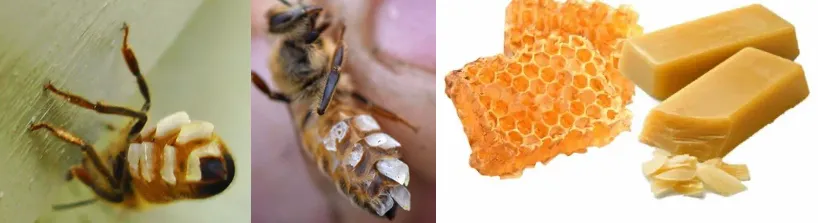
| Feature | Detail |
|---|---|
| Source | Wax glands on worker bee abdomen (segments 4, 5, 6, 7) |
| Chemical name | Myristyl Palmitate (ester of fatty acids + long-chain alcohols) |
| Conversion ratio | 20 kg honey consumed to produce 1 kg wax |
| Highest wax yield | Rock Bee (Apis dorsata) |
| Uses | Candles, pharmaceuticals, cosmetics, food wrapping, furniture polish, leather conditioning, tablet coatings |
- Wax glands are most active in young workers aged 12-18 days. Wax is secreted as tiny transparent scales, then chewed and moulded into comb.
3. Royal Jelly
| Feature | Detail |
|---|---|
| Source | Hypopharyngeal glands of workers (located in the head, most developed at 6-12 days — nurse bee age) |
| Key vitamin | Pantothenic acid |
| Composition | Proteins, sugars, lipids, B-complex vitamins |
| Function | Exclusive food of the queen throughout life; transforms a regular larva into a queen |
| Uses | Increases vigour and fertility; sold as nutritional supplement |
- Royal jelly is what makes a queen -- a remarkable example of how nutrition determines caste in honey bees.
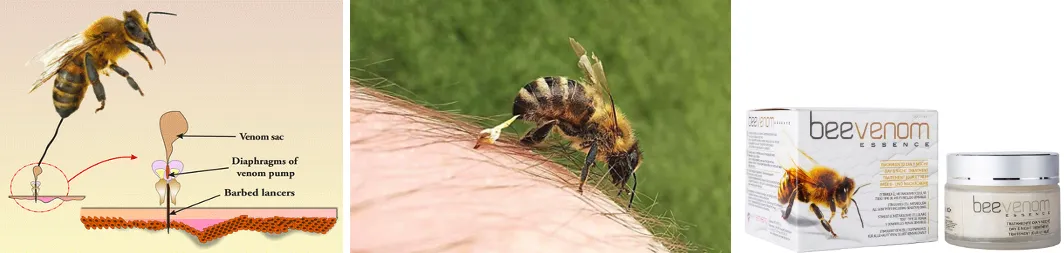
4. Bee Venom
| Feature | Detail |
|---|---|
| Source | Modified ovipositor (sting) of female bees |
| Main protein | Melittin (Melitin) — the principal protein in bee venom; responsible for the pain and lytic activity |
| Other components | Formic acid, apamin, phospholipase A2 |
| Associated gland | Dufour's gland (alkaline, at base of sting) |
| Medicinal use | Treats rheumatism and arthritis -- called Apitherapy |
| Colony odour | Secretion of Nasanov's gland (last abdominal segment of workers) creates colony-specific scent |
- Only female bees (queens and workers) possess stings since the sting evolved from the egg-laying organ.
5. Propolis
- A resinous substance collected from tree exudates, used by bees to seal cracks and maintain a sterile hive environment.
- Powerful antimicrobial, antifungal, and antioxidant properties.
- Used in health supplements, ointments, and oral care products.
6. Pollen
| Feature | Detail |
|---|---|
| Collection | Bees have electrostatically charged body hairs that attract pollen |
| Transport | Packed into corbicula (pollen basket on hind tibia) using pollen comb and pollen press |
| Load per bee | 10-30 mg (about 25% of body weight) |
| Storage | Mixed with honey to form bee bread (undergoes lactic acid fermentation for better nutrition) |
| Status | Considered a superfood -- contains proteins, vitamins, minerals, lipids, antioxidants |
Comparison of All Six Products
| Product | Source Gland/Part | Key Chemical | Primary Use |
|---|---|---|---|
| Honey | Nectar + invertase enzyme | 78% sugars (glucose + fructose) | Food, medicine, Ayurveda |
| Beeswax | Wax glands (abdomen segments 4-7) | Myristyl Palmitate | Candles, cosmetics, polish |
| Royal Jelly | Hypopharyngeal glands (worker head) | Pantothenic acid + proteins | Health supplement, queen rearing |
| Bee Venom | Modified ovipositor (sting) | Formic acid, melittin | Apitherapy (rheumatism) |
| Propolis | Collected from tree resin | Complex resins | Antimicrobial sealant, supplements |
| Pollen | Collected from flowers | Proteins, vitamins | Superfood, bee bread |
Summary Table
| Key Fact | Answer |
|---|---|
| Sugar in honey | 78% |
| Max sucrose (FSSAI) | 5% |
| Max moisture for pure honey | 20% |
| Honey pH | 3.4-6.1 (acidic) |
| Honey specific gravity (pure) | 1.25-1.44 g/cc |
| Honey granulation temp | Below 14 C |
| Honey-to-wax ratio | 20 kg honey = 1 kg wax |
| Wax chemical name | Myristyl Palmitate |
| Royal jelly source | Hypopharyngeal glands of workers |
| Bee venom therapy | Apitherapy |
| Colony odour gland | Nasanov's gland |
| Pollen load per bee | 10-30 mg (25% body weight) |
TIP
Quick Exam Recall: Wax glands = abdomen (segments 4-7). Royal jelly = hypopharyngeal glands (head). Bee venom = modified ovipositor. 20 kg honey = 1 kg wax. Apitherapy = bee venom for rheumatism.
References
1 source
References
Summary Cheat Sheet
| Concept / Topic | Key Details |
|---|---|
| Honey – sugar content | 78% (glucose + fructose) |
| Honey – max sucrose (FSSAI) | 5% |
| Honey – max moisture | 20% (above this, fermentation occurs) |
| Honey – pH | 3.4-6.1 (acidic) |
| Honey granulation | Below 14 °C — dextrose crystallises (natural, not spoilage) |
| Honey – key enzyme | Invertase — converts sucrose to glucose + fructose |
| Honey – vitamins | B1, B2, B3, B5, B6, C — NOT Vitamin E |
| Pinocembrin | Key antioxidant in honey; anti-inflammatory, neuroprotective |
| Medicinal honey | Apis florea honey — high in dextrins |
| Honey purity – hydrometer | Specific gravity 1.25-1.44 g/cc |
| Honey purity – invert sugar | Resorcinol and Aniline Chloride tests |
| Flowers for 500 g honey | 2 million flowers visited |
| Beeswax – source | Wax glands on worker abdomen (segments 4, 5, 6, 7); active at 12-18 days |
| Beeswax – chemical name | Myristyl Palmitate |
| Beeswax – conversion | 20 kg honey = 1 kg wax |
| Highest wax yield | Rock Bee (Apis dorsata) |
| Royal jelly – source | Hypopharyngeal glands of workers (head, developed at 6-12 days) |
| Royal jelly – key vitamin | Pantothenic acid |
| Bee venom – source | Modified ovipositor (sting); only female bees |
| Bee venom – components | Formic acid, melittin, apamin |
| Apitherapy | Bee venom treatment for rheumatism and arthritis |
| Propolis | Resinous substance from trees; antimicrobial, antifungal, antioxidant |
| Pollen – transport | Corbicula (pollen basket on hind tibia); 10-30 mg per bee |
| Bee bread | Pollen + honey; undergoes lactic acid fermentation |
| Nasanov's gland | Produces colony odour; located on last abdominal segment |
TIP
Next: Lesson 05 covers bee behaviour -- swarming, supersedure, absconding, the famous waggle dance, and bee morphology.