🤹♀️ Silkworm Life Cycle, Harvesting, and Processing
Moulting, silk composition, diapause, disease-free laying (DFL), grainage, mounting, reeling, stifling, and denier -- all key terms explained
In the previous lesson, we compared the five silkworm types -- their host plants, voltinism, and silk characteristics. Now we follow a single silkworm through its complete life cycle, from egg to harvested cocoon.
In a sericulture unit in Mysore, a farmer watches his 5th-instar silkworm larvae stop eating and turn translucent -- the sign that they are ready to spin. Over the next 48 hours, each larva will produce a continuous silk filament of up to 1,300 metres, wrapping itself inside a cocoon from outside to inside. Understanding the silkworm life cycle -- from egg through moulting, spinning, and harvesting -- is essential for both practical sericulture and competitive exams.
This lesson covers:
- Life cycle overview -- egg, larva, pupa, adult
- Moulting and silk composition (fibroin + sericin)
- Spinning and Disease-Free Laying (DFL)
- Diapause -- arrested development
- Grainage, mounting, harvesting, and processing -- from cocoon to raw silk
Life Cycle Overview
Silk is made of proteins secreted in fluid state by the silkworm caterpillar. The silkworm undergoes complete metamorphosis with four stages:
Pro Content Locked
Upgrade to Pro to access this lesson and all other premium content.
₹99 charged monthly · Cancel anytime
- All Agriculture & Banking Courses
- AI Lesson Questions (100/day)
- AI Doubt Solver (50/day)
- Glows & Grows Feedback (30/day)
- AI Section Quiz (20/day)
- 22-Language Translation (100/day)
- Recall Questions (20/day)
- AI Quiz (15/day)
- AI Quiz Paper Analysis (100/day)
- AI Step-by-Step Explanations (100/day)
- Spaced Repetition Recall (FSRS)
- AI Tutor
- Immersive Text Questions
- Audio Lessons — Hindi & English
- Mock Tests & Previous Year Papers
- Summary & Mind Maps
- XP, Levels, Leaderboard & Badges
- Generate New Classrooms
- Voice AI Teacher (AgriDots Live)
- AI Revision Assistant
- Knowledge Gap Analysis
- Interactive Revision (LangGraph)
🔒 Secure via Razorpay · Cancel anytime · No hidden fees
In the previous lesson, we compared the five silkworm types -- their host plants, voltinism, and silk characteristics. Now we follow a single silkworm through its complete life cycle, from egg to harvested cocoon.
In a sericulture unit in Mysore, a farmer watches his 5th-instar silkworm larvae stop eating and turn translucent -- the sign that they are ready to spin. Over the next 48 hours, each larva will produce a continuous silk filament of up to 1,300 metres, wrapping itself inside a cocoon from outside to inside. Understanding the silkworm life cycle -- from egg through moulting, spinning, and harvesting -- is essential for both practical sericulture and competitive exams.
This lesson covers:
- Life cycle overview -- egg, larva, pupa, adult
- Moulting and silk composition (fibroin + sericin)
- Spinning and Disease-Free Laying (DFL)
- Diapause -- arrested development
- Grainage, mounting, harvesting, and processing -- from cocoon to raw silk
Life Cycle Overview
Silk is made of proteins secreted in fluid state by the silkworm caterpillar. The silkworm undergoes complete metamorphosis with four stages:
Egg -- Caterpillar (Larva) -- Pupa -- Moth (Adult)
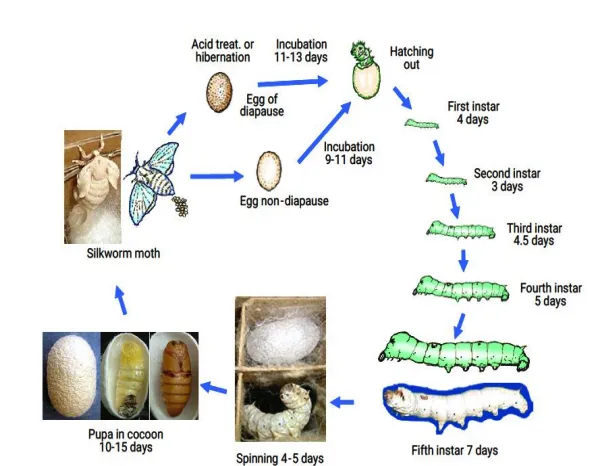
- Total life cycle: 40-55 days
- Larval period (feeding + moulting): 30-35 days
- Humans intervene at the cocoon stage to harvest silk before the moth emerges, keeping the continuous filament unbroken.
- Two processes are essential: silkworm rearing (eggs to cocoons) and moriculture (mulberry cultivation for feed). Both must be synchronised.
Moulting
- Moulting = silkworm stops feeding, becomes immobile, and sheds its old skin to accommodate rapid growth. The inactivity period is called moult sleep (24-48 hours).
- Silkworm has 5 instars and moults 4 times during the larval stage (hence called tetramoulters).
- 5 moults total across the entire life cycle (including the pupal moult).
- After the 5th instar, the silkworm ceases feeding and forms its cocoon from outside to inside (outermost layers first, working progressively inward).
Silk Composition
The silk filament is a composite structure:
| Component | Percentage | Nature | Location |
|---|---|---|---|
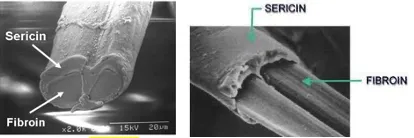
| Fibroin | 75% | Structural protein (glycine, alanine, tyrosine) | Core -- forms two thin fibres called brins |
| Sericin | 25% | Gummy adhesive protein | Sheath -- cements the two brins together |
- Liquid silk is secreted from two labial glands (modified salivary glands, up to 5x the body length). It emerges from a single spinneret (nozzle on the lower lip) and hardens on air contact.
- Fibroin gives silk its strength and lustre. Sericin acts as natural glue.
- Removing sericin from raw silk is called degumming (done by boiling in mild alkaline soap solution).
TIP
Exam Trap: Fibroin = protein (structural core). Sericin = gummy substance (adhesive coating). Do NOT reverse these. 75% fibroin, 25% sericin.
Spinning
- Optimum conditions for spinning: 24 C, 60-70% RH.
- Spinning takes 1-2 days (48 hours) in multivoltine races.
- The larva moves its head in a figure-of-eight pattern, laying silk in successive layers.
Disease-Free Laying (DFL)
| Term | Meaning |
|---|---|
| DFL | A group of eggs laid by a moth certified as disease-free |
| 1 DFL | = 400 eggs |
| Marketing standard | 20,000 eggs/box (universal standard unit) |
| Key disease checked | Pebrine (Nosema bombycis) -- transmitted from mother to offspring through eggs (transovarial) |
| Method | Mother moth's body is crushed and examined microscopically for Nosema spores after egg laying |
Diapause
- Diapause = arrested development with very low metabolic activity, allowing survival through unfavourable conditions (cold, drought).
- Chrysalis = pupa of silkworm (from Greek chrysos = gold).
- In tasar silkworm: first crop pupa diapauses for 1 week (monsoon); second crop pupa diapauses for about 6 months (winter to next monsoon).
- Bombyx mori: long-day exposure triggers diapause hormone from suboesophageal ganglion, causing next-generation eggs to enter diapause.
Breaking Diapause
| Method | How It Works |
|---|---|
| Hot HCl treatment | Disrupts biochemical signals maintaining diapause |
| Chilling of eggs | Storage at ~5 C for 40-60 days mimics winter; eggs resume development when warmed |
| Black boxing | Eggs kept in dark enclosure; opened simultaneously for uniform, synchronised hatching |
- Brushing = gently separating newly hatched larvae (chawki worms) and transferring to rearing sheets using a soft brush.
Grainage and Mounting
| Term | Definition |
|---|---|
| Grainage | Specialised facility for producing silkworm eggs (seed); controlled mating, egg laying, disease examination, cold storage |
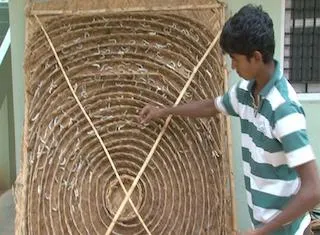
| Mounting | Transferring ripe worms (mature 5th-instar larvae that have stopped eating and become translucent) to cocoonages for spinning |
| Mountage | Device providing physical support for larvae to spin cocoons (spirals, grids, frames) |
| Chandrika | Popular round bamboo-frame mountage in South India |
Harvesting and Processing
TIP
Key Terms: Stifling = killing cocoon. Reeling = unwinding silk. Riddling = sorting cocoons. Filature = reeling factory. Denier = unit of silk thickness.
| Step | Process | Detail |
|---|---|---|
| 1 | Harvesting | Done on the 5th day of spinning (pupa has hardened sufficiently) |
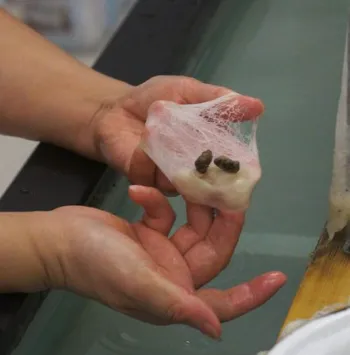
| 2 | Stifling | Killing the pupa inside using steam, hot air, or sunlight to prevent moth emergence breaking the filament |
| 3 | Riddling | Sorting cocoons by size, shape, colour, and quality; defective ones separated |
| 4 | Reeling | Cocoons soaked in hot water (softens sericin); filament end found and drawn out; 5-10 filaments combined into single raw silk thread |
| 5 | Filature | Large factory with automatic reeling machines for uniform raw silk production |
Key Numbers
| Fact | Value |
|---|---|
| Silk thread per larva | 650-1,300 m |
| Raw silk from cocoons | 1 kg from 7-8 kg cocoons |
| Quality standard (thickness) | 14 denier (internationally accepted) |
| Denier definition | Weight in grams of 9,000 metres of yarn |
| Indian silk bale | 50 kg (vs. international standard of 60 kg) |
| Reelability | % ratio of unbroken filament to whole filament length |
| Dupion silk | Silk reeled from double cocoons (two larvae spin together) -- irregular, coarse texture with natural slubs |
Summary Table
| Key Term | Definition/Value |
|---|---|
| Complete metamorphosis | Egg -- Larva -- Pupa -- Adult |
| Instars | 5 (4 moults = tetramoulters) |
| Total life cycle | 40-55 days |
| Fibroin | 75% -- structural protein core |
| Sericin | 25% -- gummy adhesive sheath |
| Two silk fibres (core) | Brins |
| Degumming | Removing sericin |
| Spinning temperature | 24 C, 60-70% RH |
| DFL | Disease-Free Laying = 400 eggs |
| Marketing unit | 20,000 eggs/box |
| Pebrine detection | Mother moth examination |
| Diapause breaking | Hot HCl, chilling, black boxing |
| Chrysalis | Pupa of silkworm |
| Stifling | Killing cocoon (steam/hot air) |
| Reeling | Unwinding silk filament |
| Riddling | Sorting cocoons |
| Filature | Reeling factory |
| Denier (quality standard) | 14 denier (international) |
| Thread per larva | 650-1,300 m |
| Raw silk yield | 1 kg from 7-8 kg cocoons |
| Indian silk bale | 50 kg (international = 60 kg) |
TIP
Quick Exam Recall: Fibroin 75% (protein core = brins), Sericin 25% (gummy sheath). Stifling = kill pupa. Reeling = unwind silk. Riddling = sort cocoons. 14 denier = international quality. 1 DFL = 400 eggs. Chandrika = South Indian mountage.
References
1 source
References
Summary Cheat Sheet
| Concept / Topic | Key Details |
|---|---|
| Complete metamorphosis | Egg → Larva → Pupa → Adult |
| Total life cycle | 40-55 days; larval period = 30-35 days |
| Instars | 5 instars, 4 moults = tetramoulters |
| 5 moults total | Including pupal moult across entire life cycle |
| Cocoon spinning | From outside to inside; figure-of-eight head movement |
| Spinning conditions | 24 °C, 60-70% RH; takes 48 hours |
| Fibroin | 75% of silk; structural protein core; forms two brins |
| Sericin | 25% of silk; gummy adhesive sheath cementing brins |
| Labial glands | Modified salivary glands secreting liquid silk; up to 5x body length |
| Spinneret | Single nozzle on lower lip; silk hardens on air contact |
| Degumming | Removing sericin by boiling in mild alkaline soap |
| DFL (Disease-Free Laying) | 400 eggs per DFL; marketing unit = 20,000 eggs/box |
| Pebrine detection | Mother moth crushed and examined for Nosema bombycis spores |
| Diapause | Arrested development; low metabolic activity for survival |
| Chrysalis | Pupa of silkworm (Greek chrysos = gold) |
| Breaking diapause | Hot HCl, chilling at ~5 °C for 40-60 days, black boxing |
| Grainage | Facility for producing silkworm eggs (seed); controlled mating |
| Mounting | Transferring ripe worms to cocoonages for spinning |
| Chandrika | Round bamboo-frame mountage in South India |
| Stifling | Killing cocoon pupa (steam/hot air/sunlight) |
| Reeling | Unwinding silk filament from cocoon in hot water |
| Riddling | Sorting cocoons by size, shape, quality |
| Filature | Large reeling factory with automatic machines |
| Silk thread per larva | 650-1,300 m |
| Raw silk yield | 1 kg from 7-8 kg cocoons |
| Denier | Weight in grams of 9,000 m of yarn; standard = 14 denier |
| Indian silk bale | 50 kg (international = 60 kg) |
| Dupion silk | From double cocoons (two larvae spin together) |
TIP
Next: Lesson 04 covers the diseases and pests of silkworms -- Pebrine, Grasserie, Flacherie, Muscardine, Uzi Fly, and Dermestid Beetle.