🐣 Introduction to Nematology
What are nematodes, where they live, and why they matter for agriculture -- covering definition, habitat, economic losses, and disease complexes
Imagine pulling up a healthy-looking tomato plant from your field and finding swollen, knotted roots underneath. The plant was yellowing and stunting despite adequate water and fertiliser. The culprit? Microscopic worms called nematodes living hidden in the soil. In India alone, nematodes cause crop losses worth over Rs. 10,000 crore every year -- yet most farmers never see them. This lesson introduces you to these invisible enemies of agriculture.
This lesson covers:
- What is nematology -- definition, etymology, and common names
- Habitat -- where nematodes live and their distribution in soil
- Economic importance -- crop losses and the most damaging groups
- Disease complexes -- how nematodes multiply damage with fungi, bacteria, and viruses
- Helminthology -- animal parasitic nematodes for exam awareness
All sections are high-yield for IBPS AFO, NABARD, and ICAR exams.
What Is Nematology?
Nematology is the branch of biological science that deals with a complex, diverse group of round worms known as nematodes. These organisms occur worldwide in essentially every environment -- from mountain tops to ocean floors, from the Arctic to the tropics.
Pro Content Locked
Upgrade to Pro to access this lesson and all other premium content.
₹99 charged monthly · Cancel anytime
- All Agriculture & Banking Courses
- AI Lesson Questions (100/day)
- AI Doubt Solver (50/day)
- Glows & Grows Feedback (30/day)
- AI Section Quiz (20/day)
- 22-Language Translation (100/day)
- Recall Questions (20/day)
- AI Quiz (15/day)
- AI Quiz Paper Analysis (100/day)
- AI Step-by-Step Explanations (100/day)
- Spaced Repetition Recall (FSRS)
- AI Tutor
- Immersive Text Questions
- Audio Lessons — Hindi & English
- Mock Tests & Previous Year Papers
- Summary & Mind Maps
- XP, Levels, Leaderboard & Badges
- Generate New Classrooms
- Voice AI Teacher (AgriDots Live)
- AI Revision Assistant
- Knowledge Gap Analysis
- Interactive Revision (LangGraph)
🔒 Secure via Razorpay · Cancel anytime · No hidden fees
Imagine pulling up a healthy-looking tomato plant from your field and finding swollen, knotted roots underneath. The plant was yellowing and stunting despite adequate water and fertiliser. The culprit? Microscopic worms called nematodes living hidden in the soil. In India alone, nematodes cause crop losses worth over Rs. 10,000 crore every year -- yet most farmers never see them. This lesson introduces you to these invisible enemies of agriculture.
This lesson covers:
- What is nematology -- definition, etymology, and common names
- Habitat -- where nematodes live and their distribution in soil
- Economic importance -- crop losses and the most damaging groups
- Disease complexes -- how nematodes multiply damage with fungi, bacteria, and viruses
- Helminthology -- animal parasitic nematodes for exam awareness
All sections are high-yield for IBPS AFO, NABARD, and ICAR exams.
What Is Nematology?
Nematology is the branch of biological science that deals with a complex, diverse group of round worms known as nematodes. These organisms occur worldwide in essentially every environment -- from mountain tops to ocean floors, from the Arctic to the tropics.
NOTE
Nematology sits at the intersection of zoology, botany, and plant pathology, making it a truly interdisciplinary science essential for crop protection.
Etymology
The word "nematode" comes from two Greek words:
| Greek Word | Meaning |
|---|---|
| Nema | Thread |
| Oides | Resembling / like |
The terms nema and nematology were coined by N. A. Cobb (1932), who laid the foundation for modern nematological science.
Common Names
Nematodes are known by different names across the world:
| Common Name | Reason | Region |
|---|---|---|
| Eelworms | Serpentine, eel-like movement | Europe |
| Nemas | Short form of nematode | United States |
| Round worms | Round (circular) cross-section | Used by zoologists |
| Verms | Cylindrical body tapering at both ends | General usage |
Habitat -- Where Do Nematodes Live?
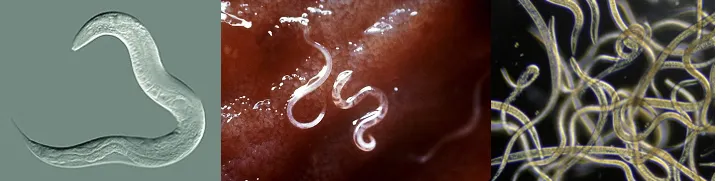
A handful of soil from anywhere in the world -- from fresh water to brackish water, from soil to plant tissues and even from blood streams of humans and livestock -- contains nematodes. This remarkable ability to survive in virtually every habitat underscores their evolutionary success.
Therefore, nematodes are cosmopolitan in nature, meaning they are found across all geographic regions and climatic zones without exception.
Cobb's Famous Quote
N.A. Cobb (1915), the Father of American Nematology, described the abundance of nematodes with this vivid statement:
"In short, if all the matter in the universe except the nematodes were swept away, our world would still be dimly recognizable ... we should find its mountains, hills, vales, rivers, lakes, and oceans represented by a film of nematodes."
This illustrates that nematodes are so numerous and widespread that the outline of the entire planet could be traced purely by their distribution.
Distribution in Soil
- Nematodes are found in soil either randomly, uniformly, or in clusters.
- In a standing crop, nematodes are present in clusters -- damage is therefore often patchy rather than uniform across a field.
- One hectare of cultivable land contains approximately 7.5 x 10^9 nematodes.
- Nematode damage is frequently overlooked because symptoms like slow growth, stunting, and yellowing mimic nutritional or water-related disorders.
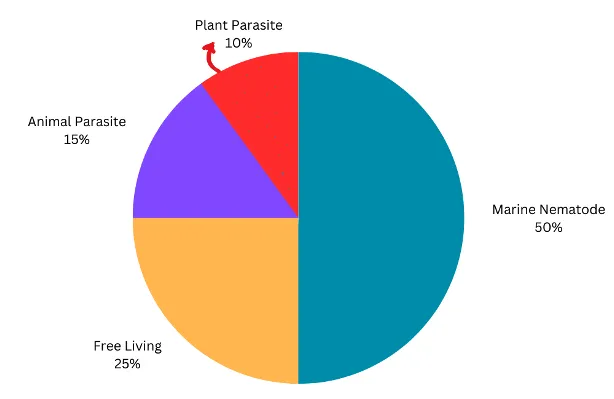
Habitat Breakdown
Nematodes occupy remarkably diverse ecological niches:
| Habitat Category | Percentage |
|---|---|
| Marine nematodes | 50% |
| Free-living | 25% |
| Animal parasitic | 15% |
| Plant parasitic | 10% |
Although plant parasitic nematodes constitute the smallest proportion, they cause the greatest economic damage to agriculture.
Types of Nematode Studies
Nematodes that parasitise humans and animals are called helminthes, and their study is known as Helminthology. These are typically larger in size and visible to the naked eye.
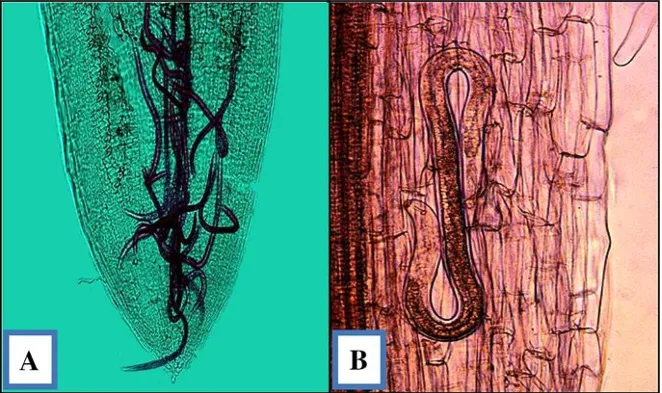
The plant parasitic forms are studied under Plant Nematology -- a science between zoology and botany that is now an independent, well-established discipline of Plant Protection.
| Branch | Subjects | Nematode Size |
|---|---|---|
| Helminthology | Human and animal parasites | Larger, often visible |
| Plant Nematology | Plant parasitic nematodes | Microscopic |
Economic Importance
Plant-parasitic nematodes are costly burdens of crop production and represent a significant constraint on global food security. Their hidden nature underground makes them particularly dangerous -- symptoms mimic nutrient deficiency, so damage is routinely under-diagnosed.
- Nematodes are more serious in warmer areas than cooler ones, and more in horticultural crops than field crops.
- In India, overall crop loss due to nematodes is 21.3%, amounting to approximately Rs. 10,200 crore ($1.2 billion USD) annually.
Crop-Wise Losses in India
| Crop | Estimated Loss (Rs. million) |
|---|---|
| Citrus | 9,828.22 |
| Banana | 9,710.46 |
| Tomato | 6,035.20 |
| Brinjal | 3,499.12 |
| Okra | 2,480.86 |
Most Damaging Nematode Groups
Root-knot nematodes (Meloidogyne spp.), cyst nematodes (Heterodera and Globodera spp.), and lesion nematodes (Pratylenchus spp.) rank at the top of the most economically important species due to their wide host range and severe damage.
In India, the cereal cyst nematode Heterodera avenae causes the "Molya" disease of wheat and barley in Rajasthan, Punjab, Haryana, Himachal Pradesh, and Jammu & Kashmir.
Disease Complexes -- How Nematodes Multiply Damage
Beyond direct damage, nematodes associate with bacteria, fungi, and viruses to cause complex diseases that are far more destructive than either pathogen acting alone.
1. As Incitants
Nematodes break the plant's defence wall, creating wound sites for secondary pathogens.
Example: Pratylenchus brachyurus creates infection sites for the fungus Phytophthora parasitica, causing "Black Shank Disease of Tobacco."
2. As Aggravators
Nematodes modify host tissue, making the plant more susceptible to other pathogens.
Fusarium wilt is more severe in the presence of root-knot nematode (Meloidogyne spp.) -- one of the most well-documented nematode-fungus synergies.
| Disease Complex | Nematode | Secondary Pathogen |
|---|---|---|
| Vascular wilt of tomato | Meloidogyne incognita | Fusarium oxysporum f. lycopersici |
| Cauliflower disease of strawberry | Aphelenchoides fragariae | Clavibacter fascians |
3. As Vectors
Nematodes carry and transmit viruses from infected to healthy plants. They transmit only RNA viruses.
IMPORTANT
NEPO = Nematode-transmitted Polyhedral viruses (transmitted by Xiphinema, Longidorus, Paralongodorus). NETU = Nematode-transmitted Tubular viruses (transmitted by Trichodorus, Paratrichodorus). All virus-vector nematodes belong to order Dorylaimida.
Hewitt, Raski, and Goheen (1958) discovered that Xiphinema index transmits Grapevine Fan Leaf Virus -- the landmark discovery establishing nematodes as virus vectors.
| Virus Type | Virus Shape | Vector Genera |
|---|---|---|
| NEPO | Polyhedral | Xiphinema, Longidorus, Paralongodorus |
| NETU | Tubular | Trichodorus, Paratrichodorus |
Helminthology -- Animal Parasitic Nematodes
Nematodes parasitic on animals and humans are called helminths and are larger in size than plant parasitic forms.
| SN | Nematode (APN) | Disease |
|---|---|---|
| 1. | Giant Nematode (Placenta gigentissima) | It is the largest animal parasitic nematode. It is found in the placenta (clues in the name) of sperm whales. It can reach a whopping 8.4 meters (28 ft) and is 2.4 cm in diameter. |
| 2. | Pin Worm (Enterobius vermicularis) | It causes severe itching in anal areas in children. |
| 3. | Guinea worm (Dracunculus medineusis) | Also known as Guinea worm. It causes 'Naru Bala' disease in human. |
| 4. | Onchocerca volvulus | It causes Onchocerciasis of river blindness which is common in Africa. It is transmitted by Black Fly, Simulium sp. |
| 5. | Filarial Worm (Wuchereria bancrofti) | It causes 'Elephantiasis' or 'Filariasis' disease in man. |
| 6. | Round Worm (Ascaris lumbricoides) | It is known as Round Worm. It is an intestinal parasite of human. |
Summary Table
| Topic | Key Fact |
|---|---|
| Definition | Study of round worms (Phylum Nematoda) |
| Greek root | Nema (thread) + Oides (resembling) |
| Father of Modern Nematology | N.A. Cobb |
| Distribution | Cosmopolitan -- found everywhere |
| Nematodes per hectare | 7.5 x 10^9 |
| Plant parasitic proportion | 10% of all nematodes |
| India crop loss | 21.3% (Rs. 10,200 crore/year) |
| Top 3 damaging genera | Meloidogyne, Heterodera/Globodera, Pratylenchus |
| Disease complex roles | Incitant, Aggravator, Vector |
| Virus types transmitted | NEPO (polyhedral) and NETU (tubular) |
| Virus vector order | Dorylaimida |
TIP
Exam mnemonic -- "CANE" for nematode roles in disease complexes: Carrier (vector), Aggravator, Nematode alone, Entry-creator (incitant).
References
- Dropkin, V.H. 1980. Introduction to plant nematology. John Wiley and sons, INC. New York.
- Singh, R.S and Sitaramaiah, K. 1994. Plant pathogens. The plant parasitic nematodes. Oxford & IBH Pub. Co. Pvt. Ltd. New Delhi.
- Parvata Reddy, P. 1983. Plant nematology. Agricole Pub. Co., New Delhi.
- Southey, J. F. Laboratory methods for work with plant and soil nematodes Tech.
- Bull. Min. Agric. Fish. Food. Her Majesty's Stationary Office, London.
- Walia, R. K and Bajaj, H. K (2014). Textbook of Introductory Plant Nematology. Directorate of Knowledge Management in Agriculture, ICAR, New Delhi.
- Kumar, V., Khan, M.R. & Walia, R.K. Crop Loss Estimations due to Plant-Parasitic Nematodes in Major Crops in India. Natl. Acad. Sci. Lett. 43, 409-412 (2020). https://doi.org/10.1007/s40009-020-00895-2
Summary Cheat Sheet
| Concept / Topic | Key Details |
|---|---|
| Definition | Study of round worms (Phylum Nematoda) |
| Greek root | Nema (thread) + Oides (resembling) |
| Father of Modern Nematology | N.A. Cobb |
| Distribution | Cosmopolitan -- found everywhere |
| Nematodes per hectare | 7.5 x 10^9 |
| Plant parasitic proportion | 10% of all nematodes |
| India crop loss | 21.3% (Rs. 10,200 crore/year) |
| Top 3 damaging genera | Meloidogyne, Heterodera/Globodera, Pratylenchus |
| Disease complex roles | Incitant, Aggravator, Vector |
| Virus types transmitted | NEPO (polyhedral) and NETU (tubular) |
| Virus vector order | Dorylaimida |
TIP
Next: Lesson 02 covers the history of nematology -- key discoveries, five landmarks, and the growth of nematological research in India.