🚥 Ecology -- Nematode Interactions and Biocontrol
Nematode interactions with fungi, bacteria, and viruses (NEPO/NETU), plus entomopathogenic nematodes (EPNs) for biological control
In the previous lesson, we covered the nematode life cycle -- stages, moulting, hatching, and voltinism. Now we explore how nematodes interact with other organisms in the soil ecosystem, both as partners in disease and as targets for biological control.
A farmer in Maharashtra notices that his tomato crop is wilting severely despite using a Fusarium-resistant variety. When the roots are examined, they are covered with root-knot nematode galls. The nematode has broken the disease resistance, allowing Fusarium to overwhelm the plant. This is a classic example of a nematode-fungus disease complex.
This lesson covers:
- Nematode-fungus interactions -- disease complexes that amplify crop damage
- Nematode-bacterium interactions -- Tundu disease, cauliflower disease
- Nematode-virus interactions -- NEPO and NETU virus transmission
- Entomopathogenic nematodes (EPNs) -- beneficial nematodes for insect pest control
Why Nematode Interactions Matter
Nematodes do not exist in isolation in the soil. They interact with fungi, bacteria, and viruses in ways that can dramatically increase disease severity:
Pro Content Locked
Upgrade to Pro to access this lesson and all other premium content.
₹99 charged monthly · Cancel anytime
- All Agriculture & Banking Courses
- AI Lesson Questions (100/day)
- AI Doubt Solver (50/day)
- Glows & Grows Feedback (30/day)
- AI Section Quiz (20/day)
- 22-Language Translation (100/day)
- Recall Questions (20/day)
- AI Quiz (15/day)
- AI Quiz Paper Analysis (100/day)
- AI Step-by-Step Explanations (100/day)
- Spaced Repetition Recall (FSRS)
- AI Tutor
- Immersive Text Questions
- Audio Lessons — Hindi & English
- Mock Tests & Previous Year Papers
- Summary & Mind Maps
- XP, Levels, Leaderboard & Badges
- Generate New Classrooms
- Voice AI Teacher (AgriDots Live)
- AI Revision Assistant
- Knowledge Gap Analysis
- Interactive Revision (LangGraph)
🔒 Secure via Razorpay · Cancel anytime · No hidden fees
In the previous lesson, we covered the nematode life cycle -- stages, moulting, hatching, and voltinism. Now we explore how nematodes interact with other organisms in the soil ecosystem, both as partners in disease and as targets for biological control.
A farmer in Maharashtra notices that his tomato crop is wilting severely despite using a Fusarium-resistant variety. When the roots are examined, they are covered with root-knot nematode galls. The nematode has broken the disease resistance, allowing Fusarium to overwhelm the plant. This is a classic example of a nematode-fungus disease complex.
This lesson covers:
- Nematode-fungus interactions -- disease complexes that amplify crop damage
- Nematode-bacterium interactions -- Tundu disease, cauliflower disease
- Nematode-virus interactions -- NEPO and NETU virus transmission
- Entomopathogenic nematodes (EPNs) -- beneficial nematodes for insect pest control
Why Nematode Interactions Matter
Nematodes do not exist in isolation in the soil. They interact with fungi, bacteria, and viruses in ways that can dramatically increase disease severity:
- Nematodes create mechanical wounds that bypass the plant's natural defence barriers.
- They alter host tissue, making it suitable for secondary pathogen colonisation.
- In some cases, the nematode-pathogen combination breaks disease resistance in resistant cultivars.
Nematode-Fungus Interaction
First observed by Atkinson (1892) in cotton -- this historic observation established the concept of disease complexes in plant pathology.
The most important example: Fusarium wilt is more severe in the presence of root-knot nematode (Meloidogyne spp.). The nematode modifies root tissues and suppresses plant defences, creating conditions that favour the Fusarium fungus.
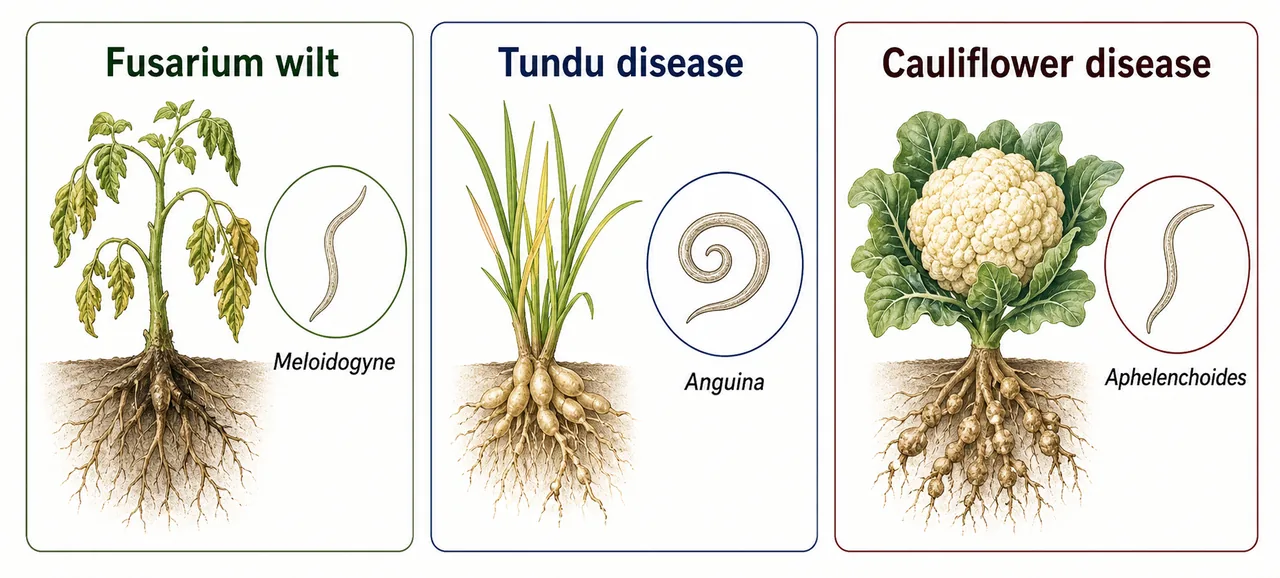
| Disease Complex | Nematode | Fungus | Crop |
|---|---|---|---|
| Vascular wilt | Meloidogyne incognita | Fusarium oxysporum f. lycopersici | Tomato |
| Panama wilt | Radopholus similis | Fusarium oxysporum f. sp. cubense | Banana |
| Black shank | Pratylenchus brachyurus | Phytophthora parasitica | Tobacco |
Nematode-Bacterium Interaction
Nematode-bacterium interactions are fewer than nematode-fungal interactions, but the known examples are agriculturally significant.
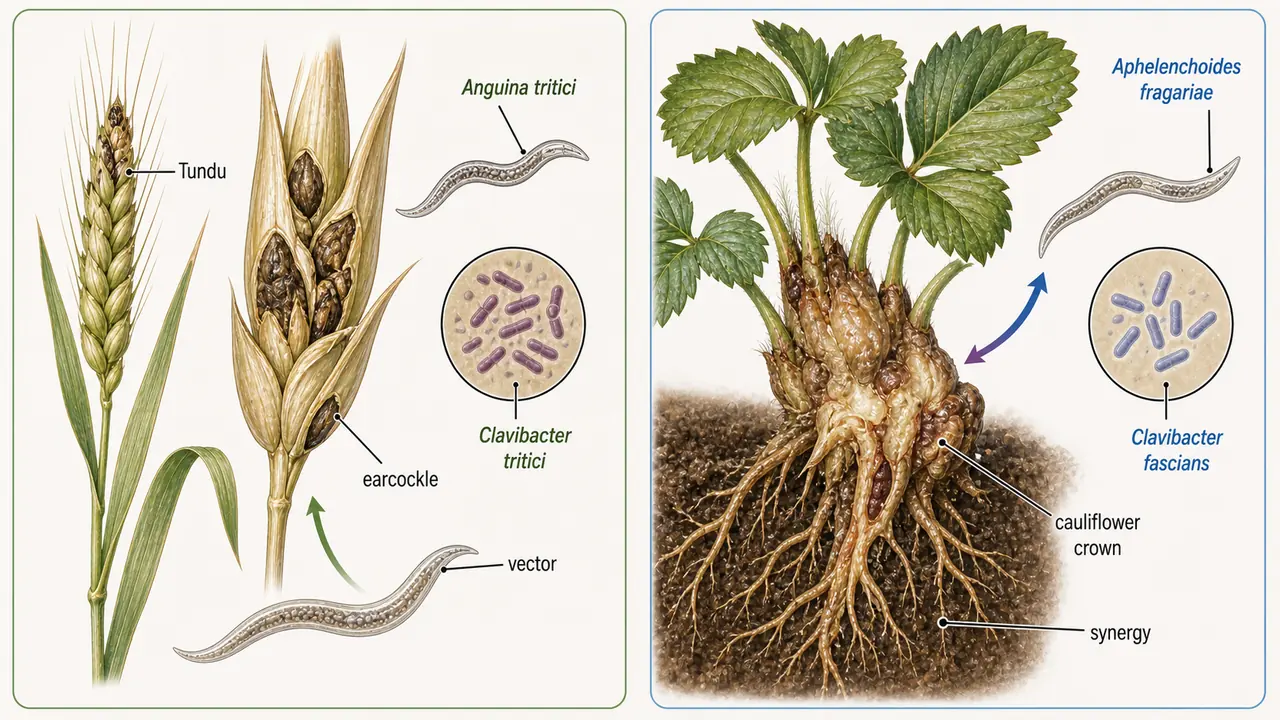
Tundu (Yellow Ear Rot) Disease of Wheat
- Anguina tritici (seed-gall nematode) + Clavibacter tritici (bacterium)
- The nematode acts as a vector, carrying the bacterium on its surface.
- Nematode alone causes earcockle disease; together they cause the more destructive Tundu disease.
- This is an obligate association -- the bacterium cannot cause disease without the nematode.
Cauliflower Disease of Strawberry
- Aphelenchoides fragariae (foliar nematode) + Clavibacter fascians (bacterium)
- Neither pathogen causes significant damage alone.
- Together, they produce severe symptoms including stunting, malformation, and the characteristic cauliflower-like crown growth.
- A classic example of synergistic interaction.
Nematode-Virus Interaction
In nematode-virus complexes, the nematode serves as a vector, carrying and transmitting the virus from infected to healthy plants as it feeds.
Key facts:
- Nematodes transmit only RNA viruses (no DNA viruses).
- All virus-vector nematodes belong to Order Dorylaimida.
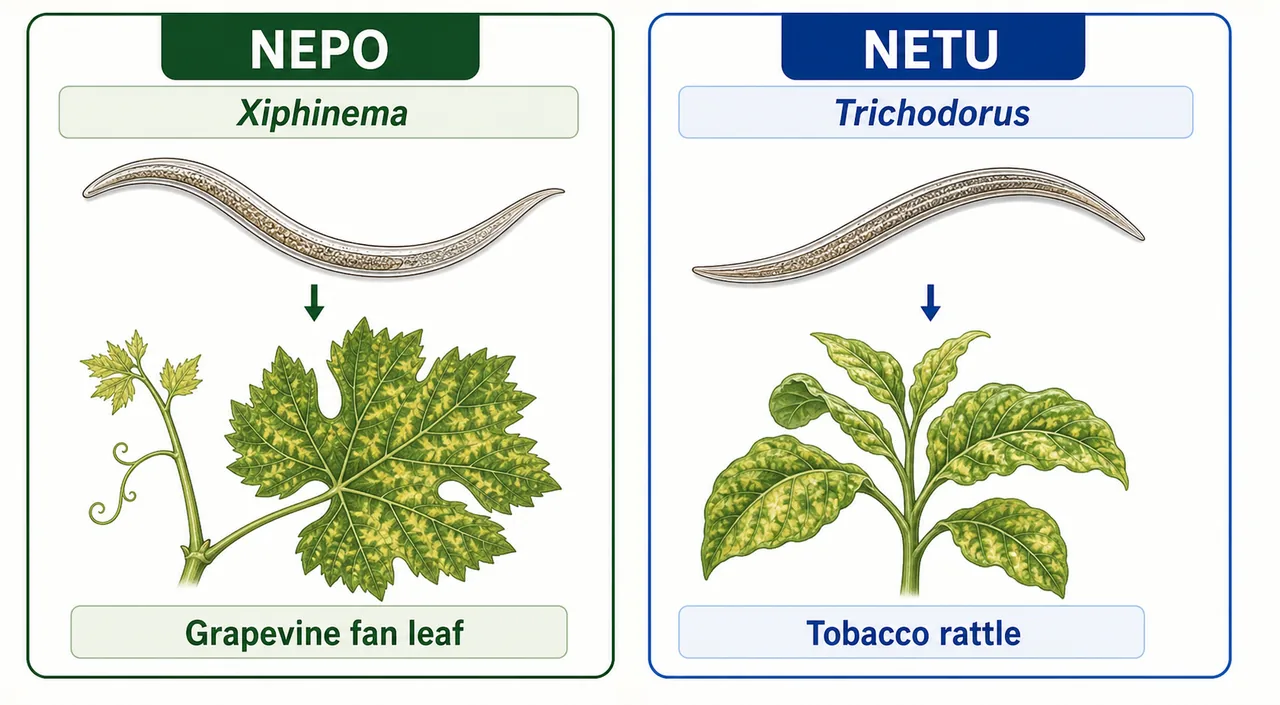
- First discovered by Hewitt, Raski, and Goheen (1958) -- Xiphinema index transmits Grapevine Fan Leaf Virus.
NEPO Viruses
NEPO = Nematode-transmitted Polyhedral virus particles.
| Virus | Vector |
|---|---|
| Grapevine Fan Leaf Virus (GFLV) | Xiphinema index |
| Tomato Black Ring Virus (TBRV) | Longidorus sp. |
| Raspberry Ring Spot Virus (RRSV) | Longidorus elongatus |
| Tobacco/Tomato Ring Spot Virus (TRSV) | Xiphinema americana |
NETU (TOBRA) Viruses
NETU = Nematode-transmitted Tubular virus particles.
| Virus | Vector |
|---|---|
| Tobacco Rattle Virus (TRV) | Trichodorus similis |
| Pea Early Browning Virus (PEBV) | Trichodorus sp. |
| Pepper Ring Spot Virus (PRSV) | Paratrichodorus minor |
Comparison: NEPO vs NETU
| Feature | NEPO | NETU |
|---|---|---|
| Full form | Nematode-transmitted Polyhedral | Nematode-transmitted Tubular |
| Virus particle shape | Polyhedral (round) | Tubular (rod-shaped) |
| Vector genera | Xiphinema, Longidorus, Paralongidorus | Trichodorus, Paratrichodorus |
| Virus examples | Ring spot viruses, Fan Leaf Virus | Rattle viruses |
| Taxonomic order | Dorylaimida | Dorylaimida |
Entomopathogenic Nematodes (EPNs) -- Beneficial Nematodes
Not all nematodes are pests. Entomopathogenic nematodes (EPNs) are beneficial organisms used for biological control of insect pests.
How EPNs Work
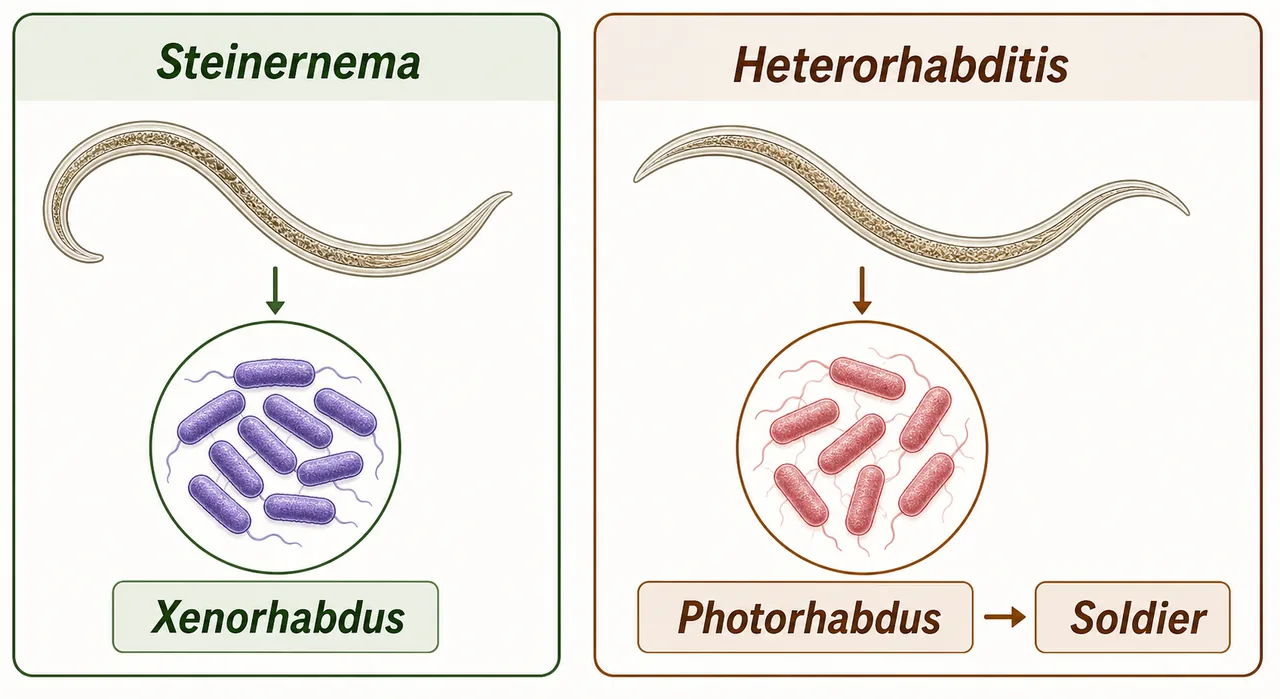
EPNs are facultative parasites that carry symbiotic bacteria inside their gut. The nematode enters an insect host, releases the bacteria, and the bacteria rapidly kill the insect.
| EPN Family | Symbiotic Bacterium |
|---|---|
| Steinernematidae (Steinernema) | Xenorhabdus |
| Heterorhabditidae (Heterorhabditis) | Photorhabdus |
TIP
Memory aid: Xenorhabdus goes with Steinernema (X-S), Photorhabdus goes with Heterorhabditis (P-H). Think "XS shirt, PH balance."
Commercial EPN Products
EPN Products Summary
| Product | EPN Species | Bacterium | Target | Status |
|---|---|---|---|---|
| Soldier | Heterorhabditis indicus | Photorhabdus | White grub (Holotrichia serrata) | Available |
| Green Commandos (Ecomax) | Steinernema carpocapsae | Xenorhabdus | Soil insects | Discontinued (poor adaptability to Indian conditions) |
| Soil Commandos (Ecomax) | Heterorhabditis bacteriophora | Photorhabdus | Soil insects | Discontinued |
| Black Commando (DD-136) | Neoplectana carpocapsae | Achromobacter nematophilus | Lepidopteran pests of apple, rice, sugarcane | Available in labs |
NOTE
Green Commandos and Soil Commandos were removed from the market because they used exotic EPN species that were poorly adapted to Indian conditions. This highlights the importance of using locally adapted biocontrol strains.
Summary Table
| Interaction Type | Key Example | Nematode | Partner Organism | Result |
|---|---|---|---|---|
| Nematode-Fungus | Fusarium wilt of tomato | Meloidogyne incognita | Fusarium oxysporum | Wilt severity increases dramatically |
| Nematode-Bacterium | Tundu disease of wheat | Anguina tritici | Clavibacter tritici | Obligate association; nematode is vector |
| Nematode-Bacterium | Cauliflower disease | Aphelenchoides fragariae | Clavibacter fascians | Synergistic damage on strawberry |
| NEPO virus | Grapevine Fan Leaf | Xiphinema index | Fan Leaf Virus (RNA) | Polyhedral virus particles |
| NETU virus | Tobacco Rattle | Trichodorus similis | Rattle Virus (RNA) | Tubular virus particles |
| EPN (beneficial) | White grub biocontrol | Heterorhabditis indicus | Photorhabdus (symbiont) | Insect killed; "Soldier" product |
TIP
Exam mnemonic -- "FAV-EPB" for interaction types: Fungus interaction (Atkinson, 1892), bActerium interaction (Tundu, Cauliflower), Virus vector (NEPO/NETU, Dorylaimida), Entomopathogenic, Photorhabdus + Heterorhabditis, XenorhaBdus + Steinernema.
References
- Dropkin, V.H. 1980. Introduction to plant nematology. John Wiley and sons, INC. New York.
- Singh, R.S and Sitaramaiah, K. 1994. Plant pathogens. The plant parasitic nematodes. Oxford & IBH Pub. Co. Pvt. Ltd. New Delhi.
- Parvata Reddy, P. 1983. Plant nematology. Agricole Pub. Co., New Delhi.
- Southey, J. F. Laboratory methods for work with plant and soil nematodes Tech.
- Bull. Min. Agric. Fish. Food. Her Majesty's Stationary Office, London.
- Walia, R. K and Bajaj, H. K (2014). Textbook of Introductory Plant Nematology. Directorate of Knowledge Management in Agriculture, ICAR, New Delhi.
- Kumar, V., Khan, M.R. & Walia, R.K. Crop Loss Estimations due to Plant-Parasitic Nematodes in Major Crops in India. Natl. Acad. Sci. Lett. 43, 409-412 (2020). https://doi.org/10.1007/s40009-020-00895-2
Summary Cheat Sheet
| Concept / Topic | Key Details |
|---|---|
| Grapevine Fan Leaf Virus (GFLV) | Xiphinema index |
| Tobacco Rattle Virus (TRV) | Trichodorus similis |
| Virus particle shape | Polyhedral (round) — Tubular (rod-shaped) |
| Steinernematidae (Steinernema) | Xenorhabdus |
| Heterorhabditidae (Heterorhabditis) | Photorhabdus |
| Soldier | Heterorhabditis indicus — Photorhabdus — White grub (Holotrichia serrata) — Available |
| Green Commandos (Ecomax) | Steinernema carpocapsae — Xenorhabdus — Soil insects — Discontinued (poor adaptability to Indian conditions) |
| Soil Commandos (Ecomax) | Heterorhabditis bacteriophora — Photorhabdus — Soil insects — Discontinued |
| Black Commando (DD-136) | Neoplectana carpocapsae — Achromobacter nematophilus — Lepidopteran pests of apple, rice, sugarcane — Available in labs |
| Nematode-Fungus | Fusarium wilt of tomato — Meloidogyne incognita — Fusarium oxysporum — Wilt severity increases dramatically |
| Nematode-Bacterium | Tundu disease of wheat — Anguina tritici — Clavibacter tritici — Obligate association; nematode is vector |
| Nematode-Bacterium | Cauliflower disease — Aphelenchoides fragariae — Clavibacter fascians — Synergistic damage on strawberry |
| NEPO virus | Grapevine Fan Leaf — Xiphinema index — Fan Leaf Virus (RNA) — Polyhedral virus particles |
| NETU virus | Tobacco Rattle — Trichodorus similis — Rattle Virus (RNA) — Tubular virus particles |
| EPN (beneficial) | White grub biocontrol — Heterorhabditis indicus — Photorhabdus (symbiont) — Insect killed; "Soldier" product |
TIP
Next: Lesson 10 covers nematode management -- cultural, regulatory, physical, biological, chemical, and integrated control methods.