🪱 Aphelenchid Nematodes -- Foliar, Mushroom, and Red Ring
Above-ground nematodes -- white tip of rice, mushroom nematode, chrysanthemum nematode, strawberry crimp, and red ring disease of coconut
In the previous lesson, we covered the citrus nematode -- a semi-endoparasite of roots. Now we shift to nematodes that break the underground rule entirely: the aphelenchid nematodes parasitise leaves, buds, seeds, and even tree trunks.
While most plant parasitic nematodes attack roots hidden underground, the aphelenchid nematodes parasitise above-ground plant parts. A rice farmer noticing bleached white leaf tips, a chrysanthemum grower finding deformed flowers, or a mushroom producer watching his yield collapse -- all may be dealing with nematodes from this unique group. Their above-ground habits require completely different management approaches.
This lesson covers:
- White tip disease of rice -- A. besseyi, seed-borne
- Mushroom nematode -- A. composticola, mycophagous
- Foliar nematodes -- chrysanthemum and strawberry parasites
- Red ring nematode -- R. cocophilus, insect-vectored, under quarantine
Overview
- Aphelenchoides = resembling Aphelenchus; from Greek apheles (smooth) + enchus (stylet).
- Commonly called Leaf and Bud Nematodes or Foliar Nematodes.
- Unlike most PPNs that attack roots, these parasitise aerial plant parts.
White Tip Disease of Rice
Causal Organism: Aphelenchoides besseyi
| Feature | Details |
|---|---|
| First report (India) | Dastur, 1934 (epidemic form in Central Provinces, MP) |
| Disease type | Seed-borne -- nematodes survive in quiescent stage between glumes and grain |
| Feeding type | Ectoparasite (feeds from outside plant surface) |
| Spread favoured by | High humidity (nematodes need moisture film to move on plant surfaces) |
Diagnostic Symptom
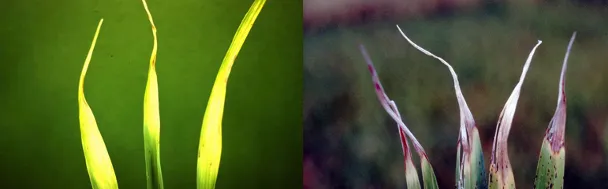
The upper 3--5 cm of the leaf tip turns white or pale yellow at the tillering stage -- the hallmark symptom giving the disease its name.
Pro Content Locked
Upgrade to Pro to access this lesson and all other premium content.
₹99 charged monthly · Cancel anytime
- All Agriculture & Banking Courses
- AI Lesson Questions (100/day)
- AI Doubt Solver (50/day)
- Glows & Grows Feedback (30/day)
- AI Section Quiz (20/day)
- 22-Language Translation (100/day)
- Recall Questions (20/day)
- AI Quiz (15/day)
- AI Quiz Paper Analysis (100/day)
- AI Step-by-Step Explanations (100/day)
- Spaced Repetition Recall (FSRS)
- AI Tutor
- Immersive Text Questions
- Audio Lessons — Hindi & English
- Mock Tests & Previous Year Papers
- Summary & Mind Maps
- XP, Levels, Leaderboard & Badges
- Generate New Classrooms
- Voice AI Teacher (AgriDots Live)
- AI Revision Assistant
- Knowledge Gap Analysis
- Interactive Revision (LangGraph)
🔒 Secure via Razorpay · Cancel anytime · No hidden fees
In the previous lesson, we covered the citrus nematode -- a semi-endoparasite of roots. Now we shift to nematodes that break the underground rule entirely: the aphelenchid nematodes parasitise leaves, buds, seeds, and even tree trunks.
While most plant parasitic nematodes attack roots hidden underground, the aphelenchid nematodes parasitise above-ground plant parts. A rice farmer noticing bleached white leaf tips, a chrysanthemum grower finding deformed flowers, or a mushroom producer watching his yield collapse -- all may be dealing with nematodes from this unique group. Their above-ground habits require completely different management approaches.
This lesson covers:
- White tip disease of rice -- A. besseyi, seed-borne
- Mushroom nematode -- A. composticola, mycophagous
- Foliar nematodes -- chrysanthemum and strawberry parasites
- Red ring nematode -- R. cocophilus, insect-vectored, under quarantine
Overview
- Aphelenchoides = resembling Aphelenchus; from Greek apheles (smooth) + enchus (stylet).
- Commonly called Leaf and Bud Nematodes or Foliar Nematodes.
- Unlike most PPNs that attack roots, these parasitise aerial plant parts.
White Tip Disease of Rice
Causal Organism: Aphelenchoides besseyi
| Feature | Details |
|---|---|
| First report (India) | Dastur, 1934 (epidemic form in Central Provinces, MP) |
| Disease type | Seed-borne -- nematodes survive in quiescent stage between glumes and grain |
| Feeding type | Ectoparasite (feeds from outside plant surface) |
| Spread favoured by | High humidity (nematodes need moisture film to move on plant surfaces) |
Diagnostic Symptom
The upper 3--5 cm of the leaf tip turns white or pale yellow at the tillering stage -- the hallmark symptom giving the disease its name.
Management
Hot water treatment: 52--55 degrees C for 10--15 minutes -- kills quiescent nematodes in seed without affecting germination. This is the primary recommended control measure.
Mushroom Nematode
Causal Organism: Aphelenchoides composticola
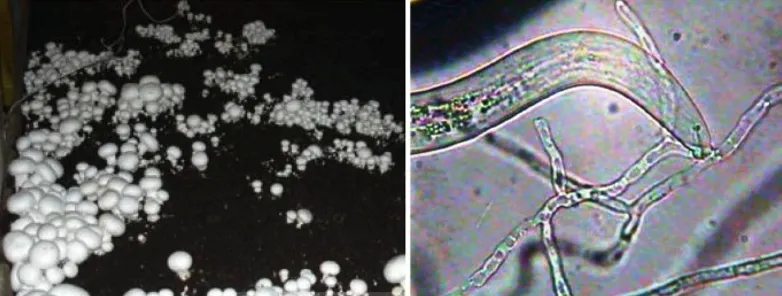
- A mycophagous (fungus-eating) nematode that feeds on fungal mycelium rather than plant tissue.
- Severely affects button mushroom (Agaricus bisporus) by destroying the mycelial network needed for fruiting body production.
- Causes drastic reduction in mushroom yield in commercial production.
Foliar Nematodes
Two important species parasitise leaves and buds with a unique dual feeding behaviour: they feed ectoparasitically on buds and endoparasitically on leaves (moving through mesophyll tissue between veins).
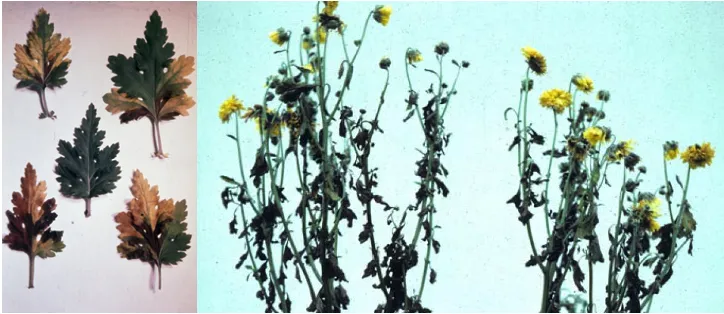
Chrysanthemum Nematode: Aphelenchoides ritzemabosi
- Feeds on buds, causing undersized and distorted flowers of chrysanthemum.
- Devastating for ornamental crops where flower quality determines market value.
Strawberry Nematode: Aphelenchoides fragariae
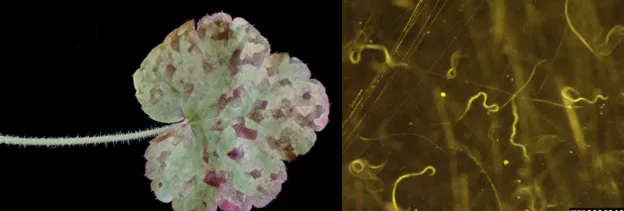
- Known as Spring crimp or Strawberry nematode.
- Causes spring crimp and summer crimp -- crinkling and distortion of leaves in respective seasons.
- Feeding on crown buds results in a blind plant -- the growing point is destroyed, preventing flower and fruit production.
- Also involved in the cauliflower disease complex with Clavibacter fascians (bacterium).
Red Ring Nematode
Causal Organism: Rhadinaphelenchus cocophilus
- Causes Red Ring Disease of Coconut in Central and South America and Caribbean islands.
- Not reported from India -- but is under quarantine regulation to prevent introduction.
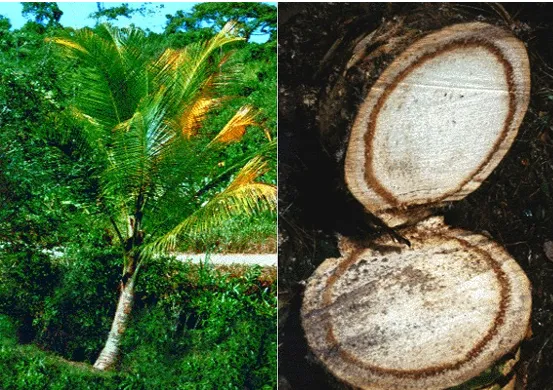
Unique Transmission
The nematode is transmitted by the palm weevil (Rhynchophorus palmarum) -- an insect vector. The weevil carries nematodes along with diseased tissue and deposits them in leaf axils of healthy palms. This is a remarkable example of insect-nematode association.
Diagnostic Symptom
When the trunk is cut in cross-section, a conspicuous ring of reddish necrotic tissue is visible about 3 cm beneath the stem surface -- giving the disease its name. The reddish colour results from necrosis and oxidation caused by nematode feeding in the stem cortex.
Comparison: Aphelenchid Nematodes at a Glance
| Species | Common Name | Host | Disease/Symptom | Key Feature |
|---|---|---|---|---|
| A. besseyi | Rice leaf nematode | Rice | White tip (3--5 cm bleached leaf tip) | Seed-borne; ectoparasite |
| A. composticola | Mushroom nematode | Button mushroom | Mycelium destruction, reduced fruiting | Mycophagous (fungus-eating) |
| A. ritzemabosi | Chrysanthemum nematode | Chrysanthemum | Distorted, undersized flowers | Ecto on buds, endo on leaves |
| A. fragariae | Strawberry nematode | Strawberry | Spring/summer crimp; blind plant | Cauliflower disease complex with bacteria |
| R. cocophilus | Red ring nematode | Coconut | Red ring in trunk cross-section | Transmitted by palm weevil (insect vector) |
Summary Table
| Feature | Key Fact |
|---|---|
| Unique trait of aphelenchids | Parasitise above-ground plant parts (leaves, buds, trunks) |
| White tip of rice | A. besseyi; seed-borne; 3--5 cm white leaf tips |
| White tip management | Hot water: 52--55 degrees C, 10--15 minutes |
| Mushroom nematode | A. composticola; mycophagous; destroys Agaricus bisporus mycelium |
| Foliar nematode feeding | Ecto on buds, endo on leaves |
| Chrysanthemum nematode | A. ritzemabosi; distorted flowers |
| Strawberry nematode | A. fragariae; spring/summer crimp; blind plants |
| Red ring disease | R. cocophilus; coconut; NOT in India; under quarantine |
| Red ring vector | Palm weevil (Rhynchophorus palmarum) -- insect-transmitted |
| Quarantine nematodes (India) | Globodera rostochiensis and Rhadinaphelenchus cocophilus |
TIP
Exam mnemonic -- "White Mushroom Chrysanthemum Strawberry Red" (WMCSR) for aphelenchid nematodes: White tip (A. besseyi), Mushroom (A. composticola), Chrysanthemum (A. ritzemabosi), Strawberry crimp (A. fragariae), Red ring (R. cocophilus -- palm weevil vector).
References
- Dropkin, V.H. 1980. Introduction to plant nematology. John Wiley and sons, INC. New York.
- Singh, R.S and Sitaramaiah, K. 1994. Plant pathogens. The plant parasitic nematodes. Oxford & IBH Pub. Co. Pvt. Ltd. New Delhi.
- Walia, R. K and Bajaj, H. K (2014). Textbook of Introductory Plant Nematology. Directorate of Knowledge Management in Agriculture, ICAR, New Delhi.
- Kumar, V., Khan, M.R. & Walia, R.K. Crop Loss Estimations due to Plant-Parasitic Nematodes in Major Crops in India. Natl. Acad. Sci. Lett. 43, 409-412 (2020).
- Figure 1: Source: A: Maggenti, 1981, B-E: Franklin, 1973
Summary Cheat Sheet
| Concept / Topic | Key Details |
|---|---|
| Unique trait of aphelenchids | Parasitise above-ground plant parts (leaves, buds, trunks) |
| White tip of rice | A. besseyi; seed-borne; 3--5 cm white leaf tips |
| White tip management | Hot water: 52--55 degrees C, 10--15 minutes |
| Mushroom nematode | A. composticola; mycophagous; destroys Agaricus bisporus mycelium |
| Foliar nematode feeding | Ecto on buds, endo on leaves |
| Chrysanthemum nematode | A. ritzemabosi; distorted flowers |
| Strawberry nematode | A. fragariae; spring/summer crimp; blind plants |
| Red ring disease | R. cocophilus; coconut; NOT in India; under quarantine |
| Red ring vector | Palm weevil (Rhynchophorus palmarum) -- insect-transmitted |
| Quarantine nematodes (India) | Globodera rostochiensis and Rhadinaphelenchus cocophilus |
TIP
Next: Lesson 06 covers the burrowing nematode (Radopholus similis) -- banana decline, yellows disease of black pepper, and spreading decline of citrus.