Question Tags
Master the rules and exceptions of question tags with clear patterns, examples, and exam traps.
Question Tags
Question tags are short questions added at the end of a statement to check, confirm, or invite agreement.
Examples:
- You are ready, aren't you?
- She didn't call, did she?
- Let's begin, shall we?
For bank and government exams, question tags are mostly tested through:
- error spotting
- sentence improvement
- fill in the blank
- grammar-based comprehension
The One Rule You Should Remember First
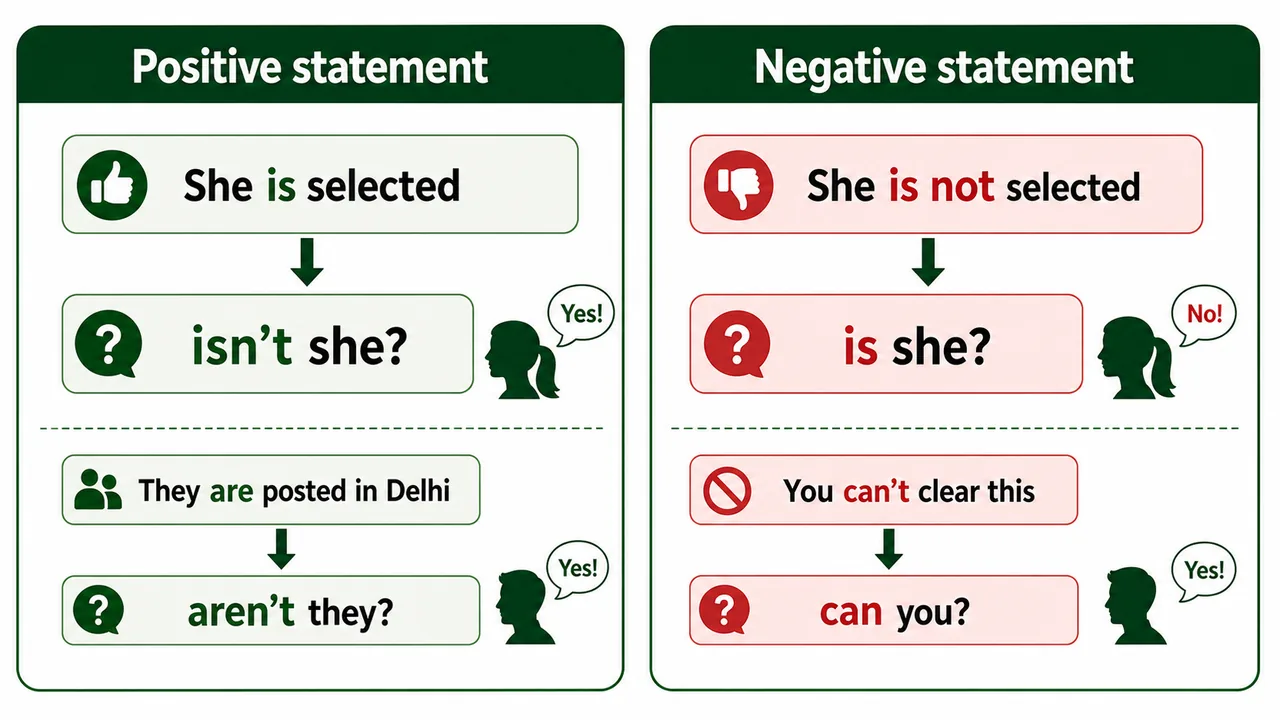
A question tag normally uses opposite polarity, the same auxiliary, and the right pronoun.
- Positive statement -> negative tag
- Negative statement -> positive tag
- Keep the same tense or helping verb
- Match the subject with the correct pronoun
Quick Formula
statement, auxiliary + pronoun?
Examples:
- She is selected, isn't she?
- They were absent, weren't they?
- He can drive, can't he?
- Rita works hard, doesn't she?
Step 1: Check Whether the Statement Is Positive or Negative
Positive statement -> negative tag
| Statement | Tag |
|---|---|
| He is an officer | isn't he? |
| They have applied | haven't they? |
| She can solve it | can't she? |
| Rita works hard | doesn't she? |
Negative statement -> positive tag
| Statement | Tag |
|---|---|
| He is not an officer | is he? |
| They haven't applied | have they? |
| She can't solve it | can she? |
| Rita doesn't work here | does she? |
Step 2: Keep the Same Auxiliary or Tense
If the sentence already has a helping verb or modal, reuse it in the tag.
| Sentence type | Example | Tag |
|---|---|---|
| be verb | She is ready | isn't she? |
| modal | They will come | won't they? |
| perfect | He has finished | hasn't he? |
| continuous | She was studying | wasn't she? |
If there is no helping verb, use:
- do/does for simple present
- did for simple past
| Statement | Why | Tag |
|---|---|---|
| She works hard | simple present | doesn't she? |
| They play daily | simple present | don't they? |
| He cleared the exam | simple past | didn't he? |
| We submitted the form | simple past | didn't we? |
Step 3: Match the Subject with the Correct Pronoun
| Subject in statement | Pronoun in tag |
|---|---|
| Riya | she |
| Mohan | he |
| the students | they |
| the book | it |
| you | you |
Examples:
- The manager is busy, isn't he/she?
- The students are ready, aren't they?
- The file is complete, isn't it?
The Most Common Exam Rules
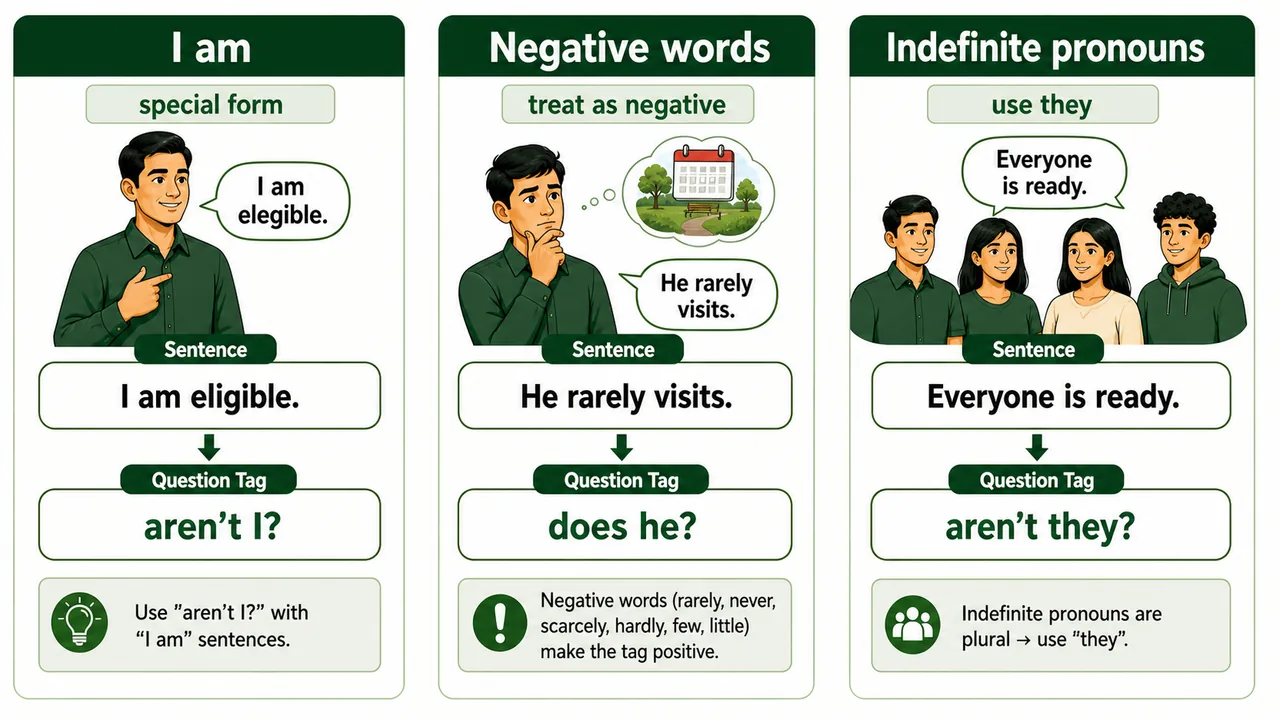
1. I am -> aren't I?
This is the standard fixed form in modern English.
- I am late, aren't I?
- I am eligible, aren't I?
But when the statement is negative:
- I am not late, am I?
2. Negative-meaning words take a positive tag
Some sentences look positive, but their meaning is negative because of words like:
- never
- rarely
- seldom
- hardly
- scarcely
- barely
- nothing
- nobody
- few
- little
Examples:
- He rarely visits the branch, does he?
- Nobody objected, did they?
- Nothing was missing, was it?
- She has little time, does she?
But remember:
- a few and a little are positive in meaning
Examples:
- You have a few doubts, don't you?
- I have a little time, don't I?
3. Indefinite pronouns for people usually take they
| Subject | Tag pronoun |
|---|---|
| everyone | they |
| someone | they |
| nobody | they |
| everybody | they |
| no one | they |
Examples:
- Everyone cleared the cut-off, didn't they?
- Nobody called, did they?
4. Things like everything, nothing, something take it
- Everything is ready, isn't it?
- Nothing was changed, was it?
- Something went wrong, didn't it?
5. This/that usually take it; these/those take they
- This is your hall ticket, isn't it?
- That was the final list, wasn't it?
- These are valid documents, aren't they?
- Those were the selected candidates, weren't they?
If this/that points to a person, match the person:
- This officer is strict, isn't she/he?
6. There is/are keeps there in the tag
- There is a vacancy, isn't there?
- There are many applicants, aren't there?
- There wasn't any mistake, was there?
7. Imperatives have special tags
For commands and requests, will you? is the safest exam rule.
- Close the door, will you?
- Please check the form, will you?
- Don't waste time, will you?
For suggestions with let's, use shall we?
- Let's revise now, shall we?
For let him/her/them, exams commonly use will you?
- Let him speak first, will you?
8. Have to/has to takes do/does in the tag
have to here works like a main verb idea of obligation, so the tag usually uses do/does.
- She has to report today, doesn't she?
- They have to submit the form, don't they?
9. Used to usually takes did
- He used to study here, didn't he?
- She didn't use to live here, did she?
Fast Decision Table
| If the statement has... | Use this idea in the tag | Example |
|---|---|---|
| is/are/was/were | repeat it | He was absent, wasn't he? |
| has/have/had as auxiliary | repeat it | She has left, hasn't she? |
| modal (can, will, should) | repeat it | They can read, can't they? |
| simple present main verb | use do/does | She teaches, doesn't she? |
| simple past main verb | use did | He arrived late, didn't he? |
| negative-meaning word | use positive tag | Nobody agreed, did they? |
| let's | shall we? | Let's go, shall we? |
| there is/are | keep there | There is a problem, isn't there? |
High-Yield Exam Traps
| Wrong pattern | Correct pattern |
|---|---|
| I am ready, amn't I? | I am ready, aren't I? |
| She works hard, isn't she? | She works hard, doesn't she? |
| Nobody came, didn't they? | Nobody came, did they? |
| Let's start, will we? | Let's start, shall we? |
| She has to go, hasn't she? | She has to go, doesn't she? |
| There are two seats, aren't they? | There are two seats, aren't there? |
Solved Examples
-
He isn't attending today, is he? Reason: negative statement -> positive tag.
-
The Ganga flows into the Bay of Bengal, doesn't it? Reason: simple present main verb -> use does.
-
Few students understood the rule, did they? Reason: few has negative meaning.
-
Everything is in place, isn't it? Reason: thing pronoun -> it.
-
Let's complete the mock test, shall we? Reason: let's suggestion -> shall we?
Practice Questions
Exam Revision Cheat Sheet
- Positive sentence -> negative tag
- Negative sentence -> positive tag
- Keep the same auxiliary or modal
- No auxiliary visible -> use do/does/did
- I am -> aren't I?
- I am not -> am I?
- nobody / nothing / rarely / few / little -> positive tag
- everyone / someone / nobody -> usually they
- everything / nothing / something -> it
- there is/are -> keep there
- let's -> shall we?
- imperative command/request -> usually will you?
- has to / have to -> doesn't / don't
Sources
These references were used to tighten the rules and keep the special cases accurate:
Lesson Doubts
Ask questions, get expert answers