🌾 Wheat -- King of Cereals (Complete Cultivation Guide)
Master wheat production for competitive exams -- from Green Revolution history and Triticum species to sowing, nutrient management, varieties, and the complete dwarf-gene classification with mnemonics.
When Dr. Norman Borlaug's Mexican dwarf wheat seeds arrived in India in 1963, the country was importing millions of tonnes of grain to feed its people. Within a decade, those seeds transformed India into a wheat-surplus nation. Today, wheat remains the second most important food crop after rice, and its story -- from Norin-10 dwarfing genes to modern rust-resistant varieties -- is one of the most examined topics in agriculture exams.
In the previous lesson, we covered Rice -- India's largest food crop. Wheat contrasts with rice in almost every way: it is a Rabi crop requiring cold weather, long days, and far less water.
This chapter covers:
- Basics and global standing -- Triticum species, ploidy, area, and production rankings
- Climate and sowing -- temperature requirements, sowing depth, FIRB, zero tillage
- Green Revolution story -- Norin-10, Borlaug, dwarf gene classification
- Varieties -- single, double, and triple gene dwarfs, mutant varieties
- Weed and harvest management -- Phalaris minor, harvest index, yield concepts
All sections are high-yield for IBPS AFO, NABARD, and RRB SO exams.
TIP
Quick answer: Wheat is called the King of Cereals.
Quick Exam Recap
| Topic | Fast Recall |
|---|---|
| Crop season | Rabi crop; cool growth and relatively dry maturity phase |
| Core species | Triticum aestivum dominates area and production |
| Signature genetics | Norin-10 dwarfing background central to Green Revolution memory questions |
| High-frequency weed point | Phalaris minor is the classic wheat weed-management anchor |
| Dryland relevance | Wheat performance links strongly to sowing window, irrigation timing, and genotype choice |
Basics
- Botanical name: Triticum spp.
- Family: Poaceae (Gramineae)
- Origin: South West Asia (Turkey)
- Wheat is a self-pollinated, C3, and hexaploid (6n = 42) plant. Having six sets of chromosomes contributes to its genetic diversity and wide adaptability.
- In India, wheat is the second most important staple food crop after rice.
- Wheat is known as King of Cereals owing to its widespread cultivation and central role in global food security.
Global Standing
| Parameter | Ranking |
|---|---|
| World's largest staple food crop | Wheat feeds more people globally than any other single crop |
| Area | India > Russia > China |
| Production | China (18%) > India (10%) > Russia |
| Productivity | Germany > China (advanced technology + favourable climate) |
| Major exporters | USA > Canada > Russia |
| Major importers | Indonesia > Algeria > Italy |
| India's export destination | Nepal > Bangladesh > UAE |
- India's share in global wheat production: 11.78% (2015-16).
- India's share in global exports: about 0.40% (2015-16).
India
| Parameter | Leading State |
|---|---|
| Area | Uttar Pradesh |
| Production | Uttar Pradesh |
| Productivity | Punjab (assured irrigation, mechanisation, HYVs) |
- National average productivity: 26.5 q/ha.
Botany
Triticum Species
| Species | Ploidy | Description |
|---|---|---|
| T. aestivum | 6n = 42 | Mexican Dwarf Wheat, everywhere grown, evolved by Dr. N.E. Borlaug of Mexico, covered 87 per cent of total wheat area. |
| T. vulgare | 6n = 42 | Tall wheat for Rainfed condition, typical wheat for alluvial soil. |
| T. durum | 4n = 28 | Macroni Wheat/Pasta Wheat, very old spp., best for drought condition, used for Suji preparation, covered 12 per cent of total wheat area. |
| T. dicocum | 4n = 28 | Emmer wheat, used for preparation, popularly grown in south India, covered 1 per cent of total wheat area. Suitable for preparation of South India dish Uppumav. |
| T. spherococum | 2n = 14 | Indian Dwarf/Club wheat, very short & compact heads |
| T. monococum | 2n = 14 | Einkorn Wheat |
- T. aestivum is the most important species, occupying >90% of wheat area and 87% of total production. It is the bread wheat used for chapatti and bread.
- Research stations:
- Modern bread wheat: CIMMYT, Mexico -- the centre that drove the Green Revolution.
- Indian Institute of Wheat and Barley Research, Karnal.
- AICRP on Wheat & Barley Improvement, Karnal.

Grain Composition

- Protein content: 10-11% (Gluten). Gluten gives dough its elasticity and binding quality.
- Chapatti/baking quality is mainly governed by Gluten strength.
Morphology

| Feature | Detail |
|---|---|
| Inflorescence | Spike/Spikelets; central zigzag axis = Rachis; flowers = Florets |
| Fruit | Caryopsis (seed coat fused with pericarp) |
| Flower enclosure | Lemma + Palea; extending portion of lemma = Awn (aids photosynthesis during grain filling) |
Root System
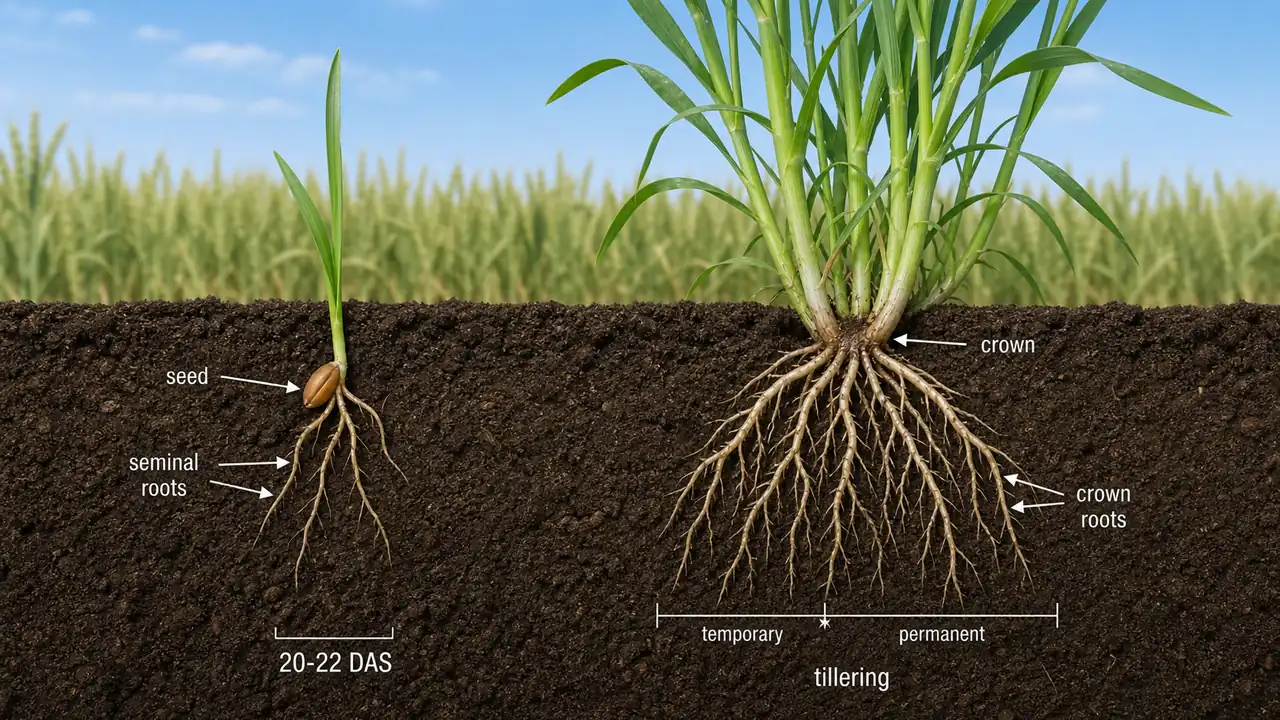
| Root Type | Nature | Timing |
|---|---|---|
| Seminal (primary) | Temporary | Early stage nourishment |
| Crown (secondary) | Permanent | Appear 20-22 days after sowing (at tillering stage) |
Climate
| Parameter | Requirement |
|---|---|
| Season | Rabi |
| Vegetative phase | Cold and moist weather (promotes tillering) |
| Grain formation | Warm and dry climate (ensures proper grain filling) |
| Photoperiod | Long-day plant (>12 hours daylight needed for flowering) |
| Photosynthetic pathway | C3 |
| Pollination | Self-pollinated |
| Water requirement | 600-900 mm |
| Best region | Indo-Gangetic plain (ideal alluvial soil + climate) |
| Minimum | Optimum/Cardinal | Maximum |
|---|---|---|
| 4.5 °C | 21°C | 32 °C |
| Stage | Optimum Temperature |
|---|---|
| Germination | 20-25 °C |
| Tillering | 16-20 °C |
| Grain formation | 23-25 °C |
TIP
Wheat vs Rice climate comparison: Wheat = Rabi, cold + dry, long-day, C3, 600-900 mm water. Rice = Kharif, hot + humid, short-day, C3, 1000-1500 mm water. Both are self-pollinated with hypogeal germination.
Sowing
- 90% seed germination occurs 4-8 days after sowing.
- Germination: Hypogeal -- cotyledons remain below the soil.
Sowing Date
| Condition | Sowing Time |
|---|---|
| Irrigated: Timely sowing | 2nd week of November |
| Irrigated: Late sowing | 15 Dec. |
| Rained: Timely sowing | 15 Oct – 15 Nov. |
| Rained: Late sowing | 15 Nov – 15 Dec. |
| In North-West plain zone | up to 25th Dec. |
| In Central zone | up to 10th Dec |
| In Peninsular zone | up to 30th Nov. |
Sowing Depth

- Dwarf wheat must be sown at only 5-6 cm depth because they have shorter coleoptiles. Sowing at 8-10 cm results in poor germination.
- The coleoptile is the protective sheath over the emerging shoot; if it is shorter than sowing depth, the seedling cannot emerge.
IMPORTANT
Dwarf wheat sowing depth = 5-6 cm only. Deeper sowing causes poor germination because dwarf varieties have shorter coleoptiles. This is a key reason dwarf HYVs need precise sowing management.
FIRB (Furrow Irrigated Raised Bed)

- Uses 25-40% less water than flatbed methods.
- Improves crop yields by >20%.
- Saves 30-50% wheat seed compared to flatbed planting.
- Particularly advantageous where groundwater levels are falling and herbicide-resistant weeds are increasing.
Zero Tillage

- Zero-till drill (seed-cum-fertiliser machine) developed at GBPUAT, Pantnagar (Uttarakhand) for the rice-wheat system -- direct sowing without ploughing.
- Seed rate is 20-25% higher than conventional (optimum: 140-150 kg/ha).
- Rice stubble should not exceed 15 cm height.
Surface Seeded Technology
- In parts of North-Eastern India, soil stays wet too long after rice harvest for tillage. Dry or soaked wheat seeds are broadcast before or immediately after rice harvest.
- Reduces production cost to 70-75% of conventional methods.
Seed Rate
- Test weight: 40 g (Phalaris minor test weight is only 2 g -- a useful comparison for identifying this weed).
| Particulars | Row to Row Spacing | Seed Rate (kg/ha) |
|---|---|---|
| Timely sown wheat | 22.5 cm x 8-10 cm | 100-125 (Drilled) |
| Late sown wheat | 15-18 cm x 8-10 cm | 125-150 (25% more than timely sown) |
| FIRB | — | 75 |
| Dibbling | — | 25-30 |
- Ug99 resistant varieties: DBW 17, PBW 550, Lok 1, Turja. Ug99 is a highly virulent race of stem rust posing a serious global threat.
- Most suitable cropping system: mixed cropping (Wheat + Mustard, Wheat + Chickpea).
- Intercrop: 4-5 rows of wheat in 2 rows of sugarcane.
- Relay cropping: Wheat in early-planted potato is a high-bonus system.
- Maximum yield requires 500 tillers per m2.
Irrigation Management
Wheat requires 4-6 irrigations depending on soil type and rainfall. The most critical irrigation is at Crown Root Initiation (CRI) stage, approximately 20-25 days after sowing. Missing CRI irrigation can reduce yield by up to 30% because crown roots form the permanent root system that sustains the plant for the rest of its life.
- Critical stages for irrigation: CRI (most critical), Tillering, Late Jointing (Booting), Flowering, Milk, and Dough.
- IW/CPE ratio: 0.9 for irrigated wheat.
- Anti-lodging chemical: Cycocel (CCC / Chlormequat chloride) -- a growth retardant that shortens internodes by inhibiting gibberellic acid synthesis, reducing lodging risk in heavily fertilised fields.
Fertiliser Management
| Particular | NPK (kg/ha) | Dose |
|---|---|---|
| Irrigated: Timely sowing | 120 : 60 : 40 | 1/2 - 1/4 - 1/4 N |
| Late sowing | 80 : 50 : 30 | 1/2 - 1/4 - 1/4 N |
| Unirrigated | 30 : 20 : 10 | Complete basal application |
| Semi irrigated | 60 : 40 : 20 | 1/2 N as basal application + 1/2 at CRI stage |
Wheat Varieties -- The Green Revolution Story
The introduction of dwarfing genes was the cornerstone of the Green Revolution in wheat.
| Milestone | Detail |
|---|---|
| Dwarfing gene | Norin (Rht = Reduced Height; genes Rht1 and Rht2) |
| Source of dwarfing gene | Norin from Japan; Olsen dwarf from S. Rhodesia |
| 1st dwarf gene variety | Norin-10, developed by Dr. N.E. Borlaug in 1961-62 |
| Indian import (1963) | 100 kg of Mexican dwarf wheat -- Sonora-63, Sonora-64, Lerma Rojo |
| Triple gene dwarfs | Released during 1970 |
NOTE
Green Revolution timeline: Norin-10 (1961-62) by Borlaug --> Mexican dwarf varieties imported to India (1963) --> Triple gene dwarfs released (1970). The Rht1/Rht2 genes from Japanese Norin were the foundation of high-yielding wheat worldwide.
- Lerma Rojo is resistant to all three rusts (yellow, brown, and black).
Pusa Yashasvi (HD-3226)
- Released by IARI with the highest genetic yield potential among Indian wheat varieties: 79.6 q/ha.
- Higher content of zinc, protein, and gluten.
- Highly resistant against all major rust fungi: yellow/stripe, brown/leaf, and black/stem.
- HD-2967 (Pusa Borlaug) and Pusa-3086 (Pusa Gautami) together cover 40% of India's wheat area (IARI).
| Category / use | Important varieties |
|---|---|
| Single gene dwarf | Sonalika, UP-262, WL-711, Girja |
| Double gene dwarf | Kalyansona, UP-215, Arjun, Pratap, Janak |
| Triple gene dwarf | Jawahar, Jyoti, Hira, Moti, Sangam, UP-301, UP-319 |
| Late sown | Sarbati sanora, Sonalika, Safed lerma, UP-301, Sanora-64, Raj 3765, UP-2425, UP-2338 |
| Rainfed timely sown | C-306, Sujata, Mukta, K-8027, HW 2004, N59 |
| Marconi wheat | Jayraj, Meghdoot, Malvika, HD-4530, Bansi |
| Bred wheat | C-306, C-3, K-65, K-68 |
| Chapati wheat | DWR-39, HI-977, HW-65, Kalyansona, NP 824, NP 891 |
| For Central zone | HI-1077, GW-190 |
| Important varieties during Green revolution | HD-2329, Kalyansona, Sonalika |
| For salt affected soil | Lok-1, Raj 3077, KRL 1-4, PBW 19 |
| Baking purpose | K 65, K 68, NP 880, UP 310, UP 319, Sarbati sanora |
| Biscuit purpose | Sonalika, HD 2285, PBW 175, HD 2285, Larma roja, Safed larma, Chhoti larma |
| Rainfed areas | C-306, Sujata, Shera, Mukta |
| Partially irrigated | GW 2004, GW 1034, GWV 17, HI 1277 |
| Timely sown irrigated | Arpa, Ratan, Bilasa, Lok1, GW190, GW147, GW273, Kanchan, Swati |
| Late sown irrigated | Lok1, Swati, GW173, Jayraj 1555, Raj 911, Meghdoot, Sonali, HD 2189, HD 2285 |
| Resistant / tolerant to | Important varieties |
|---|---|
| Blight and Rust | UP 2425, PBW 273, WH 291 |
| Shoot fly | HUW 243, HUW 468 |
| Heat tolerant | Raj 3765 |
| Leaf blight | HD 2643 |
| Drought | K 68, Narmada, NP 890 |
Weed Management
| Weed Category | Name |
|---|---|
| Objectionable weed | Convolvulus arvensis (Field Bindweed) -- extremely hard to eradicate |
| Associated weeds | Phalaris minor, Avena fatua, Chenopodium album |
| Satellite weed | Phalaris minor, Avena fatua |
| Horrible weed | Sorghum halepense |
- Phalaris minor has developed herbicide resistance in many areas.
- Common herbicide: 2,4-D (post-emergence). The milking stage is sensitive to 2,4-D -- spraying at this stage causes grain shrivelling and yield loss.
Harvesting
| Parameter | Value |
|---|---|
| Shelling % | 60% |
| Harvest Index | 40-45% (0.4-0.45) — ratio of economic yield to biological yield; concept by Donald (1968) |
| Grain : Straw ratio (Mexican dwarf) | 1 : 1.5 |
| Harvest moisture | 20-25% |
| Safe storage moisture | 10-12% |
| Irrigated yield | 40-45 q/ha |
| Rainfed yield | 20-25 q/ha |
| Average yield | 30 q/ha |
Important Wheat Varieties Asked in AFO/NABARD
| Variety | Special Characteristics |
|---|---|
| Sujata, Lerma Rajo 64-A, Sonalika (Late sown, 130 days -- HD 1553 x RR 21), UP 115, UP 262, Rohini | Single gene dwarf varieties |
| HD-2009 (Arjun), Kalyan Sona, Sonora-64, Chhoti Lerma, WG 356, Janak, Sharbati Sonora, UP 2003, UP 608, HD 2177, HD 2204, Pratap, HD 2329 | Double gene dwarf varieties |
| Heera, Moti, Lal Bahadur, UP 301, UP 310, UP 319, K 816 | Triple gene dwarf varieties |
| C 306 | For rainfed area, tall variety, Farmy wheat |
| Sharbati Sonora (from Sonora 64 by M.S. Swaminathan), Pusa Lerma (from Lerma Rajo 64-A) | Mutant varieties |
| K 65, WH 157, PBW 65, Raj 1972, Raj 3077, Lok 1 | For salt-affected soils (Lok 1 for late sowing) |
| VL 616, KSML 3, MLKS 11 | Dual purpose multiline varieties |
| Raj 3765 (resistant to lodging), PBW 373 | Very late sown varieties |
| HS 375 | Summer sowing |
| Sonak (replaces Sonalika) | 2,4-D susceptible variety |
| Raj 911, Jairaj, Malvaraj, HD 4530, NP 404, Meghdoot | Triticum durum varieties |
| DT 46 | Triticale variety |
| DBW-17 | Suitable for bread making |
| DBW-187, Karan Vandana | Newly released by IIWBR, resistant to yellow rust and wheat blast |
| PBW-502 | Good yielder under irrigated, cool climate |
| Raj-4120 | Resistant to UG-99 race of rust |
IMPORTANT
Wheat dwarf gene classification (frequently asked): Single gene = Sujata, Sonalika. Double gene = HD-2009 (Arjun), Kalyan Sona. Triple gene = Heera, Moti, Lal Bahadur. C 306 = best rainfed tall variety. Sharbati Sonora = mutant of Sonora 64 by Swaminathan.
Key Wheat Growth and Yield Concepts
| Term | Definition | Agricultural Detail |
|---|---|---|
| Booting | Growth stage when the flag leaf sheath swells, enclosing the developing ear | Critical stage for irrigation, disease management, and foliar feeding |
| Ideotype | Model plant designed to perform predictably in a given environment; concept by Donald (1968) | Ideal wheat ideotype: semi-dwarf, erect leaves, few tillers, large ear |
| Economic yield | Fraction of biological yield useful to humans | Grain in wheat, tuber in potato, lint in cotton |
| Yield components | Characters directly determining crop yield | In wheat: tillers/plant, grains/ear, 1000-grain weight (test weight) |
| Harvest Index | (Economic yield / Biological yield) × 100; concept by Donald | Higher HI = more grain per unit biomass; wheat HI = 40-45% |
TIP
Exam fact: Both Ideotype and Harvest Index concepts were given by Donald (1968). The ideal wheat ideotype has semi-dwarf stature with erect leaves for maximum light interception — this is what Green Revolution varieties achieved.
Summary Table -- Wheat at a Glance
| Parameter | Value |
|---|---|
| Botanical name | Triticum aestivum (bread wheat) |
| Family | Poaceae |
| Origin | South-West Asia (Turkey) |
| Ploidy | Hexaploid (6n = 42) |
| Protein | 10-11% (Gluten) |
| Pollination | Self-pollinated, long-day, C3 |
| Season | Rabi |
| Water requirement | 600-900 mm |
| Test weight | 40 g |
| Harvest Index | 40-45% |
| National avg productivity | 26.5 q/ha |
| Dwarfing gene source | Norin (Japan), Rht1 and Rht2 |
| Father of Green Revolution | Dr. N.E. Borlaug |
| Highest yield potential variety | Pusa Yashasvi (HD-3226), 79.6 q/ha |
| 40% area coverage | HD-2967 + Pusa-3086 |
Wheat Cultivation: Practical Decision Guide
Sowing time is the single most critical factor for wheat yield.
| Zone | Optimal Sowing Window | Late Sowing Penalty | Late-Sown Variety |
|---|---|---|---|
| NW India (Punjab, Haryana, W. UP) | Nov 1-20 | Yield drops ~1-1.5% per day of delay after Nov 25 | HD-3059, PBW-373 (early maturing) |
| NE Plains (Bihar, E. UP) | Nov 15-30 | Significant after Dec 15 — terminal heat stress | HUW-234, NW-1014 |
| Central India (MP, Rajasthan) | Nov 10-25 | Dec sowing faces both cold and terminal heat | GW-273, Lok-1 |
| Peninsular India (Maharashtra, Karnataka) | Oct 15 - Nov 15 | Very narrow window due to early heat onset | NIAW-34, HD-2189 |
Irrigation scheduling — 6 critical stages (Crown Root Initiation to Dough):
| Irrigation # | Stage | DAS (approx.) | What It Affects |
|---|---|---|---|
| 1st | CRI (Crown Root Initiation) | 20-25 | Most critical — missing this reduces yield 30-40% |
| 2nd | Tillering | 40-45 | Tiller survival |
| 3rd | Late jointing | 60-65 | Stem elongation |
| 4th | Flowering | 80-85 | Grain set |
| 5th | Milk stage | 95-100 | Grain filling |
| 6th | Dough stage | 110-115 | Grain weight |
If only one irrigation is available, give it at CRI stage. If two, give at CRI + flowering. This is among the most frequently tested facts in AFO exams.
Crop Lodging: Quick Exam Note
Crop lodging is the falling or bending of crop plants due to strong wind, heavy rain, weak stems, or excess nitrogen. It is common in tall cereals such as wheat and rice, and it reduces grain filling and makes mechanical harvesting difficult.
Prevent lodging by using semi-dwarf varieties, balanced nitrogen, proper spacing, timely earthing-up where applicable, and growth retardants such as CCC/Cycocel in wheat.
Summary Cheat Sheet
| Concept / Topic | Key Details |
|---|---|
| Botanical name | Triticum aestivum (bread wheat); Family Poaceae |
| Origin | South-West Asia (Turkey) |
| Ploidy | Hexaploid (6n = 42) |
| Title | King of Cereals |
| Protein | 10-11% (Gluten) |
| Pollination | Self-pollinated; Long-day; C3 |
| Season | Rabi; water requirement 600-900 mm |
| Dwarfing genes | Rht1, Rht2 from Norin 10 (Japan) |
| Father of Green Revolution | Dr. Norman Borlaug (Nobel 1970) |
| India — Green Revolution | Dr. M.S. Swaminathan; started 1967-68 |
| Area leader (India) | Uttar Pradesh |
| National avg productivity | 26.5 q/ha |
| Highest yield potential | Pusa Yashasvi (HD-3226) — 79.6 q/ha |
| 40% area coverage | HD-2967 + Pusa-3086 |
| Test weight | 40 g |
| Harvest Index | 40-45% |
| Single dwarf gene | Sujata, Sonalika |
| Double dwarf gene | HD-2009 (Arjun), Kalyan Sona |
| Triple dwarf gene | Heera, Moti, Lal Bahadur |
| Best rainfed variety | C 306 (tall) |
| Sharbati Sonora | Mutant of Sonora 64 (by Swaminathan) |
| Anti-lodging | Cycocel (CCC) — inhibits GA synthesis |
| Booting | Flag leaf sheath swells enclosing ear — critical irrigation stage |
| CRI stage | Crown Root Initiation — most critical irrigation stage in wheat; concept by B.L. Bhardwaj |
| Ideotype | Model plant by Donald (1968) — semi-dwarf, erect leaves |
| Economic yield | Fraction of biological yield useful to humans (grain in wheat) |
| Yield components | Tillers/plant, grains/ear, 1000-grain weight |
| Harvest Index | Economic yield / Biological yield — concept by Donald |
TIP
Next: The following lesson covers Barley -- the hardy Rabi cereal that thrives where wheat cannot, requiring only 350-500 mm of water. Compare barley's malting uses and nematode-resistant varieties with wheat's gluten-based quality distinctions.
When Dr. Norman Borlaug's Mexican dwarf wheat seeds arrived in India in 1963, the country was importing millions of tonnes of grain to feed its people. Within a decade, those seeds transformed India into a wheat-surplus nation. Today, wheat remains the second most important food crop after rice, and its story -- from Norin-10 dwarfing genes to modern rust-resistant varieties -- is one of the most examined topics in agriculture exams.
In the previous lesson, we covered Rice -- India's largest food crop. Wheat contrasts with rice in almost every way: it is a Rabi crop requiring cold weather, long days, and far less water.
This chapter covers:
- Basics and global standing -- Triticum species, ploidy, area, and production rankings
- Climate and sowing -- temperature requirements, sowing depth, FIRB, zero tillage
- Green Revolution story -- Norin-10, Borlaug, dwarf gene classification
- Varieties -- single, double, and triple gene dwarfs, mutant varieties
- Weed and harvest management -- Phalaris minor, harvest index, yield concepts
All sections are high-yield for IBPS AFO, NABARD, and RRB SO exams.
TIP
Quick answer: Wheat is called the King of Cereals.
Quick Exam Recap
| Topic | Fast Recall |
|---|---|
| Crop season | Rabi crop; cool growth and relatively dry maturity phase |
| Core species | Triticum aestivum dominates area and production |
| Signature genetics | Norin-10 dwarfing background central to Green Revolution memory questions |
| High-frequency weed point | Phalaris minor is the classic wheat weed-management anchor |
| Dryland relevance | Wheat performance links strongly to sowing window, irrigation timing, and genotype choice |
Basics
- Botanical name: Triticum spp.
- Family: Poaceae (Gramineae)
- Origin: South West Asia (Turkey)
- Wheat is a self-pollinated, C3, and hexaploid (6n = 42) plant. Having six sets of chromosomes contributes to its genetic diversity and wide adaptability.
- In India, wheat is the second most important staple food crop after rice.
- Wheat is known as King of Cereals owing to its widespread cultivation and central role in global food security.
Global Standing
| Parameter | Ranking |
|---|---|
| World's largest staple food crop | Wheat feeds more people globally than any other single crop |
| Area | India > Russia > China |
| Production | China (18%) > India (10%) > Russia |
| Productivity | Germany > China (advanced technology + favourable climate) |
| Major exporters | USA > Canada > Russia |
| Major importers | Indonesia > Algeria > Italy |
| India's export destination | Nepal > Bangladesh > UAE |
- India's share in global wheat production: 11.78% (2015-16).
- India's share in global exports: about 0.40% (2015-16).
India
| Parameter | Leading State |
|---|---|
| Area | Uttar Pradesh |
| Production | Uttar Pradesh |
| Productivity | Punjab (assured irrigation, mechanisation, HYVs) |
- National average productivity: 26.5 q/ha.
Botany
Triticum Species
| Species | Ploidy | Description |
|---|---|---|
| T. aestivum | 6n = 42 | Mexican Dwarf Wheat, everywhere grown, evolved by Dr. N.E. Borlaug of Mexico, covered 87 per cent of total wheat area. |
| T. vulgare | 6n = 42 | Tall wheat for Rainfed condition, typical wheat for alluvial soil. |
| T. durum | 4n = 28 | Macroni Wheat/Pasta Wheat, very old spp., best for drought condition, used for Suji preparation, covered 12 per cent of total wheat area. |
| T. dicocum | 4n = 28 | Emmer wheat, used for preparation, popularly grown in south India, covered 1 per cent of total wheat area. Suitable for preparation of South India dish Uppumav. |
| T. spherococum | 2n = 14 | Indian Dwarf/Club wheat, very short & compact heads |
| T. monococum | 2n = 14 | Einkorn Wheat |
- T. aestivum is the most important species, occupying >90% of wheat area and 87% of total production. It is the bread wheat used for chapatti and bread.
- Research stations:
- Modern bread wheat: CIMMYT, Mexico -- the centre that drove the Green Revolution.
- Indian Institute of Wheat and Barley Research, Karnal.
- AICRP on Wheat & Barley Improvement, Karnal.
Grain Composition
- Protein content: 10-11% (Gluten). Gluten gives dough its elasticity and binding quality.
- Chapatti/baking quality is mainly governed by Gluten strength.
Morphology
| Feature | Detail |
|---|---|
| Inflorescence | Spike/Spikelets; central zigzag axis = Rachis; flowers = Florets |
| Fruit | Caryopsis (seed coat fused with pericarp) |
| Flower enclosure | Lemma + Palea; extending portion of lemma = Awn (aids photosynthesis during grain filling) |
Root System
| Root Type | Nature | Timing |
|---|---|---|
| Seminal (primary) | Temporary | Early stage nourishment |
| Crown (secondary) | Permanent | Appear 20-22 days after sowing (at tillering stage) |
Climate
| Parameter | Requirement |
|---|---|
| Season | Rabi |
| Vegetative phase | Cold and moist weather (promotes tillering) |
| Grain formation | Warm and dry climate (ensures proper grain filling) |
| Photoperiod | Long-day plant (>12 hours daylight needed for flowering) |
| Photosynthetic pathway | C3 |
| Pollination | Self-pollinated |
| Water requirement | 600-900 mm |
| Best region | Indo-Gangetic plain (ideal alluvial soil + climate) |
| Minimum | Optimum/Cardinal | Maximum |
|---|---|---|
| 4.5 °C | 21°C | 32 °C |
| Stage | Optimum Temperature |
|---|---|
| Germination | 20-25 °C |
| Tillering | 16-20 °C |
| Grain formation | 23-25 °C |
TIP
Wheat vs Rice climate comparison: Wheat = Rabi, cold + dry, long-day, C3, 600-900 mm water. Rice = Kharif, hot + humid, short-day, C3, 1000-1500 mm water. Both are self-pollinated with hypogeal germination.
Sowing
- 90% seed germination occurs 4-8 days after sowing.
- Germination: Hypogeal -- cotyledons remain below the soil.
Sowing Date
| Condition | Sowing Time |
|---|---|
| Irrigated: Timely sowing | 2nd week of November |
| Irrigated: Late sowing | 15 Dec. |
| Rained: Timely sowing | 15 Oct – 15 Nov. |
| Rained: Late sowing | 15 Nov – 15 Dec. |
| In North-West plain zone | up to 25th Dec. |
| In Central zone | up to 10th Dec |
| In Peninsular zone | up to 30th Nov. |
Sowing Depth
- Dwarf wheat must be sown at only 5-6 cm depth because they have shorter coleoptiles. Sowing at 8-10 cm results in poor germination.
- The coleoptile is the protective sheath over the emerging shoot; if it is shorter than sowing depth, the seedling cannot emerge.
IMPORTANT
Dwarf wheat sowing depth = 5-6 cm only. Deeper sowing causes poor germination because dwarf varieties have shorter coleoptiles. This is a key reason dwarf HYVs need precise sowing management.
FIRB (Furrow Irrigated Raised Bed)
- Uses 25-40% less water than flatbed methods.
- Improves crop yields by >20%.
- Saves 30-50% wheat seed compared to flatbed planting.
- Particularly advantageous where groundwater levels are falling and herbicide-resistant weeds are increasing.
Zero Tillage
- Zero-till drill (seed-cum-fertiliser machine) developed at GBPUAT, Pantnagar (Uttarakhand) for the rice-wheat system -- direct sowing without ploughing.
- Seed rate is 20-25% higher than conventional (optimum: 140-150 kg/ha).
- Rice stubble should not exceed 15 cm height.
Surface Seeded Technology
- In parts of North-Eastern India, soil stays wet too long after rice harvest for tillage. Dry or soaked wheat seeds are broadcast before or immediately after rice harvest.
- Reduces production cost to 70-75% of conventional methods.
Seed Rate
- Test weight: 40 g (Phalaris minor test weight is only 2 g -- a useful comparison for identifying this weed).
| Particulars | Row to Row Spacing | Seed Rate (kg/ha) |
|---|---|---|
| Timely sown wheat | 22.5 cm x 8-10 cm | 100-125 (Drilled) |
| Late sown wheat | 15-18 cm x 8-10 cm | 125-150 (25% more than timely sown) |
| FIRB | — | 75 |
| Dibbling | — | 25-30 |
- Ug99 resistant varieties: DBW 17, PBW 550, Lok 1, Turja. Ug99 is a highly virulent race of stem rust posing a serious global threat.
- Most suitable cropping system: mixed cropping (Wheat + Mustard, Wheat + Chickpea).
- Intercrop: 4-5 rows of wheat in 2 rows of sugarcane.
- Relay cropping: Wheat in early-planted potato is a high-bonus system.
- Maximum yield requires 500 tillers per m2.
Irrigation Management
Wheat requires 4-6 irrigations depending on soil type and rainfall. The most critical irrigation is at Crown Root Initiation (CRI) stage, approximately 20-25 days after sowing. Missing CRI irrigation can reduce yield by up to 30% because crown roots form the permanent root system that sustains the plant for the rest of its life.
- Critical stages for irrigation: CRI (most critical), Tillering, Late Jointing (Booting), Flowering, Milk, and Dough.
- IW/CPE ratio: 0.9 for irrigated wheat.
- Anti-lodging chemical: Cycocel (CCC / Chlormequat chloride) -- a growth retardant that shortens internodes by inhibiting gibberellic acid synthesis, reducing lodging risk in heavily fertilised fields.
Fertiliser Management
| Particular | NPK (kg/ha) | Dose |
|---|---|---|
| Irrigated: Timely sowing | 120 : 60 : 40 | 1/2 - 1/4 - 1/4 N |
| Late sowing | 80 : 50 : 30 | 1/2 - 1/4 - 1/4 N |
| Unirrigated | 30 : 20 : 10 | Complete basal application |
| Semi irrigated | 60 : 40 : 20 | 1/2 N as basal application + 1/2 at CRI stage |
Wheat Varieties -- The Green Revolution Story
The introduction of dwarfing genes was the cornerstone of the Green Revolution in wheat.
| Milestone | Detail |
|---|---|
| Dwarfing gene | Norin (Rht = Reduced Height; genes Rht1 and Rht2) |
| Source of dwarfing gene | Norin from Japan; Olsen dwarf from S. Rhodesia |
| 1st dwarf gene variety | Norin-10, developed by Dr. N.E. Borlaug in 1961-62 |
| Indian import (1963) | 100 kg of Mexican dwarf wheat -- Sonora-63, Sonora-64, Lerma Rojo |
| Triple gene dwarfs | Released during 1970 |
NOTE
Green Revolution timeline: Norin-10 (1961-62) by Borlaug --> Mexican dwarf varieties imported to India (1963) --> Triple gene dwarfs released (1970). The Rht1/Rht2 genes from Japanese Norin were the foundation of high-yielding wheat worldwide.
- Lerma Rojo is resistant to all three rusts (yellow, brown, and black).
Pusa Yashasvi (HD-3226)
- Released by IARI with the highest genetic yield potential among Indian wheat varieties: 79.6 q/ha.
- Higher content of zinc, protein, and gluten.
- Highly resistant against all major rust fungi: yellow/stripe, brown/leaf, and black/stem.
- HD-2967 (Pusa Borlaug) and Pusa-3086 (Pusa Gautami) together cover 40% of India's wheat area (IARI).
| Category / use | Important varieties |
|---|---|
| Single gene dwarf | Sonalika, UP-262, WL-711, Girja |
| Double gene dwarf | Kalyansona, UP-215, Arjun, Pratap, Janak |
| Triple gene dwarf | Jawahar, Jyoti, Hira, Moti, Sangam, UP-301, UP-319 |
| Late sown | Sarbati sanora, Sonalika, Safed lerma, UP-301, Sanora-64, Raj 3765, UP-2425, UP-2338 |
| Rainfed timely sown | C-306, Sujata, Mukta, K-8027, HW 2004, N59 |
| Marconi wheat | Jayraj, Meghdoot, Malvika, HD-4530, Bansi |
| Bred wheat | C-306, C-3, K-65, K-68 |
| Chapati wheat | DWR-39, HI-977, HW-65, Kalyansona, NP 824, NP 891 |
| For Central zone | HI-1077, GW-190 |
| Important varieties during Green revolution | HD-2329, Kalyansona, Sonalika |
| For salt affected soil | Lok-1, Raj 3077, KRL 1-4, PBW 19 |
| Baking purpose | K 65, K 68, NP 880, UP 310, UP 319, Sarbati sanora |
| Biscuit purpose | Sonalika, HD 2285, PBW 175, HD 2285, Larma roja, Safed larma, Chhoti larma |
| Rainfed areas | C-306, Sujata, Shera, Mukta |
| Partially irrigated | GW 2004, GW 1034, GWV 17, HI 1277 |
| Timely sown irrigated | Arpa, Ratan, Bilasa, Lok1, GW190, GW147, GW273, Kanchan, Swati |
| Late sown irrigated | Lok1, Swati, GW173, Jayraj 1555, Raj 911, Meghdoot, Sonali, HD 2189, HD 2285 |
| Resistant / tolerant to | Important varieties |
|---|---|
| Blight and Rust | UP 2425, PBW 273, WH 291 |
| Shoot fly | HUW 243, HUW 468 |
| Heat tolerant | Raj 3765 |
| Leaf blight | HD 2643 |
| Drought | K 68, Narmada, NP 890 |
Weed Management
| Weed Category | Name |
|---|---|
| Objectionable weed | Convolvulus arvensis (Field Bindweed) -- extremely hard to eradicate |
| Associated weeds | Phalaris minor, Avena fatua, Chenopodium album |
| Satellite weed | Phalaris minor, Avena fatua |
| Horrible weed | Sorghum halepense |
- Phalaris minor has developed herbicide resistance in many areas.
- Common herbicide: 2,4-D (post-emergence). The milking stage is sensitive to 2,4-D -- spraying at this stage causes grain shrivelling and yield loss.
Harvesting
| Parameter | Value |
|---|---|
| Shelling % | 60% |
| Harvest Index | 40-45% (0.4-0.45) — ratio of economic yield to biological yield; concept by Donald (1968) |
| Grain : Straw ratio (Mexican dwarf) | 1 : 1.5 |
| Harvest moisture | 20-25% |
| Safe storage moisture | 10-12% |
| Irrigated yield | 40-45 q/ha |
| Rainfed yield | 20-25 q/ha |
| Average yield | 30 q/ha |
Important Wheat Varieties Asked in AFO/NABARD
| Variety | Special Characteristics |
|---|---|
| Sujata, Lerma Rajo 64-A, Sonalika (Late sown, 130 days -- HD 1553 x RR 21), UP 115, UP 262, Rohini | Single gene dwarf varieties |
| HD-2009 (Arjun), Kalyan Sona, Sonora-64, Chhoti Lerma, WG 356, Janak, Sharbati Sonora, UP 2003, UP 608, HD 2177, HD 2204, Pratap, HD 2329 | Double gene dwarf varieties |
| Heera, Moti, Lal Bahadur, UP 301, UP 310, UP 319, K 816 | Triple gene dwarf varieties |
| C 306 | For rainfed area, tall variety, Farmy wheat |
| Sharbati Sonora (from Sonora 64 by M.S. Swaminathan), Pusa Lerma (from Lerma Rajo 64-A) | Mutant varieties |
| K 65, WH 157, PBW 65, Raj 1972, Raj 3077, Lok 1 | For salt-affected soils (Lok 1 for late sowing) |
| VL 616, KSML 3, MLKS 11 | Dual purpose multiline varieties |
| Raj 3765 (resistant to lodging), PBW 373 | Very late sown varieties |
| HS 375 | Summer sowing |
| Sonak (replaces Sonalika) | 2,4-D susceptible variety |
| Raj 911, Jairaj, Malvaraj, HD 4530, NP 404, Meghdoot | Triticum durum varieties |
| DT 46 | Triticale variety |
| DBW-17 | Suitable for bread making |
| DBW-187, Karan Vandana | Newly released by IIWBR, resistant to yellow rust and wheat blast |
| PBW-502 | Good yielder under irrigated, cool climate |
| Raj-4120 | Resistant to UG-99 race of rust |
IMPORTANT
Wheat dwarf gene classification (frequently asked): Single gene = Sujata, Sonalika. Double gene = HD-2009 (Arjun), Kalyan Sona. Triple gene = Heera, Moti, Lal Bahadur. C 306 = best rainfed tall variety. Sharbati Sonora = mutant of Sonora 64 by Swaminathan.
Key Wheat Growth and Yield Concepts
| Term | Definition | Agricultural Detail |
|---|---|---|
| Booting | Growth stage when the flag leaf sheath swells, enclosing the developing ear | Critical stage for irrigation, disease management, and foliar feeding |
| Ideotype | Model plant designed to perform predictably in a given environment; concept by Donald (1968) | Ideal wheat ideotype: semi-dwarf, erect leaves, few tillers, large ear |
| Economic yield | Fraction of biological yield useful to humans | Grain in wheat, tuber in potato, lint in cotton |
| Yield components | Characters directly determining crop yield | In wheat: tillers/plant, grains/ear, 1000-grain weight (test weight) |
| Harvest Index | (Economic yield / Biological yield) × 100; concept by Donald | Higher HI = more grain per unit biomass; wheat HI = 40-45% |
TIP
Exam fact: Both Ideotype and Harvest Index concepts were given by Donald (1968). The ideal wheat ideotype has semi-dwarf stature with erect leaves for maximum light interception — this is what Green Revolution varieties achieved.
Summary Table -- Wheat at a Glance
| Parameter | Value |
|---|---|
| Botanical name | Triticum aestivum (bread wheat) |
| Family | Poaceae |
| Origin | South-West Asia (Turkey) |
| Ploidy | Hexaploid (6n = 42) |
| Protein | 10-11% (Gluten) |
| Pollination | Self-pollinated, long-day, C3 |
| Season | Rabi |
| Water requirement | 600-900 mm |
| Test weight | 40 g |
| Harvest Index | 40-45% |
| National avg productivity | 26.5 q/ha |
| Dwarfing gene source | Norin (Japan), Rht1 and Rht2 |
| Father of Green Revolution | Dr. N.E. Borlaug |
| Highest yield potential variety | Pusa Yashasvi (HD-3226), 79.6 q/ha |
| 40% area coverage | HD-2967 + Pusa-3086 |
Wheat Cultivation: Practical Decision Guide
Sowing time is the single most critical factor for wheat yield.
| Zone | Optimal Sowing Window | Late Sowing Penalty | Late-Sown Variety |
|---|---|---|---|
| NW India (Punjab, Haryana, W. UP) | Nov 1-20 | Yield drops ~1-1.5% per day of delay after Nov 25 | HD-3059, PBW-373 (early maturing) |
| NE Plains (Bihar, E. UP) | Nov 15-30 | Significant after Dec 15 — terminal heat stress | HUW-234, NW-1014 |
| Central India (MP, Rajasthan) | Nov 10-25 | Dec sowing faces both cold and terminal heat | GW-273, Lok-1 |
| Peninsular India (Maharashtra, Karnataka) | Oct 15 - Nov 15 | Very narrow window due to early heat onset | NIAW-34, HD-2189 |
Irrigation scheduling — 6 critical stages (Crown Root Initiation to Dough):
| Irrigation # | Stage | DAS (approx.) | What It Affects |
|---|---|---|---|
| 1st | CRI (Crown Root Initiation) | 20-25 | Most critical — missing this reduces yield 30-40% |
| 2nd | Tillering | 40-45 | Tiller survival |
| 3rd | Late jointing | 60-65 | Stem elongation |
| 4th | Flowering | 80-85 | Grain set |
| 5th | Milk stage | 95-100 | Grain filling |
| 6th | Dough stage | 110-115 | Grain weight |
If only one irrigation is available, give it at CRI stage. If two, give at CRI + flowering. This is among the most frequently tested facts in AFO exams.
Crop Lodging: Quick Exam Note
Crop lodging is the falling or bending of crop plants due to strong wind, heavy rain, weak stems, or excess nitrogen. It is common in tall cereals such as wheat and rice, and it reduces grain filling and makes mechanical harvesting difficult.
Prevent lodging by using semi-dwarf varieties, balanced nitrogen, proper spacing, timely earthing-up where applicable, and growth retardants such as CCC/Cycocel in wheat.
Summary Cheat Sheet
| Concept / Topic | Key Details |
|---|---|
| Botanical name | Triticum aestivum (bread wheat); Family Poaceae |
| Origin | South-West Asia (Turkey) |
| Ploidy | Hexaploid (6n = 42) |
| Title | King of Cereals |
| Protein | 10-11% (Gluten) |
| Pollination | Self-pollinated; Long-day; C3 |
| Season | Rabi; water requirement 600-900 mm |
| Dwarfing genes | Rht1, Rht2 from Norin 10 (Japan) |
| Father of Green Revolution | Dr. Norman Borlaug (Nobel 1970) |
| India — Green Revolution | Dr. M.S. Swaminathan; started 1967-68 |
| Area leader (India) | Uttar Pradesh |
| National avg productivity | 26.5 q/ha |
| Highest yield potential | Pusa Yashasvi (HD-3226) — 79.6 q/ha |
| 40% area coverage | HD-2967 + Pusa-3086 |
| Test weight | 40 g |
| Harvest Index | 40-45% |
| Single dwarf gene | Sujata, Sonalika |
| Double dwarf gene | HD-2009 (Arjun), Kalyan Sona |
| Triple dwarf gene | Heera, Moti, Lal Bahadur |
| Best rainfed variety | C 306 (tall) |
| Sharbati Sonora | Mutant of Sonora 64 (by Swaminathan) |
| Anti-lodging | Cycocel (CCC) — inhibits GA synthesis |
| Booting | Flag leaf sheath swells enclosing ear — critical irrigation stage |
| CRI stage | Crown Root Initiation — most critical irrigation stage in wheat; concept by B.L. Bhardwaj |
| Ideotype | Model plant by Donald (1968) — semi-dwarf, erect leaves |
| Economic yield | Fraction of biological yield useful to humans (grain in wheat) |
| Yield components | Tillers/plant, grains/ear, 1000-grain weight |
| Harvest Index | Economic yield / Biological yield — concept by Donald |
TIP
Next: The following lesson covers Barley -- the hardy Rabi cereal that thrives where wheat cannot, requiring only 350-500 mm of water. Compare barley's malting uses and nematode-resistant varieties with wheat's gluten-based quality distinctions.
Pro Content Locked
Upgrade to Pro to access this lesson and all other premium content.
₹99 charged monthly · Cancel anytime
- All Agriculture & Banking Courses
- AI Lesson Questions (100/day)
- AI Doubt Solver (50/day)
- Glows & Grows Feedback (30/day)
- AI Section Quiz (20/day)
- 22-Language Translation (100/day)
- Recall Questions (20/day)
- AI Quiz (15/day)
- AI Quiz Paper Analysis (100/day)
- AI Step-by-Step Explanations (100/day)
- Spaced Repetition Recall (FSRS)
- AI Tutor
- Immersive Text Questions
- Audio Lessons — Hindi & English
- Mock Tests & Previous Year Papers
- Summary & Mind Maps
- XP, Levels, Leaderboard & Badges
- Generate New Classrooms
- Voice AI Teacher (AgriDots Live)
- AI Revision Assistant
- Knowledge Gap Analysis
- Interactive Revision (LangGraph)
🔒 Secure via Razorpay · Cancel anytime · No hidden fees
Frequently Asked Questions
Which cereal is called the King of Cereals?
Wheat is called the King of Cereals.
What is wheat's botanical name?
Wheat belongs to Triticum spp. (Family Poaceae).