🌽 Maize -- Queen of Cereals (Complete Cultivation Guide)
Master maize production for competitive exams -- botany, protandry, QPM, sweet corn, baby corn, seed rate, nutrient management, and exam-important variety tables with mnemonics.
In Bihar's river plains, farmers harvest Rabi maize under cool winter skies and achieve yields that rival those of temperate countries. In Karnataka's rainfed uplands, Kharif maize sustains both poultry feed mills and rural kitchens. Maize is India's third most important food crop and holds the title "Queen of Cereals" because it has the highest genetic yield potential among all cereals.

In the previous lesson, we covered Barley -- a self-pollinated Rabi cereal. Maize is fundamentally different: it is cross-pollinated (due to protandry), a C4 plant (not C3), and day neutral (not long-day). These distinctions make maize a favourite comparison target in exams.
This chapter covers:
- Basics and QPM -- botany, protein quality, and the Opaque-2 gene
- Climate and soil -- temperature, waterlogging sensitivity
- Botany -- protandry, tassel, silk, and Sturtevant's species classification
- Varieties -- hybrids, composites, sweet corn, baby corn, fodder, and popcorn
- Nutrient management and yield -- NPK doses, critical stages
All sections are high-yield for IBPS AFO, NABARD, and RRB SO exams.
TIP
Quick answer: Maize is called the Queen of Cereals.
Basics
| Parameter | Detail |
|---|---|
| Botanical name | Zea mays |
| Family | Poaceae |
| Origin | Central America & Mexico |
| Chromosomes | 2n = 20 |
| World Area | China (largest) |
| World Production | USA > China |
| World Productivity | USA |
| India rank | 3rd most important food crop (after rice and wheat) |
| Highest production in India | Karnataka (2018-19) |
- Maize is known as the Queen of Cereals / Backbone of America because it has the highest genetic yield potential among all cereals.
- Maize is a cross-pollinated crop. Cross-pollination occurs because male (tassel) and female (silk) flowers mature at different times -- a phenomenon called protandry.
- Maize contains 65-70% starch, 8-10% protein (Zein), and 4-5% oil. Zein is deficient in lysine and tryptophan.
Quality Protein Maize (QPM)
QPM is an improved variety containing higher amounts of tryptophan and lysine with lower leucine and isoleucine in the endosperm, developed using Opaque-2 genes. QPM addresses the nutritional deficiency of normal maize, making it a better source of essential amino acids.
Climate
| Parameter | Requirement |
|---|---|
| Temperature (germination) | 21-23 C |
| Temperature (growth) | 30-35 C |
| Rainfall | 600-800 mm |
| Photoperiod | Day neutral (can flower regardless of day length) |
| Main Kharif season | North India |
| Rabi maize | Extensively grown in Bihar (higher yields due to longer grain-filling) |
| Altitude range | Sea level to 3000 m |
Soil
- Best adapted to well-drained sandy loam to silty loam soils.
- pH range: 5.5-7.5.
- Very sensitive to waterlogging -- cannot tolerate standing water beyond 4-5 hours.
WARNING
Maize cannot tolerate waterlogging beyond 4-5 hours. Ensure proper drainage, especially during Kharif. Ridge and furrow planting (ridges 6 m long) helps prevent water stagnation.

Botany

| Feature | Detail |
|---|---|
| Male inflorescence | Tassel -- terminal flower cluster producing pollen |
| Female inflorescence | Silk -- long silky filament; each silk = one potential kernel |
| Flowering pattern | Protandry -- male (tassel) sheds pollen before silk is fully emerged, promoting cross-pollination |
| Fruit | Caryopsis |
TIP
Exam mnemonic for protandry: "Proto = First, Andro = Male" -- male flowers mature first in maize. Compare with pearl millet which shows protogyny (female first).
Maize Species (Sturtevant, 1899)
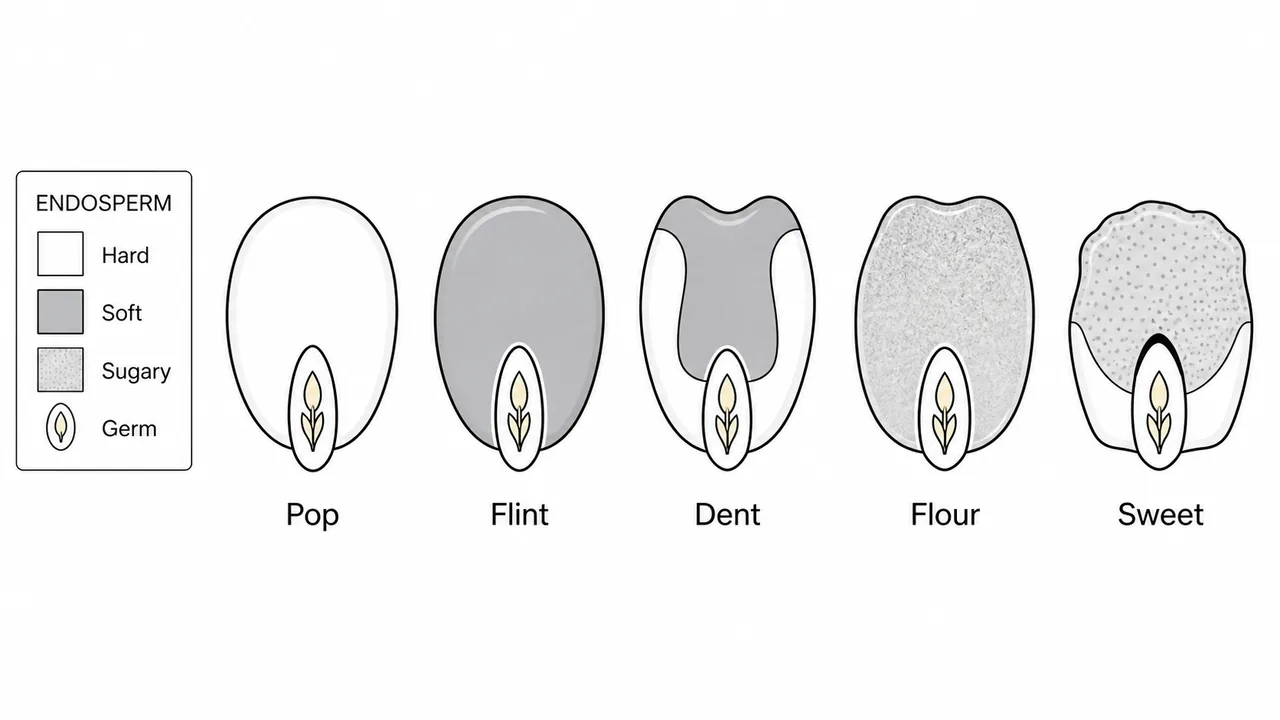
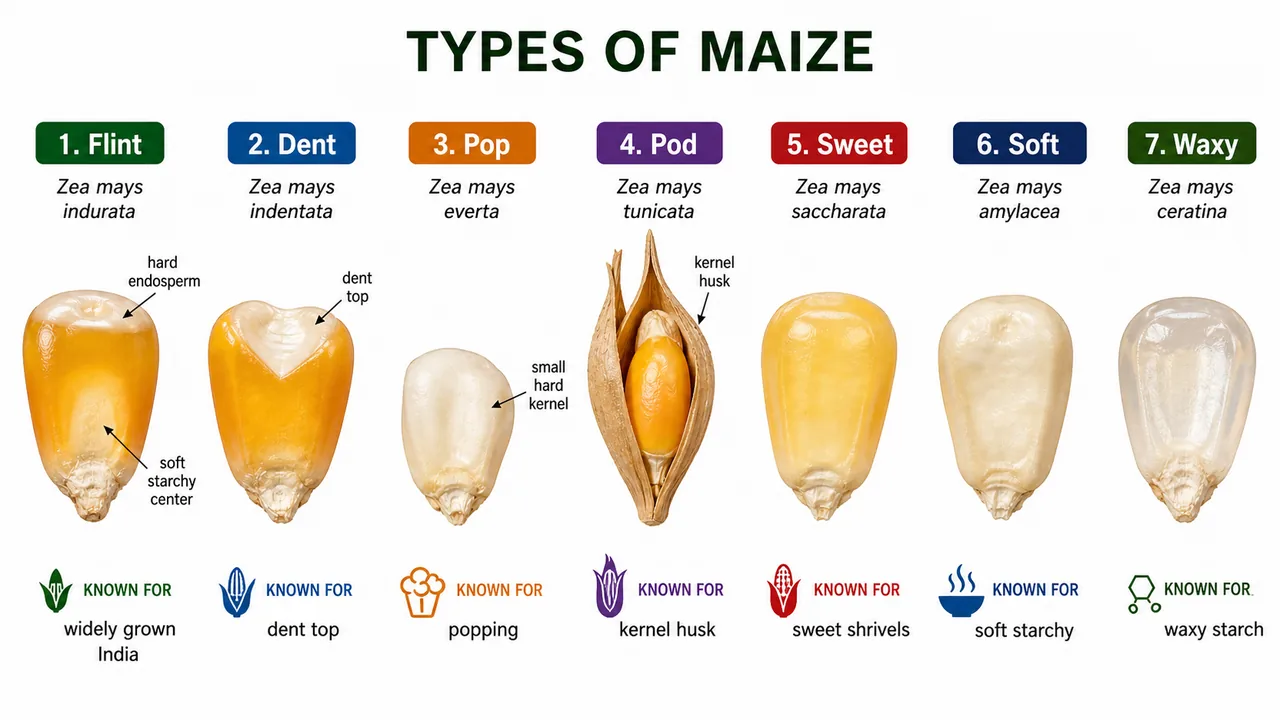
| Type | Endosperm | Key Feature |
|---|---|---|
| Dent (Z.m. indentata) | Hard sides, soft centre; dent on top | Most widely grown in USA |
| Flint (Z.m. indurata) | Entirely hard and vitreous | Dominant in India; better storage |
| Sweet (Z.m. saccharata) | High sugar, shrunken when dry | Harvested at milk stage |
| Pop (Z.m. everta) | Very hard; expands when heated | Small, round kernels |
| Flour (Z.m. amylacea) | Entirely soft/starchy | Easy to grind; used by tribal communities |
| Waxy (Z.m. ceratina) | 100% amylopectin (no amylose) | Industrial starch use |
| Pod (Z.m. tunicata) | Each kernel enclosed in glumes | Primitive; not commercially grown |
Varieties by Type
| Type | Varieties |
|---|---|
| Fodder Maize | African Tall, J1006 |
| Sweet Corn | Composite Madhuri, Composite Priya |
| Popcorn | Amber Pop, VL Amber Pop, Pearl Popcorn |
| Baby Corn | Prakash, Parvati, VL 42 |
| QPM (Opaque-2 gene) | Shaktiman 1 & 2, HQPM 1, Sakti 1, Proteina, Ratan |
| Flood-prone area | Diara |
| Drought resistant | Prakash, Megha |
| Hybrid (Yellow seeded) | Ganga-1, 3, 5, 101, Ranjit, Himalaya, VL-54 |
| Hybrid (White seeded) | Ganga Safed-2, High Starch, Ganga-4 |
Seed Rate and Root System
| Parameter | Value |
|---|---|
| Composite | 15-20 kg/ha |
| Hybrid | 20-25 kg/ha |
| Baby Corn | 25 kg/ha |
| Fodder Maize | 40-50 kg/ha (higher for dense biomass) |
| Spacing | 60 x 20-25 cm |
| Plant population | 60-65 thousand/ha |
| Germination | Hypogeal |
Root System

Maize has a fibrous, deep root system consisting of:
- Seminal roots -- first roots during germination.
- Crown roots -- from lower nodes; form the permanent root system.
- Brace / Prop roots -- aerial roots from above-ground nodes providing additional support and nutrient absorption.
Nutrient Management
| Type | NPK Dose (kg/ha) |
|---|---|
| Hybrid | 120 : 50 : 40 |
| Composite | 100 : 40 : 30 |
- Critical stages for irrigation: Tasseling and Silking. Even 2-3 days of water deficit at this stage can reduce yield by 20-30%.
Yield
| Type | Yield |
|---|---|
| Hybrid | 50-60 q/ha |
| Composite | 40-50 q/ha |
| Fodder | 300-400 q/ha |
| Average yield (India) | 27.5 q/ha |
Sweet Corn

- Harvesting is done 2-3 days after silking UPPSC 2021 at the milk stage when kernels are tender and sugar content is high. Delayed harvesting converts sugar to starch, reducing sweetness.
Important Maize Varieties Asked in AFO/NABARD
| Variety | Special Characteristics |
|---|---|
| HQPM 1, HQPM 5 | Quality Protein Maize (QPM) for all states |
| HQPM-7, QPM-9, Vivek | QPM for Peninsular India |
| Shaktiman 1, 2, 3, 4 | QPM for Bihar |
| Punjab Sweet Maize 1, Madhuri, Win Orange, Priya | Sweet corn varieties |
| African tall, Pratap Chari 6 (PC 6), J 1006 | Fodder maize |
| Amber (synthetic variety), VL Amber, Pearl Popcorn | Best popcorn varieties |
| Vikram, Vijay, Amber, Kisan, Jawahar, Sona, Protina (4% lysine), Shakti (3.45%), Ratna (4.46%) | Composite varieties |
| Ganga-1, Ganga-101, Deccan, Ranjeet | First 4 double cross hybrids in India (1961) |
| Ganga-2, Hi-Starch | Top cross varieties |
| VL 42, Him 129, VL Baby corn 1, HM 4, Prakash 1, Pratap 1, Kesari | Baby corn varieties |
| Pusa Giant Napier (P. glaucum x P. purpureum), PUSS Napier-1 | Forage variety |
Explore More
Summary Table -- Maize at a Glance
| Parameter | Value |
|---|---|
| Botanical name | Zea mays |
| Family | Poaceae |
| Origin | Central America & Mexico |
| Chromosome | 2n = 20 |
| Protein | 8-10% (Zein) -- deficient in lysine & tryptophan |
| Starch | 65-70% |
| Oil | 4-5% |
| Pollination | Cross-pollinated (protandry) |
| Photoperiod | Day neutral |
| Critical stage | Tasseling and Silking |
| Waterlogging tolerance | Cannot survive >4-5 hours |
| Best soil | Sandy loam to silty loam |
| India's rank | 3rd food crop |
| Highest Indian production | Karnataka |
| QPM gene | Opaque-2 |
| 1st double-cross hybrids | Ganga-1, Ganga-101, Deccan, Ranjeet (1961) |
| Sweet corn harvest | 2-3 days after silking (milk stage) |
Maize: Practical Decision Guide
Maize is unique among cereals — it is cross-pollinated (protandry), making hybrid seed production natural:
| Maize Type | Use | Special Feature | Market |
|---|---|---|---|
| Normal field corn | Grain, feed, starch | Standard dent/flint types | Poultry feed, starch industry |
| Sweet corn | Fresh eating, canning | Harvest 2-3 days after silking (milk stage); sugar converts to starch rapidly | Premium vegetable market |
| Baby corn | Fresh/canned vegetable | Harvest at silk emergence, before fertilization | Export-oriented, high value |
| Pop corn | Snack food | Hard endosperm, moisture trapped; explodes when heated | Consumer retail |
| QPM (Quality Protein Maize) | Nutritional security | Opaque-2 gene doubles lysine + tryptophan content | Biofortification programmes |
Critical growth stage — Tasseling + Silking:
The 7-10 days around tasseling-silking is the make-or-break period for maize. Stress during this window (drought, waterlogging >4-5 hours, or nutrient deficiency) can reduce yield by 40-60%. An AFO officer should advise farmers to ensure:
- Adequate moisture (irrigation if no rain for 5+ days)
- No waterlogging (maize cannot survive >4-5 hours submergence)
- Nitrogen top-dressing completed before tasseling
Why Karnataka leads: Karnataka produces the most maize in India, driven by the poultry feed industry demand in southern India and suitable climate for year-round cultivation (Kharif + Rabi).
Summary Cheat Sheet
| Concept / Topic | Key Details |
|---|---|
| Botanical name | Zea mays; Family Poaceae; Origin Central America & Mexico |
| Chromosome | 2n = 20 |
| Title | Queen of Cereals / Backbone of America |
| Protein | 8-10% (Zein) — deficient in lysine & tryptophan |
| Starch | 65-70%; Oil 4-5% |
| Pollination | Cross-pollinated — protandry (male tassel matures first) |
| Photoperiod | Day neutral |
| QPM | Uses Opaque-2 gene; higher tryptophan & lysine |
| Waterlogging tolerance | Cannot survive > 4-5 hours |
| Critical stage | Tasseling and Silking — 2-3 days stress = 20-30% yield loss |
| Seed rate (hybrid) | 20-25 kg/ha; composite 15-20 kg/ha |
| NPK (hybrid) | 120:50:40 kg/ha |
| Yield (hybrid) | 50-60 q/ha |
| India rank | 3rd food crop; highest production = Karnataka |
| World production | USA > China |
| First 4 hybrids (1961) | Ganga-1, Ganga-101, Deccan, Ranjeet |
| Sweet corn harvest | 2-3 days after silking (milk stage) |
| Brace/Prop roots | Aerial roots from above-ground nodes for support |
| Germination | Hypogeal |
| De-tasseling | Removing male tassel in hybrid seed production |
TIP
Next: The following lessons cover Millets -- starting with Sorghum (King of Coarse Cereals), then Pearl Millet (most drought-tolerant cereal), and finally Minor Millets (nutri-cereals). All millets are C4 plants, contrasting with the C3 rice and wheat covered earlier.
In Bihar's river plains, farmers harvest Rabi maize under cool winter skies and achieve yields that rival those of temperate countries. In Karnataka's rainfed uplands, Kharif maize sustains both poultry feed mills and rural kitchens. Maize is India's third most important food crop and holds the title "Queen of Cereals" because it has the highest genetic yield potential among all cereals.
In the previous lesson, we covered Barley -- a self-pollinated Rabi cereal. Maize is fundamentally different: it is cross-pollinated (due to protandry), a C4 plant (not C3), and day neutral (not long-day). These distinctions make maize a favourite comparison target in exams.
This chapter covers:
- Basics and QPM -- botany, protein quality, and the Opaque-2 gene
- Climate and soil -- temperature, waterlogging sensitivity
- Botany -- protandry, tassel, silk, and Sturtevant's species classification
- Varieties -- hybrids, composites, sweet corn, baby corn, fodder, and popcorn
- Nutrient management and yield -- NPK doses, critical stages
All sections are high-yield for IBPS AFO, NABARD, and RRB SO exams.
TIP
Quick answer: Maize is called the Queen of Cereals.
Basics
| Parameter | Detail |
|---|---|
| Botanical name | Zea mays |
| Family | Poaceae |
| Origin | Central America & Mexico |
| Chromosomes | 2n = 20 |
| World Area | China (largest) |
| World Production | USA > China |
| World Productivity | USA |
| India rank | 3rd most important food crop (after rice and wheat) |
| Highest production in India | Karnataka (2018-19) |
- Maize is known as the Queen of Cereals / Backbone of America because it has the highest genetic yield potential among all cereals.
- Maize is a cross-pollinated crop. Cross-pollination occurs because male (tassel) and female (silk) flowers mature at different times -- a phenomenon called protandry.
- Maize contains 65-70% starch, 8-10% protein (Zein), and 4-5% oil. Zein is deficient in lysine and tryptophan.
Quality Protein Maize (QPM)
QPM is an improved variety containing higher amounts of tryptophan and lysine with lower leucine and isoleucine in the endosperm, developed using Opaque-2 genes. QPM addresses the nutritional deficiency of normal maize, making it a better source of essential amino acids.
Climate
| Parameter | Requirement |
|---|---|
| Temperature (germination) | 21-23 C |
| Temperature (growth) | 30-35 C |
| Rainfall | 600-800 mm |
| Photoperiod | Day neutral (can flower regardless of day length) |
| Main Kharif season | North India |
| Rabi maize | Extensively grown in Bihar (higher yields due to longer grain-filling) |
| Altitude range | Sea level to 3000 m |
Soil
- Best adapted to well-drained sandy loam to silty loam soils.
- pH range: 5.5-7.5.
- Very sensitive to waterlogging -- cannot tolerate standing water beyond 4-5 hours.
WARNING
Maize cannot tolerate waterlogging beyond 4-5 hours. Ensure proper drainage, especially during Kharif. Ridge and furrow planting (ridges 6 m long) helps prevent water stagnation.
Botany
| Feature | Detail |
|---|---|
| Male inflorescence | Tassel -- terminal flower cluster producing pollen |
| Female inflorescence | Silk -- long silky filament; each silk = one potential kernel |
| Flowering pattern | Protandry -- male (tassel) sheds pollen before silk is fully emerged, promoting cross-pollination |
| Fruit | Caryopsis |
TIP
Exam mnemonic for protandry: "Proto = First, Andro = Male" -- male flowers mature first in maize. Compare with pearl millet which shows protogyny (female first).
Maize Species (Sturtevant, 1899)
| Type | Endosperm | Key Feature |
|---|---|---|
| Dent (Z.m. indentata) | Hard sides, soft centre; dent on top | Most widely grown in USA |
| Flint (Z.m. indurata) | Entirely hard and vitreous | Dominant in India; better storage |
| Sweet (Z.m. saccharata) | High sugar, shrunken when dry | Harvested at milk stage |
| Pop (Z.m. everta) | Very hard; expands when heated | Small, round kernels |
| Flour (Z.m. amylacea) | Entirely soft/starchy | Easy to grind; used by tribal communities |
| Waxy (Z.m. ceratina) | 100% amylopectin (no amylose) | Industrial starch use |
| Pod (Z.m. tunicata) | Each kernel enclosed in glumes | Primitive; not commercially grown |
Varieties by Type
| Type | Varieties |
|---|---|
| Fodder Maize | African Tall, J1006 |
| Sweet Corn | Composite Madhuri, Composite Priya |
| Popcorn | Amber Pop, VL Amber Pop, Pearl Popcorn |
| Baby Corn | Prakash, Parvati, VL 42 |
| QPM (Opaque-2 gene) | Shaktiman 1 & 2, HQPM 1, Sakti 1, Proteina, Ratan |
| Flood-prone area | Diara |
| Drought resistant | Prakash, Megha |
| Hybrid (Yellow seeded) | Ganga-1, 3, 5, 101, Ranjit, Himalaya, VL-54 |
| Hybrid (White seeded) | Ganga Safed-2, High Starch, Ganga-4 |
Seed Rate and Root System
| Parameter | Value |
|---|---|
| Composite | 15-20 kg/ha |
| Hybrid | 20-25 kg/ha |
| Baby Corn | 25 kg/ha |
| Fodder Maize | 40-50 kg/ha (higher for dense biomass) |
| Spacing | 60 x 20-25 cm |
| Plant population | 60-65 thousand/ha |
| Germination | Hypogeal |
Root System
Maize has a fibrous, deep root system consisting of:
- Seminal roots -- first roots during germination.
- Crown roots -- from lower nodes; form the permanent root system.
- Brace / Prop roots -- aerial roots from above-ground nodes providing additional support and nutrient absorption.
Nutrient Management
| Type | NPK Dose (kg/ha) |
|---|---|
| Hybrid | 120 : 50 : 40 |
| Composite | 100 : 40 : 30 |
- Critical stages for irrigation: Tasseling and Silking. Even 2-3 days of water deficit at this stage can reduce yield by 20-30%.
Yield
| Type | Yield |
|---|---|
| Hybrid | 50-60 q/ha |
| Composite | 40-50 q/ha |
| Fodder | 300-400 q/ha |
| Average yield (India) | 27.5 q/ha |
Sweet Corn
- Harvesting is done 2-3 days after silking UPPSC 2021 at the milk stage when kernels are tender and sugar content is high. Delayed harvesting converts sugar to starch, reducing sweetness.
Important Maize Varieties Asked in AFO/NABARD
| Variety | Special Characteristics |
|---|---|
| HQPM 1, HQPM 5 | Quality Protein Maize (QPM) for all states |
| HQPM-7, QPM-9, Vivek | QPM for Peninsular India |
| Shaktiman 1, 2, 3, 4 | QPM for Bihar |
| Punjab Sweet Maize 1, Madhuri, Win Orange, Priya | Sweet corn varieties |
| African tall, Pratap Chari 6 (PC 6), J 1006 | Fodder maize |
| Amber (synthetic variety), VL Amber, Pearl Popcorn | Best popcorn varieties |
| Vikram, Vijay, Amber, Kisan, Jawahar, Sona, Protina (4% lysine), Shakti (3.45%), Ratna (4.46%) | Composite varieties |
| Ganga-1, Ganga-101, Deccan, Ranjeet | First 4 double cross hybrids in India (1961) |
| Ganga-2, Hi-Starch | Top cross varieties |
| VL 42, Him 129, VL Baby corn 1, HM 4, Prakash 1, Pratap 1, Kesari | Baby corn varieties |
| Pusa Giant Napier (P. glaucum x P. purpureum), PUSS Napier-1 | Forage variety |
Explore More
Summary Table -- Maize at a Glance
| Parameter | Value |
|---|---|
| Botanical name | Zea mays |
| Family | Poaceae |
| Origin | Central America & Mexico |
| Chromosome | 2n = 20 |
| Protein | 8-10% (Zein) -- deficient in lysine & tryptophan |
| Starch | 65-70% |
| Oil | 4-5% |
| Pollination | Cross-pollinated (protandry) |
| Photoperiod | Day neutral |
| Critical stage | Tasseling and Silking |
| Waterlogging tolerance | Cannot survive >4-5 hours |
| Best soil | Sandy loam to silty loam |
| India's rank | 3rd food crop |
| Highest Indian production | Karnataka |
| QPM gene | Opaque-2 |
| 1st double-cross hybrids | Ganga-1, Ganga-101, Deccan, Ranjeet (1961) |
| Sweet corn harvest | 2-3 days after silking (milk stage) |
Maize: Practical Decision Guide
Maize is unique among cereals — it is cross-pollinated (protandry), making hybrid seed production natural:
| Maize Type | Use | Special Feature | Market |
|---|---|---|---|
| Normal field corn | Grain, feed, starch | Standard dent/flint types | Poultry feed, starch industry |
| Sweet corn | Fresh eating, canning | Harvest 2-3 days after silking (milk stage); sugar converts to starch rapidly | Premium vegetable market |
| Baby corn | Fresh/canned vegetable | Harvest at silk emergence, before fertilization | Export-oriented, high value |
| Pop corn | Snack food | Hard endosperm, moisture trapped; explodes when heated | Consumer retail |
| QPM (Quality Protein Maize) | Nutritional security | Opaque-2 gene doubles lysine + tryptophan content | Biofortification programmes |
Critical growth stage — Tasseling + Silking:
The 7-10 days around tasseling-silking is the make-or-break period for maize. Stress during this window (drought, waterlogging >4-5 hours, or nutrient deficiency) can reduce yield by 40-60%. An AFO officer should advise farmers to ensure:
- Adequate moisture (irrigation if no rain for 5+ days)
- No waterlogging (maize cannot survive >4-5 hours submergence)
- Nitrogen top-dressing completed before tasseling
Why Karnataka leads: Karnataka produces the most maize in India, driven by the poultry feed industry demand in southern India and suitable climate for year-round cultivation (Kharif + Rabi).
Summary Cheat Sheet
| Concept / Topic | Key Details |
|---|---|
| Botanical name | Zea mays; Family Poaceae; Origin Central America & Mexico |
| Chromosome | 2n = 20 |
| Title | Queen of Cereals / Backbone of America |
| Protein | 8-10% (Zein) — deficient in lysine & tryptophan |
| Starch | 65-70%; Oil 4-5% |
| Pollination | Cross-pollinated — protandry (male tassel matures first) |
| Photoperiod | Day neutral |
| QPM | Uses Opaque-2 gene; higher tryptophan & lysine |
| Waterlogging tolerance | Cannot survive > 4-5 hours |
| Critical stage | Tasseling and Silking — 2-3 days stress = 20-30% yield loss |
| Seed rate (hybrid) | 20-25 kg/ha; composite 15-20 kg/ha |
| NPK (hybrid) | 120:50:40 kg/ha |
| Yield (hybrid) | 50-60 q/ha |
| India rank | 3rd food crop; highest production = Karnataka |
| World production | USA > China |
| First 4 hybrids (1961) | Ganga-1, Ganga-101, Deccan, Ranjeet |
| Sweet corn harvest | 2-3 days after silking (milk stage) |
| Brace/Prop roots | Aerial roots from above-ground nodes for support |
| Germination | Hypogeal |
| De-tasseling | Removing male tassel in hybrid seed production |
TIP
Next: The following lessons cover Millets -- starting with Sorghum (King of Coarse Cereals), then Pearl Millet (most drought-tolerant cereal), and finally Minor Millets (nutri-cereals). All millets are C4 plants, contrasting with the C3 rice and wheat covered earlier.
Pro Content Locked
Upgrade to Pro to access this lesson and all other premium content.
₹99 charged monthly · Cancel anytime
- All Agriculture & Banking Courses
- AI Lesson Questions (100/day)
- AI Doubt Solver (50/day)
- Glows & Grows Feedback (30/day)
- AI Section Quiz (20/day)
- 22-Language Translation (100/day)
- Recall Questions (20/day)
- AI Quiz (15/day)
- AI Quiz Paper Analysis (100/day)
- AI Step-by-Step Explanations (100/day)
- Spaced Repetition Recall (FSRS)
- AI Tutor
- Immersive Text Questions
- Audio Lessons — Hindi & English
- Mock Tests & Previous Year Papers
- Summary & Mind Maps
- XP, Levels, Leaderboard & Badges
- Generate New Classrooms
- Voice AI Teacher (AgriDots Live)
- AI Revision Assistant
- Knowledge Gap Analysis
- Interactive Revision (LangGraph)
🔒 Secure via Razorpay · Cancel anytime · No hidden fees
Frequently Asked Questions
Which cereal is called the Queen of Cereals?
Maize is called the Queen of Cereals.
Why is maize called the Queen of Cereals?
Because it has very high genetic yield potential among cereals (common exam phrasing).