🐐 Goat Farming - Breeds (Indigenous and Exotic), Management, Housing and Diseases
Complete guide to goat farming covering Jamnapari, Barbari, Black Bengal, Changthangi (Pashmina), Saanen (Queen of Goats), Angora (Mohair), Boer breeds, goat housing, feeding management, PPR disease, and key exam facts for IBPS AFO, NABARD, and RRB-SO exams.
Why Goat Farming Matters
- Capra hircus
- Family: Bovidae
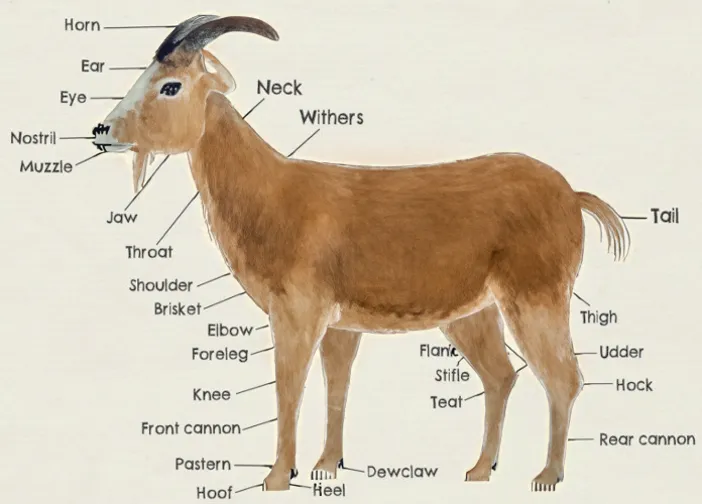
Goat farming is one of the most important livestock enterprises in India, particularly for small and marginal farmers. Goats are versatile animals that provide meat, milk, fibre, and skin, making them invaluable to the rural economy.
- Goats have a gestation period (pregnancy) of 150-152 days (five month) and the average birth rate for goats is 2.2 kids per year. This relatively short gestation period and tendency to produce twins or triplets gives goats a significant reproductive advantage over cattle.
IMPORTANT
Key reproductive parameters (highly tested in MCQs): Gestation period 147–152 days (~5 months); Estrus cycle 21 days; Estrus (heat) duration 24–36 hours; Litter size 1–3 kids (Black Bengal most prolific); Age at first kidding 12–18 months (breed-dependent). These numbers must be memorised precisely.
- Goats produce lean and juicy meats (chevon) which is preferred by all religious sects. Chevon (goat meat) has no religious taboos in India, making it universally acceptable and ensuring a consistent market demand.
- Goats provide an dependable source of income to more than 40% of the rural population who live below the poverty line in India.
- Goats are mostly raised by land less labourers and marginal farmers.
- Goats are very economic to rearing therefore known as 'Poor Man's Cow' in India. This popular title reflects the goat's ability to provide milk, meat, and income with minimal investment, even for the poorest families.
Goat Milk and Feeding Behaviour
- The goat milk contains lower fat percent with smaller fat globules, higher protein and lactose and rich in minerals. The smaller fat globules in goat milk make it naturally homogenised and easier to digest than cow milk, which is why it is often recommended for infants, elderly people, and those with digestive sensitivities.
NOTE
Pro Content Locked
Upgrade to Pro to access this lesson and all other premium content.
₹99 charged monthly · Cancel anytime
- All Agriculture & Banking Courses
- AI Lesson Questions (100/day)
- AI Doubt Solver (50/day)
- Glows & Grows Feedback (30/day)
- AI Section Quiz (20/day)
- 22-Language Translation (100/day)
- Recall Questions (20/day)
- AI Quiz (15/day)
- AI Quiz Paper Analysis (100/day)
- AI Step-by-Step Explanations (100/day)
- Spaced Repetition Recall (FSRS)
- AI Tutor
- Immersive Text Questions
- Audio Lessons — Hindi & English
- Mock Tests & Previous Year Papers
- Summary & Mind Maps
- XP, Levels, Leaderboard & Badges
- Generate New Classrooms
- Voice AI Teacher (AgriDots Live)
- AI Revision Assistant
- Knowledge Gap Analysis
- Interactive Revision (LangGraph)
🔒 Secure via Razorpay · Cancel anytime · No hidden fees

Why Goat Farming Matters
- Capra hircus
- Family: Bovidae
Goat farming is one of the most important livestock enterprises in India, particularly for small and marginal farmers. Goats are versatile animals that provide meat, milk, fibre, and skin, making them invaluable to the rural economy.
- Goats have a gestation period (pregnancy) of 150-152 days (five month) and the average birth rate for goats is 2.2 kids per year. This relatively short gestation period and tendency to produce twins or triplets gives goats a significant reproductive advantage over cattle.
IMPORTANT
Key reproductive parameters (highly tested in MCQs): Gestation period 147–152 days (~5 months); Estrus cycle 21 days; Estrus (heat) duration 24–36 hours; Litter size 1–3 kids (Black Bengal most prolific); Age at first kidding 12–18 months (breed-dependent). These numbers must be memorised precisely.
- Goats produce lean and juicy meats (chevon) which is preferred by all religious sects. Chevon (goat meat) has no religious taboos in India, making it universally acceptable and ensuring a consistent market demand.
- Goats provide an dependable source of income to more than 40% of the rural population who live below the poverty line in India.
- Goats are mostly raised by land less labourers and marginal farmers.
- Goats are very economic to rearing therefore known as 'Poor Man's Cow' in India. This popular title reflects the goat's ability to provide milk, meat, and income with minimal investment, even for the poorest families.
Goat Milk and Feeding Behaviour
- The goat milk contains lower fat percent with smaller fat globules, higher protein and lactose and rich in minerals. The smaller fat globules in goat milk make it naturally homogenised and easier to digest than cow milk, which is why it is often recommended for infants, elderly people, and those with digestive sensitivities.
NOTE
Goat milk vs Cow milk — key distinctions for exams:
- Fat globule size: Goat milk fat globules are significantly smaller (~2 µm) than cow milk (~3.5 µm), so they remain suspended without mechanical homogenisation — this is called natural homogenisation.
- Reaction: Goat milk has an alkaline reaction (slightly higher pH), unlike cow milk which tends towards neutral/slightly acidic.
- α-s1 Casein: Goat milk is low in α-s1 casein (the main allergen in cow milk), making it better tolerated by people with cow milk sensitivity.
- Uses in cheese: Goat milk is the base for feta (Greece) and chèvre (France); the distinctive flavour comes from medium-chain fatty acids (capric, caprylic acids) unique to goat milk.
- India context: Rajasthan has the highest goat population in India by state.
- Goats generally accept a wide variety of feeds but what is acceptable to one may not be equally acceptable to the others.They prefer to select from the wide variety of feeds and vegetarians (Preferably leaves) and like fresh fodder, grains, seeds and pellets rather than the wet feeds, silages, chopped greens, soiled forages and hays.
- Goats have higher tolerance to the wide variety of otherwise undesirable phyto-chemical compounds which enable them to consume a wide range of plant species. This ability to tolerate tannins, alkaloids, and other plant toxins that other livestock avoid is a unique survival advantage.
- In comparison with cows, then milch goats require a higher amount of TDN. Goats have the capability of consuming dry matter to the tune of 5 to 8% of its body weight. Therefore known as Enemy of vegetation. The term Enemy of Vegetation reflects the goat's voracious appetite and ability to consume virtually all types of plant material, which can lead to overgrazing and environmental degradation if stocking density is not properly managed.
- Being smaller in size - with larger surface area, well adapted to high temperature - arid areas. The goat's high surface-area-to-body-weight ratio allows efficient heat dissipation, making them well suited to hot, dry climates.
- Semi-arid areas with sparse vegetation, bushes, shrups - steeply sloped mountainous regions cannot be suited for cattle but goat and sheep.
- High growth rate despite being slaughtered at higher numbers due to its prolificacy, short generation, regular breeding throughout \ the year, short inter kidding interval.
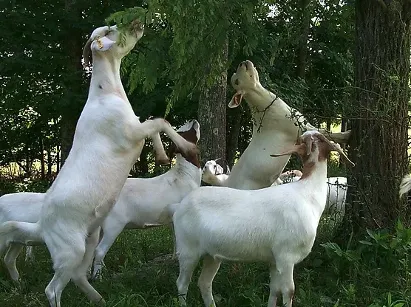
- Browsing: Goats are natural browsers. This means that they like to eat with their heads up, often reaching as high as they can for leaves, twigs and wooded area's understory. Browsing (feeding on leaves, shrubs, and tree branches) is distinct from grazing (feeding on ground-level grasses), and it is a defining characteristic of goat feeding behaviour.
Special Utility and Exam Hooks
- Morocco: Fine leather is prepared from goat skin. Morocco fine leather is prepared from goat skin. Morocco leather (also known as Moroccan leather) is a premium-quality leather prized for its fine grain, softness, and durability. It has been used for centuries in bookbinding, luxury goods, and footwear.

Nomenclature
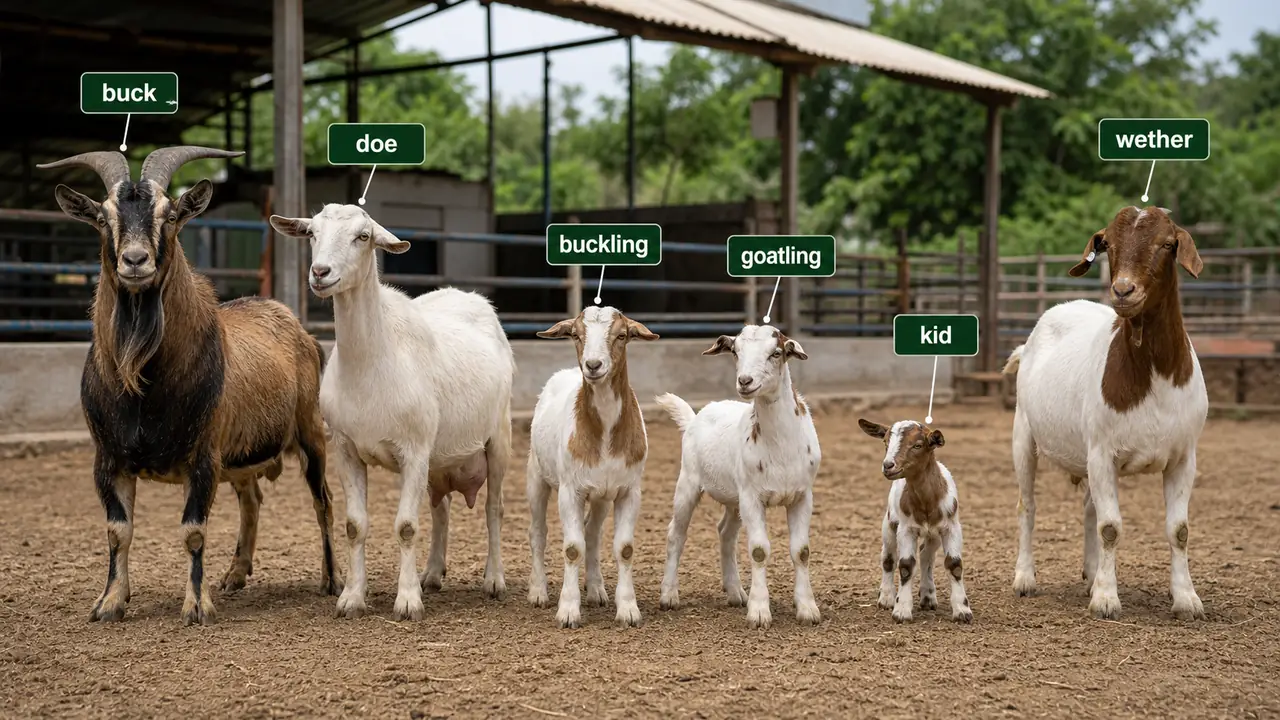
| Traits | Goat |
|---|---|
| Species | Caprine |
| Group | Band/herd |
| Adult male | Buck |
| Adult female | Doe |
| Young male | Buckling |
| Young female | Goatling |
| New born | Kid |
| Castrated Male | Wether |
| Castrated Female | Spayed |
| Act of parturition | Kidding |
| Act of mating | Servicing |
Understanding the correct terminology for goats at different ages and sexes is essential for proper record-keeping and communication. The male goat is called a buck, the female is a doe, and young goats are called kids.
Indeginous Breeds
- India has 41 registered goat breeds (NBAGR, 2024) with varying potential for meat, milk and fiber production.
- India ranks 2nd globally in goat population (after China), with approximately 148–150 million goats (20th Livestock Census, 2019). Goats contribute approximately 3% of total livestock GDP in India.
NOTE
Economic importance — exam facts: As per the 20th Livestock Census (2019), India has approximately 148.8 million goats — the world's largest goat population by some estimates (India ranks 1st or 2nd depending on source; China leads in some counts). Rajasthan has the highest goat population among Indian states. Goats are called "Poor Man's Cow" because they provide milk, meat, fibre, and manure with minimal land, feed, and investment — making them accessible to the landless poor.
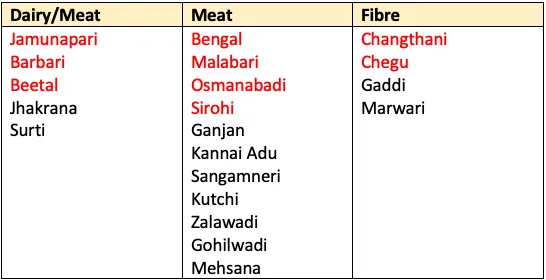
- Classification of Indian breeds of Goats according to their functions:
Jamnapari
- Dual Purpose Breed. The Jamnapari is valued for both milk and meat production.
- Jamunapari breeds is native of Etawa (Uttar Pradesh). The Chambal river region around Etawah in UP is the home tract of this breed — the name "Jamnapari" itself derives from "Jamna" (Yamuna river) + "pari" (fairy), reflecting its elegant appearance.
- Biggest and Majestic goat breed in India. The Jamnapari is the tallest Indian goat breed, with adult males reaching heights of over 100 cm at the withers.
- Its coat colour is white with tan or black markings at neck and ears.
- They have beard in both sexes.
- They have tuft of think and long hairs in the buttocks known as feather. This distinctive feathering on the hindquarters is a hallmark identification feature of the Jamnapari breed.
- It is largest and most elegant of the long-legged goats of India.
- It has Roman nose (hook nose) and parrot mouth appearance. The Roman nose (convex profile) is a characteristic feature used in breed identification.
- Their horns are short and flat and horizontally twisting backward.
- It has folded pendulated (hanging down loosely) and large ears drooped downwards. The long, pendulous ears can measure up to 25 cm and are a distinguishing trait.
- An adult female weighs between 45 kgs to 60 kgs, whereas an adult male ranges between 65 kgs to 80 kgs.
- Average birth weight is up to 4 kg.
- Average age at first kidding is 20-25 months.
- They have large udder and big teats and average yield is 280 kg (highest among indigenous) and lactation length is 274 days (longest). This combination of highest milk yield and longest lactation length among Indian goat breeds makes Jamnapari the premier indigenous dairy goat.
TIP
Jamnapari memory hook: "Tallest + Longest + Highest" — Tallest breed, Longest lactation (274 days), Highest milk yield (280 kg) among indigenous breeds. Roman nose + pendulous ears + feathered hindquarters = the three hallmark physical identification features.
- Have the ability to yield 2 to 2.5 kgs of milk per day.
- The fat content of the milk ranges between 3 to 3.5%.
Barbari
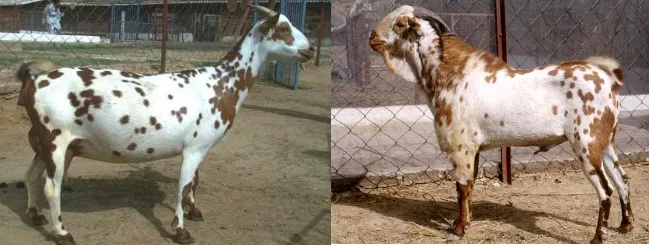 - **Dairy Breed** (Miltch). *Also classified as dual-purpose in many texts due to acceptable meat production.*
- Origin is traditionally believed to have originated from Berbera, Somalia (disputed; some sources suggest Indian subcontinent origin); name derived from Berbera city. The breed has adapted well to the **semi-arid conditions** of northern India.
- Now common in the farms of the arid and semi-arid regions of north and north-western India. Found in Uttar Pradesh, prevalently in the Mathura, Etah, Aligarh, Agra districts, Bharatpur in Rajasthan.
- It is dwarf breed & suitable for stall feeding, therefore found in cities. The **compact body size** of the Barbari makes it ideal for **urban and peri-urban** goat rearing where space is limited.
- Prolific breeder and kid twice in **12-15 months**. Usually give birth two kids (twins) in one parturition. This high **twinning rate** and short **inter-kidding interval** make the Barbari one of the most prolific goat breeds in India.
- The average daily milk yield is 1 to 1.5 kg with a lactation period of 150 days.
- *Coat colour is distinctive — predominantly white with two-tone (light brown/tan) patches, making it easily identifiable.* *Body is small and compact with upright ears — unlike the long pendulous ears of Jamnapari.*
- **Dairy Breed** (Miltch). *Also classified as dual-purpose in many texts due to acceptable meat production.*
- Origin is traditionally believed to have originated from Berbera, Somalia (disputed; some sources suggest Indian subcontinent origin); name derived from Berbera city. The breed has adapted well to the **semi-arid conditions** of northern India.
- Now common in the farms of the arid and semi-arid regions of north and north-western India. Found in Uttar Pradesh, prevalently in the Mathura, Etah, Aligarh, Agra districts, Bharatpur in Rajasthan.
- It is dwarf breed & suitable for stall feeding, therefore found in cities. The **compact body size** of the Barbari makes it ideal for **urban and peri-urban** goat rearing where space is limited.
- Prolific breeder and kid twice in **12-15 months**. Usually give birth two kids (twins) in one parturition. This high **twinning rate** and short **inter-kidding interval** make the Barbari one of the most prolific goat breeds in India.
- The average daily milk yield is 1 to 1.5 kg with a lactation period of 150 days.
- *Coat colour is distinctive — predominantly white with two-tone (light brown/tan) patches, making it easily identifiable.* *Body is small and compact with upright ears — unlike the long pendulous ears of Jamnapari.*
Beetal
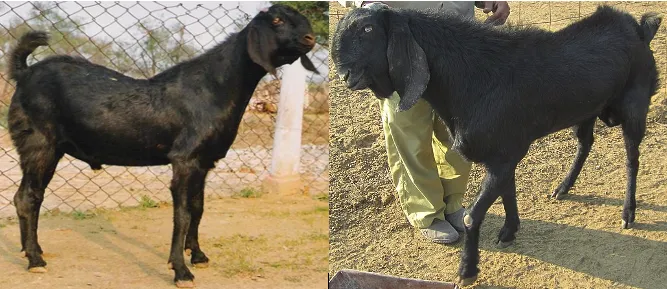 - **Dual purpose** breed.
- Mainly found in Punjab state. *Also common in Haryana. Beetal is considered the **best milch goat breed of Punjab and Haryana**.*
- This breed is evolved from Jamunapari, therefor it's physical traits are almost similar to it. But it is smaller than Jamnapari. The **Beetal** can be considered a more compact version of the Jamnapari, sharing many physical features like pendulous ears and a Roman nose.
- *Horns are present in both sexes, **twisted and spiralling backward** — a key identification trait distinct from Jamnapari's short flat horns.*
- Coat Colour is predominantly black, red, tan or black, heavily spotted on white also found.
- An adult male ranges between 50 kgs to 70 kgs.
- Age at first kidding 20-22 months.
- Milk yield 1-2 kgs of milk per day.
- **Dual purpose** breed.
- Mainly found in Punjab state. *Also common in Haryana. Beetal is considered the **best milch goat breed of Punjab and Haryana**.*
- This breed is evolved from Jamunapari, therefor it's physical traits are almost similar to it. But it is smaller than Jamnapari. The **Beetal** can be considered a more compact version of the Jamnapari, sharing many physical features like pendulous ears and a Roman nose.
- *Horns are present in both sexes, **twisted and spiralling backward** — a key identification trait distinct from Jamnapari's short flat horns.*
- Coat Colour is predominantly black, red, tan or black, heavily spotted on white also found.
- An adult male ranges between 50 kgs to 70 kgs.
- Age at first kidding 20-22 months.
- Milk yield 1-2 kgs of milk per day.
Sirohi
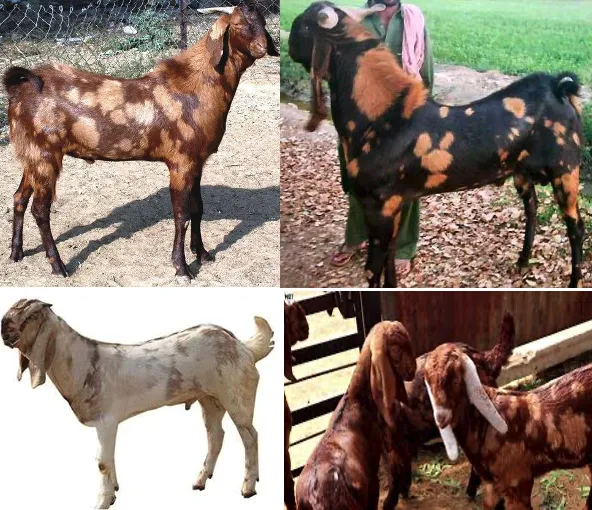 - This breed is mainly reared for meat and milk yield is very small. **Sirohi** is primarily a **meat-type** breed with limited dairy potential.
- Native of **Sirohi** district of *Rajasthan*, hence the name.
- Coat colour is brown, white, and admixture of colours in typical patches.
- Short and coarse hairs on body. The **short, coarse coat** is well adapted to the hot, dry climate of Rajasthan.
- This breed is mainly reared for meat and milk yield is very small. **Sirohi** is primarily a **meat-type** breed with limited dairy potential.
- Native of **Sirohi** district of *Rajasthan*, hence the name.
- Coat colour is brown, white, and admixture of colours in typical patches.
- Short and coarse hairs on body. The **short, coarse coat** is well adapted to the hot, dry climate of Rajasthan.
Black Bengal
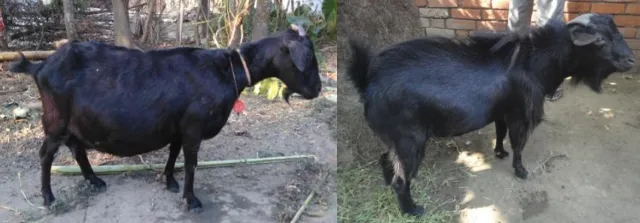 - This breed is known for its excellent quality of meat. **Black Bengal** meat is considered among the finest goat meat in the world due to its tenderness, flavour, and low fat content.
- Animals are predominantly **black** and found in eastern India and northern parts of **Bangladesh** (Hence named as Black Bengal)
- Animal are small and compact i.e. **Dwarf** in body size
- Its meat is tender and has a good taste. *The meat of Black Bengal goats is called **chevon** and is especially prized in West Bengal, Jharkhand, Bihar, and northeastern states.*
- **Prolific breed** and multiple births are common, twins or triplets are born in **12-14** months old doe. The **Black Bengal** is renowned for its **exceptionally high prolificacy**, frequently producing triplets or even quadruplets.
- It's skin is great demand for high class shoe-making. **Black Bengal skin** is considered one of the best quality goat skins in the world and fetches premium prices in the international leather market.
- This breed is known for its excellent quality of meat. **Black Bengal** meat is considered among the finest goat meat in the world due to its tenderness, flavour, and low fat content.
- Animals are predominantly **black** and found in eastern India and northern parts of **Bangladesh** (Hence named as Black Bengal)
- Animal are small and compact i.e. **Dwarf** in body size
- Its meat is tender and has a good taste. *The meat of Black Bengal goats is called **chevon** and is especially prized in West Bengal, Jharkhand, Bihar, and northeastern states.*
- **Prolific breed** and multiple births are common, twins or triplets are born in **12-14** months old doe. The **Black Bengal** is renowned for its **exceptionally high prolificacy**, frequently producing triplets or even quadruplets.
- It's skin is great demand for high class shoe-making. **Black Bengal skin** is considered one of the best quality goat skins in the world and fetches premium prices in the international leather market.
IMPORTANT
Black Bengal — exam superlatives: (1) Highest kidding rate in India — twins and triplets are the norm, not the exception. (2) Best quality skin in India — fetches highest price in the international leather market. (3) Earliest puberty among Indian breeds — as early as 5–7 months. (4) Distribution: West Bengal, Jharkhand, Bihar, Assam, Odisha, Bangladesh. Remember: Black Bengal = Prolific + Best Skin + Earliest Puberty.
Osmanabadi
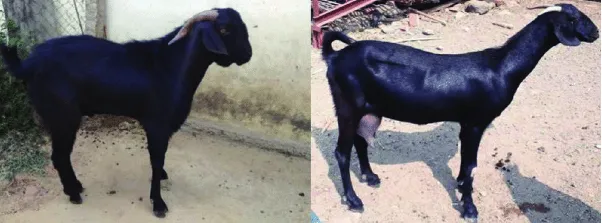 - Reared for meat (good quality). The **Osmanabadi** is a sturdy breed well adapted to the semi-arid regions of Maharashtra and northern Karnataka.
- Colour is predominantly black; white, brown and spotted occur.
- Reared for meat (good quality). The **Osmanabadi** is a sturdy breed well adapted to the semi-arid regions of Maharashtra and northern Karnataka.
- Colour is predominantly black; white, brown and spotted occur.
Marwari
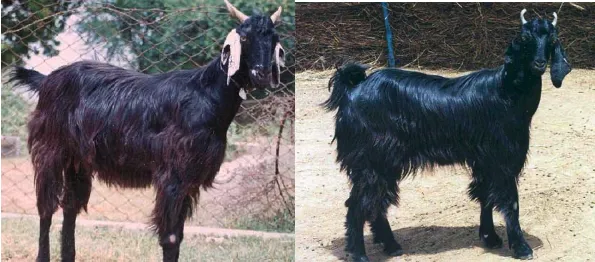 - Marwar region of Rajasthan.
- Predominantly jet black colour.
- It is disease resistant breed. The **Marwari** goat's natural **disease resistance** makes it well suited for low-input farming systems in arid regions.
- The average daily milk yield is poor, about 0.8 kg.
- It is good for **meat**.
- Marwar region of Rajasthan.
- Predominantly jet black colour.
- It is disease resistant breed. The **Marwari** goat's natural **disease resistance** makes it well suited for low-input farming systems in arid regions.
- The average daily milk yield is poor, about 0.8 kg.
- It is good for **meat**.
Tellicherry
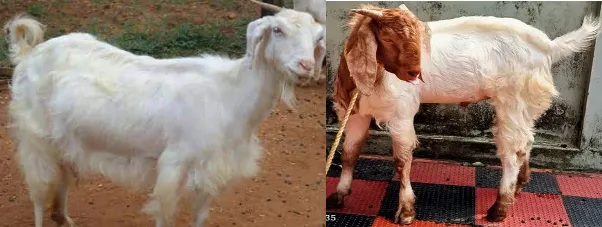 - Tellicherry breeds are also called as Malabari breeds. The name **Malabari** reflects the breed's origin in the Malabar coast of Kerala.
- These types of breeds are found mostly in the state of Kerala.
- This breed is reared mainly for **meat** purpose and their skin is popular with the tanning insustry.
- *Classified as a **dual-purpose breed** (meat + milk) in ICAR/NBAGR records. Good adaptability to the hot, humid coastal climate of Kerala. Adults have a well-muscled body with a predominantly **black, brown, or white** coat.*
- Tellicherry breeds are also called as Malabari breeds. The name **Malabari** reflects the breed's origin in the Malabar coast of Kerala.
- These types of breeds are found mostly in the state of Kerala.
- This breed is reared mainly for **meat** purpose and their skin is popular with the tanning insustry.
- *Classified as a **dual-purpose breed** (meat + milk) in ICAR/NBAGR records. Good adaptability to the hot, humid coastal climate of Kerala. Adults have a well-muscled body with a predominantly **black, brown, or white** coat.*
Jakhrana
- Dairy Breed (highest milk-yielding indigenous dairy goat breed in India).
- Origin: Jakhrana village, Behror tehsil, Rajasthan.
- Highest milk yield among indigenous goat breeds: 2–3 kg/day; lactation period approximately 150 days.
- Characteristics: large body, pendulous ears, black coat with white spots on ears and muzzle.
- Often compared to Jamnapari in size but surpasses it in daily milk yield.
Changthangi
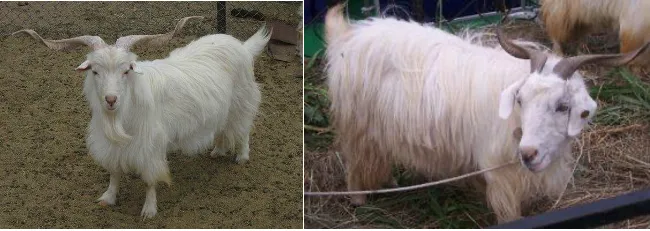 - Native of **Ladakh**. The **Changthangi** goat thrives at altitudes above **4,000 metres** in the cold, arid plateaus of Ladakh.
- Breed is also known as Pashmina due the ability of the breed produce longer and finer pashmina on the sides of shoulders.
- Native of **Ladakh**. The **Changthangi** goat thrives at altitudes above **4,000 metres** in the cold, arid plateaus of Ladakh.
- Breed is also known as Pashmina due the ability of the breed produce longer and finer pashmina on the sides of shoulders.
IMPORTANT
Pashmina vs Mohair — the most commonly confused MCQ topic:
| Feature | Pashmina (Cashmere) | Mohair |
|---|---|---|
| Source animal | Changthangi / Chegu goats | Angora goat |
| Origin | Ladakh / Himachal Pradesh, India | Turkey (Ankara/Angora) |
| Fibre fineness | 10–16 microns (ultra-fine) | 25–45 microns (coarser but lustrous) |
| Key property | Extreme softness, warmth | Lustre, durability, takes dye well |
| Product | Kashmir Pashmina shawls | Mohair fabric, yarn |
| Memory trick | Pashmina = Plateau (high altitude) goats | Mohair = Mediterranean origin (Turkey) |
Do NOT confuse: Angora rabbit also produces a fibre called Angora wool — this is separate from the Angora goat's Mohair.
- Average production of pashmina is 215 gm. It is used for making Kashmir "Rug or Shawl" of high quality.
- This breed is primarily raised for the production of super-fine cashmere wool. They are largely reared by a tribe of nomadic people called the 'Changpa'. The Changpa are nomadic herders of the Changthang plateau who have maintained this breed for centuries, with their entire livelihood revolving around these goats.
- This cashmere variety of wool is considered to be the 'world's finest cashmere'.
- The fiber thickness measures 11–13 microns (standard cited range; some sources up to 16 µm). For comparison, a human hair is approximately 60-100 microns thick, making Pashmina fibre extraordinarily fine.
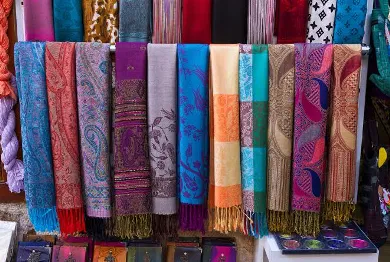
- Once weaved, the cashmere wool is known as the Pashmina, and is used to make the popular Pashmina Shawls of Kashmir. These shawls or rugs (wrappers) are exported throughout the world at a very expensive rate.
- It is a fine type of wool used in winter clothes mainly obtained from goat Changthangi, Chegu etc.
Chegu
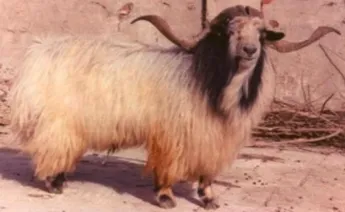 - Native of **Himachal Pradesh**. The **Chegu** is found in the higher elevations of the Spiti and Kinnaur valleys.
- The breed is marked for Pashmina production.
- Average yearly production is about 120 grams with 5.9 cm fibre length having 10-12 micron diameters. The extremely fine **10-12 micron** fibre diameter makes Chegu pashmina one of the softest natural fibres available.
- Native of **Himachal Pradesh**. The **Chegu** is found in the higher elevations of the Spiti and Kinnaur valleys.
- The breed is marked for Pashmina production.
- Average yearly production is about 120 grams with 5.9 cm fibre length having 10-12 micron diameters. The extremely fine **10-12 micron** fibre diameter makes Chegu pashmina one of the softest natural fibres available.
CIRG — Central Institute for Research on Goats
- CIRG is located at Makhdoom, Farah, Mathura, Uttar Pradesh, under the Indian Council of Agricultural Research (ICAR).
- It is the premier national institute for research on goat production, health, and breeding in India.
- Breeds maintained at CIRG: Jamunapari, Barbari, Black Bengal, Sirohi, Marwari.
- Key research areas: goat nutrition, reproductive management, disease control (especially PPR), genetic improvement, and breed conservation.
- CIRG has developed protocols for intensive goat farming that have benefited thousands of farmers across India.
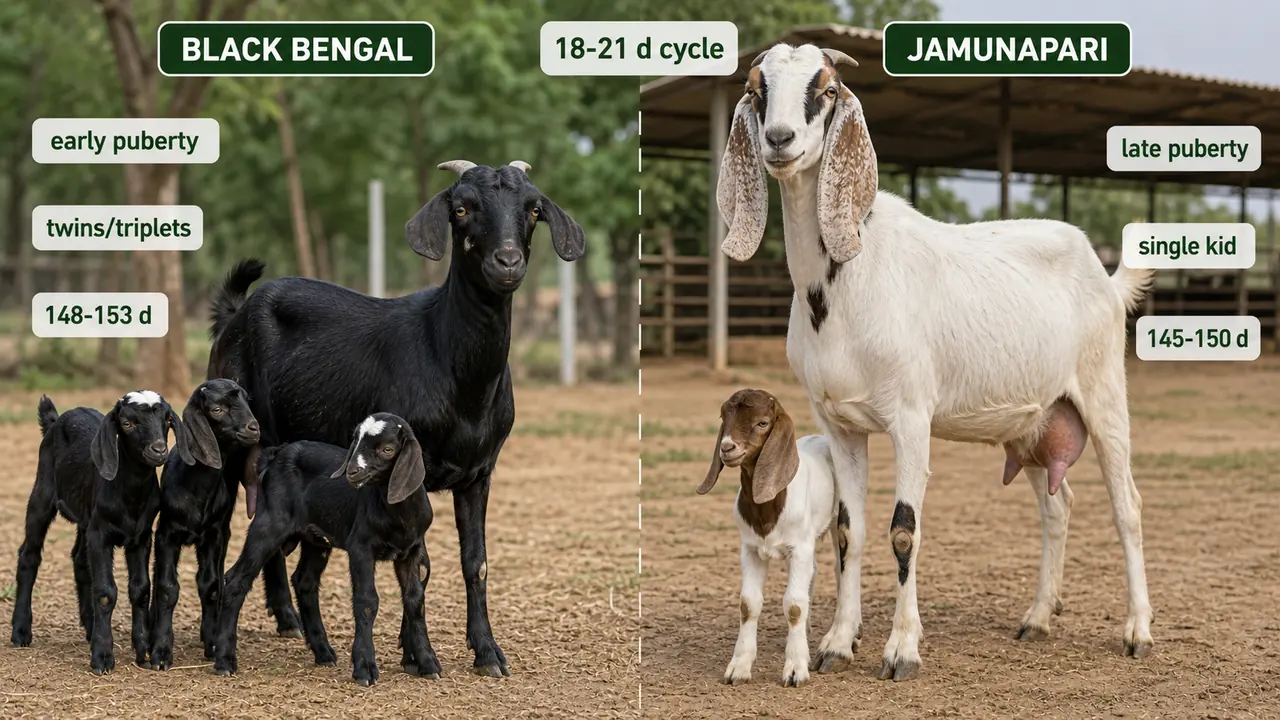
Reproductive Parameters of Key Breeds
| Parameter | Black Bengal | Jamunapari |
|---|---|---|
| Age at puberty | 5–7 months | 10–12 months |
| Estrus cycle | ~18–21 days | ~18–21 days |
| Gestation period | 148–153 days | 145–150 days |
| Average litter size | 1.5–2.5 kids | 1.1–1.3 kids |
- The shorter age at puberty and higher litter size of Black Bengal make it the most prolific Indian goat breed.
- The estrus (heat) cycle of approximately 18–21 days is consistent across most goat breeds.
Exotic Breeds
Saanen
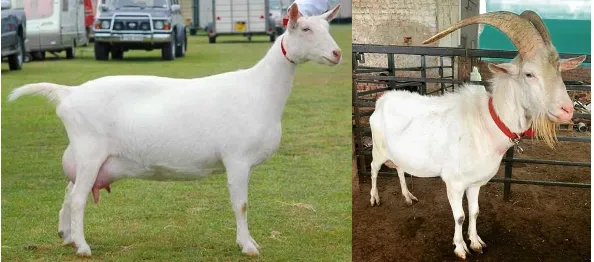 - Native of **Switzerland**. The **Saanen** originated in the Saanen Valley of the Swiss Alps and is now found worldwide.
- Colour is white or light cream.
- Presence of beard in both the sexes is the characteristic feature.
- AKA Queen of Goats. The title **Queen of Goats** is attributed to the Saanen because of its **highest milk production** among all goat breeds globally, with top animals producing over **1,000 kg of milk per lactation**.
- Native of **Switzerland**. The **Saanen** originated in the Saanen Valley of the Swiss Alps and is now found worldwide.
- Colour is white or light cream.
- Presence of beard in both the sexes is the characteristic feature.
- AKA Queen of Goats. The title **Queen of Goats** is attributed to the Saanen because of its **highest milk production** among all goat breeds globally, with top animals producing over **1,000 kg of milk per lactation**.
Anglo-Nubian
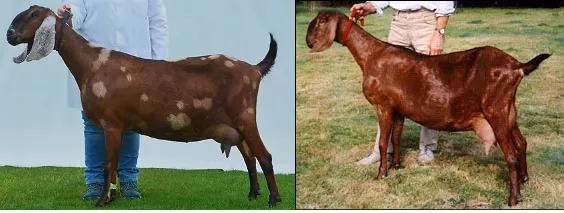 - Native of **England**.
- Developed in England (19th century) from British does × large lop-eared bucks from India (Jamnapari), Middle East, and Egypt (Zaraibi). Named 'Anglo-Nubian' for the Nubian influence.
- AKA Jersey Cow. This nickname reflects the Anglo-Nubian's **high milk fat content**, similar to how the Jersey cow is known for rich, creamy milk among cattle breeds.
- Peak yield goes upto 6.5 kg/day.
- It is a big animal with a fine skin and glossy coat, pendulous ears, and Roman nose. The **long, pendulous ears** and **convex (Roman) nose** are the most distinctive features for breed identification.
- Native of **England**.
- Developed in England (19th century) from British does × large lop-eared bucks from India (Jamnapari), Middle East, and Egypt (Zaraibi). Named 'Anglo-Nubian' for the Nubian influence.
- AKA Jersey Cow. This nickname reflects the Anglo-Nubian's **high milk fat content**, similar to how the Jersey cow is known for rich, creamy milk among cattle breeds.
- Peak yield goes upto 6.5 kg/day.
- It is a big animal with a fine skin and glossy coat, pendulous ears, and Roman nose. The **long, pendulous ears** and **convex (Roman) nose** are the most distinctive features for breed identification.
Alpine
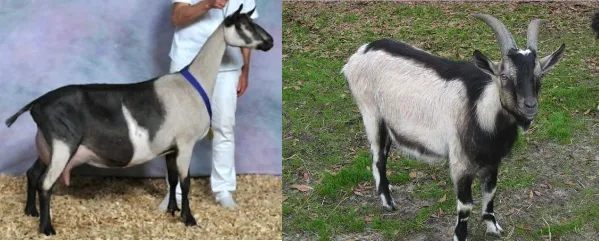 - Native of **Europe**. The **Alpine** goat originated in the French Alps and is well adapted to mountainous terrain and cooler climates.
- Milk breed. The Alpine is one of the top **dairy goat breeds**, known for consistent milk production over long lactation periods.
- Fat of 3-4%.
- Native of **Europe**. The **Alpine** goat originated in the French Alps and is well adapted to mountainous terrain and cooler climates.
- Milk breed. The Alpine is one of the top **dairy goat breeds**, known for consistent milk production over long lactation periods.
- Fat of 3-4%.
Toggenburg
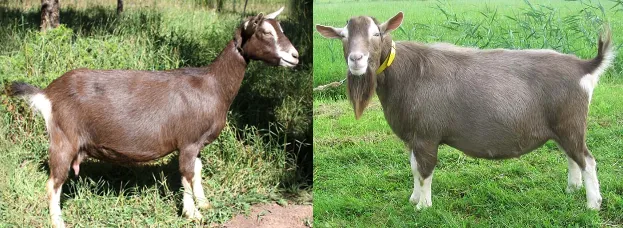 - Native of Switzerland. The **Toggenburg** is the oldest known dairy goat breed, originating from the Toggenburg Valley.
- Chocolate colour. The characteristic **chocolate brown** coat with white facial stripes makes the Toggenburg easily recognizable.
- Hornless breed, miltch breed. Being **naturally hornless** (polled) is an advantage in management, as it eliminates the need for disbudding.
- Skin is very soft and pliable.
- Fat content of milk 3-4 percent.
- Native of Switzerland. The **Toggenburg** is the oldest known dairy goat breed, originating from the Toggenburg Valley.
- Chocolate colour. The characteristic **chocolate brown** coat with white facial stripes makes the Toggenburg easily recognizable.
- Hornless breed, miltch breed. Being **naturally hornless** (polled) is an advantage in management, as it eliminates the need for disbudding.
- Skin is very soft and pliable.
- Fat content of milk 3-4 percent.
Angora
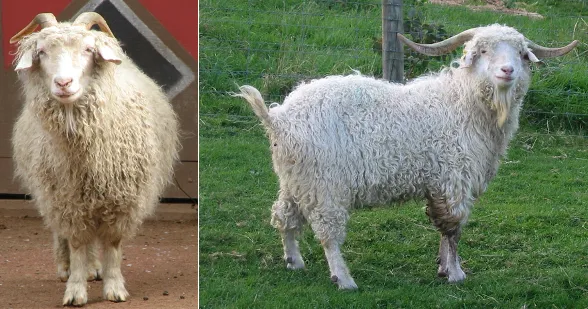 - Native of **Turkey** or **Asia Minor**. The **Angora** goat takes its name from Ankara (formerly Angora), the capital of Turkey.
- Its hairs produce a superior quality fibre called mohair. This soft white wool is in great demand for clothing. **Mohair** is distinct from **cashmere/pashmina**; it comes from the Angora goat and is valued for its lustre, durability, and ability to take dyes beautifully. An adult Angora goat produces approximately **3 to 5 kg of mohair** per year.
- *The Angora goat has a distinctive long, curly, lustrous white fleece that covers the entire body. It is shorn twice a year. **Mohair** is stronger than wool and becomes more lustrous with age — the finest mohair comes from **kid Angora** goats (first shearing).*
- *In India, Angora goats are reared experimentally in hilly regions; they are not a mainstream Indian breed.*
- Native of **Turkey** or **Asia Minor**. The **Angora** goat takes its name from Ankara (formerly Angora), the capital of Turkey.
- Its hairs produce a superior quality fibre called mohair. This soft white wool is in great demand for clothing. **Mohair** is distinct from **cashmere/pashmina**; it comes from the Angora goat and is valued for its lustre, durability, and ability to take dyes beautifully. An adult Angora goat produces approximately **3 to 5 kg of mohair** per year.
- *The Angora goat has a distinctive long, curly, lustrous white fleece that covers the entire body. It is shorn twice a year. **Mohair** is stronger than wool and becomes more lustrous with age — the finest mohair comes from **kid Angora** goats (first shearing).*
- *In India, Angora goats are reared experimentally in hilly regions; they are not a mainstream Indian breed.*
Boer
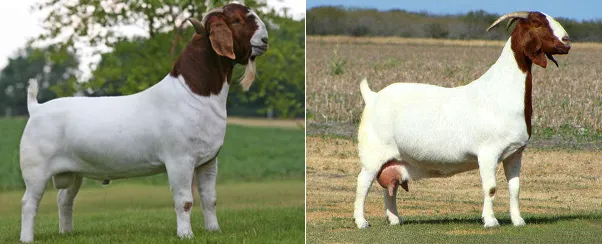 - It is a **South African** breed. The **Boer** goat was developed in South Africa in the early 1900s specifically for **meat production**.
- It is mainly reared for good quality **meat**. The Boer is considered the **world's best meat goat breed** due to its rapid growth rate, excellent carcass conformation, and high dressing percentage.
- It is a **South African** breed. The **Boer** goat was developed in South Africa in the early 1900s specifically for **meat production**.
- It is mainly reared for good quality **meat**. The Boer is considered the **world's best meat goat breed** due to its rapid growth rate, excellent carcass conformation, and high dressing percentage.
Management
- Feeding of Lambs and kids: Lambs and kids will suckle from the mother until they are 4 months old but they will start to show an interest in green plants from 3 weeks of age. This early interest in solid feed is important for the development of the rumen and should be encouraged by providing access to palatable, high-quality forage.
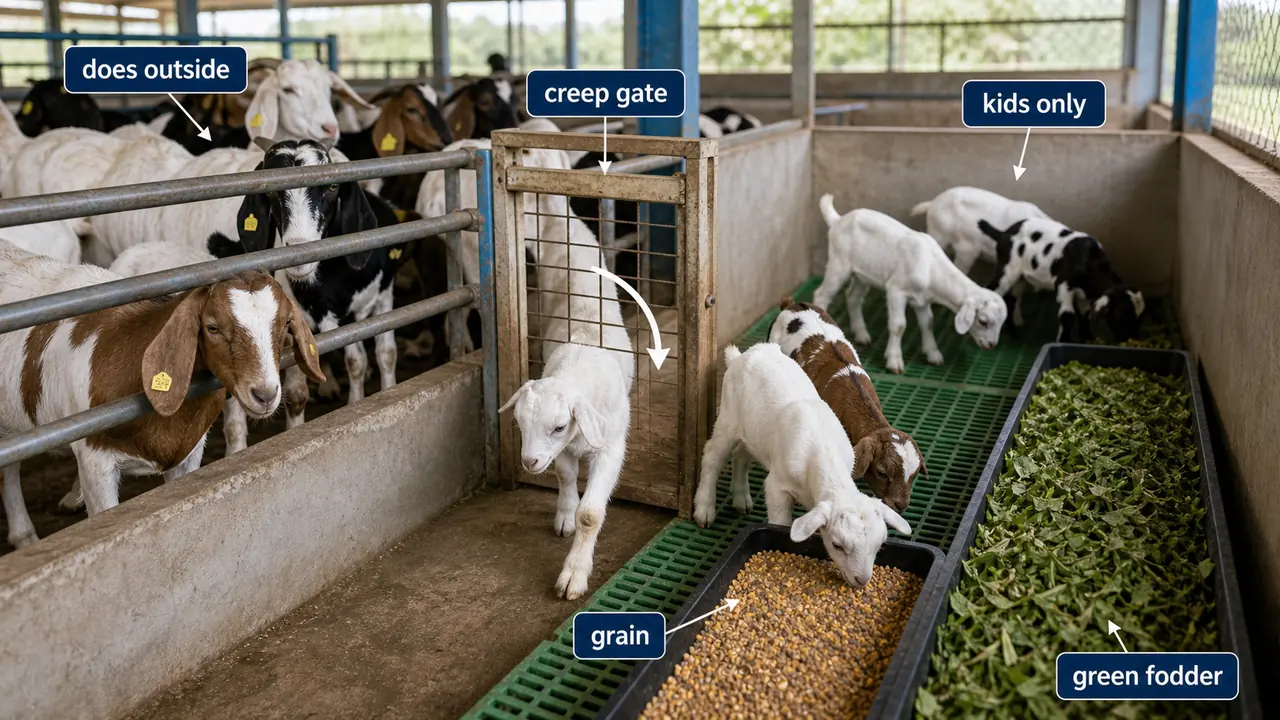
- 'Creep Feeding', the practice of offering grain to lambs/kids that have not yet been weaned, can help the eventual transition off of milk to a post-weaning diet and can reduce stress at weaning time. Creep feeding involves placing feed in an area accessible only to the young kids (using a creep gate that the larger does cannot pass through), ensuring they receive supplemental nutrition without competition from adults.
Housing
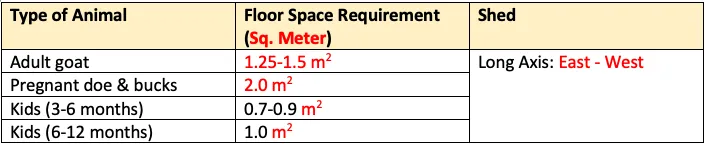
Proper goat housing protects animals from rain, extreme heat, cold, and predators. The housing should be well-ventilated, dry, and easy to clean. Adequate floor space per animal must be provided to prevent overcrowding, which can lead to stress, disease outbreaks, and reduced productivity.
Diseases in Goat
PPR
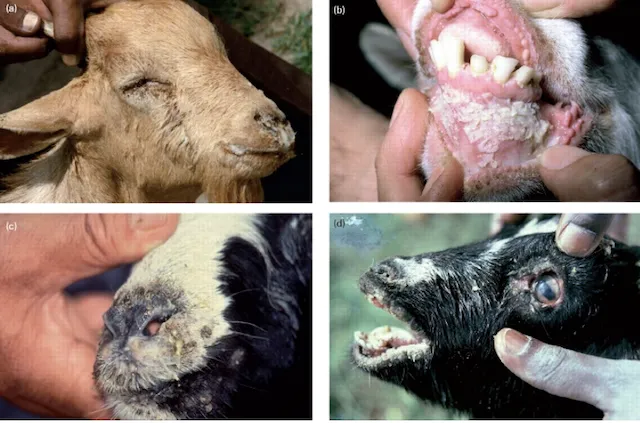 - Peste Des Petits Ruminants (PPR)
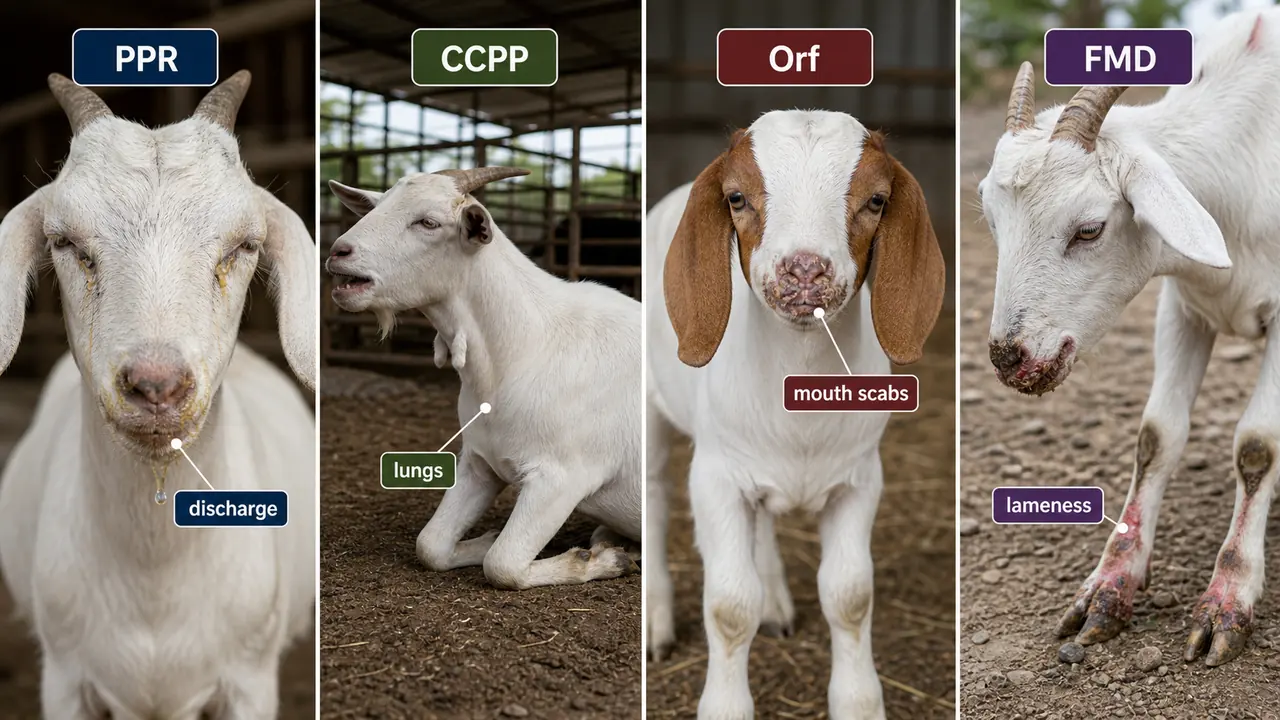
- The PPR is most important infectious disease of small ruminants caused by a virus and is known as **sheep and goat plague**. **PPR** is caused by a **Morbillivirus** (related to the rinderpest virus of cattle) and is one of the most economically devastating diseases of small ruminants in Asia and Africa.
- It causes up to 80–100% mortality in naive/susceptible flocks; morbidity approaches 100% due to **high fever**, **pneumonia**, oculo-nasal discharges, **diarrhoea** and **dehydration**. The devastatingly high mortality rate underscores the critical importance of timely **vaccination** as the primary control measure.
- Peste Des Petits Ruminants (PPR)
- The PPR is most important infectious disease of small ruminants caused by a virus and is known as **sheep and goat plague**. **PPR** is caused by a **Morbillivirus** (related to the rinderpest virus of cattle) and is one of the most economically devastating diseases of small ruminants in Asia and Africa.
- It causes up to 80–100% mortality in naive/susceptible flocks; morbidity approaches 100% due to **high fever**, **pneumonia**, oculo-nasal discharges, **diarrhoea** and **dehydration**. The devastatingly high mortality rate underscores the critical importance of timely **vaccination** as the primary control measure.
Contagious Caprine Pleuropneumonia (CCPP)
- Caused by Mycoplasma capricolum subsp. capripneumoniae.
- Primarily affects the lungs (pleuropneumonia); highly contagious among goats.
- Mortality can reach up to 100% in outbreak situations; significant economic losses in affected flocks.
- Notifiable disease; vaccination and quarantine are key control measures.
Enterotoxaemia (Pulpy Kidney Disease)
- Caused by Clostridium perfringens Type D.
- Also known as "Pulpy Kidney" disease because the kidneys become soft and pulpy at post-mortem.
- Affects well-fed, rapidly growing kids; associated with sudden change in diet or overeating of concentrate feed.
- Vaccine is available (Clostridial vaccines); vaccination is the primary prevention strategy.
Foot and Mouth Disease (FMD) in Goats
- Caused by the FMD virus (Aphthovirus); vesicular disease affecting cloven-hoofed animals.
- In goats: vesicular lesions on mouth, feet, and teats; causes lameness and reduced productivity.
- FMD status is critically important for livestock export restrictions — FMD-free status is required for most international meat and livestock trade.
- Vaccination programs (O, A, Asia-1 serotypes) are mandatory in India.
Tuberculosis
- Goats are resistant to tuberculosis. This natural resistance to tuberculosis is a notable advantage of goats over cattle.
Goat Pox (Capripox)
- Caused by Capripoxvirus (genus Capripoxvirus, family Poxviridae). Closely related to sheep pox virus — they are antigenically distinct but in the same genus.
- Characterised by generalised skin nodules/pox lesions, fever, and respiratory distress.
- Notifiable disease — must be reported to authorities; important for trade restrictions.
- Vaccine is available (live attenuated); vaccination is the primary control measure.
- Memory hook: Capripox = Capra (goat) + Ovis (sheep) pox — both are caused by Capripoxviruses.
Contagious Ecthyma (Orf / Sore Mouth)
- Caused by Orf virus (Parapoxvirus ovis), a DNA virus in family Poxviridae.
- Produces proliferative, scabby lesions around the mouth, lips, nostrils, and sometimes teats of does.
- Primarily affects young kids and lambs; adults can be infected but usually recover faster.
- Zoonotic disease — can transmit to humans (especially shepherds, farmers) through direct contact with lesions; causes painful nodular lesions on hands.
- Also known as Contagious Pustular Dermatitis or Scabby Mouth.
- No specific treatment; supportive care + topical antiseptics. Live attenuated vaccines available.
IMPORTANT
Orf (Contagious Ecthyma) exam points: Causative agent = Parapoxvirus ovis (Orf virus); Zoonotic = YES; Lesions on lips/mouth of young kids; Called "Sore Mouth" or "Scabby Mouth". This disease is commonly asked in the context of zoonotic goat diseases.
TIP
Quick recall for goat breeds: Jamnapari = Biggest + Longest lactation (274 days) + Highest milk (280 kg) among indigenous; Roman nose + pendulous ears + feathered hindquarters. Jakhrana = Highest daily milk yield (2–3 kg/day). Beetal = Best milch goat of Punjab/Haryana. Barbari = Dwarf dual-purpose, white with tan patches, twins in 12–15 months. Saanen = Queen of Goats (highest milk globally). Anglo-Nubian = Jersey Cow of goats (pendulous ears, Roman nose, high fat milk). Changthangi = Pashmina wool (10–16 microns, Ladakh). Chegu = Pashmina (10–12 microns, Himachal Pradesh). Angora = Mohair fibre (Turkey). Pashmina ≠ Mohair — different breeds, different fibres. Boer = Best meat breed (South Africa). Black Bengal = Most prolific + Best skin + Earliest puberty (5–7 months). CIRG = Makhdoom, Mathura, UP (ICAR). PPR = Morbillivirus, 80–100% mortality. CCPP = Mycoplasma, lungs. Orf = Parapoxvirus, zoonotic, scabby mouth. Goat Pox = Capripoxvirus. Rajasthan = Highest goat population state. Goats = "Poor Man's Cow". While goats can occasionally contract tuberculosis, clinical cases are rare and they are generally considered a low-risk species.
References
2 sources • [1] [2]
References
Summary Cheat Sheet
| Concept / Topic | Key Details |
|---|---|
| Scientific name | Capra hircus; Family: Bovidae |
| Gestation period | 150–152 days (5 months) |
| Average birth rate | 2.2 kids/year; twins/triplets common |
| AKA | Poor Man's Cow (low investment, high returns) |
| Enemy of vegetation | Consumes DM at 5–8% body weight; tolerates tannins & alkaloids |
| Goat meat | Chevon; no religious taboos in India |
| Morocco leather | Premium fine leather from goat skin |
| Male / Female / Young | Buck / Doe / Kid |
| Registered breeds in India | 41 goat breeds (NBAGR, 2024) |
| India goat population | 2nd globally (after China); ~148–150 million (20th Livestock Census, 2019); ~3% of livestock GDP |
| CIRG | Central Institute for Research on Goats; Makhdoom, Farah, Mathura, UP; under ICAR; breeds: Jamunapari, Barbari, Black Bengal, Sirohi, Marwari |
| Jamnapari | Etawa (UP); biggest Indian goat; highest milk (280 kg); longest lactation (274 days); Roman nose, pendulous ears |
| Barbari | Origin disputed (Berbera, Somalia / Indian subcontinent); dwarf breed; dairy; twins in 12–15 months; stall feeding |
| Jakhrana | Jakhrana village, Behror, Rajasthan; highest daily milk yield (2–3 kg/day) among indigenous; black with white spots |
| Beetal | Punjab; dual purpose; evolved from Jamnapari; smaller |
| Black Bengal | West Bengal; most prolific (litter 1.5–2.5); puberty 5–7 months; best skin quality; meat breed |
| Changthangi | Ladakh; produces Pashmina wool (11–13 microns); cold-adapted |
| Osmanabadi | Maharashtra; dual purpose; black colour |
| Saanen | Switzerland; Queen of Goats; highest milk among exotics; white |
| Angora | Turkey; produces Mohair fibre (not milk) |
| Boer | South Africa; best meat breed in the world |
| Anglo-Nubian | Developed in England (19th c.); British does × Jamnapari/Middle East/Zaraibi bucks; long pendulous ears; high fat milk; AKA Jersey Cow of goats |
| PPR (Peste des Petits Ruminants) | Viral (Morbillivirus); 80–100% mortality in naive flocks; morbidity ~100% |
| CCPP | Mycoplasma capricolum subsp. capripneumoniae; lung disease; up to 100% mortality |
| Enterotoxaemia | Clostridium perfringens Type D; "Pulpy Kidney"; vaccine available |
| FMD in goats | Vesicular disease; critical for export restrictions |
| Goat Pox | Capripoxvirus; notifiable; vaccine available |
| Contagious Ecthyma (Orf) | Parapoxvirus ovis (Orf virus); scabby mouth lesions in kids; zoonotic |
| Goat milk advantage | Smaller fat globules (~2 µm); naturally homogenised; alkaline pH; low α-s1 casein; easier to digest; used for feta & chèvre cheese |
| Reproductive cycle | Estrus: 18–21 days; Estrus duration: 24–36 hours; Gestation: Black Bengal 148–153 days, Jamunapari 145–150 days; Age at first kidding: 12–18 months |
| Pashmina vs Mohair | Pashmina = Changthangi/Chegu goats (Ladakh/HP), 10–16 microns; Mohair = Angora goat (Turkey), 25–45 microns — frequently confused in MCQs |
| Goat population by state | Rajasthan has the highest goat population in India |
Lesson Doubts
Ask questions, get expert answers