🪱 Reniform Nematode (Rotylenchulus reniformis)
Kidney-shaped female, immature female as infective stage, two races in India, and impact on cotton, castor, and pulses
In the previous lesson, we covered the burrowing nematode -- a migratory endoparasite of banana and black pepper. Now we examine another semi-endoparasite with a distinctive body shape and an unusual infective stage.
Cotton farmers in Gujarat often notice patchy yellowing and wilting in their fields despite adequate irrigation. When roots are examined, they find no obvious galls -- unlike root-knot nematode damage. The hidden culprit is often the reniform nematode (Rotylenchulus reniformis), ranked as the second most important nematode of vegetables after root-knot nematodes.
This lesson covers:
- Etymology and discovery -- Linford (1940), first report in India
- Biology -- immature female as infective stage, two races in India
- Symptoms -- non-specific, no galls, easily missed
- Comparison -- reniform vs root-knot vs citrus nematode
Etymology and Discovery
| Feature | Details |
|---|---|
| Common name | Reniform = kidney-shaped (from Latin reniformis) |
| Scientific name | Rotylenchulus reniformis |
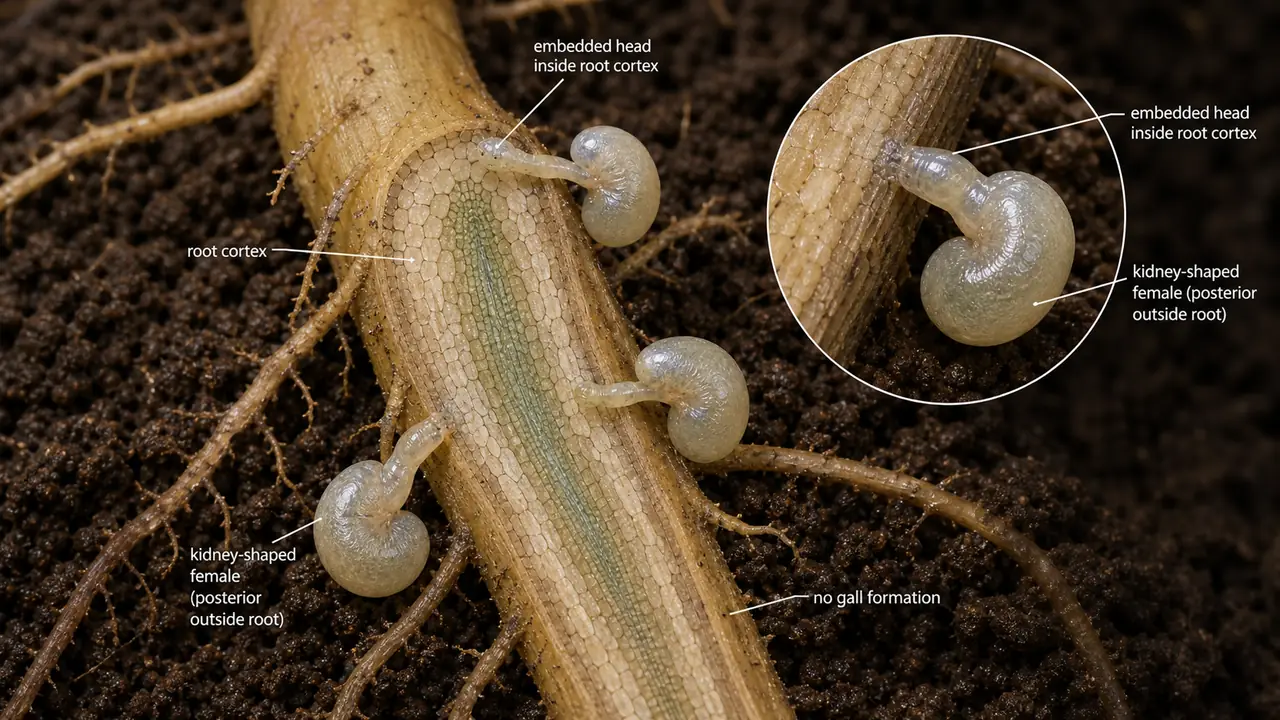
| Female shape | Kidney-shaped -- the immature female swells into this shape after penetrating a root |
| First report (World) | Linford and Oliveira, 1940 -- on cowpea in USA |
| First report (India) | Seshadri and Sivakumar, 1963 -- on cotton |
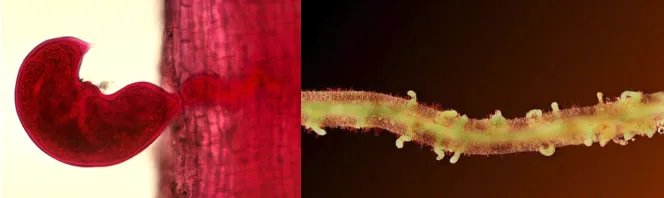
Biology
| Feature | Details |
|---|---|
| Parasitism type | Sedentary semi-endoparasite -- head portion inside root cortex, posterior hangs in soil |
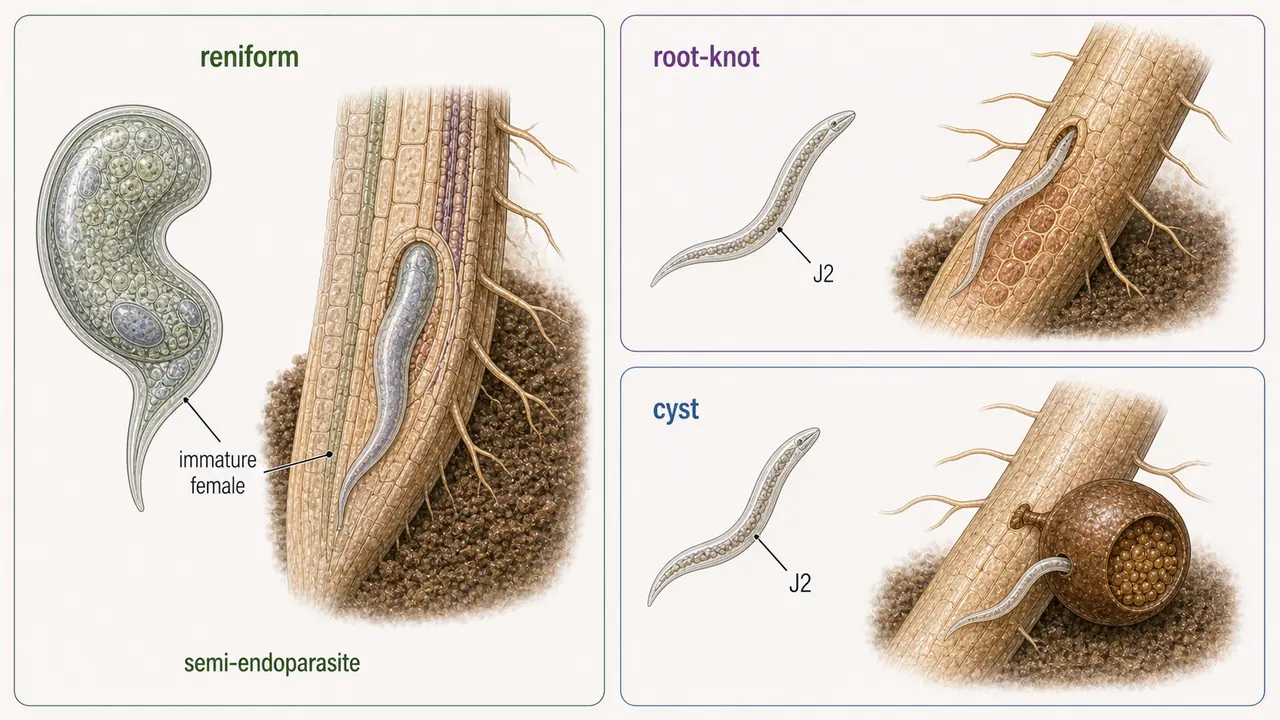
| Infective stage | Immature (pre-adult) female -- NOT J2 (unlike root-knot and cyst nematodes) |
| Host range | Very broad: vegetables, fruits, pulses, fibre crops, ornamentals |
| Key crops in India | Cotton, castor, cowpea, coffee, grapes, pineapple, papaya, vegetables, pulses |
| Ranking | 2nd most important nematode of vegetables (after Meloidogyne) |
Two Races in India
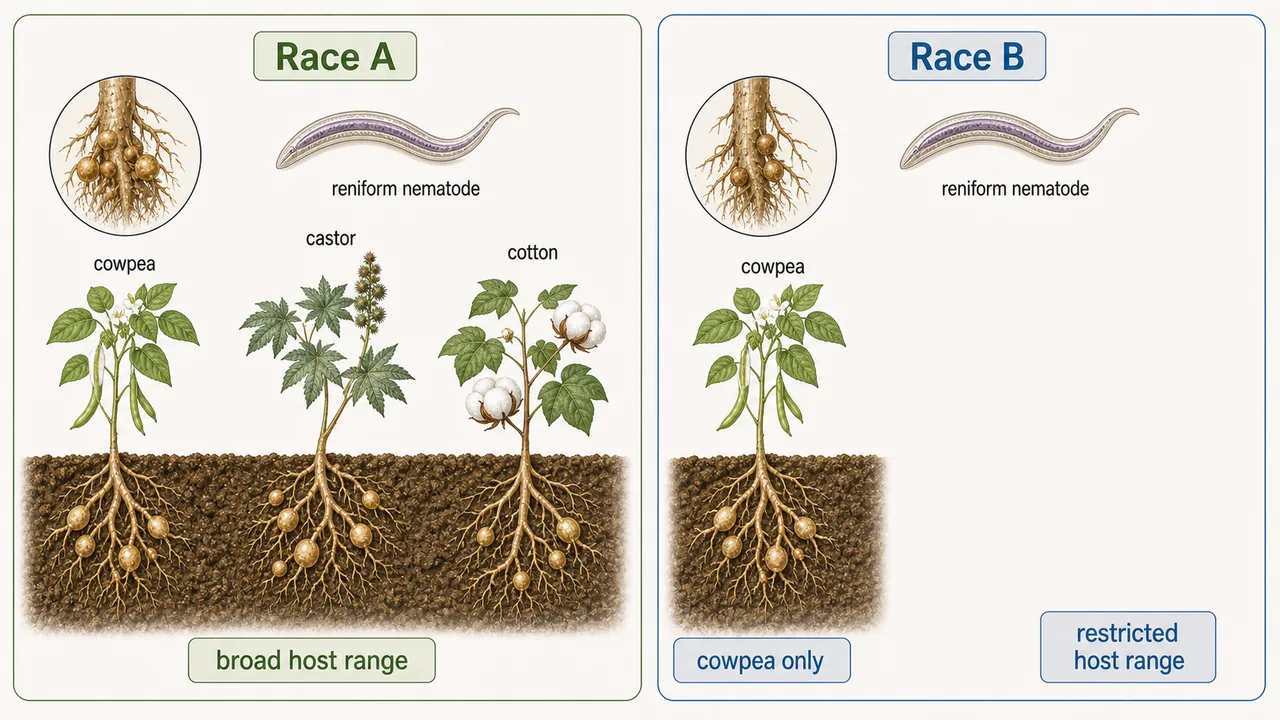
| Race | Multiplies On | Host Range |
|---|---|---|
| Race "A" | Cowpea, castor, and cotton | Broader (3 crop groups) |
| Race "B" | Cowpea only | Restricted (1 crop only) |
The existence of these races has practical implications: a crop rotation strategy effective against Race B may not work against Race A due to its wider host range. Identifying which race is present is important for designing management plans.
Pro Content Locked
Upgrade to Pro to access this lesson and all other premium content.
₹99 charged monthly · Cancel anytime
- All Agriculture & Banking Courses
- AI Lesson Questions (100/day)
- AI Doubt Solver (50/day)
- Glows & Grows Feedback (30/day)
- AI Section Quiz (20/day)
- 22-Language Translation (100/day)
- Recall Questions (20/day)
- AI Quiz (15/day)
- AI Quiz Paper Analysis (100/day)
- AI Step-by-Step Explanations (100/day)
- Spaced Repetition Recall (FSRS)
- AI Tutor
- Immersive Text Questions
- Audio Lessons — Hindi & English
- Mock Tests & Previous Year Papers
- Summary & Mind Maps
- XP, Levels, Leaderboard & Badges
- Generate New Classrooms
- Voice AI Teacher (AgriDots Live)
- AI Revision Assistant
- Knowledge Gap Analysis
- Interactive Revision (LangGraph)
🔒 Secure via Razorpay · Cancel anytime · No hidden fees
In the previous lesson, we covered the burrowing nematode -- a migratory endoparasite of banana and black pepper. Now we examine another semi-endoparasite with a distinctive body shape and an unusual infective stage.
Cotton farmers in Gujarat often notice patchy yellowing and wilting in their fields despite adequate irrigation. When roots are examined, they find no obvious galls -- unlike root-knot nematode damage. The hidden culprit is often the reniform nematode (Rotylenchulus reniformis), ranked as the second most important nematode of vegetables after root-knot nematodes.
This lesson covers:
- Etymology and discovery -- Linford (1940), first report in India
- Biology -- immature female as infective stage, two races in India
- Symptoms -- non-specific, no galls, easily missed
- Comparison -- reniform vs root-knot vs citrus nematode
Etymology and Discovery
| Feature | Details |
|---|---|
| Common name | Reniform = kidney-shaped (from Latin reniformis) |
| Scientific name | Rotylenchulus reniformis |
| Female shape | Kidney-shaped -- the immature female swells into this shape after penetrating a root |
| First report (World) | Linford and Oliveira, 1940 -- on cowpea in USA |
| First report (India) | Seshadri and Sivakumar, 1963 -- on cotton |
Biology
| Feature | Details |
|---|---|
| Parasitism type | Sedentary semi-endoparasite -- head portion inside root cortex, posterior hangs in soil |
| Infective stage | Immature (pre-adult) female -- NOT J2 (unlike root-knot and cyst nematodes) |
| Host range | Very broad: vegetables, fruits, pulses, fibre crops, ornamentals |
| Key crops in India | Cotton, castor, cowpea, coffee, grapes, pineapple, papaya, vegetables, pulses |
| Ranking | 2nd most important nematode of vegetables (after Meloidogyne) |
Two Races in India
| Race | Multiplies On | Host Range |
|---|---|---|
| Race "A" | Cowpea, castor, and cotton | Broader (3 crop groups) |
| Race "B" | Cowpea only | Restricted (1 crop only) |
The existence of these races has practical implications: a crop rotation strategy effective against Race B may not work against Race A due to its wider host range. Identifying which race is present is important for designing management plans.
Symptoms
Symptoms are non-specific and closely resemble nutrient deficiency or water stress, which is why reniform nematode damage often goes undiagnosed:
| Symptom | Details |
|---|---|
| Above ground | Stunted growth, yellowing of leaves, wilting, deterioration in fruit quality |
| Castor seeds | Malformation and discolouration -- reduces both oil content and quality |
| Root symptoms | No conspicuous galls (unlike root-knot nematode) -- often difficult to distinguish from healthy roots without laboratory examination |
Comparison: Reniform vs Root-Knot vs Citrus Nematode
All three are sedentary nematodes that partially or fully penetrate roots, but they differ in key ways:
| Feature | Reniform (Rotylenchulus) | Root-Knot (Meloidogyne) | Citrus (Tylenchulus) |
|---|---|---|---|
| Parasitism | Semi-endoparasite | Endoparasite | Semi-endoparasite |
| Female shape | Kidney | Pyriform/saccate | Swollen/obese |
| Infective stage | Immature female | J2 | J2 |
| Root symptom | No galls | Conspicuous galls | Dark feeder roots |
| Host range | Very broad | Very broad | Mainly citrus |
| Importance rank (vegetables) | 2nd | 1st | Not a vegetable pest |
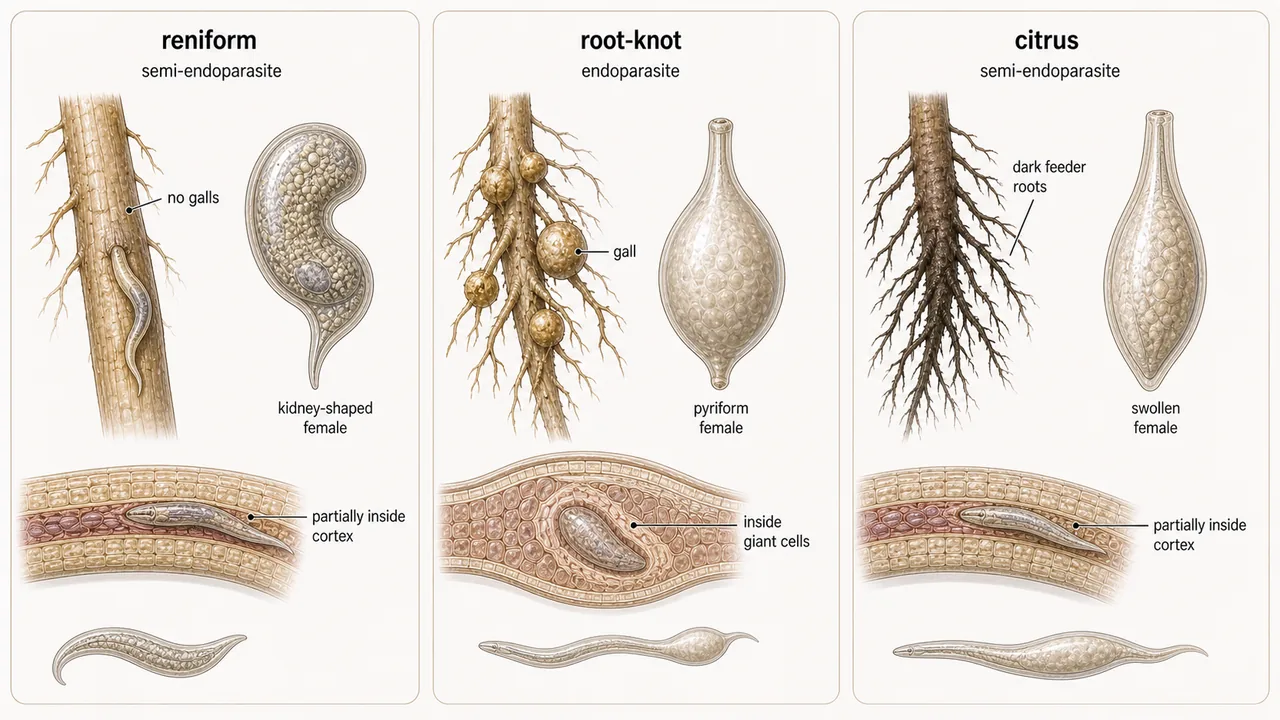
Summary Table
| Feature | Key Fact |
|---|---|
| Scientific name | Rotylenchulus reniformis |
| Common name | Reniform (kidney-shaped) nematode |
| Ranking | 2nd most important nematode of vegetables |
| Female shape | Kidney-shaped |
| Parasitism | Sedentary semi-endoparasite |
| Infective stage | Immature female (not J2) |
| First report (World) | Linford and Oliveira, 1940, cowpea, USA |
| First report (India) | Seshadri and Sivakumar, 1963, cotton |
| Races in India | Race A (cowpea + castor + cotton), Race B (cowpea only) |
| Key crops affected | Cotton, castor, cowpea, pulses, vegetables |
| Castor impact | Malformed seeds with reduced oil content |
| Root symptoms | No conspicuous galls -- easily missed |
TIP
Exam mnemonic -- "KIF" for reniform nematode: Kidney-shaped female, Immature female is infective (not J2), First on cowpea (Linford, 1940).
References
- Dropkin, V.H. 1980. Introduction to plant nematology. John Wiley and sons, INC. New York.
- Singh, R.S and Sitaramaiah, K. 1994. Plant pathogens. The plant parasitic nematodes. Oxford & IBH Pub. Co. Pvt. Ltd. New Delhi.
- Walia, R. K and Bajaj, H. K (2014). Textbook of Introductory Plant Nematology. Directorate of Knowledge Management in Agriculture, ICAR, New Delhi.
- Kumar, V., Khan, M.R. & Walia, R.K. Crop Loss Estimations due to Plant-Parasitic Nematodes in Major Crops in India. Natl. Acad. Sci. Lett. 43, 409-412 (2020).
- Figure 1: Source: A: Maggenti, 1981, B-E: Franklin, 1973
Summary Cheat Sheet
| Concept / Topic | Key Details |
|---|---|
| Scientific name | Rotylenchulus reniformis |
| Common name | Reniform (kidney-shaped) nematode |
| Ranking | 2nd most important nematode of vegetables |
| Female shape | Kidney-shaped |
| Parasitism | Sedentary semi-endoparasite |
| Infective stage | Immature female (not J2) |
| First report (World) | Linford and Oliveira, 1940, cowpea, USA |
| First report (India) | Seshadri and Sivakumar, 1963, cotton |
| Races in India | Race A (cowpea + castor + cotton), Race B (cowpea only) |
| Key crops affected | Cotton, castor, cowpea, pulses, vegetables |
| Castor impact | Malformed seeds with reduced oil content |
| Root symptoms | No conspicuous galls -- easily missed |
TIP
Next: Lesson 08 covers Ditylenchus nematodes -- stem and bulb parasites causing Ufra disease of rice, onion bloat, and potato rot.