🧑🏽🌾 Digital Agriculture Mission / AgriStack -- Farmer Registry, Crop Registry, Land Records and AI Advisory
AgriStack and Digital Agriculture Mission explained for IBPS AFO and NABARD with budget, Farmer Registry, Crop Registry, geo-referenced land records, Farmer ID progress, crop survey scale, and Bharat-VISTAAR linkage.
In the previous lesson, we studied major recent programmes such as Krishonnati Yojana, NFSM, RKVY-RAFTAAR, and DAY-NRLM. This lesson isolates one current topic that is now heavily exam-oriented: the digital public infrastructure being built for Indian agriculture.
That framework is the Digital Agriculture Mission, commonly discussed through AgriStack.
AgriStack in One Line
If a student searches what is AgriStack in agriculture, the shortest correct answer is this:
AgriStack is the digital backbone of the Digital Agriculture Mission that links Farmer Registry, Crop Registry, geo-referenced land records, and AI advisory for targeted agricultural service delivery.
This lesson is therefore important not only for current affairs, but also for IBPS AFO, NABARD, agriculture extension, and digital agriculture policy questions.
What Is Digital Agriculture Mission?
Digital Agriculture Mission is India's framework for building digital public infrastructure for agriculture so that farmer identity, crop data, land records, and advisory services can work together.
Pro Content Locked
Upgrade to Pro to access this lesson and all other premium content.
₹99 charged monthly · Cancel anytime
- All Agriculture & Banking Courses
- AI Lesson Questions (100/day)
- AI Doubt Solver (50/day)
- Glows & Grows Feedback (30/day)
- AI Section Quiz (20/day)
- 22-Language Translation (100/day)
- Recall Questions (20/day)
- AI Quiz (15/day)
- AI Quiz Paper Analysis (100/day)
- AI Step-by-Step Explanations (100/day)
- Spaced Repetition Recall (FSRS)
- AI Tutor
- Immersive Text Questions
- Audio Lessons — Hindi & English
- Mock Tests & Previous Year Papers
- Summary & Mind Maps
- XP, Levels, Leaderboard & Badges
- Generate New Classrooms
- Voice AI Teacher (AgriDots Live)
- AI Revision Assistant
- Knowledge Gap Analysis
- Interactive Revision (LangGraph)
🔒 Secure via Razorpay · Cancel anytime · No hidden fees
In the previous lesson, we studied major recent programmes such as Krishonnati Yojana, NFSM, RKVY-RAFTAAR, and DAY-NRLM. This lesson isolates one current topic that is now heavily exam-oriented: the digital public infrastructure being built for Indian agriculture.
That framework is the Digital Agriculture Mission, commonly discussed through AgriStack.
AgriStack in One Line
If a student searches what is AgriStack in agriculture, the shortest correct answer is this:
AgriStack is the digital backbone of the Digital Agriculture Mission that links Farmer Registry, Crop Registry, geo-referenced land records, and AI advisory for targeted agricultural service delivery.
This lesson is therefore important not only for current affairs, but also for IBPS AFO, NABARD, agriculture extension, and digital agriculture policy questions.
What Is Digital Agriculture Mission?
Digital Agriculture Mission is India's framework for building digital public infrastructure for agriculture so that farmer identity, crop data, land records, and advisory services can work together.
| Feature | Detail |
|---|---|
| Launch | 2023-24 |
| Total outlay | Rs 2,817 crore |
| FY 2025-26 allocation | Rs 54.972 crore |
| Nodal ministry | Ministry of Agriculture & Farmers Welfare |
| Operational logic | Create a verified digital agriculture stack for service delivery |
| Farmer-facing layer | Bharat-VISTAAR |
From an extension perspective, this mission matters because it shifts advisory from generic messages to data-linked, personalised recommendations.
IMPORTANT
Budget highlight: Digital Agriculture Mission was approved with a total outlay of Rs 2,817 crore. PIB also stated an allocation of Rs 54.972 crore for FY 2025-26. Bharat-VISTAAR is the separate farmer-facing Budget 2026-27 layer with Rs 150 crore.
AgriStack: The Four Core Layers
The current exam-friendly way to understand AgriStack is through its four linked layers:
| Layer | What It Does |
|---|---|
| Farmers' Digital Registry | Unique digital identity for each farmer; linked with Aadhaar and scheme datasets |
| Crop Sown Registry | Records which crop is grown by which farmer in which season |
| Geo-referenced Land Records | Maps agricultural parcels digitally and links them to farmer identity |
| AI Multilingual Advisory | Converts field data into personalised recommendations in farmer-facing form |
In exam language:
- Farmer Registry = identity layer
- Crop Registry = cultivation layer
- Geo-referenced land records = parcel layer
- Bharat-VISTAAR = advisory and delivery layer

Latest PIB-Verified Farmer Registry and Crop Survey Progress
The most exam-relevant update is that AgriStack is no longer only a concept. It is being operationalised around a live Farmer Registry / Farmer ID system, and PIB has now given two nearby dated snapshots:
| Date | Official PIB update |
|---|---|
| 27 November 2025 | 7.63 crore Farmer IDs, including 1.93 crore women farmers |
| 4 February 2026 | More than 8.48 crore Farmer IDs generated across India |
- target: 11 crore Farmer IDs by 2026-27
- latest PIB figure available in the lesson sources: 8.48 crore+ Farmer IDs as of 4 February 2026
- earlier PIB benchmark: 7.63 crore IDs as of 27 November 2025
- women farmers in the November 2025 snapshot: 1.93 crore
Digital Crop Survey expansion
PIB's later update also adds fresh operational scale data:
- during Rabi 2024-25, the mobile-based Digital Crop Survey covered 492 districts and 23.5 crore plots
- during Kharif 2025, PIB reported coverage in 604 districts and more than 28.5 crore plots
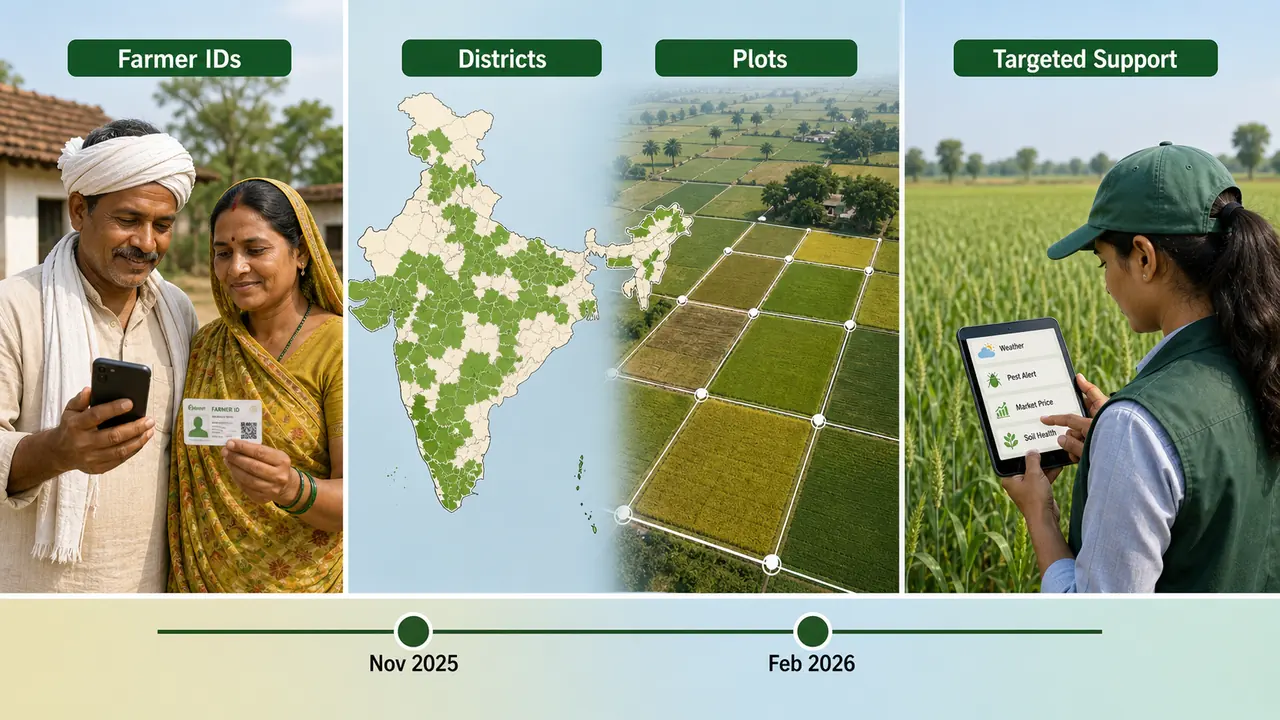
This registry is intended to support:
- land-linked farmer identification
- benefit delivery such as PM-KISAN and input support
- crop and season-wise service targeting
- convergence with credit, insurance, and extension advisories
Why AgriStack Matters in Extension Education
Traditional extension often works through broad advisories for a village, block, or district. AgriStack aims to make extension more precise.
Extension link:
- supports personalised advisories rather than one-size-fits-all recommendations
- helps target schemes using verified farmer and crop records
- reduces dependence on repeated manual verification and field paperwork
- improves convergence between extension, credit, insurance, and input support
This is why AgriStack belongs not only to current affairs, but also to Extension and Rural Development.
What the latest PIB updates add conceptually
- AgriStack is described as the single source of truth for farmer identity, land, and crops
- Farmer ID is linked to DBT-style delivery, MSP procurement, credit, input distribution, and disaster relief
- recent PIB examples show actual state use cases, not just pilot language
AgriStack and Bharat-VISTAAR: Relationship
Students often mix up the two terms. The clean distinction is:
- Digital Agriculture Mission = overall policy framework
- AgriStack = underlying digital architecture
- Bharat-VISTAAR = farmer-facing advisory and access platform built on that stack
So if an exam asks for the digital backbone, think AgriStack. If it asks for the service delivery interface, think Bharat-VISTAAR.
TIP
Exam angle: Digital Agriculture Mission outlay = Rs 2,817 crore. FY 2025-26 allocation = Rs 54.972 crore. AgriStack target = 11 crore Farmer IDs by 2026-27. Latest PIB figure in this lesson = 8.48 crore+ Farmer IDs as of 4 February 2026. Crop Survey scale = 604 districts and 28.5 crore+ plots in Kharif 2025.
Summary Cheat Sheet
| Topic | Key Takeaway |
|---|---|
| Parent scheme | Digital Agriculture Mission |
| Total outlay | Rs 2,817 crore |
| FY 2025-26 allocation | Rs 54.972 crore |
| Core meaning of AgriStack | Digital architecture linking farmer identity, land, crop, and service delivery |
| Four lesson layers | Farmer Registry, Crop Registry, Geo-referenced land records, Bharat-VISTAAR |
| Farmer ID target | 11 crore by 2026-27 |
| PIB milestone on 27 November 2025 | 7.63 crore Farmer IDs including 1.93 crore women farmers |
| PIB milestone on 4 February 2026 | 8.48 crore+ Farmer IDs |
| Digital Crop Survey scale in Rabi 2024-25 | 492 districts and 23.5 crore plots |
| Digital Crop Survey scale in Kharif 2025 | 604 districts and 28.5 crore+ plots |
| Extension relevance | Supports personalised advisories, targeted scheme delivery, and data-linked extension services |
| Relationship with Bharat-VISTAAR | AgriStack is the backbone; Bharat-VISTAAR is the farmer-facing advisory interface |
Frequently Asked Questions
What is AgriStack in agriculture?
AgriStack is the digital backbone under India's Digital Agriculture Mission. It combines Farmer Registry, Crop Sown Registry, geo-referenced land records, and AI-based advisory so services can be delivered in a targeted way.
What is the budget of Digital Agriculture Mission?
The Digital Agriculture Mission has a total outlay of Rs 2,817 crore. PIB also reported an allocation of Rs 54.972 crore for FY 2025-26. Bharat-VISTAAR is the separate farmer-facing Budget 2026-27 layer with Rs 150 crore.
How many Farmer IDs were generated under AgriStack?
PIB reported more than 8.48 crore Farmer IDs as of 4 February 2026. An earlier PIB update dated 27 November 2025 reported 7.63 crore Farmer IDs, including 1.93 crore women farmers.
What is the difference between AgriStack and Bharat-VISTAAR?
AgriStack is the backend digital architecture for farmer identity, crop data, and land records, while Bharat-VISTAAR is the farmer-facing advisory and access platform built on top of that stack.
What are the four components of AgriStack?
The four exam-relevant AgriStack layers are Farmers' Registry, Crop Sown Registry, geo-referenced land records, and AI multilingual advisory.
What is Farmer Registry under AgriStack?
Farmer Registry is the identity layer of AgriStack. It creates a verified digital identity for farmers so land-linked services, benefits, and advisories can be targeted correctly.
What is Crop Sown Registry?
Crop Sown Registry records which crop is grown by which farmer in which season. It is the cultivation layer that supports targeted advisory, planning, and service delivery.
What is the Farmer ID target under AgriStack?
The government target highlighted in PIB-linked updates is 11 crore Farmer IDs by 2026-27.
Why is AgriStack important for IBPS AFO and NABARD?
AgriStack is important because it is both a current-affairs topic and an extension-education topic. Questions can come on its budget, layers, Farmer ID progress, crop survey scale, and its link with Bharat-VISTAAR.