🖖🏻 Extension Concept
Learn about concept of Education, Extension Process, Pricipale and Philosophy.
Which of the following statement is wrong about extension education? 📚
Concept of Extension Education
I. The Basic Concept
The basic concept of extension is education. At its core, extension is fundamentally an educational endeavour -- everything it does is aimed at helping people learn, grow, and improve their lives through knowledge.
Education
- Education is essential considered as production of desirable change in behaviour. This means true education goes beyond memorising facts -- it results in observable and meaningful changes in how a person thinks, acts, and feels.
- Education causes change in Knowledge (things known), Skill (things done) and Attitude (things felt). These three dimensions -- often abbreviated as KSA -- form the foundation of all educational outcomes.
- "Education is the manifestation of perfection already in man" is said by Swami Vivekananda. This profound statement suggests that education does not create ability from scratch but rather unlocks the latent potential within every individual.
- Education is shaped by society. The values, culture, and needs of the surrounding society determine what is taught, how it is taught, and what outcomes are prioritised.
Types
Formal
- Institutionalised, chronologically graded and hierarchically structured education system. This is the conventional schooling system with defined levels -- primary, secondary, higher education -- following a fixed curriculum and timeline.
- It's characteristic feature are Subject and target group specificity. Formal education is designed for a specific age group and follows a predetermined syllabus.
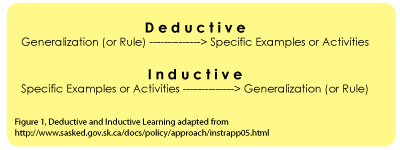
- Deductive approach. Teaching moves from general principles to specific applications -- the teacher presents theory first, then examples.
- Vertical Teaching. Knowledge flows in a top-down manner from teacher to student within a rigid hierarchy.
Non-formal
- It is organised, systematic, educational activity carried on outside framework of the formal system to provide selected type of learning to particular sub-group in the population, adult as well as children according to their needs. Non-formal education fills the gaps that formal education cannot reach, offering flexible and need-based learning opportunities.
- Inductive approach. (teacher will explain many examples showing how concept is used) Here, learning moves from specific examples to general principles, making it more practical and grounded in real-life experience.
IMPORTANT
Pro Content Locked
Upgrade to Pro to access this lesson and all other premium content.
₹99 charged monthly · Cancel anytime
- All Agriculture & Banking Courses
- AI Lesson Questions (100/day)
- AI Doubt Solver (50/day)
- Glows & Grows Feedback (30/day)
- AI Section Quiz (20/day)
- 22-Language Translation (100/day)
- Recall Questions (20/day)
- AI Quiz (15/day)
- AI Quiz Paper Analysis (100/day)
- AI Step-by-Step Explanations (100/day)
- Spaced Repetition Recall (FSRS)
- AI Tutor
- Immersive Text Questions
- Audio Lessons — Hindi & English
- Mock Tests & Previous Year Papers
- Summary & Mind Maps
- XP, Levels, Leaderboard & Badges
- Generate New Classrooms
- Voice AI Teacher (AgriDots Live)
- AI Revision Assistant
- Knowledge Gap Analysis
- Interactive Revision (LangGraph)
🔒 Secure via Razorpay · Cancel anytime · No hidden fees
Which of the following statement is wrong about extension education? 📚
Concept of Extension Education
I. The Basic Concept
The basic concept of extension is education. At its core, extension is fundamentally an educational endeavour -- everything it does is aimed at helping people learn, grow, and improve their lives through knowledge.
Education
- Education is essential considered as production of desirable change in behaviour. This means true education goes beyond memorising facts -- it results in observable and meaningful changes in how a person thinks, acts, and feels.
- Education causes change in Knowledge (things known), Skill (things done) and Attitude (things felt). These three dimensions -- often abbreviated as KSA -- form the foundation of all educational outcomes.
- "Education is the manifestation of perfection already in man" is said by Swami Vivekananda. This profound statement suggests that education does not create ability from scratch but rather unlocks the latent potential within every individual.
- Education is shaped by society. The values, culture, and needs of the surrounding society determine what is taught, how it is taught, and what outcomes are prioritised.
Types
Formal
- Institutionalised, chronologically graded and hierarchically structured education system. This is the conventional schooling system with defined levels -- primary, secondary, higher education -- following a fixed curriculum and timeline.
- It's characteristic feature are Subject and target group specificity. Formal education is designed for a specific age group and follows a predetermined syllabus.
- Deductive approach. Teaching moves from general principles to specific applications -- the teacher presents theory first, then examples.
- Vertical Teaching. Knowledge flows in a top-down manner from teacher to student within a rigid hierarchy.
Non-formal
- It is organised, systematic, educational activity carried on outside framework of the formal system to provide selected type of learning to particular sub-group in the population, adult as well as children according to their needs. Non-formal education fills the gaps that formal education cannot reach, offering flexible and need-based learning opportunities.
- Inductive approach. (teacher will explain many examples showing how concept is used) Here, learning moves from specific examples to general principles, making it more practical and grounded in real-life experience.
IMPORTANT
Formal vs Non-formal: Formal education is Deductive (theory → examples) and Vertical (top-down). Non-formal education is Inductive (examples → theory) and Horizontal (participatory). Extension Education is a prime example of non-formal education.
- In non-formal education 6 key elements were identified by Etling, Radhakrishna & Bowen are:
- Its significant aspect is flexible curriculum. The content can be adapted and modified to suit the learners' needs and local conditions.
- Teaching is horizontal. There is a democratic and participatory relationship between teacher and learner, rather than a hierarchical one.
- Learners are heterogeneous. The group may include people of different ages, backgrounds, and education levels, learning together.
- Learner centred. The focus is on the learner's needs and pace, not on the teacher's convenience or a fixed syllabus.
- Less bureaucratic control &
- More decentralization. Decisions about what and how to teach are made locally, closer to the learners themselves.
- Ex. Agricultural Extension. Extension education is a prime example of non-formal education, delivering practical agricultural knowledge directly to farmers in their own environment.
Informal
- Life long process of learning happening through daily experience and exposure. Informal education is unstructured and spontaneous -- it includes everything a person learns from family, community, media, and everyday interactions throughout their life.
II. The Extension Education Process
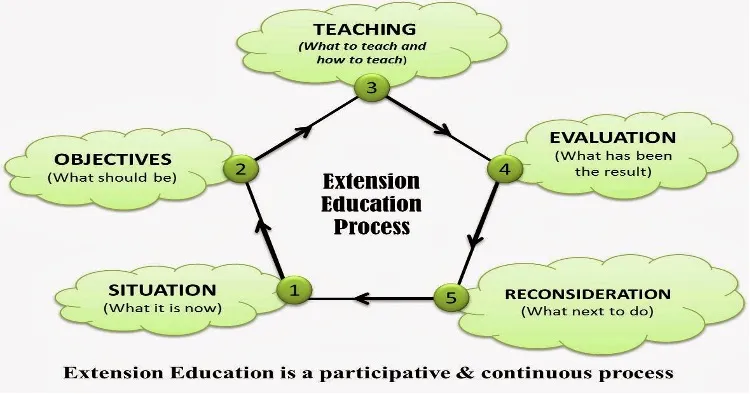
- Concept given by Leagans (1967). Leagans was one of the key thinkers who formalised the extension education process into a clear, step-by-step framework.
- It involves 5 steps: SOTER. These five steps provide a systematic approach to planning and implementing extension programmes, ensuring that every effort is purposeful and results-oriented.
Meaning of Extension Education
It is an applied science consisting of content derived from research, accumulated field experiences and relevant principles drawn from the behavioural sciences synthesised with useful technology into a body of philosophy, principles, content and methods focused on the problems of out-of-school education for adults and youths. This comprehensive definition highlights that extension education is not just teaching -- it is a scientific, research-backed discipline that combines theory with practice to solve real-world problems.
Agricultural Extension
- Deals with farmer. Agricultural extension specifically focuses on improving the knowledge, skills, and attitudes of farmers to enhance agricultural productivity and rural livelihoods.
- It is a special branch of Extension Education. While extension education covers many fields, agricultural extension is its most widely practised and prominent branch.
- Book entitled "Agricultural Extension" written by Van den Ban. This is a foundational reference text in the field.
- Book entitled "Extension Education" written by Dr. A. Adivi Reddy. Another important scholarly contribution to the discipline.
Scope of Extension Education
- Extension Education/Discipline:
- Educational Organisation/ Agency
- Educational Process/ Means
- Educational Job/Work
These three dimensions show that extension functions as an organised institution, a systematic process, and a professional career field all at once.
- Extension Service:
- An organisation or programme for agricultural development & rural welfare, which employs the extension process as a mean of programme implementation. The extension service is the organisational machinery that delivers extension education to the community.
- Main responsibility of Extension Service is with State Government. In India's federal structure, agriculture is a state subject, so the primary duty of running extension services rests with the respective state governments.
- Extension Process
- Working with the rural people through out of school education along with current interest & needs for getting overall development of rural families. The extension process is a participatory approach that emphasises working with people, not for them.
- Extension Job/Profession
- The job of extension in agriculture & home economics is to assist people engaged in farming & home making to utilize full resources, solving problem and meeting socio-economics condition. Extension professionals serve as facilitators and advisors, helping rural families make the best use of available resources.
Scope of Agricultural Extension
A/Q Kelsey & Hearne, the scope of agricultural extension identified in 9 areas of programme emphasis. These nine areas cover virtually every aspect of rural life:
- Efficiency in agricultural production
- Efficiency in marketing, distribution & utilisation
- Conservation, development and use of natural resources.
- Management on the farm & in the home
- Family living
- Youth development
- Leadership development
- Community development & rural area development
- Public affairs.
This wide scope demonstrates that agricultural extension is not limited to crop production alone -- it addresses the total well-being of the rural community.
Need of Extension
To interpret the findings of research to the farmers and to carry the problems of the farmers to research for solution. This gap is filled by the extension. Extension serves as the vital two-way bridge between research laboratories and farmers' fields. Without extension, scientific discoveries would remain in labs, and farmers' real-world challenges would go unheard by researchers.
Objective of Extension
- Expression of ends towards which our efforts are directed or Direction of movement towards a particular activity is known as Objective. Objectives give extension work its direction and purpose.
- There are 3 levels of objectives:
1. Fundamental Objective
- All-inclusive objectives of a society are fundamental objective. These are the broadest goals that guide all societal development.
- Good life, better citizenship, democracy, better prosperity are included in fundamental objective.
- Example: People's Participation in planning at grass root level.
2. General Objective:
- Objective which is general but more definite social objective are general objective. These are more specific than fundamental objectives but still broadly defined.
- Example: Mandatory creation of Panchayat Raj bodies in the states
3. Working Objective:
- Also known as specific objective. These are the most concrete, measurable, and actionable objectives that guide day-to-day extension work.
- Working objectives operates at field extension work.
- Example: Enactment of suitable laws relating to Panchayats, holding election in time, providing funds & facilities
-
Fundamental objective of extension is the overall development of the individual or Destination Man. The ultimate vision of extension is to develop the individual as a complete, self-reliant, and productive member of society.
-
Major objective categories as:
- Material - Increase production, income.
- Educational -- change the outlook of people or develop the individual.
- Social & cultural -- development of the community.
-
The ultimate obj. of ext. is realizing ones fullest potential/change in behaviour.
-
The ultimate obj. of ext. work is the full development of an individual.
-
The basic element at the core of extension education is man himself. Everything in extension revolves around human development.
-
The basic objective of ext. ed. is to create opportunities for effective learning.
-
The most important motive for extension work is influence motivation. This means extension workers are driven by the desire to positively influence the lives of the people they serve.
Function of Extension Education:
The primary function of extension education is to bring about desirable changes in human behaviour (KAS) by means of education.
- Change in Knowledge -- Change in what people know
- Change in skill -- Change in the technique of doing things
- Change in attitude -- Change in the feelings or reaction towards certain things
These three domains of change are interconnected -- a change in knowledge often leads to a change in attitude, which in turn motivates a change in skill and practice.
Principal of Motivation in Extension
- A motive is some inner drive, impulse, intention etc. that causes or moves a person to do something or act in a certain way. Understanding what motivates people is essential for effective extension work.
- A process of initiating a conscious and purposeful action is called as motivation. Motivation is the engine that drives people to participate in and benefit from extension activities.
- It is goal seeking or goal directed behaviour or activity.
- Motivation has intrinsic and extrinsic value.
- Intrinsic values are what a learner does for sake of engaging in the activity itself. This is the most powerful and sustainable form of motivation.
- Intrinsic motivation is desirable, especially in learning because it contributes in active participation. When people are intrinsically motivated, they engage more deeply and persistently.
- Extrinsic motivation is an incentive or goal is artificially introduced in the situation to cause or accelerate activity. External rewards can be useful to initiate behaviour change, but long-term success depends on building intrinsic motivation.
- Eg. All prize schemes are largely extrinsic in value.
Philosophy of Extension Education
- Philosophy is a body of general principles or laws of a field of knowledge. The philosophy of extension provides the guiding vision and values that shape all extension activities.
- Term philosophy is derived from Greek language.
- The basic philosophy of extension is to teach people How to do not "What to do". This is a critical distinction -- extension aims to empower people with skills and methods so they can solve their own problems, rather than simply giving them instructions to follow.
- To teach people how to think not "what to think". Extension fosters critical thinking and independent decision-making rather than creating dependence on external experts.
TIP
The twin philosophies of extension are easy to remember: "How to do" (not what to do) and "How to think" (not what to think). Both emphasise empowerment over dependence.
Lesson Doubts
Ask questions, get expert answers