💡 Diffusion and Adoption
Learn about Diffusion and Adoption of Innovations.
Adoption
- It is a decision to make full use of an innovation as a best course of action available. In other words, when a farmer or individual decides that a new practice, technology, or idea is the best option and begins using it regularly, that constitutes adoption.
- Adoption is continuous & mental process. It is not a one-time event but rather an ongoing commitment to using the innovation.
Adoption Process
- According to Rogers, "adoption process is the mental process through which an individual passes from hearing about an innovation to final adoption". Adoption process occurs at individual level. This means each person goes through their own internal journey of learning, evaluating, and deciding before adopting something new.
- Normal rate of adoption require 6-10 years from the introduction of the innovation to its adoption throughout the community. This timeline underscores that widespread change in farming practices takes considerable time, patience, and persistent extension efforts.
Diffusion
- It is a process by which an innovation is communicated through certain channels overtime among the members of the social system. Diffusion operates at the community or social system level, in contrast to adoption which happens at the individual level.
- It is special type of communication in that the messages are concerned with new ideas. The uniqueness of diffusion lies in the novelty of the message being communicated, which often introduces uncertainty that must be overcome.
Innovation
- An innovation is an idea, practice or object that is perceived as new by an individual or other unit of adoption. The key word here is "perceived" -- if the idea is new to the person encountering it, it counts as an innovation for them, regardless of how long ago it was first developed.
- Ex. When farmer learn the teaching of growing the HYV crops, which they did not know earlier is innovation for them.
Perception
- Perception is an activity through which an individual becomes aware of objects around oneself and of events taking place. Perception shapes how a person interprets and understands new information, which in turn affects their decision to adopt or reject an innovation.
Perceived attributes of innovation
- The qualities, characteristics or traits possessed by an object are known as attributes.
- The attributes of the innovation are most important for potential adopters. How an innovation is perceived largely determines the speed and extent of its adoption.
- Communication of information is most effective when source & receiver are alike. This principle of homophily means that farmers are more likely to trust and act on information from people who share their background, language, and farming experience.
1. Relative advantage
- The degree to which an innovation is perceived as being better than idea it supersedes. This could be measured in terms of economic gain, social prestige, convenience, or satisfaction. A higher relative advantage leads to faster adoption.
- An innovation with low relative advantage may have slow rate of adoption, high rate of discontinuance & low return on investment.
2. Compatibility
- It is the degree to which an innovation is perceived consistent with clients' needs for innovation, previously introduced needs & socio-cultural values & beliefs. An innovation that fits well with a farmer's existing practices, beliefs, and local conditions is adopted more readily.
- Compatibility has at least two dimensions: Situational & Cultural.
- Situational compatibility refers to whether the innovation suits the physical and environmental conditions of the farmer.
- Cultural compatibility refers to whether it aligns with the farmer's values, beliefs, and social norms.
- Example: When a new breed of livestock is in agreement with farmer's belief & values & new crop variety advocated to farmers suits the agro-climatic condition then it indicates the cultural compatibility & situational compatibility respectively.
3. Complexity
- The degree to which an innovation is perceived as relatively difficult to understand & use. Innovations that are simpler to understand and implement tend to be adopted faster.
- Only attribute which shows negative correlation with rate of adoption. This means the more complex an innovation is, the slower it is adopted -- the opposite of all other attributes.
IMPORTANT
Pro Content Locked
Upgrade to Pro to access this lesson and all other premium content.
₹2,388 billed annually · Cancel anytime
You save ₹4,800/year vs original price
🔒 Secure via Razorpay · No hidden fees
Everything in one plan
- All Agriculture & Banking Courses
- Unlimited AI-Powered Lesson Tests
- Audio Lessons — Hindi & English
- Interactive Infographics & Mind Maps
- Spaced Repetition Recall (FSRS)
- Glows & Grows AI Study Feedback
- 22 Indian Language Translation
- Pomodoro Focus Timer & Planner
- XP Points, Levels & Leaderboard
- Achievement Badges & Milestones
- Daily Streaks & Smart Reminders
- Memory Health Dashboard
- Instant Search Across All Content
- Live Telegram Feed Mirror
- Mock Tests & Previous Year Papers
- IBPS · NABARD · ICAR · ASRB · SBI · RRB
Cancel anytime · Secure payment via Razorpay · See our methodology
Adoption
- It is a decision to make full use of an innovation as a best course of action available. In other words, when a farmer or individual decides that a new practice, technology, or idea is the best option and begins using it regularly, that constitutes adoption.
- Adoption is continuous & mental process. It is not a one-time event but rather an ongoing commitment to using the innovation.
Adoption Process
- According to Rogers, "adoption process is the mental process through which an individual passes from hearing about an innovation to final adoption". Adoption process occurs at individual level. This means each person goes through their own internal journey of learning, evaluating, and deciding before adopting something new.
- Normal rate of adoption require 6-10 years from the introduction of the innovation to its adoption throughout the community. This timeline underscores that widespread change in farming practices takes considerable time, patience, and persistent extension efforts.
Diffusion
- It is a process by which an innovation is communicated through certain channels overtime among the members of the social system. Diffusion operates at the community or social system level, in contrast to adoption which happens at the individual level.
- It is special type of communication in that the messages are concerned with new ideas. The uniqueness of diffusion lies in the novelty of the message being communicated, which often introduces uncertainty that must be overcome.
Innovation
- An innovation is an idea, practice or object that is perceived as new by an individual or other unit of adoption. The key word here is "perceived" -- if the idea is new to the person encountering it, it counts as an innovation for them, regardless of how long ago it was first developed.
- Ex. When farmer learn the teaching of growing the HYV crops, which they did not know earlier is innovation for them.
Perception
- Perception is an activity through which an individual becomes aware of objects around oneself and of events taking place. Perception shapes how a person interprets and understands new information, which in turn affects their decision to adopt or reject an innovation.
Perceived attributes of innovation
- The qualities, characteristics or traits possessed by an object are known as attributes.
- The attributes of the innovation are most important for potential adopters. How an innovation is perceived largely determines the speed and extent of its adoption.
- Communication of information is most effective when source & receiver are alike. This principle of homophily means that farmers are more likely to trust and act on information from people who share their background, language, and farming experience.
1. Relative advantage
- The degree to which an innovation is perceived as being better than idea it supersedes. This could be measured in terms of economic gain, social prestige, convenience, or satisfaction. A higher relative advantage leads to faster adoption.
- An innovation with low relative advantage may have slow rate of adoption, high rate of discontinuance & low return on investment.
2. Compatibility
- It is the degree to which an innovation is perceived consistent with clients' needs for innovation, previously introduced needs & socio-cultural values & beliefs. An innovation that fits well with a farmer's existing practices, beliefs, and local conditions is adopted more readily.
- Compatibility has at least two dimensions: Situational & Cultural.
- Situational compatibility refers to whether the innovation suits the physical and environmental conditions of the farmer.
- Cultural compatibility refers to whether it aligns with the farmer's values, beliefs, and social norms.
- Example: When a new breed of livestock is in agreement with farmer's belief & values & new crop variety advocated to farmers suits the agro-climatic condition then it indicates the cultural compatibility & situational compatibility respectively.
3. Complexity
- The degree to which an innovation is perceived as relatively difficult to understand & use. Innovations that are simpler to understand and implement tend to be adopted faster.
- Only attribute which shows negative correlation with rate of adoption. This means the more complex an innovation is, the slower it is adopted -- the opposite of all other attributes.
IMPORTANT
Complexity is the only attribute with a negative correlation to adoption rate. All other attributes (relative advantage, compatibility, trialability, observability, predictability) show a positive correlation -- more of each leads to faster adoption.
- Example: Adoption of high yielding technologies require adoption of balanced nutrition practices, appropriate protection technology & better management methods to get best result.
4. Trialability
- The degree to which an innovation can be experimented with on a limited basis. Farmers prefer to test new practices on a small portion of their land before committing fully, which reduces the perceived risk.
- It reduces risk component.
- Example: Providing free seeds & fertilizer samples to the farmers.
5. Obervability
- The degree to which the result of an innovation is visible to others. When the benefits of an innovation are clearly visible, other farmers are more likely to adopt it because they can see the results with their own eyes.
- Example: Effect of nitrogenious fertilizers is more prominent in plants as compared to effect of phosphate & potassic fertilizers. The green colour boost from nitrogen is immediately visible, making it highly observable.
6. Predictability
- The degree to expecting certain benefits from adoption of innovation. When farmers can reliably predict the outcomes of using an innovation, they feel more confident in adopting it.
Preventive Innovation
- An idea an individual adopt at one time in order to lower probability that some future unwanted event will occur. These innovations are adopted proactively to avoid a potential problem rather than to solve a current one.
- Example: Contraceptives, smoking, buy insurance etc.
- 'Preventive innovations' have less adoption rate mainly due to low observability. Since the benefit is an event that does NOT happen, it is very difficult for adopters to see the results of their decision.
Innovation Negativism
- The degree to which an innovation failure condition a client system to reject future innovation. When a farmer has a bad experience with one innovation, they may become skeptical and resistant to trying any new innovations in the future, even unrelated ones.
FIVE STAGE MODEL OF ADOPTION PROCESS [AIETA]
(A/Q to North Central Rural Sociology Sub-committee, 1955)
This is one of the earliest and most widely referenced models of the adoption process. The acronym AIETA helps remember the five stages: Awareness, Interest, Evaluation, Trial, Adoption.
1. Awareness
- The individual learns of the existence of the new idea but lacks information about it. At this stage, the person merely knows the innovation exists but has no detailed understanding of what it does or how it works.
2. Interest
- The individual develops interest in the innovation and seeks additional information about it. The person begins to actively seek knowledge about the innovation -- reading about it, asking questions, and exploring its potential.
- The extension activity that needs to be emphasized in the interest stage of adoption is rapport building is needed.
3. Evaluation
- The individual makes mental application of the new idea to the present and anticipated future situations and decides whether or not to try it. This is a critical decision-making stage where the farmer mentally weighs the pros and cons.
- At this stage the individual judges the worth of the innovation.
4. Trial
- The stage wherein the individual makes full use of innovation is trial but on limited scale. The farmer tests the innovation on a small area or with limited resources to assess its practical value before full commitment.
5. Adoption
- The stage wherein the individual decides to continue the full use of the innovation is adoption. The farmer is now satisfied with the results from the trial stage and commits to using the innovation on a regular and full-scale basis.
- At adoption stage, information source is self-experience gained at the trial stage.
- Over adoption is due to insufficient knowledge. This occurs when farmers adopt an innovation beyond its recommended scope because they lack complete understanding of its proper use.
SEVEN STAGE MODEL OF ADOPTION PROCESS [NAID TEA]
- The stages of adoption are dynamic not static according to Y.P. Singh. This means a person can move back and forth between stages rather than progressing in a strictly linear fashion.
- Y.P. Singh is the scientist who added Need as the first stage of adoption of innovation. He recognised that without a felt need, the adoption process cannot begin.
- Given by Singh & Pareek.
- Need
- Awareness
- Interest
- Deliberation
- Trial
- Evaluation
- Adoption
The acronym NAID TEA helps recall the seven stages in order. Note that compared to the five-stage model, Need is added at the beginning, Deliberation replaces Evaluation in its original position, and Evaluation now comes after Trial.
INNOVATION DECISION PROCESS
- The term innovation decision process was given by Rogers. This is the most comprehensive and widely used model of adoption in modern extension literature.
- The process through which an individual passes from first knowledge of an innovation, to forming an attitude towards the innovation, to a decision to adopt or reject, to implement & use of new ideas & to confirmation of this decision called innovation decision process.
- The length of time required to pass through the innovation decision process is called innovation decision period. Innovation decision period is actually a gestation period. The shorter this period, the faster the innovation spreads through a community.
- Innovation decision process can be shortly called as KPDIC. This acronym stands for Knowledge, Persuasion, Decision, Implementation, Confirmation.
TIP
Three Adoption Models Compared: 5-Stage (AIETA) | 7-Stage (NAID TEA, by Singh & Pareek) | Innovation Decision Process (KPDIC, by Rogers). The 7-stage model adds "Need" at the start and rearranges Evaluation after Trial.
1. Knowledge
- When an individual is exposed to an innovation's existence & gains some understanding of how it functions. At the knowledge stage, a person learns what the innovation is, how it works, and why it works.
- Knowledge function is mainly cognitive or knowing.
- Types of knowledge Questions answered

2. Persuasion
- During this stage an individual forms a favourable or unfavourable attitude towards an innovation. Persuasion occurs after sensation. This is primarily an affective (feeling) stage where emotions and attitudes come into play.
- The chief concern of farmer at the persuasion stage is How to information.
- The individual is more psychologically involved with the innovation at this stage.
- The perceived attributes of innovation are specially important at persuasion stage. How the farmer perceives the relative advantage, compatibility, complexity, trialability, and observability of the innovation will shape their attitude.
- The outcome of persuasion leads to subsequent change in overt behaviour.
- Dissonance should not occur at persuasion stage. Dissonance is a state of mental discomfort that arises when a person holds two conflicting beliefs or when their actions contradict their attitudes.
- An uncomfortable stage of mind that an individual seeks to reduce or eliminate is dissonance.
- The method of reduction of dissonance comprises changing behaviour to bring attitude and actions in line.
3. Decision
- Decision Making is the process of consciously choosing courses of action from available alternatives & integrating them for the purpose of achieving the desired goal. At this critical juncture, the individual weighs all the information gathered and attitudes formed to make a final choice.
- The alternatives will be:
- Adoption
- Rejection
4. Implementation
- The individual puts an innovation into use. This is where the innovation moves from a mental decision to actual practice. The farmer begins physically using the new technology, seed, or method on their farm.
- The degree to which an innovation is changed or modified by a user in the process of its adoption implementation is called re-invention. Farmers often adapt innovations to suit their local conditions, which is a natural and often beneficial part of the process.
5. Confirmation
- The reinforcement of innovation decision making occurs at this stage. The individual seeks validation that their decision to adopt (or reject) was correct.
- Conflicting information should be strictly avoided during this stage. If the adopter encounters contradictory information at this point, it may cause dissonance and lead to discontinuance.
- Discontinuance occurs at this stage. A farmer may stop using an adopted innovation if they become dissatisfied or encounter problems.
Communication in Innovation Decision Process
- Mass media channels are relatively more important at knowledge stage. Radio, television, newspapers, and the internet are effective for creating awareness about new innovations among large audiences.
- Interpersonal channel are important at persuasion stage. Face-to-face conversations with extension workers, fellow farmers, and local leaders are more influential when farmers are forming opinions and attitudes about an innovation.
ADOPTER CATEGORIES AND THEIR CHARACTERISTICS
- Classified OTBO innovativeness. Therefore individuals in the same adopters category have similar degree of innovativeness.
- Innovativeness is the degree to which an individual or other unit of adoption is relatively earlier in adopting new ideas than other members of a system. It is measured by the time at which a person adopts an innovation relative to others in their community.
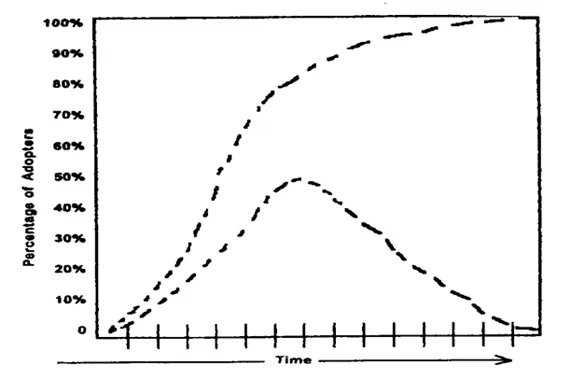
- The classification of adopters into various categories is based on mean & standard deviation. Using these statistical measures, the population is divided into five categories along a normal distribution curve.
- Frequency of adopters when plotted over time follows a normal or bell-shape curve. Most people adopt in the middle of the time range, with fewer very early and very late adopters.
- The cumulative frequency of adopters over time follows S - shaped curve. The S-shape reflects slow initial adoption, followed by rapid acceleration as the majority adopts, and then tapering off as the remaining laggards finally come on board.
- Individual adopters in a social system are described in terms of his time of adoption.
- The S shape adoption curve increases at an increasing rate for innovators, early adopters & early majority.
- The time of adoption of an innovation by all the members in a social system always vary.
- All individuals in a social system adopt innovations in an ordered time sequence.
- There are 5 types of adopter categories in adoption.
1. Innovators (Venturesome)
- The farmers who are the first to try new idea are innovators. They are willing to take high risks and can absorb the financial loss if an innovation fails.
- These are generally viewed as deviant by other members of the society. Because they are so far ahead of their peers, they may be seen as unconventional or eccentric.
- These have good contacts with cosmopolite, literate & more prestigious.
- 2.5 % of the total population are innovators. (-Infinite to X -- 2 sigma)
- Initiators incorporate the innovators into a specific plan of action adapted to needs of the system.
2. Early adopters (Respectful)
- They do not test untried idea, but quickest to use tried ideas in their own situation. So, these are considered by many as the men to "check with". Other farmers look to them for guidance and advice before making their own adoption decisions.
- These are regarded as opinion leaders. They hold a central position in the communication network of their community and are the most influential category for extension workers to target.
- 'Legitimization' (validation) is done by early adopters. When early adopters embrace an innovation, it signals to the rest of the community that the innovation is safe and worthwhile.
- These are more concerned about the trialability of the innovation.
- Personality wise these are lesser dogmatic & higher empathy.
- 13.5 % of the total population are early adopters. (X -- 2 sigma to X - sigma)
3. Early majority (Deliberate and local adoption leaders)
- "Be not the last to lay the old aside nor be the first by which the new is tried" is the motto of Early Majority. This reflects their cautious but not overly hesitant approach to new ideas.
- These are considered as friend & neighbours by other members in the social system. They interact frequently with their peers and serve as a bridge between early adopters and later adopters.
- These adopt an innovation before every average member of the society does. 34 % of the total population. (X -- sigma to X)
4. Late majority (Sceptical and Cautious)
- 34 % of the total population. (X to X + sigma)
- The late majority adopt innovations only after most of their peers have already done so. They tend to be sceptical and are often motivated to adopt by economic necessity or peer pressure rather than genuine conviction about the innovation's value.
5. Laggards (Traditional)
- These have little or no education, least participation & hardly any contact with outsider. The point of reference for laggards is Past. They tend to look backwards to traditional methods rather than forward to new possibilities.
- These are considered as custodian of indigenous knowledge. While they are slow to adopt new innovations, they often possess valuable traditional farming wisdom that should be respected and preserved.
- 16 % of the total population are laggards. (up to X + sigma to X + 2 sigma)
NOTE
Adopter Category Percentages: Innovators (2.5%) | Early Adopters (13.5%) | Early Majority (34%) | Late Majority (34%) | Laggards (16%). Together they form the classic bell-shaped curve of adoption.