Cropping Patterns & Systems: Types, Examples, and Farming Decisions
Comprehensive guide to cropping patterns in India: monoculture, mixed cropping, intercropping, crop rotation, relay cropping — with definitions, examples, LER, cropping intensity, and exam cheat sheet.
Cropping Patterns in Agriculture: Types, Systems & Examples
Cropping patterns define the yearly sequence and spatial arrangement of crops on a piece of land — the core decision every farmer makes to balance yield, soil health, and income. With field preparation and plant stand established (previous lesson), the next decision is what to grow, when, and in what combination.
Why Cropping Systems Matter
A rice-wheat farmer in Punjab grows two crops a year on the same plot, while a dryland farmer in Rajasthan may grow only pearl millet with an intercrop of moth bean. Both are following a cropping system -- the planned sequence and combination of crops on a given piece of land. Choosing the right system determines not just yield, but also soil health, income stability, and food security for millions.
Farming System
Before diving into cropping systems specifically, it helps to understand the broader concept of a farming system — the integrated whole that cropping is part of.
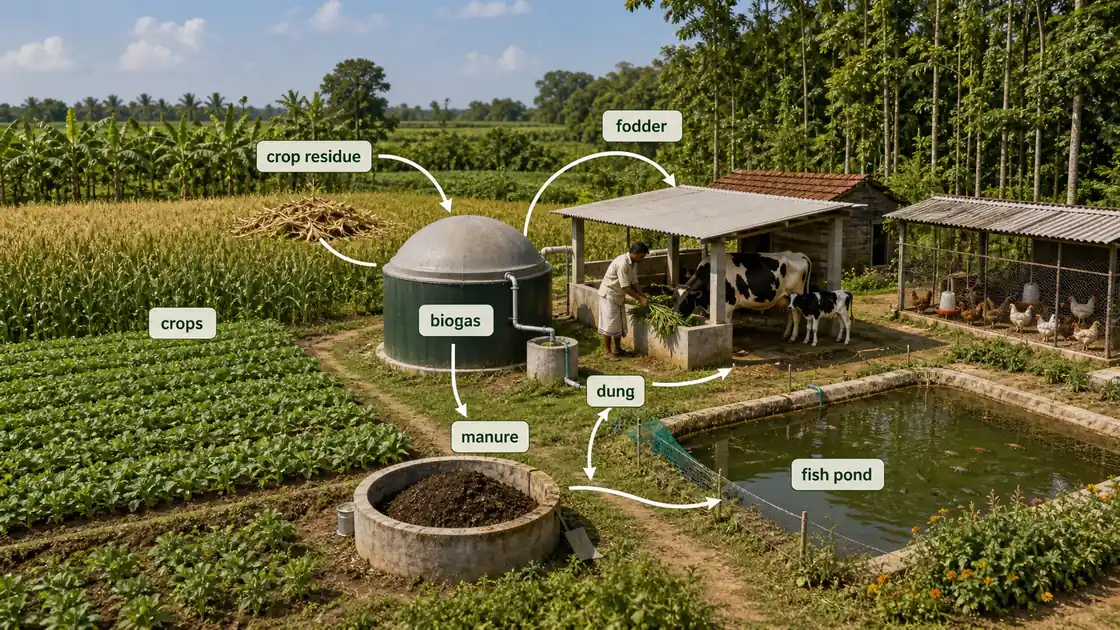
A farming system is a complex, inter-related matrix of soil, plants, animals, implements, labour, capital, and other inputs managed by the farm family. It represents the holistic integration of crop production with enterprises like dairying, fisheries, poultry, sericulture, and agroforestry for optimal resource utilisation.
Principles of Farming System
- Risk minimisation through diversification
- Use of end products from one enterprise as input in another (e.g., cattle dung for biogas and manure)
- Recycling of wastes and residues
- Integration of two or more enterprises
- Optimum utilisation of all resources
- Maximum productivity and profitability
- Ecological balance
- Employment generation
- Increased input-use efficiency
Determinants of Farming System
| Factor | Type | Examples |
|---|---|---|
| A -- Physical & Biological | Sets limits on what can be produced | Climate, soil type, topography, local varieties |
| B -- Endogenous Human | Within farmer's control | Family size, skills, preferences, farm size |
| C -- Exogenous Human | External influences | Market prices, government policy, credit, infrastructure |

Components of Farming System
Dairying, Biogas plant, Sheep & goat rearing, Poultry, Fisheries, Bee-keeping (Apiculture), Sericulture, Agro-forestry -- each integrates with crop production for a diversified, resilient farm.
Cropping System
- The principles and practices of cropping and their interaction with farm resources, technology, and environment to suit regional/national needs. FCI AGM 2021
- Most common cropping system in India: Rice-based cropping system.
Cropping Pattern
- The yearly sequence and spatial arrangement of crops on a given area, considering soil, climate, crop efficiency, socio-economic factors, technology, and national agricultural policy.
- It is dynamic -- changes over space and time.
Major Cropping Patterns in India
| Pattern | Key States | No. of Patterns | Most Prominent |
|---|---|---|---|
| (A) Rice-based | West Bengal, Uttar Pradesh, Bihar, Madhya Pradesh, Odisha, Andhra Pradesh, Tamil Nadu, Kerala; Non-traditional: Punjab, Haryana, Western Uttar Pradesh | 30 | Rice-Wheat (Indo-Gangetic Plains) |
| (B) Wheat-based | Traditional wheat areas; Non-traditional: North-West India | 19 | Rice-Wheat, Pigeon pea-Wheat |
| (C) Kharif Sorghum | Maharashtra, Madhya Pradesh, Karnataka, Gujarat, Rajasthan, Andhra Pradesh | 17 | -- |
| (D) Rabi Sorghum | Maharashtra, Karnataka | 13 | -- |
| (E) Pearl millet | Gujarat, Rajasthan (arid/semi-arid tropics) | 20 | Bajra-based rotations |
| (F) Maize | Uttar Pradesh, Bihar, Rajasthan, Madhya Pradesh, Punjab | 12 | -- |
| (G) Cotton | Gujarat, Maharashtra, Andhra Pradesh | 16 | -- |
| (H) Chickpea/Pulses | Non-traditional: Karnataka, Andhra Pradesh, Tamil Nadu | -- | -- |
| (I) Groundnut | Gujarat, Karnataka, Andhra Pradesh, Tamil Nadu (rainfed) | 9 | -- |
Rice-Wheat dominates the Indo-Gangetic Plains (Zones 3-6) because rice thrives in hot wet kharif and wheat in cool dry rabi — the same alluvial soil serves both.
Multiple Cropping
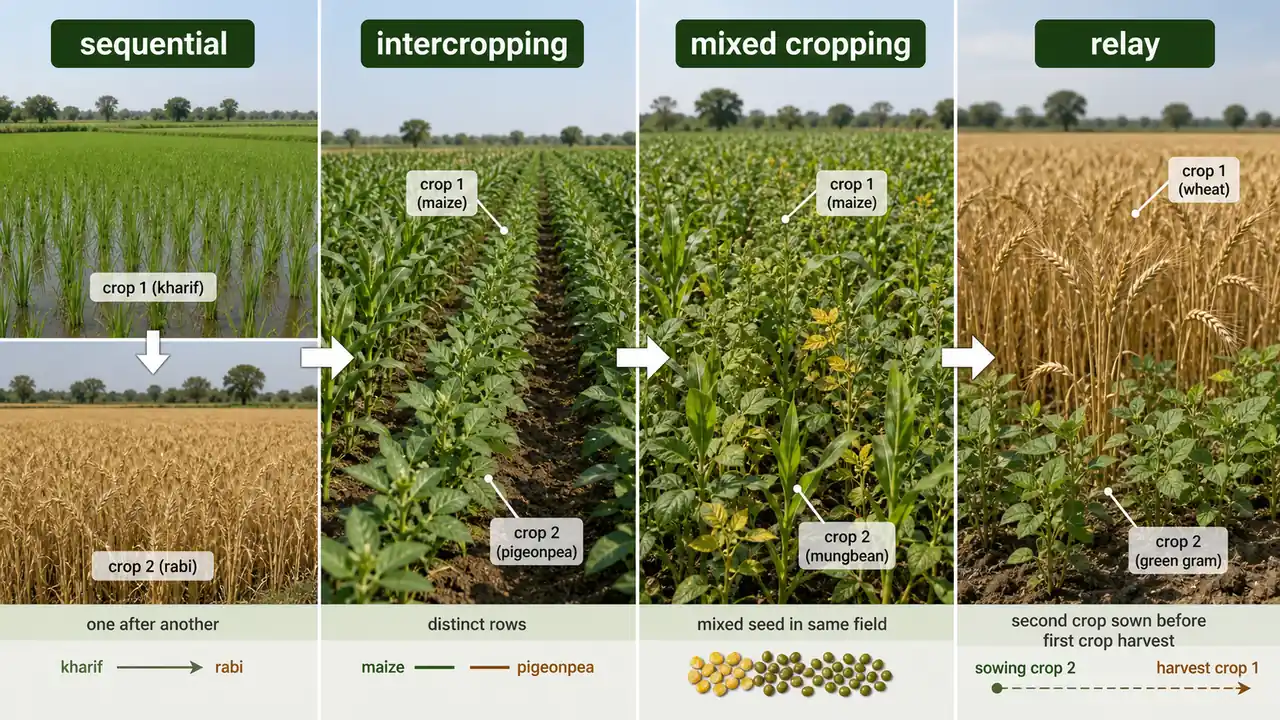
Multiple cropping is the primary strategy for intensifying production on limited land. It can be done by growing crops one after another (sequential) or simultaneously (intercropping). Understanding these distinctions is critical — exams often test sequential vs intercropping vs mixed cropping.
Growing two or more crops in a year on the same land to intensify production in both time and space.
(A) Sequential Cropping
- Two or more crops grown one after another on the same field in a year. No overlap in growth periods.
- Intensification in time dimension only.
- No inter-crop competition; farmer manages one crop at a time.
- Double cropping (Rice-Potato), Triple cropping (Rice-Potato-Groundnut).
(B) Intercropping
- Two or more dissimilar crops grown simultaneously on the same land with base crop in distinct row arrangement.
- Intensification in both time and space.
Advantages: Yield stability, better resource use, weed/pest control, mutual support, erosion control.
Disadvantages: Adverse competition, allelopathic effects, obstruction to machinery.
Four Types of Intercropping
| Type | Arrangement | Use |
|---|---|---|
| Mixed intercropping | No distinct row arrangement | Labour-intensive subsistence farming |
| Row intercropping | Distinct rows for each crop | Mechanised agriculture |
| Strip intercropping | Wide strips for independent cultivation | Large-scale farms |
| Relay intercropping | Growth cycles overlap; 2nd crop planted before 1st is harvested | Extending growing season |
(C) Relay / Overlapped Cropping
- Inter-planting 2nd crop before harvest of maturing 1st crop.
- Example: Potato planted before maize harvest; Radish sown before potato harvest.
- Paira (Bihar/WB) and Utera (MP) cropping = sowing lathyrus or lentil before rice harvest to use residual moisture in lowland.
Mixed Cropping
Mixed cropping is conceptually different from intercropping — it prioritises insurance against failure over systematic resource optimisation. It is most common in dryland areas where monsoon uncertainty makes sole cropping risky.
- Two or more crops grown simultaneously, seeds may be mixed or in alternate rows.
- Crops should have different durations and be harvested at different times. NABARD 2021
- Main objective: Insurance against crop failure in aberrant weather.
- Studied scientifically first by La-Flitze (1929).
- Common in dryland areas of India; sowing by broadcasting.
Intercropping vs Mixed Cropping
| Aspect | Intercropping | Mixed Cropping |
|---|---|---|
| Objective | Utilise space between main crop rows | Insurance against total crop failure |
| Crop status | Clear main + subsidiary crop | All crops have equal status |
| Duration | Subsidiary = shorter duration | Crops of similar duration |
| Sowing | Both in rows | May be broadcast or in rows |
Intercropping uses defined rows so mechanized harvesting remains possible. Mixed cropping broadcasts seeds together because the dryland farmer's priority is insurance — if one crop fails, the other might survive.
Other Cropping Concepts
Beyond multiple and mixed cropping, several specialised cropping concepts appear frequently in exams. Each describes a specific way of managing crops on the same land — from ratooning (re-growing from stubble) to multistorey cropping (layering crops by height).
| Concept | Definition | Example |
|---|---|---|
| Sole Cropping | One crop variety grown alone at normal density | Wheat sole crop |
| Monoculture | Same crop in same season (space sequence) | Rice every kharif |
| Monocropping | Same crop year after year (time sequence) -- risks soil degradation | Continuous rice-rice |
| Ratooning | Fresh crop from stubbles/suckers without replanting; matures earlier | Sugarcane ratoon crop |
| Mixed Farming | Crop production + livestock + poultry + fisheries on same farm | Rice + dairy + fish pond |
| Multistorey Cropping | 2+ crops of different heights on same field | Sugarcane + Mustard + Onion (Karnataka, Kerala) |
| Parallel Cropping | Crops with different growth habits, zero competition | Urd/Moong + Maize |
| Companion Cropping | Both intercrops yield = their sole crop yield | Mustard + Sugarcane |
| Synergetic Cropping | Both crops yield higher than sole crop | Sugarcane + Potato |
| Staggered Planting | Sowing spread over optimum period to reduce risk or extend market supply | -- |
| Live Mulch | Planting food crop into living cover crop without tillage | -- |


Crop Rotation
Rotation is one of the oldest and most effective soil management practices. By alternating between exhaustive crops (cereals) and restorative crops (legumes), farmers maintain fertility, break pest cycles, and reduce disease pressure without chemicals.
The repetitive cultivation of an ordered succession of crops on the same land. Crop rotation is the reverse of land rotation — the crop is rotated, not the land.
Principles of Crop Rotation
- Exhaustive crop followed by restorative crop — cereal (heavy feeder) followed by legume (N-fixer).
- Deep-rooted crop followed by shallow-rooted crop — uses different soil layers.
- Crops of different families — breaks host-specific pest and disease cycles.
- Cash crop followed by food/fodder crop — balances farm economy.
- Water-demanding crop followed by drought-tolerant crop — conserves moisture.
Common Indian Crop Rotation Examples
| Rotation | Region | Logic |
|---|---|---|
| Rice → Wheat | Punjab, Haryana, UP | Most dominant; kharif-rabi; high productivity |
| Rice → Lentil/Chickpea | Eastern India | Legume restores N after rice |
| Maize → Wheat → Cowpea (fodder) | North India | 3-crop rotation; cowpea fixes N |
| Cotton → Jowar → Groundnut | Maharashtra | Breaks cotton bollworm cycle |
| Sugarcane → Wheat → Moong | UP | Exhaustive → cereal → restorative |
| Bajra → Mustard → Moong | Rajasthan | Dryland 3-year rotation |
Example of pest cycle break: Rice stem borer (Scirpophaga spp.) survives in rice stubble. If rotated with wheat → legume, the pest loses its host, population crashes.
Advantages of Crop Rotation
- Prevents soil depletion — different crops draw different nutrients
- Maintains soil fertility — legumes fix atmospheric N₂ (50–200 kg N/ha/yr)
- Controls weeds — different crop canopies shade out different weed species
- Breaks pest and disease cycles — host-specific pathogens starve without host
- Reduces chemical inputs — less need for pesticides/fertilisers
- Reduces soil erosion — continuous soil cover
- Increases overall productivity — Rotation yield > monocropping yield over time
Disadvantages of Crop Rotation
- Complex planning — needs knowledge of crop families and sequences
- Market linkage needed — rotating crops must all be marketable or usable
- Equipment and skill requirements vary across crops in the rotation
Land Equivalent Ratio (LER)
IMPORTANT
LER > 1 means intercropping is beneficial. Formula: LER = Ya/Sa + Yb/Sb

- LER = relative land area under sole crops needed to produce the same yields as intercropping.
- Given by Willey, R.W.
- Example: La = 0.70, Lb = 0.40 --> LER = 1.10 --> intercropping is 10% more land-efficient.
Cropping Intensity
- Cropping Intensity (CI) = (Total cropped area / Net cultivated area) x 100
- India's cropping intensity: 143%
- Highest cropping intensity: Punjab
- Cropping Index = number of crops per year x 100. E.g., Cowpea-Rice-Wheat = 300%.
Important Agronomical Crop Terms
These specialised terms describe the role a crop plays within a cropping system — whether it suppresses weeds, traps pests, restores fertility, or serves as insurance. Exams frequently test the definition-example pairs.
| Term | Definition | Examples |
|---|---|---|
| Smother crops | Suppress weeds by dense foliage, quick growth | Barley, Mustard, Cowpea |
| Nurse crops | Nourish main crop by N-fixation / OM | Cowpea with cereals |
| Guard / Barrier crops | Protect main crop from wind/pests | Mesta around Sugarcane; Sorghum around Cotton |
| Augmenting crops | Increase yield of main crop | Mustard with Berseem |
| Alley crops | Grown in alleys of trees for fertility and erosion control | Pulses between Poplar rows |
| Catch / Contingent crops | Substitute when main crop fails | Chickpea, Cowpea, Bajra |
| Cover crops | Protect soil from erosion | Groundnut, Chickpea, Sweet potato |
| Trap crops | Trap harmful insects/nematodes/weeds | Castor in Cotton for army worm |
| Cash crops | Grown for sale | Sugarcane, Cotton, Tobacco, Jute |
| Complementary crops | Each crop benefits the other | Jowar + Lobia |
| Ley crops | Grown for grazing/harvesting for livestock | Berseem + Mustard |
| Break crops | Pulse/oilseed instead of cereals to break disease cycle | Lentil or Mustard instead of Wheat |
| Exhaustive crops | Feed heavily on soil nutrients, deplete fertility | Sorghum, Tobacco, Sugarcane |
| Restorative crops | Enrich soil while providing harvest (fix nitrogen) | Legumes — Gram, Moong, Berseem |
| Dobari crops | Crop grown on residual moisture after rice harvest (same concept as Paira/Utera) | Lathyrus, lentil in eastern India |
A smother crop is the organic farmer's alternative to herbicides — it physically shades out weeds through rapid dense growth.
TIP
Most asked: Smother = weed suppression. Trap = pest trapping. Catch = substitute after failure. Guard = barrier around main crop.
Indices in Cropping Systems
| Index | Definition |
|---|---|
| LER | Land needed under sole crop to match intercrop yield. LER > 1 = advantage. |
| Relative Crowding Coefficient (RCC) | Replacement series: more/less yield than expected in mixture |
| Aggressivity | Relative yield increase of crop A vs crop B in mixture |
| Cropping Intensity | (Total cropped area / Net cultivated area) x 100 |
| Multiple Cropping Index | Total area cropped in a year / Land area available x 100 |
| Crop Equivalent Yield | Intercrop yields converted to equivalent of one crop using price ratios |
IMPORTANT
Key numbers: India's cropping intensity = ~143%. Monocropping intensity = always 100%. LER > 1 = intercropping advantage.
Seed Measurement Terms
| Term | Definition |
|---|---|
| Seed Index | Weight of 100 seeds — used to compare seed size across varieties |
| Test Weight | Weight of 1000 seeds — Tobacco has the lightest (0.25-0.30 g) |
TIP
Exam fact: Seed Index = 100 seeds. Test Weight = 1000 seeds. Don't confuse the two — frequently asked.
Additive vs Replacement Series
| Aspect | Additive Series | Replacement Series |
|---|---|---|
| Design | Base crop at full population + intercrop added | Both crops share combined population equal to sole crop |
| Population | More than sole crop | Equal or less than sole crop |
| Efficiency | More efficient | LER often < 1 |
| Example | Sugarcane (full) + Potato (additional) | Maize replacing some sorghum rows |
Cropping Scheme
The plan for growing crops on individual plots to get maximum return without impairing soil fertility.
NOTE
Cropping Pattern = what crops and in what sequence. Cropping System = Cropping Pattern + Management. Cropping Scheme = plot-level plan for returns + soil health.
Cropping System Selection Guide for Different Agro-Climatic Zones
Which cropping system to recommend? Match zone + irrigation + soil:
| Zone / Situation | Recommended System | Cropping Intensity | Why It Works |
|---|---|---|---|
| NW India (Punjab, Haryana) — canal-irrigated | Rice-Wheat | 200% | Assured irrigation; but causes groundwater depletion + residue burning problem |
| NW India — diversification needed | Rice-Potato-Wheat or Rice-Mustard-Moong | 250-300% | Breaks rice-wheat monotony; adds income; legume fixes N |
| Eastern India (Bihar, WB) — medium land | Rice-Lentil/Chickpea | 200% | Rabi pulse uses residual moisture; improves soil N |
| Central India (MP, Rajasthan) — rainfed | Soybean-Wheat | 200% | Soybean fixes N; both crops suit Vertisols |
| Dryland — single season only | Pearl millet + intercrop (cowpea/pigeon pea) | 100-150% | Drought-tolerant base crop + legume safety net |
| Sugarcane belt (UP, Maharashtra) | Sugarcane + intercrop (potato/wheat in autumn) | ~150% | Long-duration sugarcane allows early intercrop for extra income |
| Perennial systems — small holdings | Agroforestry (fruit trees + field crops + livestock) | Multi-tier | Year-round income; risk diversification; ecological sustainability |
Key principle: A good cropping system maximizes cropping intensity (% of land under crop per year) while maintaining soil health through legume inclusion and residue management. The best system for any farm depends on water availability, soil type, and market access.
Exam-critical distinction: Cropping Pattern = what crops, what sequence. Cropping System = pattern + management practices. Cropping Intensity = (Gross Cropped Area / Net Sown Area) × 100. India's average cropping intensity is approximately 140%.
Summary Cheat Sheet
| Concept / Topic | Key Details / Explanation |
|---|---|
| Farming System | Holistic integration of crops, livestock, fisheries, agroforestry for optimal resource utilisation |
| Farming System Principles | Risk minimisation, recycling, enterprise integration, ecological balance, employment generation |
| Farming System Determinants | A: Physical/Biological (climate, soil); B: Endogenous Human (skills, farm size); C: Exogenous Human (markets, policy) |
| Cropping System | Cropping pattern + management practices; Most common in India: Rice-based |
| Cropping Pattern | Yearly sequence & spatial arrangement of crops; dynamic — changes over space and time |
| Cropping Scheme | Plot-level plan for maximum return without impairing soil fertility |
| Rice-based pattern | 30 patterns, dominant: Rice-Wheat (Indo-Gangetic Plains, Zones 3-6) |
| Wheat-based pattern | 19 patterns; includes Rice-Wheat, Pigeonpea-Wheat |
| Pearl millet pattern | 20 patterns; Gujarat, Rajasthan (arid/semi-arid tropics) |
| Other major patterns | Kharif Sorghum (17), Cotton (16), Rabi Sorghum (13), Maize (12), Groundnut (9) |
| Multiple Cropping | 2+ crops/year on same land; intensification in both time and space |
| Sequential Cropping | Crops grown one after another, no overlap; intensification in time only |
| Intercropping | Dissimilar crops in distinct row arrangement; intensification in time + space |
| 4 Types of Intercropping | Mixed (no rows), Row (distinct rows), Strip (wide strips), Relay (overlap periods) |
| Relay / Overlapped Cropping | 2nd crop planted before 1st harvested; Paira (Bihar/WB), Utera (MP) = lathyrus/lentil before rice harvest |
| Mixed Cropping | Seeds mixed/broadcast; objective: insurance against crop failure; crops of similar duration |
| Mixed Cropping — first study | La-Flitze (1929); common in dryland areas of India |
| Intercropping vs Mixed Cropping | Intercropping: defined rows, main + subsidiary crop; Mixed: broadcast, equal status, insurance motive |
| Crop Rotation | Ordered succession of crops on same land; breaks pest/disease cycle, maintains fertility |
| Sole Cropping | One crop variety grown alone at normal density |
| Monoculture | Same crop in same season (space sequence) |
| Monocropping | Same crop year after year (time sequence); risks soil degradation |
| Ratooning | Fresh crop from stubbles/suckers without replanting; matures earlier (e.g., sugarcane) |
| Mixed Farming | Crop production + livestock + poultry + fisheries on same farm |
| Multistorey Cropping | 2+ crops of different heights; e.g., Sugarcane + Mustard + Onion (Karnataka, Kerala) |
| Parallel Cropping | Different growth habits, zero competition; e.g., Urd/Moong + Maize |
| Companion Cropping | Both intercrops yield = their sole crop yield; e.g., Mustard + Sugarcane |
| Synergetic Cropping | Both crops yield higher than sole crop; e.g., Sugarcane + Potato |
| LER (Land Equivalent Ratio) | Ya/Sa + Yb/Sb; given by Willey; LER > 1 = intercropping advantageous |
| Cropping Intensity (CI) | (Total cropped area / Net cultivated area) x 100; India: ~143%; Highest: Punjab |
| Cropping Index | Number of crops/year x 100; e.g., Cowpea-Rice-Wheat = 300% |
| RCC | Relative Crowding Coefficient — replacement series yield comparison |
| Aggressivity | Relative yield increase of crop A vs crop B in mixture |
| Crop Equivalent Yield | Intercrop yields converted using price ratios |
| Seed Index | Weight of 100 seeds |
| Test Weight | Weight of 1000 seeds; Tobacco lightest (0.25-0.30 g) |
| Additive Series | Base crop at full population + intercrop added; more efficient; population > sole crop |
| Replacement Series | Both crops share combined population = sole crop; LER often < 1 |
| Smother crops | Suppress weeds by dense foliage; Barley, Mustard, Cowpea |
| Nurse crops | Nourish main crop by N-fixation / OM; Cowpea with cereals |
| Guard / Barrier crops | Protect from wind/pests; Mesta around Sugarcane; Sorghum around Cotton |
| Augmenting crops | Increase yield of main crop; Mustard with Berseem |
| Alley crops | Grown in alleys of trees; Pulses between Poplar rows |
| Catch / Contingent crops | Substitute when main crop fails; Chickpea, Cowpea, Bajra |
| Cover crops | Protect soil from erosion; Groundnut, Chickpea, Sweet potato |
| Trap crops | Trap harmful insects; Castor in Cotton for army worm |
| Cash crops | Grown for sale; Sugarcane, Cotton, Tobacco, Jute |
| Complementary crops | Each crop benefits the other; Jowar + Lobia |
| Ley crops | For grazing/harvesting for livestock; Berseem + Mustard |
| Break crops | Pulse/oilseed to break disease cycle; Lentil instead of Wheat |
| Exhaustive crops | Deplete soil nutrients; Sorghum, Tobacco, Sugarcane |
| Restorative crops | Enrich soil, fix nitrogen; Legumes — Gram, Moong, Berseem |
| Dobari crops | Grown on residual moisture after rice harvest (= Paira/Utera); Lathyrus, Lentil |
TIP
Next: Lesson 06 covers sustainable and precision agriculture — organic farming, ZBNF, and GPS/GIS-based precision techniques that represent the future direction of Indian agriculture.