🎎 Bee Castes, Life Cycle, and Division of Labour
Queen, Worker, and Drone -- the three castes of a honey bee colony, their duties, haplodiploidy, life cycle, and the superorganism structure
In the previous lesson, we compared the five bee species found in India. Now we look inside a single colony to understand who does what -- the three castes, their origin, duties, and life cycle.
Think of it this way: A bee colony works like a well-run factory. The queen is the CEO — her only job is production (laying eggs). The workers are the entire workforce — they clean, build, nurse, guard, forage, and even air-condition the hive. The drones are like seasonal contractors — hired only for one job (mating), then let go when the season ends. Together, they form a superorganism — no individual can survive alone, just as no single organ can function without the body.
Open a well-managed bee box in an apiary and you will see thousands of bees working in perfect coordination -- some building comb, some feeding larvae, and some guarding the entrance. Yet among them is just one queen, a few hundred drones, and tens of thousands of workers.
Pro Content Locked
Upgrade to Pro to access this lesson and all other premium content.
₹99 charged monthly · Cancel anytime
- All Agriculture & Banking Courses
- AI Lesson Questions (100/day)
- AI Doubt Solver (50/day)
- Glows & Grows Feedback (30/day)
- AI Section Quiz (20/day)
- 22-Language Translation (100/day)
- Recall Questions (20/day)
- AI Quiz (15/day)
- AI Quiz Paper Analysis (100/day)
- AI Step-by-Step Explanations (100/day)
- Spaced Repetition Recall (FSRS)
- AI Tutor
- Immersive Text Questions
- Audio Lessons — Hindi & English
- Mock Tests & Previous Year Papers
- Summary & Mind Maps
- XP, Levels, Leaderboard & Badges
- Generate New Classrooms
- Voice AI Teacher (AgriDots Live)
- AI Revision Assistant
- Knowledge Gap Analysis
- Interactive Revision (LangGraph)
🔒 Secure via Razorpay · Cancel anytime · No hidden fees
In the previous lesson, we compared the five bee species found in India. Now we look inside a single colony to understand who does what -- the three castes, their origin, duties, and life cycle.
Think of it this way: A bee colony works like a well-run factory. The queen is the CEO — her only job is production (laying eggs). The workers are the entire workforce — they clean, build, nurse, guard, forage, and even air-condition the hive. The drones are like seasonal contractors — hired only for one job (mating), then let go when the season ends. Together, they form a superorganism — no individual can survive alone, just as no single organ can function without the body.
Open a well-managed bee box in an apiary and you will see thousands of bees working in perfect coordination -- some building comb, some feeding larvae, and some guarding the entrance. Yet among them is just one queen, a few hundred drones, and tens of thousands of workers.
This lesson covers:
- Three castes -- Queen, Worker, Drone at a glance
- Haplodiploidy -- how sex is determined in bees
- Queen, Worker, and Drone -- detailed roles and biology
- Bee hive structure and life cycle stages
- Other social insects for comparison
The Three Castes at a Glance
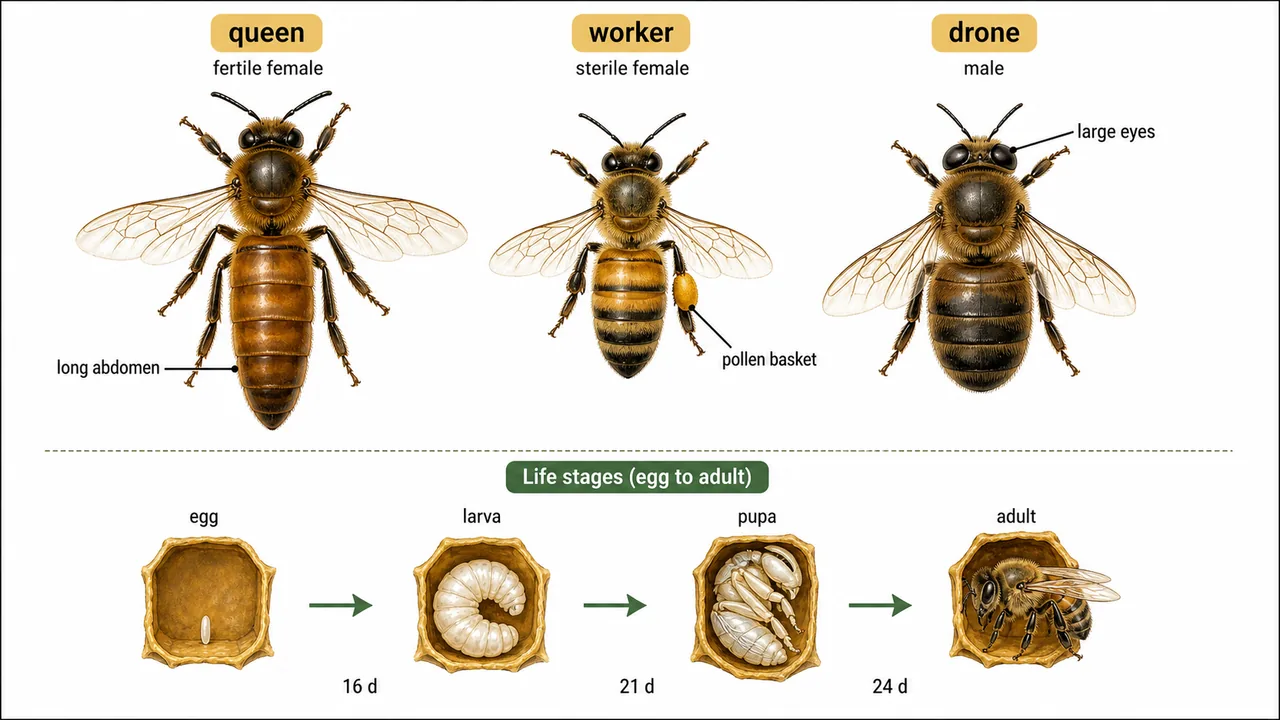
| Feature | Queen | Worker | Drone |
|---|---|---|---|
| Sex | Female (fertile) | Female (sterile) | Male (fertile) |
| Ploidy | Diploid (2n) | Diploid (2n) | Haploid (n) |
| Origin | Fertilised egg + royal jelly | Fertilised egg + bee bread | Unfertilised egg (parthenogenesis) |
| Number per colony | 1 | 40,000-80,000 | A few hundred |
| Size | Largest | Smallest | Medium |
| Sting | Smooth (for killing rival queens) | Barbed (one-time, fatal defence) | None |
| Primary role | Egg laying | All colony tasks | Mating with queen |
Haplodiploidy -- How Sex is Determined
IMPORTANT
Haplodiploidy: Unfertilised eggs (haploid) = Drones (males). Fertilised eggs (diploid) = Queen and Workers (females). Diet determines whether a diploid female becomes a queen (royal jelly throughout) or a worker (bee bread after day 3).
- Sex is determined by fertilisation: the queen controls whether an egg is fertilised based on the cell size in which she lays it.
- Males are produced by parthenogenesis -- drones have no father but do have a grandfather.
- This sex-determination system is called haplodiploidy and is characteristic of all Hymenoptera (bees, wasps, ants).
The Queen -- Mother of the Colony
- The queen is the only individual that lays eggs -- she is the reproductive engine of the entire colony.
- Egg-laying capacity:
- Apis mellifera: 2,000-3,000 eggs/day
- Apis cerana indica: 500-600 eggs/day
- 5-10 days after emergence, she mates with 10-20 drones during one or more nuptial flights at a height of 10-40 m in drone congregation areas (DCAs).
- Her spermatheca stores 5-6 million spermatozoa -- sufficient for her entire laying career. She lives for 2-3 years, with peak performance in the first 1-2 years.
Queen's Substance (Pheromone)
- Secreted from the mandibular gland, identified by Butler et al. (1962) as 9-Oxodec-trans-2-enoic acid.
- Functions (when present in sufficient quantity):
- Prevents swarming and absconding
- Prevents ovary development in workers
- Maintains colony cohesion
- Attracts drones during mating flights
- The queen also secretes an anti-queen substance that inhibits workers from building royal brood chambers, ensuring only one queen rules at a time.
The Worker -- The Backbone of the Colony
Workers make up the vast majority of the colony and perform all tasks except reproduction. Their adult lifespan of about 6 weeks is divided into two phases:
Indoor Duties (First 3 Weeks -- "House Bees")
| Days | Task |
|---|---|
| 1-2 | Cleaning cells |
| 3-5 | Feeding older larvae with bee bread (pollen + honey) |
| 6-10 | Feeding young larvae with royal jelly (from hypopharyngeal gland) |
| 11-12 | Orientation flights |
| 12-18 | Producing wax, building comb, receiving and ripening honey |
| 20-21 | Guarding the hive entrance |
Outdoor Duties (Day 21 onwards -- "Field Bees")
- Collecting nectar, pollen, propolis, and water
- Ripening honey in the honey stomach (enzymes convert sucrose to glucose and fructose during flight)
TIP
This age-based task assignment is called temporal polyethism (or age polyethism). Remember: "P for Polyethism, P for Progressive duties by age."
Fascinating Worker Facts
| Fact | Figure |
|---|---|
| Trips per day | 19,000 |
| Honey produced in entire lifetime | 1/12th of a teaspoon |
| Wing strokes | 11,000/minute |
| Flight speed | 9 km/hr |
| Flowers visited for 500 g honey | 2 million |
- If 50% or more of nectar comes from the same plant, the honey is called unifloral honey (e.g., sunflower, mustard, litchi honey), which fetches a premium price. Otherwise it is mixed honey.
The Drone -- The Mating Partner
- Sole purpose: Fertilise the queen during nuptial flights.
- Drones cannot collect nectar or pollen and do not possess a sting.
- After mating, the drone dies immediately. Those that fail to mate are expelled from the hive before winter.
- Drones help in hive temperature maintenance through their larger body mass.
- They emerge mainly during spring and summer.
The Bee Hive
- The place where colonies are maintained is called an Apiary (also called comb or bee hive).
- Cell arrangement (top to bottom): Honey cells -- Pollen cells -- Worker cells -- Drone cells -- Queen cells (at the bottom).
- Hive temperature is maintained at 32-36 C by fanning (to cool) and clustering (to warm).
| Cell Type | Shape | Cap |
|---|---|---|
| Worker cells | Hexagonal | Flat cap |
| Drone cells | Spherical | Convex cap with central hole |
| Queen cells | Cylindrical, large | -- |
- Apis cerana indica and A. mellifera construct parallel combs -- hence suited for movable-frame hives.
- Apis dorsata and Apis florea build single vertical combs -- cannot be managed in standard bee boxes.
Life Cycle
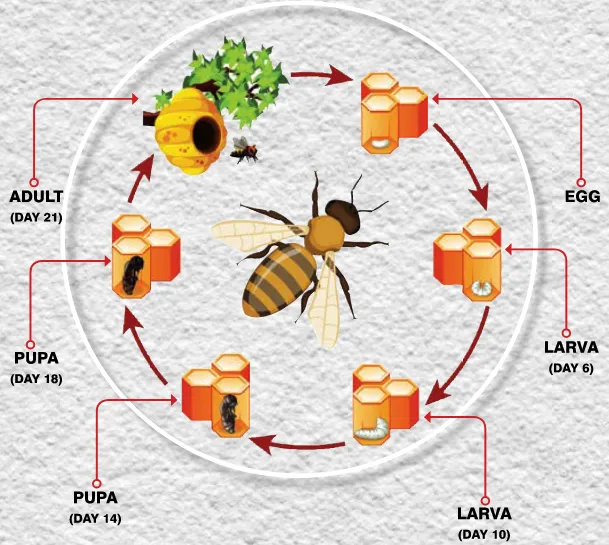
The honey bee undergoes complete metamorphosis: Egg -- Larva -- Pupa -- Adult. The duration differs by caste:
| Cast | Egg | Larva | Pupa | Adult |
|---|---|---|---|---|
| Queen | 3 | 7 | 14 | 2-3 years |
| Worker | 3 | 5 | 8 | 60 days |
| Drone | 3 | 4-5 | 11-12 | 90 days |
Other Social Insects
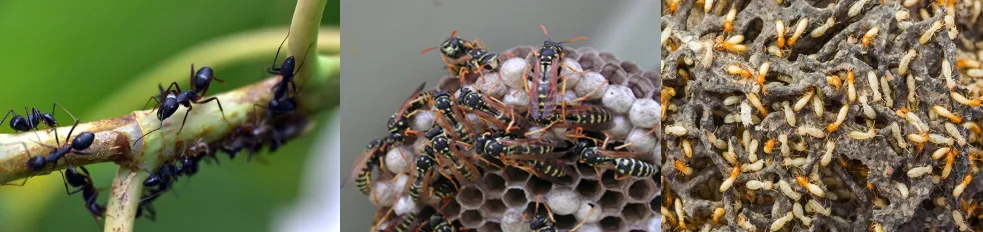
Honey bees are not the only insects with a caste-based social structure. Several other insect groups exhibit eusociality -- cooperative brood care, overlapping generations, and division into reproductive and non-reproductive castes.
NOTE
Other Eusocial Insects: Ants, Wasps, and Termites also form colonies with queen, worker, and soldier castes. Among these, termites are unique because their workers can be both male and female, unlike Hymenoptera where workers are always female.
Summary Table
| Topic | Key Fact |
|---|---|
| Number of castes | 3 -- Queen, Worker, Drone |
| Sex determination | Haplodiploidy |
| Queen egg-laying (A. mellifera) | 2,000-3,000 eggs/day |
| Queen egg-laying (A. cerana) | 500-600 eggs/day |
| Queen lifespan | 2-3 years |
| Queen substance | 9-Oxodec-trans-2-enoic acid (Butler, 1962) |
| Worker lifespan | ~6 weeks |
| Worker division of labour | Temporal polyethism |
| Drone origin | Parthenogenesis (unfertilised, haploid eggs) |
| Hive temperature | 32-36 C |
| Flowers for 500 g honey | 2 million |
| Worker wing strokes | 11,000/minute |
TIP
Exam Quick Recall: Queen substance = 9-Oxodec-trans-2-enoic acid. Drones = haploid, parthenogenesis, no sting. Workers = sterile females, temporal polyethism. Queen = only fertile female, 2000-3000 eggs/day (mellifera).
References
1 source
References
Summary Cheat Sheet
| Concept / Topic | Key Details |
|---|---|
| Three castes | Queen (fertile female), Worker (sterile female), Drone (fertile male) |
| Haplodiploidy | Fertilised egg (diploid) = female; Unfertilised egg (haploid) = male |
| Parthenogenesis | Drones produced from unfertilised eggs; have no father but have a grandfather |
| Caste determination | Diet — royal jelly throughout = Queen; bee bread after day 3 = Worker |
| Queen egg-laying (A. mellifera) | 2,000-3,000 eggs/day |
| Queen egg-laying (A. cerana) | 500-600 eggs/day |
| Queen lifespan | 2-3 years; peak performance first 1-2 years |
| Nuptial flight | 5-10 days after emergence; mates with 10-20 drones at 10-40 m height |
| Spermatheca | Stores 5-6 million spermatozoa for queen's lifetime |
| Queen's substance | 9-Oxodec-trans-2-enoic acid (mandibular gland); identified by Butler et al. (1962) |
| Queen's substance functions | Prevents swarming, prevents worker ovary development, maintains cohesion, attracts drones |
| Temporal polyethism | Age-based division of labour in workers |
| Indoor duties (Days 1-21) | Cleaning → feeding older larvae → feeding young larvae (royal jelly) → wax/comb → guarding |
| Outdoor duties (Day 21+) | Foraging for nectar, pollen, propolis, water |
| Worker lifespan | ~6 weeks |
| Worker wing strokes | 11,000/minute |
| Flowers for 500 g honey | 2 million flowers |
| Unifloral honey | ≥ 50% nectar from same plant; fetches premium price |
| Drone function | Sole purpose = fertilise queen; dies after mating |
| Drone sting | None — drones have no sting |
| Cell arrangement (top to bottom) | Honey → Pollen → Worker → Drone → Queen cells (bottom) |
| Hive temperature | 32-36 °C maintained by fanning and clustering |
| Parallel combs | Built by A. cerana indica and A. mellifera — suited for movable-frame hives |
| Single vertical combs | Built by A. dorsata and A. florea — cannot use standard bee boxes |
TIP
Next: Lesson 04 covers the six bee products -- honey, beeswax, royal jelly, bee venom, propolis, and pollen -- their composition, properties, and commercial uses.