🔮 Bee Behaviour, Communication, and Morphology
Swarming, supersedure, absconding, foraging, dance language, and bee body structure -- essential concepts for competitive exams
In the previous lesson, we covered the six bee products -- from honey and beeswax to royal jelly and bee venom. Now we examine how bees actually behave -- the colony-level behaviours, communication systems, and body structures that make all that production possible.
A farmer maintaining an apiary near a mustard field notices one morning that half the bees from his strongest colony have clustered on a nearby mango branch, with the old queen among them. His colony has just swarmed -- a natural but costly event that every beekeeper must understand and manage. Bee behaviour, from swarming and absconding to the famous waggle dance, is central to successful colony management and a favourite topic in competitive exams.
Think of it this way: Bee behaviours map to human organizational parallels — swarming is like a company splitting into two when it outgrows its office. Supersedure is a peaceful CEO transition (old queen replaced without disruption). Absconding is the entire company abandoning headquarters due to hostile conditions. And the waggle dance is the world's most sophisticated GPS system — encoded in body movements.
Pro Content Locked
Upgrade to Pro to access this lesson and all other premium content.
₹99 charged monthly · Cancel anytime
- All Agriculture & Banking Courses
- AI Lesson Questions (100/day)
- AI Doubt Solver (50/day)
- Glows & Grows Feedback (30/day)
- AI Section Quiz (20/day)
- 22-Language Translation (100/day)
- Recall Questions (20/day)
- AI Quiz (15/day)
- AI Quiz Paper Analysis (100/day)
- AI Step-by-Step Explanations (100/day)
- Spaced Repetition Recall (FSRS)
- AI Tutor
- Immersive Text Questions
- Audio Lessons — Hindi & English
- Mock Tests & Previous Year Papers
- Summary & Mind Maps
- XP, Levels, Leaderboard & Badges
- Generate New Classrooms
- Voice AI Teacher (AgriDots Live)
- AI Revision Assistant
- Knowledge Gap Analysis
- Interactive Revision (LangGraph)
🔒 Secure via Razorpay · Cancel anytime · No hidden fees
In the previous lesson, we covered the six bee products -- from honey and beeswax to royal jelly and bee venom. Now we examine how bees actually behave -- the colony-level behaviours, communication systems, and body structures that make all that production possible.
A farmer maintaining an apiary near a mustard field notices one morning that half the bees from his strongest colony have clustered on a nearby mango branch, with the old queen among them. His colony has just swarmed -- a natural but costly event that every beekeeper must understand and manage. Bee behaviour, from swarming and absconding to the famous waggle dance, is central to successful colony management and a favourite topic in competitive exams.
Think of it this way: Bee behaviours map to human organizational parallels — swarming is like a company splitting into two when it outgrows its office. Supersedure is a peaceful CEO transition (old queen replaced without disruption). Absconding is the entire company abandoning headquarters due to hostile conditions. And the waggle dance is the world's most sophisticated GPS system — encoded in body movements.
This lesson covers:
- Swarming, supersedure, and absconding -- colony-level behaviours
- Foraging and emergency queen rearing
- Dance language -- round dance vs waggle dance (Karl von Frisch, Nobel 1973)
- Bee morphology -- specialised body structures, legs, and vision
Swarming -- Natural Colony Multiplication
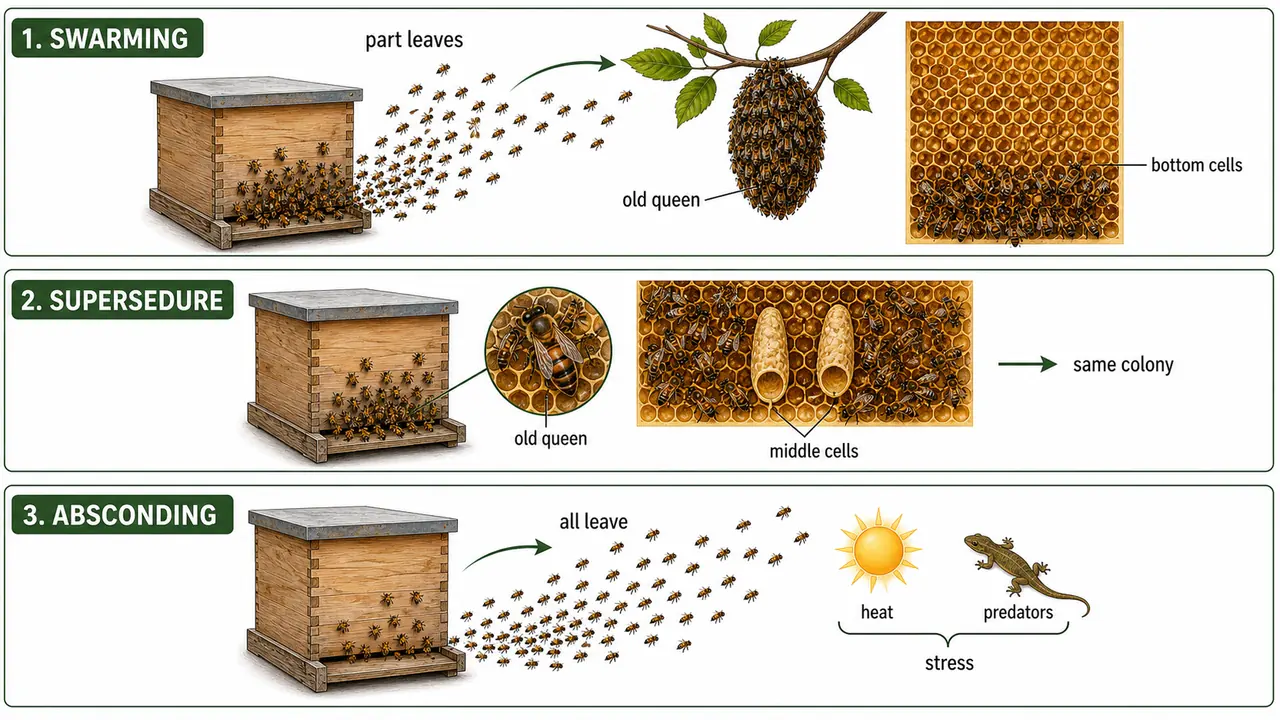
- Swarming is a natural method of colony multiplication in which a part of the colony migrates to a new site with the old queen. It is the reproductive process of the colony as a superorganism.
- Occurs when a colony builds up considerable strength or when the queen's substance falls below a certain level (diluted among too many workers).
Steps in Swarming
| Step | What Happens |
|---|---|
| 1 | Colony reaches peak strength |
| 2 | Drone brood develops; large number of drones emerge (first sign) |
| 3 | New queen cells are built at the bottom of comb (peanut-shaped) |
| 4 | When queen cells are sealed, old queen + 1/3 to 1/2 of colony flies out |
| 5 | Swarm settles in a pendant cluster on a nearby branch |
| 6 | Scout bees search for a permanent site; entire swarm moves there |
| 7 | The first swarm with old queen = primary swarm |
| 8 | New queen emerges and kills all other queen stages in the hive |
| 9 | If prevented from killing rivals, new queen leaves with workers = after swarm or cast |
TIP
Exam Trap: Queen cells at the bottom of comb = swarming. Queen cells in the middle of comb = supersedure. This distinction is frequently tested.
Supersedure -- Replacing a Failing Queen
- When an old queen is unable to lay sufficient eggs or has exhausted her sperm supply (laying only unfertilised drone eggs), the colony replaces her through supersedure.
- 1-2 queen cells are built in the middle of the comb (not at the bottom).
- Both the new and old queens coexist peacefully for a period before the old queen disappears.
- This peaceful coexistence is a unique feature -- unlike the aggressive queen elimination seen in swarming.
Absconding -- Complete Colony Departure
- Absconding means the entire colony leaves the hive permanently to find a new home.
- Not the same as swarming: In swarming, part leaves; in absconding, all bees leave.
- Causes: severe pest infestation (wax moths, mites), repeated disturbance, food scarcity, extreme temperatures, poor hive conditions.
- This is the most frustrating problem for beekeepers since the entire colony is lost.
Quick Comparison: Swarming vs. Absconding
| Feature | Swarming | Absconding |
|---|---|---|
| Bees that leave | Part of colony (1/3 to 1/2) | Entire colony |
| Queen | Old queen leaves with swarm | Queen leaves with all bees |
| Purpose | Natural reproduction | Escape from stress |
| Colony survives? | Yes (new queen emerges in old hive) | No -- hive is abandoned |
| Queen cells | Built at bottom of comb | None (triggered by stress) |
| Desirable? | Natural but undesirable for beekeeper | Highly undesirable |
Foraging
- The collection of pollen and nectar by honey bees is called foraging.
- Foraging range of Apis mellifera: 3 km. Most efficient foraging occurs within this radius.
- This is why apiaries should be placed near abundant floral sources.
Emergency Queen
- On sudden death of a queen, worker eggs are converted to a queen by rearing the larva in extended cells and feeding them exclusively with royal jelly.
- This demonstrates the incredible flexibility of bee biology -- the only difference between a queen and a worker is their diet during larval development.
Colony Odour and Hive Maintenance
- Every colony has a specific odour produced by the Nasanov gland (last abdominal segment of workers). This gland produces terpenes (geraniol, citral) used for orientation and colony recognition.
- Temperature regulation:
- Hot weather: Workers fan their wings to cool the hive
- Cold weather: Bees cluster on the brood, vibrating flight muscles to generate heat, maintaining 32-36 C
- Royal fidelity (floral constancy): Bees restrict themselves to a single flower species until it is exhausted before switching. This behaviour ensures effective cross-pollination within the same species.
Communication in Bees -- Dance Language
Bees communicate through pheromones (queen's substance, Nasanov gland secretion, alarm pheromone from sting, tarsal gland secretion) and through dances.
Karl von Frisch won the Nobel Prize in 1973 for decoding the dance language and orientation of bees -- one of the most remarkable examples of symbolic communication in the animal kingdom.
Round Dance -- Short Distance
| Feature | Detail |
|---|---|
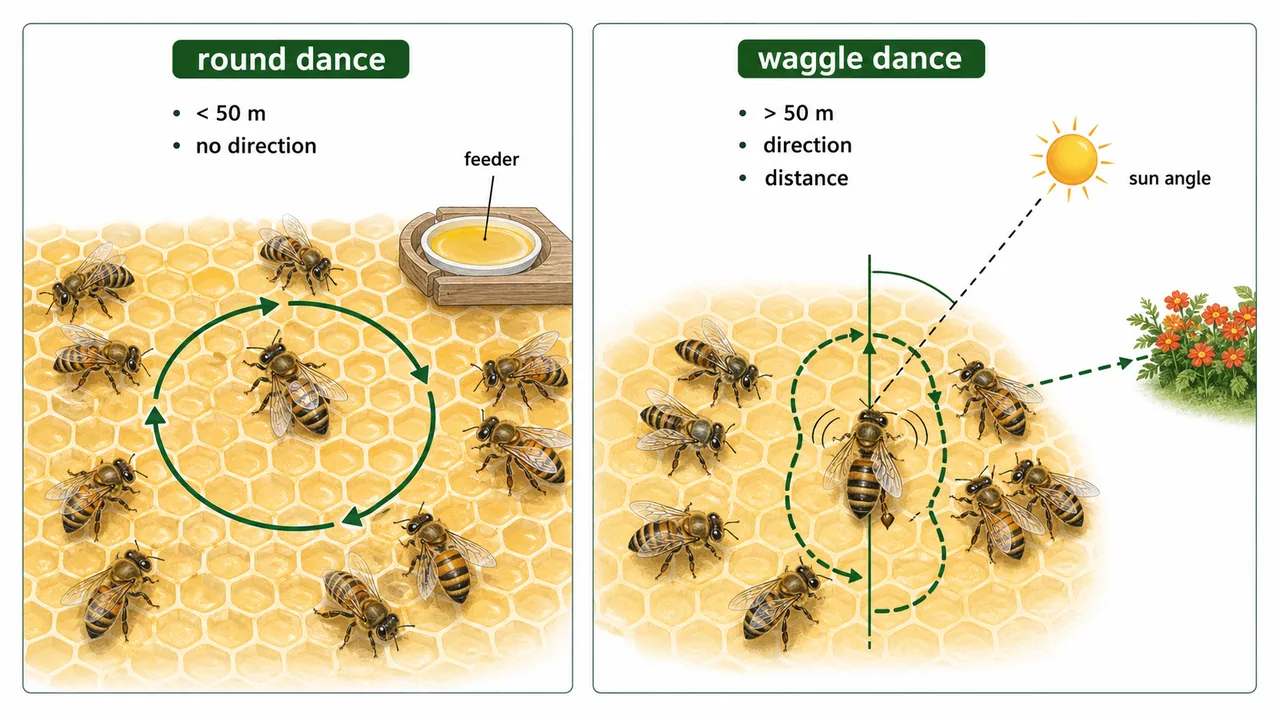
| Distance indicated | Short -- less than 50 m (for A. mellifera) |
| Direction info | No -- only says "food is nearby, search around" |
| Movement | Bee runs in circles, alternating clockwise and anticlockwise |
| Intensity | Duration and vigour indicate quality and abundance of food |
Waggle Dance -- Long Distance
| Feature | Detail |
|---|---|
| Distance indicated | Long -- more than 50 m (for A. mellifera) |
| Direction info | Yes -- angle of straight run relative to vertical = angle of food relative to sun |
| Movement | Two half-circles with a straight run in between, abdomen waggling side to side |
| Distance coding | More wags per unit time = closer food source (inverse relationship) |
| Sun navigation | Bees perceive polarised ultraviolet light, locating the sun even through clouds |
- Also known as tail-wagging dance or wag-tail dance.
TIP
Exam Mnemonic: "Round = shoRt distance (< 50 m), no direction. Waggle = Way far (> 50 m), gives direction." Karl von Frisch = Nobel Prize 1973.
Explore More
- How bees communicate with the waggle dance
- The waggle dance of the honey bee explained
- Bee dance language and navigation
Bee Morphology
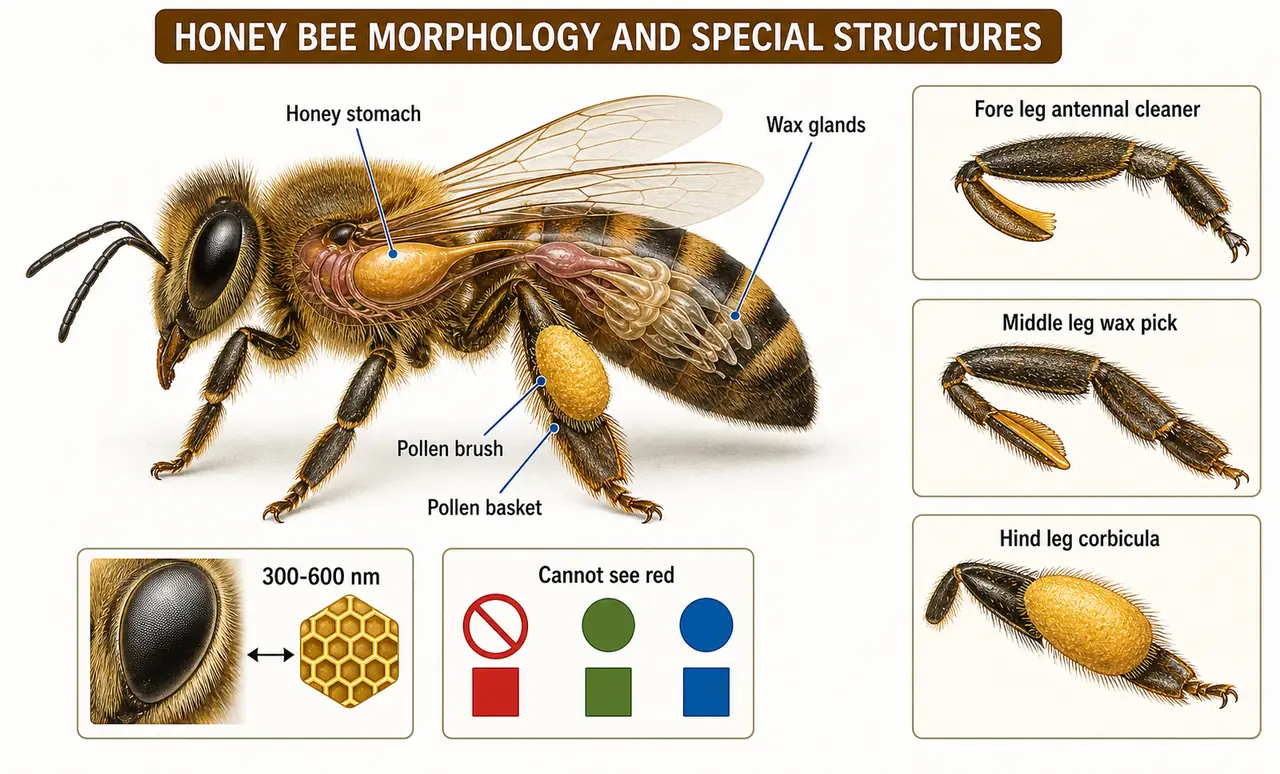
The honey bee's body is highly specialised. Understanding morphology helps in species identification and functional understanding.
Key Body Structures
| Structure | Location | Function |
|---|---|---|
| Pollen basket (corbicula) | Hind legs (tibia) | Smooth, concave surface with stiff hairs for carrying pollen |
| Pollen brush (scopa) | Hind legs (tibia) | Long curved hairs for collecting pollen |
| Stinger | Abdomen (female only) | Worker: barbed (one-time, fatal); Queen: smooth (kills rival queens) |
| Honey sac (crop/honey stomach) | Internal | Stores and transports nectar (separate from digestive stomach) |
| Wax glands | Underside of abdomen | Secrete wax as transparent scales for comb building |
Specialised Legs
| Leg Pair | Modification | Function |
|---|---|---|
| Fore legs | Notch (basitarsus) + spur (tibia) | Antennal cleaning |
| Middle legs | Short spine (wax pick) | Wax picking and scraping pollen basket |
| Hind legs | Corbicula + pollen brush + 10 rows of stiff spines | Pollen collection and transport |
Bee Vision
- Visible range: 300-600 nm
- Colours seen: blue-green, blue-violet, ultraviolet (collectively called Bee's purple)
- Bees cannot see red but can perceive ultraviolet patterns on flowers invisible to humans
Explore More
Summary Table
| Topic | Key Fact |
|---|---|
| Swarming | Natural colony multiplication; part of colony leaves with old queen |
| Swarming queen cells | At bottom of comb |
| Supersedure | Failing queen replaced; queen cells in middle of comb |
| Absconding | Entire colony abandons hive (stress-induced) |
| Foraging range (A. mellifera) | 3 km |
| Emergency queen | Worker egg + royal jelly in extended cell |
| Colony odour gland | Nasanov gland (last abdominal segment) |
| Round dance | < 50 m, no direction info |
| Waggle dance | > 50 m, gives direction and distance |
| Nobel Prize for dance language | Karl von Frisch, 1973 |
| Bee vision range | 300-600 nm (Bee's purple) |
| Pollen basket | Corbicula (hind tibia) |
| Honey stomach | Modified crop |
| Crop converted to | Honey stomach in honey bees |
TIP
Quick Exam Recall: Swarming = part leaves (bottom cells). Absconding = all leave (stress). Supersedure = queen replaced (middle cells). Waggle dance = distance + direction. Round dance = distance only (< 50 m). Karl von Frisch = 1973 Nobel.
References
1 source
References
Summary Cheat Sheet
| Concept / Topic | Key Details |
|---|---|
| Swarming | Natural colony multiplication; part of colony leaves with old queen |
| Swarming queen cells | Built at bottom of comb (peanut-shaped) |
| Primary swarm | First swarm departing with the old queen |
| After swarm / Cast | New queen leaves if prevented from killing rivals |
| Supersedure | Failing queen replaced; 1-2 queen cells in middle of comb |
| Supersedure coexistence | Old and new queens coexist peacefully for a period |
| Absconding | Entire colony leaves permanently due to stress |
| Swarming vs Absconding | Swarming = part leaves; Absconding = all leave |
| Foraging | Collection of pollen + nectar; A. mellifera range = 3 km |
| Emergency queen | Worker egg reared in extended cell with royal jelly |
| Nasanov gland | Last abdominal segment of workers; produces colony odour (geraniol, citral) |
| Hive temperature | Maintained at 32-36 °C; fanning to cool, clustering to warm |
| Floral constancy | Bees visit single flower species until exhausted |
| Dance language decoder | Karl von Frisch — Nobel Prize 1973 |
| Round dance | < 50 m; no direction info; alternating circles |
| Waggle dance | > 50 m; gives direction + distance; straight run + waggle |
| Waggle dance direction | Angle of straight run vs vertical = angle of food vs sun |
| Pollen basket (Corbicula) | Smooth concave surface on hind tibia |
| Honey sac / Crop | Stores and transports nectar internally |
| Worker sting | Barbed — one-time, fatal; Queen sting = smooth |
| Bee vision | 300-600 nm; sees UV, blue-green, blue-violet (Bee's purple); cannot see red |
TIP
Next: Lesson 06 covers pests and diseases of honey bees -- wax moths, mites, Nosema, foul brood, and their management.