🐛 Types of Silkworms and Silk Varieties
Mulberry, Tasar, Oak Tasar, Muga, and Eri silkworms -- host plants, voltinism, silk characteristics, and classification for exams
In the previous lesson, we introduced sericulture -- its definition, India's global position, and why the silk industry matters for rural livelihoods. Now we examine the five types of silkworms reared in India, each producing a distinct variety of silk.
In Assam, a farmer rears Muga silkworms on Som trees to produce the world-famous golden-yellow silk for traditional mekhela chadors. In Jharkhand, tribal communities rear Tasar silkworms on Sal and Arjun trees in the open forest for the distinctive copper-brown Tussar silk. Meanwhile, in Karnataka, millions of Mulberry silkworms are fed on fresh mulberry leaves indoors, producing over 40% of India's total silk. Each type of silk comes from a different silkworm species with unique biology, host plants, and rearing methods.
This lesson covers:
- Five silkworm types -- Mulberry, Tropical Tasar, Oak Tasar, Muga, Eri
- Host plants, voltinism, and silk characteristics for each
- Classification by occurrence and generations per year
- Silkworm morphology basics
Quick Differentiation Rule
| If exam says... | Most likely answer path |
|---|---|
| Fully domesticated, indoor, mulberry-fed | Bombyx mori (Mulberry silk) |
| Golden natural silk, Assam dominance | Muga |
| Copper-brown wild silk from forest hosts | Tropical Tasar |
| Oak host and finer tasar | Oak Tasar |
| Spun/peace silk, castor host | Eri |
| Common Name | Scientific Name | Origin | Primary Food Plant(s) |
|---|---|---|---|
| Mulberry Silkworm | Bombyx mori | China | Mulberry (Morus indica) |
| Tropical Tasar Silkworm | Antheraea mylitta | India | Sal (Shorea robusta), Asan (Terminalia tomentosa), Arjun (Terminalia arjuna) |
| Oak Tasar Silkworm | Antheraea proylei | India | Oak (Quercus sp.) |
| Muga Silkworm | Antheraea assama | India | Som (Machilus bombycina), Soalu (Litsaea polyantha) |
| Eri Silkworm | Philosamia ricini | India | Castor (Ricinus communis) |
Master Comparison of Five Silkworm Types
| Feature | Mulberry | Tropical Tasar | Oak Tasar | Muga | Eri |
|---|---|---|---|---|---|
| Scientific name | Bombyx mori | Antheraea mylitta | Antheraea proylei | Antheraea assamensis | Philosamia ricini |
| Family | Bombycidae | Saturniidae | Saturniidae | Saturniidae | Saturniidae |
| Silk colour | White/cream | Copper/brown | Finer brown | Golden yellow | White/cream |
| Host plant | Mulberry (Morus alba) | Asan, Arjun, Sal, Ber | Oak | Som, Soalu | Castor (Ricinus communis), Kesseru |
| Feeding | Monophagous | Polyphagous | Polyphagous | Polyphagous | Polyphagous |
| Rearing | Indoor (fully domesticated) | Outdoor (wild, on trees) | Outdoor | Outdoor (semi-domesticated) | Indoor (domesticated) |
| Voltinism | Uni/Bi/Multivoltine | Bivoltine | -- | Multivoltine (5-6 gen/yr) | Multivoltine |
| Main states | Karnataka, AP, TN, WB, J&K | Jharkhand, Chhattisgarh, Odisha | Manipur, HP, J&K, Meghalaya | Assam (>95%) | NE states, Assam, Bihar |
| Reelable? | Yes | Yes | Yes | Yes | No (spun, not reeled) |
| Special feature | Best quality, most produced | Peduncle on cocoon | Finer than tropical tasar | Exclusive to India; lustre improves with washing | Peace silk (moth not killed); pupae eaten as food |
1. Mulberry Silk -- Bombyx mori
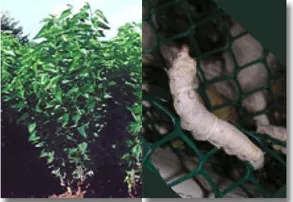
- Family: Bombycidae, Lepidoptera. The most thoroughly domesticated insect after the honeybee -- selectively bred for over 5,000 years; cannot survive in the wild.
- Feeds exclusively on mulberry leaves (Morus alba) -- monophagous. Cultivation of mulberry is called moriculture.
- Accounts for the bulk of world commercial silk -- often, "silk" simply refers to mulberry silk.
- Major Indian states: Karnataka (>40%), Andhra Pradesh, Tamil Nadu, West Bengal, J&K (together = 92% of India's mulberry silk).
- Native to northern China; imported to India centuries ago.
- Five larval instars (four moults -- hence called tetramoulters).
- Optimum growth: 20-28 C, 70-85% RH.
- Female pupa has an 'X' mark on the 8th abdominal segment (used for sex sorting).
- Herold's gland present in females between 8th and 9th segments.
2. Tropical Tasar Silk -- Antheraea mylitta
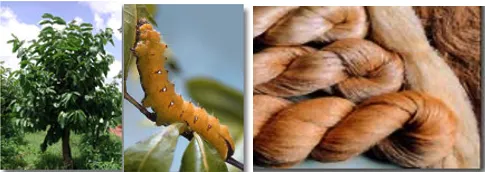
- Family: Saturniidae, Lepidoptera. A wild silkworm reared in open forests on host trees.
- Host plants: Asan (Terminalia tomentosa), Arjun (Terminalia arjuna), Sal (Shorea robusta), Ber (Zizyphus jujuba).
- Bivoltine (two generations per year).
- Produces copper-brown, coarse silk -- used mainly for furnishings and interiors. Less lustrous than mulberry but has its own distinctive appeal. The natural colour comes from tannins in host plant leaves.
- Larva spins a ring-like structure and a peduncle (silk stalk) attaching the cocoon to the twig -- a unique feature.
- Main states: Jharkhand, Chhattisgarh, Odisha, Maharashtra, WB, AP (Central Indian tribal belt / Gondwana region).
- Mainstay livelihood for tribal communities. India is the exclusive producer of tropical tasar globally.
3. Oak Tasar Silk -- Antheraea proylei
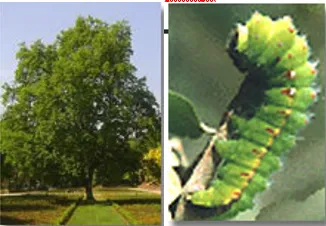
- Family: Saturniidae. A finer variety of tasar feeding on oak trees in the sub-Himalayan belt.
- States: Manipur, Himachal Pradesh, UP, Assam, Meghalaya, J&K.
- China is the world's major producer (from Antheraea pernyi); India is the second-largest producer.
- Also called temperate tasar. Finer and lighter than tropical tasar -- suitable for fashion garments, dress materials, and sarees.
4. Muga Silk -- Antheraea assamensis
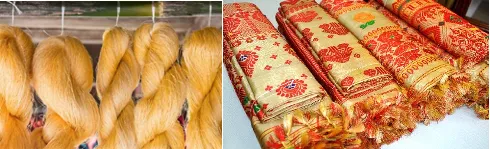
- Family: Saturniidae. A semi-domesticated, multivoltine silkworm (5-6 generations/year; 2-3 crops commercially harvested).
- The unique monopoly of India -- no other country produces muga silk.
- Assam accounts for more than 95% of production.
- Host plants: Som (Machilus bombycina) and Soalu (Litsaea polyantha) -- evergreen trees of the laurel family.
- Produces golden-yellow silk with a natural lustre that improves with each wash (a unique property).
- Commands the highest price among all Indian silks due to rarity and exceptional beauty.
- Deeply embedded in Assamese culture -- the traditional mekhela chador is made of muga silk for festivals and special occasions.
Explore More
5. Eri Silk -- Philosamia ricini
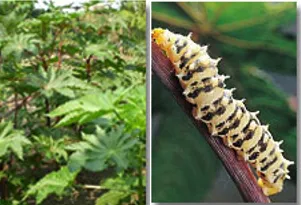
- Family: Saturniidae (not Bombycidae -- this is an exam trap). Multivoltine, domesticated.
- Also known as: Endi, Errandi, or Arandi silk (from Hindi arandi = castor).
- Host plant: Castor leaves (Ricinus communis) and Kesseru (Heteropanax fragrans).
- Non-reelable silk -- the cocoon has an open end, so the moth can emerge without breaking the filament. This is why eri is called "Peace silk" or "Ahimsa silk" (the moth is not killed).
- Since the filament is discontinuous, eri silk is spun (like cotton or wool), giving it a soft, warm, cottony texture.
- In NE India, eri cocoons are produced primarily for their edible pupae (rich in protein) -- silk is the by-product. Dual use (food + fibre) makes eri uniquely valuable.
- Excellent thermal insulation -- ideal for winter shawls and chaddars. Can be blended with cotton, wool, jute, or mulberry silk.
Classification
By Occurrence
| Category | Types | Meaning |
|---|---|---|
| Mulberry silk | Mulberry only | Domesticated (Bombyx mori) |
| Vanya silks (Wild silks) | Tasar, Muga, Eri | From Sanskrit vanya = "of the forest" |
- Vanya sericulture was an exclusive craft of tribal and hill communities in Central and NE India, now gaining national importance due to global demand for eco-friendly, natural textiles.
By Voltinism (Generations per Year)
| Type | Generations/Year | Region | Silk Quality |
|---|---|---|---|
| Univoltine | 1 | Europe, Kashmir, Punjab | Superior quality |
| Bivoltine | 2 | Preferred for commercial sericulture | Good quality |
| Multivoltine | 3+ | South India, Assam, Bengal | Inferior quality |
TIP
Exam Rule: Fewer generations = better quality silk. Univoltine (1 gen) = superior. Multivoltine (3+ gen) = inferior. Remember: "Less is More" for silk quality.
Silkworm Morphology
| Feature | Larva | Adult Moth |
|---|---|---|
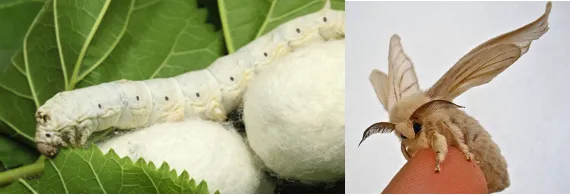
| Mouth parts | Biting and chewing (mandibles for eating leaves) | Siphoning type (vestigial in B. mori -- moth does not feed) |
| Excretory organ | Malpighian tubules (filter waste from haemolymph, like kidneys in vertebrates) | -- |
Summary Table
| Key Fact | Answer |
|---|---|
| Five commercial silks | Mulberry, Tropical Tasar, Oak Tasar, Muga, Eri |
| Only mulberry silkworm family | Bombycidae (all others: Saturniidae) |
| Only monophagous silkworm | Bombyx mori (mulberry only) |
| Only non-reelable silk | Eri (open-ended cocoon, spun not reeled) |
| Peace/Ahimsa silk | Eri |
| Golden silk exclusive to India | Muga (A. assamensis, Assam) |
| Silk city | Bhagalpur, Bihar (Tussar) |
| Vanya silks | Tasar + Muga + Eri |
| Best quality (by voltinism) | Univoltine (1 gen/year) |
| Inferior quality | Multivoltine (3+ gen/year) |
| Philosamia ricini family | Saturniidae (not Bombycidae) |
| Optimum temp for B. mori | 20-28 C, 70-85% RH |
| Female pupa marker | 'X' mark on 8th abdominal segment |
| Excretory organ | Malpighian tubules |
TIP
Quick Exam Recall: Mulberry = Bombycidae, indoor, monophagous. Tasar = Saturniidae, outdoor, wild, peduncle on cocoon. Muga = India-exclusive, golden, Assam. Eri = peace silk, non-reelable, castor-fed, edible pupae. Philosamia ricini = Saturniidae (not Bombycidae -- exam trap!).
References
1 source
References
Quick Comparison: Which Silkworm for Which Region?
AFO advisory guide — recommending the right silkworm:
| If Farmer Is In... | Recommend | Why | Economics |
|---|---|---|---|
| Karnataka, Tamil Nadu, AP (irrigated) | Mulberry (Bombyx mori) | Irrigated mulberry gardens; indoor rearing; highest quality silk | ₹60,000-1L/acre/year; 4-5 crops |
| Jharkhand, Chhattisgarh, MP (forest areas) | Tropical Tasar (Antheraea mylitta) | Wild; feeds on Asan/Arjun trees already in forests; outdoor | ₹15,000-30,000/season; tribal livelihood |
| Manipur, Himachal, Uttarakhand (hilly) | Oak Tasar (A. proylei) | Feeds on oak trees in hills; cooler climate | Emerging sector |
| Assam (exclusively) | Muga (A. assamensis) | India-exclusive; golden silk; feeds on Som/Soalu; GI tag | Premium: ₹3,000-5,000/kg cocoons |
| Assam, NE India, Bihar | Eri (Philosamia ricini) | Feeds on castor; non-killing/peace silk; pupae edible; warmest silk | ₹20,000-40,000/season; dual income (silk + food) |
India is the ONLY country producing all 5 commercial silks. This is a guaranteed exam fact.
Summary Cheat Sheet
| Concept / Topic | Key Details |
|---|---|
| Five commercial silks | Mulberry, Tropical Tasar, Oak Tasar, Muga, Eri |
| Mulberry (Bombyx mori) | Family Bombycidae; monophagous (mulberry only); indoor, fully domesticated |
| Mulberry – key states | Karnataka (>40%), AP, TN, WB, J&K |
| Mulberry – optimum | 20-28 °C, 70-85% RH |
| Female pupa marker | 'X' mark on 8th abdominal segment |
| Tropical Tasar (A. mylitta) | Family Saturniidae; wild, outdoor; bivoltine; copper-brown silk |
| Tasar – host plants | Asan, Arjun, Sal, Ber |
| Tasar – unique feature | Peduncle (silk stalk) attaching cocoon to twig |
| Oak Tasar (A. proylei) | Finer tasar on oak trees; sub-Himalayan belt; temperate tasar |
| Muga (A. assamensis) | Exclusive to India; golden yellow; lustre improves with washing |
| Muga – host plants | Som (Machilus bombycina), Soalu (Litsaea polyantha) |
| Muga – production | Assam accounts for >95%; multivoltine (5-6 gen/yr) |
| Eri (Philosamia ricini) | Family Saturniidae (NOT Bombycidae); peace/Ahimsa silk |
| Eri – host plant | Castor (Ricinus communis), Kesseru |
| Eri – non-reelable | Open-ended cocoon; moth not killed; silk is spun |
| Eri – dual use | Edible pupae (protein-rich) + silk fibre |
| Vanya silks | Tasar + Muga + Eri (Sanskrit vanya = "of the forest") |
| Univoltine (1 gen/yr) | Superior quality silk |
| Multivoltine (3+ gen/yr) | Inferior quality silk |
| Voltinism rule | Fewer generations = better quality ("Less is More") |
| Silk city | Bhagalpur, Bihar (Tussar silk) |
| Larva mouth parts | Biting and chewing (mandibles) |
| Excretory organ | Malpighian tubules |
TIP
Next: Lesson 03 covers the silkworm life cycle -- moulting, silk composition, spinning, diapause, grainage, and harvesting.
In the previous lesson, we introduced sericulture -- its definition, India's global position, and why the silk industry matters for rural livelihoods. Now we examine the five types of silkworms reared in India, each producing a distinct variety of silk.
In Assam, a farmer rears Muga silkworms on Som trees to produce the world-famous golden-yellow silk for traditional mekhela chadors. In Jharkhand, tribal communities rear Tasar silkworms on Sal and Arjun trees in the open forest for the distinctive copper-brown Tussar silk. Meanwhile, in Karnataka, millions of Mulberry silkworms are fed on fresh mulberry leaves indoors, producing over 40% of India's total silk. Each type of silk comes from a different silkworm species with unique biology, host plants, and rearing methods.
This lesson covers:
- Five silkworm types -- Mulberry, Tropical Tasar, Oak Tasar, Muga, Eri
- Host plants, voltinism, and silk characteristics for each
- Classification by occurrence and generations per year
- Silkworm morphology basics
Quick Differentiation Rule
| If exam says... | Most likely answer path |
|---|---|
| Fully domesticated, indoor, mulberry-fed | Bombyx mori (Mulberry silk) |
| Golden natural silk, Assam dominance | Muga |
| Copper-brown wild silk from forest hosts | Tropical Tasar |
| Oak host and finer tasar | Oak Tasar |
| Spun/peace silk, castor host | Eri |
| Common Name | Scientific Name | Origin | Primary Food Plant(s) |
|---|---|---|---|
| Mulberry Silkworm | Bombyx mori | China | Mulberry (Morus indica) |
| Tropical Tasar Silkworm | Antheraea mylitta | India | Sal (Shorea robusta), Asan (Terminalia tomentosa), Arjun (Terminalia arjuna) |
| Oak Tasar Silkworm | Antheraea proylei | India | Oak (Quercus sp.) |
| Muga Silkworm | Antheraea assama | India | Som (Machilus bombycina), Soalu (Litsaea polyantha) |
| Eri Silkworm | Philosamia ricini | India | Castor (Ricinus communis) |
Master Comparison of Five Silkworm Types
| Feature | Mulberry | Tropical Tasar | Oak Tasar | Muga | Eri |
|---|---|---|---|---|---|
| Scientific name | Bombyx mori | Antheraea mylitta | Antheraea proylei | Antheraea assamensis | Philosamia ricini |
| Family | Bombycidae | Saturniidae | Saturniidae | Saturniidae | Saturniidae |
| Silk colour | White/cream | Copper/brown | Finer brown | Golden yellow | White/cream |
| Host plant | Mulberry (Morus alba) | Asan, Arjun, Sal, Ber | Oak | Som, Soalu | Castor (Ricinus communis), Kesseru |
| Feeding | Monophagous | Polyphagous | Polyphagous | Polyphagous | Polyphagous |
| Rearing | Indoor (fully domesticated) | Outdoor (wild, on trees) | Outdoor | Outdoor (semi-domesticated) | Indoor (domesticated) |
| Voltinism | Uni/Bi/Multivoltine | Bivoltine | -- | Multivoltine (5-6 gen/yr) | Multivoltine |
| Main states | Karnataka, AP, TN, WB, J&K | Jharkhand, Chhattisgarh, Odisha | Manipur, HP, J&K, Meghalaya | Assam (>95%) | NE states, Assam, Bihar |
| Reelable? | Yes | Yes | Yes | Yes | No (spun, not reeled) |
| Special feature | Best quality, most produced | Peduncle on cocoon | Finer than tropical tasar | Exclusive to India; lustre improves with washing | Peace silk (moth not killed); pupae eaten as food |
1. Mulberry Silk -- Bombyx mori
- Family: Bombycidae, Lepidoptera. The most thoroughly domesticated insect after the honeybee -- selectively bred for over 5,000 years; cannot survive in the wild.
- Feeds exclusively on mulberry leaves (Morus alba) -- monophagous. Cultivation of mulberry is called moriculture.
- Accounts for the bulk of world commercial silk -- often, "silk" simply refers to mulberry silk.
- Major Indian states: Karnataka (>40%), Andhra Pradesh, Tamil Nadu, West Bengal, J&K (together = 92% of India's mulberry silk).
- Native to northern China; imported to India centuries ago.
- Five larval instars (four moults -- hence called tetramoulters).
- Optimum growth: 20-28 C, 70-85% RH.
- Female pupa has an 'X' mark on the 8th abdominal segment (used for sex sorting).
- Herold's gland present in females between 8th and 9th segments.
2. Tropical Tasar Silk -- Antheraea mylitta
- Family: Saturniidae, Lepidoptera. A wild silkworm reared in open forests on host trees.
- Host plants: Asan (Terminalia tomentosa), Arjun (Terminalia arjuna), Sal (Shorea robusta), Ber (Zizyphus jujuba).
- Bivoltine (two generations per year).
- Produces copper-brown, coarse silk -- used mainly for furnishings and interiors. Less lustrous than mulberry but has its own distinctive appeal. The natural colour comes from tannins in host plant leaves.
- Larva spins a ring-like structure and a peduncle (silk stalk) attaching the cocoon to the twig -- a unique feature.
- Main states: Jharkhand, Chhattisgarh, Odisha, Maharashtra, WB, AP (Central Indian tribal belt / Gondwana region).
- Mainstay livelihood for tribal communities. India is the exclusive producer of tropical tasar globally.
3. Oak Tasar Silk -- Antheraea proylei
- Family: Saturniidae. A finer variety of tasar feeding on oak trees in the sub-Himalayan belt.
- States: Manipur, Himachal Pradesh, UP, Assam, Meghalaya, J&K.
- China is the world's major producer (from Antheraea pernyi); India is the second-largest producer.
- Also called temperate tasar. Finer and lighter than tropical tasar -- suitable for fashion garments, dress materials, and sarees.
4. Muga Silk -- Antheraea assamensis
- Family: Saturniidae. A semi-domesticated, multivoltine silkworm (5-6 generations/year; 2-3 crops commercially harvested).
- The unique monopoly of India -- no other country produces muga silk.
- Assam accounts for more than 95% of production.
- Host plants: Som (Machilus bombycina) and Soalu (Litsaea polyantha) -- evergreen trees of the laurel family.
- Produces golden-yellow silk with a natural lustre that improves with each wash (a unique property).
- Commands the highest price among all Indian silks due to rarity and exceptional beauty.
- Deeply embedded in Assamese culture -- the traditional mekhela chador is made of muga silk for festivals and special occasions.
Explore More
5. Eri Silk -- Philosamia ricini
- Family: Saturniidae (not Bombycidae -- this is an exam trap). Multivoltine, domesticated.
- Also known as: Endi, Errandi, or Arandi silk (from Hindi arandi = castor).
- Host plant: Castor leaves (Ricinus communis) and Kesseru (Heteropanax fragrans).
- Non-reelable silk -- the cocoon has an open end, so the moth can emerge without breaking the filament. This is why eri is called "Peace silk" or "Ahimsa silk" (the moth is not killed).
- Since the filament is discontinuous, eri silk is spun (like cotton or wool), giving it a soft, warm, cottony texture.
- In NE India, eri cocoons are produced primarily for their edible pupae (rich in protein) -- silk is the by-product. Dual use (food + fibre) makes eri uniquely valuable.
- Excellent thermal insulation -- ideal for winter shawls and chaddars. Can be blended with cotton, wool, jute, or mulberry silk.
Classification
By Occurrence
| Category | Types | Meaning |
|---|---|---|
| Mulberry silk | Mulberry only | Domesticated (Bombyx mori) |
| Vanya silks (Wild silks) | Tasar, Muga, Eri | From Sanskrit vanya = "of the forest" |
- Vanya sericulture was an exclusive craft of tribal and hill communities in Central and NE India, now gaining national importance due to global demand for eco-friendly, natural textiles.
By Voltinism (Generations per Year)
| Type | Generations/Year | Region | Silk Quality |
|---|---|---|---|
| Univoltine | 1 | Europe, Kashmir, Punjab | Superior quality |
| Bivoltine | 2 | Preferred for commercial sericulture | Good quality |
| Multivoltine | 3+ | South India, Assam, Bengal | Inferior quality |
TIP
Exam Rule: Fewer generations = better quality silk. Univoltine (1 gen) = superior. Multivoltine (3+ gen) = inferior. Remember: "Less is More" for silk quality.
Silkworm Morphology
| Feature | Larva | Adult Moth |
|---|---|---|
| Mouth parts | Biting and chewing (mandibles for eating leaves) | Siphoning type (vestigial in B. mori -- moth does not feed) |
| Excretory organ | Malpighian tubules (filter waste from haemolymph, like kidneys in vertebrates) | -- |
Summary Table
| Key Fact | Answer |
|---|---|
| Five commercial silks | Mulberry, Tropical Tasar, Oak Tasar, Muga, Eri |
| Only mulberry silkworm family | Bombycidae (all others: Saturniidae) |
| Only monophagous silkworm | Bombyx mori (mulberry only) |
| Only non-reelable silk | Eri (open-ended cocoon, spun not reeled) |
| Peace/Ahimsa silk | Eri |
| Golden silk exclusive to India | Muga (A. assamensis, Assam) |
| Silk city | Bhagalpur, Bihar (Tussar) |
| Vanya silks | Tasar + Muga + Eri |
| Best quality (by voltinism) | Univoltine (1 gen/year) |
| Inferior quality | Multivoltine (3+ gen/year) |
| Philosamia ricini family | Saturniidae (not Bombycidae) |
| Optimum temp for B. mori | 20-28 C, 70-85% RH |
| Female pupa marker | 'X' mark on 8th abdominal segment |
| Excretory organ | Malpighian tubules |
TIP
Quick Exam Recall: Mulberry = Bombycidae, indoor, monophagous. Tasar = Saturniidae, outdoor, wild, peduncle on cocoon. Muga = India-exclusive, golden, Assam. Eri = peace silk, non-reelable, castor-fed, edible pupae. Philosamia ricini = Saturniidae (not Bombycidae -- exam trap!).
References
1 source
References
Quick Comparison: Which Silkworm for Which Region?
AFO advisory guide — recommending the right silkworm:
| If Farmer Is In... | Recommend | Why | Economics |
|---|---|---|---|
| Karnataka, Tamil Nadu, AP (irrigated) | Mulberry (Bombyx mori) | Irrigated mulberry gardens; indoor rearing; highest quality silk | ₹60,000-1L/acre/year; 4-5 crops |
| Jharkhand, Chhattisgarh, MP (forest areas) | Tropical Tasar (Antheraea mylitta) | Wild; feeds on Asan/Arjun trees already in forests; outdoor | ₹15,000-30,000/season; tribal livelihood |
| Manipur, Himachal, Uttarakhand (hilly) | Oak Tasar (A. proylei) | Feeds on oak trees in hills; cooler climate | Emerging sector |
| Assam (exclusively) | Muga (A. assamensis) | India-exclusive; golden silk; feeds on Som/Soalu; GI tag | Premium: ₹3,000-5,000/kg cocoons |
| Assam, NE India, Bihar | Eri (Philosamia ricini) | Feeds on castor; non-killing/peace silk; pupae edible; warmest silk | ₹20,000-40,000/season; dual income (silk + food) |
India is the ONLY country producing all 5 commercial silks. This is a guaranteed exam fact.
Summary Cheat Sheet
| Concept / Topic | Key Details |
|---|---|
| Five commercial silks | Mulberry, Tropical Tasar, Oak Tasar, Muga, Eri |
| Mulberry (Bombyx mori) | Family Bombycidae; monophagous (mulberry only); indoor, fully domesticated |
| Mulberry – key states | Karnataka (>40%), AP, TN, WB, J&K |
| Mulberry – optimum | 20-28 °C, 70-85% RH |
| Female pupa marker | 'X' mark on 8th abdominal segment |
| Tropical Tasar (A. mylitta) | Family Saturniidae; wild, outdoor; bivoltine; copper-brown silk |
| Tasar – host plants | Asan, Arjun, Sal, Ber |
| Tasar – unique feature | Peduncle (silk stalk) attaching cocoon to twig |
| Oak Tasar (A. proylei) | Finer tasar on oak trees; sub-Himalayan belt; temperate tasar |
| Muga (A. assamensis) | Exclusive to India; golden yellow; lustre improves with washing |
| Muga – host plants | Som (Machilus bombycina), Soalu (Litsaea polyantha) |
| Muga – production | Assam accounts for >95%; multivoltine (5-6 gen/yr) |
| Eri (Philosamia ricini) | Family Saturniidae (NOT Bombycidae); peace/Ahimsa silk |
| Eri – host plant | Castor (Ricinus communis), Kesseru |
| Eri – non-reelable | Open-ended cocoon; moth not killed; silk is spun |
| Eri – dual use | Edible pupae (protein-rich) + silk fibre |
| Vanya silks | Tasar + Muga + Eri (Sanskrit vanya = "of the forest") |
| Univoltine (1 gen/yr) | Superior quality silk |
| Multivoltine (3+ gen/yr) | Inferior quality silk |
| Voltinism rule | Fewer generations = better quality ("Less is More") |
| Silk city | Bhagalpur, Bihar (Tussar silk) |
| Larva mouth parts | Biting and chewing (mandibles) |
| Excretory organ | Malpighian tubules |
TIP
Next: Lesson 03 covers the silkworm life cycle -- moulting, silk composition, spinning, diapause, grainage, and harvesting.
Pro Content Locked
Upgrade to Pro to access this lesson and all other premium content.
₹99 charged monthly · Cancel anytime
- All Agriculture & Banking Courses
- AI Lesson Questions (100/day)
- AI Doubt Solver (50/day)
- Glows & Grows Feedback (30/day)
- AI Section Quiz (20/day)
- 22-Language Translation (100/day)
- Recall Questions (20/day)
- AI Quiz (15/day)
- AI Quiz Paper Analysis (100/day)
- AI Step-by-Step Explanations (100/day)
- Spaced Repetition Recall (FSRS)
- AI Tutor
- Immersive Text Questions
- Audio Lessons — Hindi & English
- Mock Tests & Previous Year Papers
- Summary & Mind Maps
- XP, Levels, Leaderboard & Badges
- Generate New Classrooms
- Voice AI Teacher (AgriDots Live)
- AI Revision Assistant
- Knowledge Gap Analysis
- Interactive Revision (LangGraph)
🔒 Secure via Razorpay · Cancel anytime · No hidden fees