🥨 Lac Culture: Status, Strains, Hosts, and Life Cycle
Lac insect biology, Rangeeni and Kusami strains, host plants, crop seasons, and the life cycle of Kerria lacca for competitive exams
Having completed the sericulture sub-section, we now move to the third major beneficial insect industry -- lac culture, the management of lac insects for resin production.
In the tribal belts of Jharkhand, farmers do not need farmland to earn a cash income -- they manage lac insects on Palash and Kusum trees growing naturally in forests and village commons. The tiny lac insect (Kerria lacca) secretes a resinous coating on tree branches that, once harvested and processed, becomes shellac -- a natural product used worldwide in food coatings, pharmaceuticals, cosmetics, and polishes. India produces 70-80% of the world's lac, making lac culture a critical livelihood for millions of tribal families.
What is Lac Culture?
- Lac culture is the scientific management of lac insects on host plants to obtain high-quality lac.
- It involves: selection and maintenance of host plants, inoculation with healthy lac insects, collection, processing, and protection against enemies.
- Lac is a resin (not a gum). Gums are water-soluble polysaccharides; lac resin is composed of polyhydroxy polyester acids -- a unique natural thermoplastic.
- Lac is an important Non-Wood Forest Product (NWFP), ranking among the most commercially valuable alongside tendu leaves, honey, and medicinal plants.
Current Status
| Parameter | Data |
|---|---|
| World's largest producer | India (contributes 70-80% of global supply) |
| Production (2018-19) | 18,944 MT |
| #1 state in India | Jharkhand (largest number of host trees, Chhotanagpur Plateau) |
| Other major states | Chhattisgarh, MP, WB, Maharashtra, Odisha, UP, AP, Gujarat, NE region |
| Cultivated mainly by | Tribal communities and forest dwellers |
Taxonomy of Lac Insect
| Level | Classification |
|---|---|
| Phylum | Arthropoda |
| Class | Insecta |
| Order | Hemiptera (not Homoptera in modern classification) |
| Super family | Coccidae |
| Family | Kerriidae |
| Genus | Laccifer |
| Species | lacca |
- Two genera and 19 species observed in India; commercially important species: Kerria lacca (earlier known as Laccifer lacca).
- First scientific account given by Dr. J. Kerr in 1782.
- Detailed account by Roxburgh (William Roxburgh, "father of Indian botany").
- Lac insects are scale insects within Hemiptera, characterised by a sedentary, sap-sucking lifestyle.
The Two Strains
IMPORTANT
Pro Content Locked
Upgrade to Pro to access this lesson and all other premium content.
₹99 charged monthly · Cancel anytime
- All Agriculture & Banking Courses
- AI Lesson Questions (100/day)
- AI Doubt Solver (50/day)
- Glows & Grows Feedback (30/day)
- AI Section Quiz (20/day)
- 22-Language Translation (100/day)
- Recall Questions (20/day)
- AI Quiz (15/day)
- AI Quiz Paper Analysis (100/day)
- AI Step-by-Step Explanations (100/day)
- Spaced Repetition Recall (FSRS)
- AI Tutor
- Immersive Text Questions
- Audio Lessons — Hindi & English
- Mock Tests & Previous Year Papers
- Summary & Mind Maps
- XP, Levels, Leaderboard & Badges
- Generate New Classrooms
- Voice AI Teacher (AgriDots Live)
- AI Revision Assistant
- Knowledge Gap Analysis
- Interactive Revision (LangGraph)
🔒 Secure via Razorpay · Cancel anytime · No hidden fees
Having completed the sericulture sub-section, we now move to the third major beneficial insect industry -- lac culture, the management of lac insects for resin production.
In the tribal belts of Jharkhand, farmers do not need farmland to earn a cash income -- they manage lac insects on Palash and Kusum trees growing naturally in forests and village commons. The tiny lac insect (Kerria lacca) secretes a resinous coating on tree branches that, once harvested and processed, becomes shellac -- a natural product used worldwide in food coatings, pharmaceuticals, cosmetics, and polishes. India produces 70-80% of the world's lac, making lac culture a critical livelihood for millions of tribal families.
What is Lac Culture?
- Lac culture is the scientific management of lac insects on host plants to obtain high-quality lac.
- It involves: selection and maintenance of host plants, inoculation with healthy lac insects, collection, processing, and protection against enemies.
- Lac is a resin (not a gum). Gums are water-soluble polysaccharides; lac resin is composed of polyhydroxy polyester acids -- a unique natural thermoplastic.
- Lac is an important Non-Wood Forest Product (NWFP), ranking among the most commercially valuable alongside tendu leaves, honey, and medicinal plants.
Current Status
| Parameter | Data |
|---|---|
| World's largest producer | India (contributes 70-80% of global supply) |
| Production (2018-19) | 18,944 MT |
| #1 state in India | Jharkhand (largest number of host trees, Chhotanagpur Plateau) |
| Other major states | Chhattisgarh, MP, WB, Maharashtra, Odisha, UP, AP, Gujarat, NE region |
| Cultivated mainly by | Tribal communities and forest dwellers |
Taxonomy of Lac Insect
| Level | Classification |
|---|---|
| Phylum | Arthropoda |
| Class | Insecta |
| Order | Hemiptera (not Homoptera in modern classification) |
| Super family | Coccidae |
| Family | Kerriidae |
| Genus | Laccifer |
| Species | lacca |
- Two genera and 19 species observed in India; commercially important species: Kerria lacca (earlier known as Laccifer lacca).
- First scientific account given by Dr. J. Kerr in 1782.
- Detailed account by Roxburgh (William Roxburgh, "father of Indian botany").
- Lac insects are scale insects within Hemiptera, characterised by a sedentary, sap-sucking lifestyle.
The Two Strains
IMPORTANT
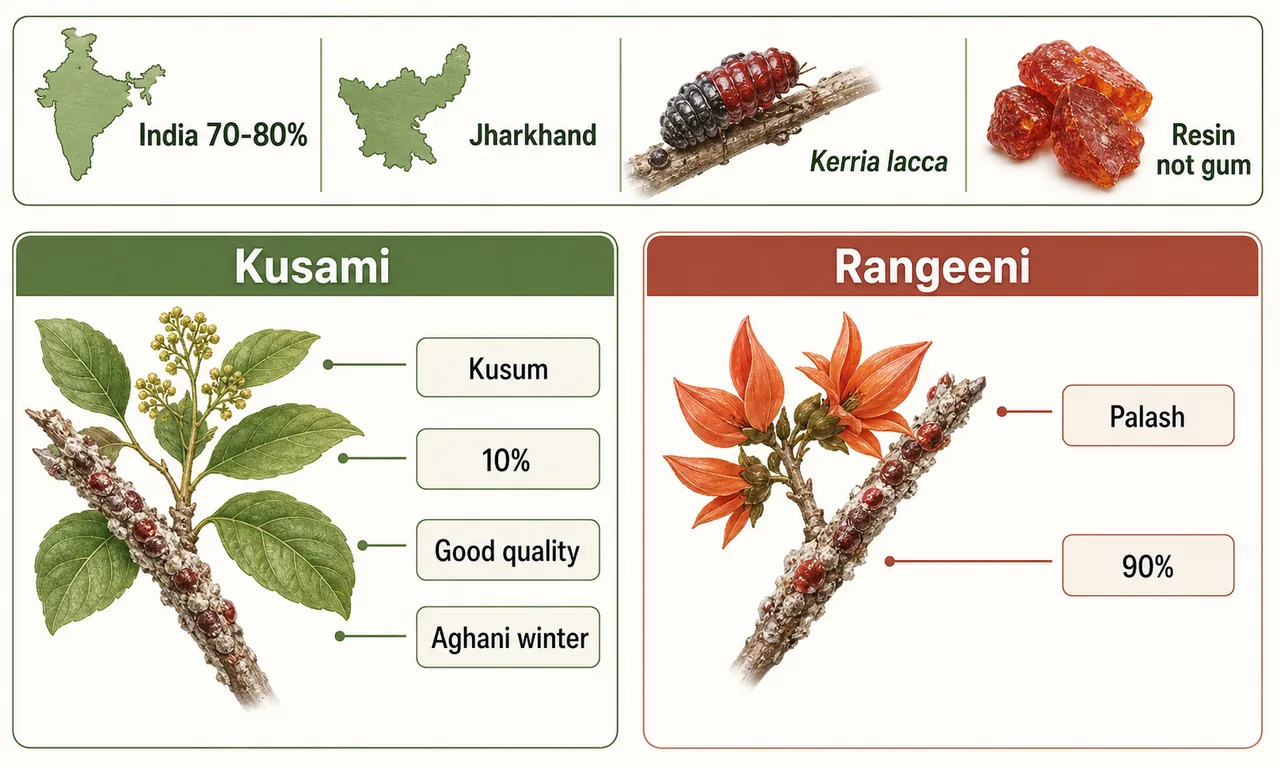
Kusami grows on Kusum (not Palash), produces good quality lac but only 10% of production. Rangeeni grows on Palash (not Kusum), produces 90% of total output. The two strains CANNOT be interchanged between host trees.
| Feature | Kusami | Rangeeni |
|---|---|---|
| Main host plant | Kusum (Schleichera oleosa) | Palash (Butea monosperma), Ber, Acacia spp. |
| NOT suitable for | Palash | Kusum |
| Lac quality | Good (lighter colour resin -- preferred for transparent shellac) | Average (darker resin) |
| Production share | 10% | 90% |
| Crop seasons | Jethwi (summer: Jan-Jun) + Aghani (winter: Jun-Jan) | Baisakhi (summer: harvested Apr-May) + Katki (rainy: harvested Oct-Nov) |
| Generations/year | 2 (bivoltine) | 2 (bivoltine) |
TIP
Exam Mnemonic: "Kusami = Kusum" (both start with K). "Rangeeni = the Rest (Palash, Ber, Acacia)." Kusami = better quality but only 10%.
Crop Calendar
| Strain | Season 1 | Season 2 |
|---|---|---|
| Rangeeni | Baisakhi (summer, harvested Apr-May) | Katki (rainy, harvested Oct-Nov) |
| Kusami | Jethwi (summer, Jan/Feb to Jun/Jul) | Aghani (winter, Jun/Jul to Jan/Feb) |
TIP
Exam Trap: Aghani is the WINTER (not summer) season crop of Kusami. This is commonly tested.
Life Cycle of Lac Insect
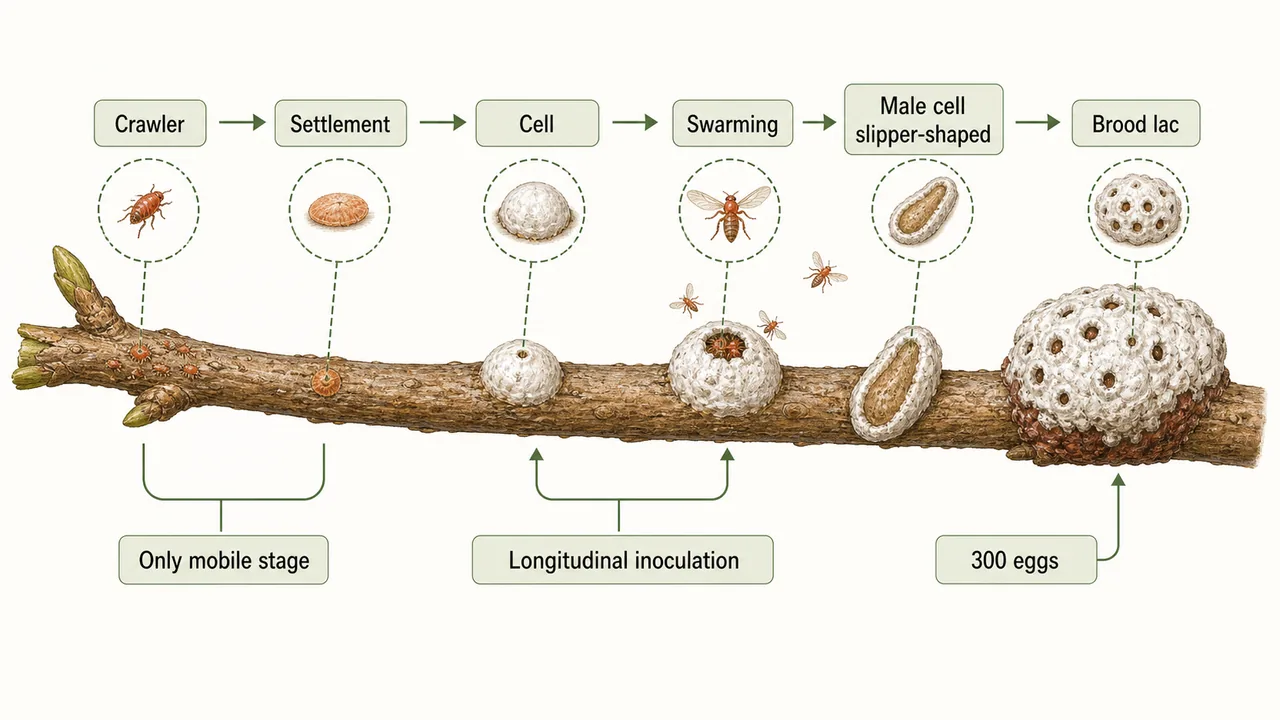
The lac insect passes through 2 generations per year (bivoltine). Females reproduce ovoviviparously (eggs develop and hatch inside the mother, live crawlers emerge directly), laying an average of 300 eggs.
Key Life Cycle Events
| Stage/Event | Description |
|---|---|
| Crawlers | First-instar nymphs -- the only mobile stage. They crawl on branches and fix themselves to the host to feed on phloem sap. |
| Settlement | Crawlers pierce branches with piercing-sucking mouthparts (stylets); seal holes with wax; begin secreting lac resin. |
| Cell | The body of a lac insect covered by lac is called a cell -- a self-contained resin chamber with openings for mouthparts, breathing pores, and anus. |
| Encrustation | Lac secretion from adjacent insects meets and fuses, forming a continuous/semi-continuous resinous coating on the twig. |
| Swarming | Mass emergence of crawlers from brood lac and their dispersal onto new shoots. |
| First moult | Lac insect loses eyes, antennae, and legs -- becomes permanently sessile (immobile). |
| Male cells | Slipper-shaped (elongated); males emerge as short-lived winged adults for mating only. |
| Mature lac | Has a yellow spot on the posterior cell -- indicator of maturity (developing offspring inside). |
Key Terms
| Term | Meaning |
|---|---|
| Brood lac | Host twig bearing lac along with eggs -- the "planting material" of lac culture |
| Inoculation | Tying brood lac sticks onto fresh tender shoots for new colony establishment |
| Longitudinal method | Most common inoculation method -- brood lac tied lengthwise along host branches |
| Phunkai | Spent brood lac sticks after crawler emergence -- still contains valuable resin |
| Dye origin | Red pigment (erythrolaccin) originates in the insect's haemolymph (blood) |
Important Numbers
| Fact | Value |
|---|---|
| Lac resin from insects | 1 kg from 3,00,000 lac insects |
| Optimal temperature | 27-30 C |
| Crawler eggs per female | ~300 (ovoviviparous) |
| Generations per year | 2 (bivoltine) |
- The Hindi word "Lakh" (one hundred thousand) possibly derives from the large number of insects needed to produce lac. The English word "lac" is derived from this Hindi/Sanskrit root.
Summary Table
| Key Fact | Answer |
|---|---|
| Lac is a | Resin (not gum) |
| Lac insect species | Kerria lacca (Hemiptera, Kerriidae) |
| World's largest producer | India (70-80% of global supply) |
| #1 state in India | Jharkhand |
| Two strains | Kusami and Rangeeni |
| Kusami host | Kusum (Schleichera oleosa) |
| Rangeeni host | Palash (Butea monosperma) |
| Kusami quality vs. share | Better quality, only 10% |
| Rangeeni share | 90% |
| Aghani is | Winter crop of Kusami |
| Only mobile stage | Crawlers (1st instar nymphs) |
| Reproduction | Ovoviviparous (~300 eggs) |
| Lost after first moult | Eyes, antennae, legs |
| Male cell shape | Slipper-shaped |
| 1 kg resin from | 3,00,000 lac insects |
| Optimal temp | 27-30 C |
| Brood lac | Twig + lac + eggs (planting material) |
| Common inoculation method | Longitudinal method |
TIP
Quick Exam Recall: Lac = resin (not gum). India = 70-80% global production. Jharkhand = #1 state. Kusami = Kusum = good quality = 10%. Rangeeni = Palash = 90%. Aghani = winter (Kusami). 3 lakh insects = 1 kg lac. Crawlers = only mobile stage. First moult = loses eyes/antennae/legs.
References
1 source
References
Lac Culture Economics and Seasonal Calendar
Why lac culture is ideal for tribal/forest communities:
| Parameter | Detail |
|---|---|
| Investment | Minimal — host trees (Palash, Kusum, Ber) already grow wild |
| Returns | ₹15,000-25,000/acre/year from Palash; higher from Kusum |
| Labour | Low-skill; suitable for women and elderly |
| India's share | 70-80% of global lac production |
| Top state | Jharkhand (followed by Chhattisgarh, MP, West Bengal) |
| Output | 3 lakh insects produce ~1 kg stick lac |
Two crop strains and their seasons:
| Strain | Host Tree | Season | Months | Share |
|---|---|---|---|---|
| Rangeeni | Palash (Butea), Ber | Baisakhi (summer) + Katki (rainy) | Jun-Oct + Oct-Jun | 90% of production |
| Kusami | Kusum (Schleichera) | Aghani (winter) + Jethwi (summer) | Jun-Jan + Jan-Jun | 10% — but higher quality |
Key insight for AFO: Lac is a forest-based livelihood — promoting it aligns with both MGNREGA and tribal welfare schemes. Unlike apiculture, it requires almost no equipment.
Summary Cheat Sheet
| Concept / Topic | Key Details |
|---|---|
| Lac culture definition | Scientific management of lac insects on host plants for high-quality lac |
| Lac is a | Resin (polyhydroxy polyester acids) — NOT a gum |
| World's largest lac producer | India (70-80% of global supply) |
| #1 state in India | Jharkhand (Chhotanagpur Plateau) |
| Lac insect species | Kerria lacca (Order: Hemiptera, Family: Kerriidae) |
| First scientific account | Dr. J. Kerr (1782); detailed by Roxburgh |
| Two strains | Kusami and Rangeeni — cannot be interchanged |
| Kusami host | Kusum (Schleichera oleosa); good quality; 10% production |
| Rangeeni host | Palash (Butea monosperma), Ber, Acacia; 90% production |
| Kusami seasons | Jethwi (summer: Jan-Jun) + Aghani (winter: Jun-Jan) |
| Rangeeni seasons | Baisakhi (summer: Apr-May) + Katki (rainy: Oct-Nov) |
| Aghani is | Winter crop of Kusami (NOT summer) |
| Generations per year | 2 (bivoltine) |
| Reproduction | Ovoviviparous (~300 eggs per female) |
| Crawlers | 1st instar nymphs — only mobile stage |
| After first moult | Loses eyes, antennae, and legs — permanently sessile |
| Male cell shape | Slipper-shaped (elongated) |
| Mature lac indicator | Yellow spot on posterior cell |
| 1 kg lac resin from | 3,00,000 lac insects |
| Optimal temperature | 27-30 °C |
| Brood lac | Twig + lac + eggs — the "planting material" |
| Inoculation method | Longitudinal method (most common) |
| Dye origin | Erythrolaccin from insect haemolymph |
Additional Lac Insect Facts
- Female lac insect is the commercially important sex — females secrete lac resin and are responsible for production; males are short-lived and winged, only for mating
- Rangeeni strain — produces 90% of India's lac output; grows on Palash (Butea monosperma), Ber, and Acacia
- Predators of Kerria lacca:
- Eublemma amabilis (White enemy, Noctuidae) — most destructive predator of lac insects
- Holococera pulverea (Black enemy, Blastobasidae) — second major predator of lac insects
TIP
Next: Lesson 02 covers lac harvesting and processing -- from stick lac to shellac, economic uses, natural enemies, and the NISA research institute.