👀 Insect Sense Organs
Visual organs (compound eyes, ocelli), auditory organs (tympanum, Johnston's organ), chemoreceptors, mechanoreceptors, and thermoreceptors
In the previous lesson, we studied the nervous system -- neurons, impulse conduction, and the CNS-SNS-PNS subdivisions. Now we examine the input side: the sense organs that detect light, sound, chemicals, temperature, and touch.
How does a male silk moth locate a female from 4.5 kilometres away? Through its feathery antennae, which can detect a single molecule of the female's sex pheromone. How does a moth escape a hunting bat? Its tympanal organ detects ultrasonic echolocation calls and triggers evasive flight. Insect sense organs are extraordinarily specialised, and understanding them helps us develop better pest management tools -- from pheromone traps for monitoring moth populations to light traps that exploit phototactic behaviour.
This lesson covers:
- Visual organs -- compound eyes (ommatidia, apposition vs. superposition) and ocelli
- Auditory organs -- tympanum and Johnston's organ
- Chemoreceptors, thermoreceptors, and mechanoreceptors -- smell, taste, temperature, and touch
Insect Physiology -- A Brief Introduction
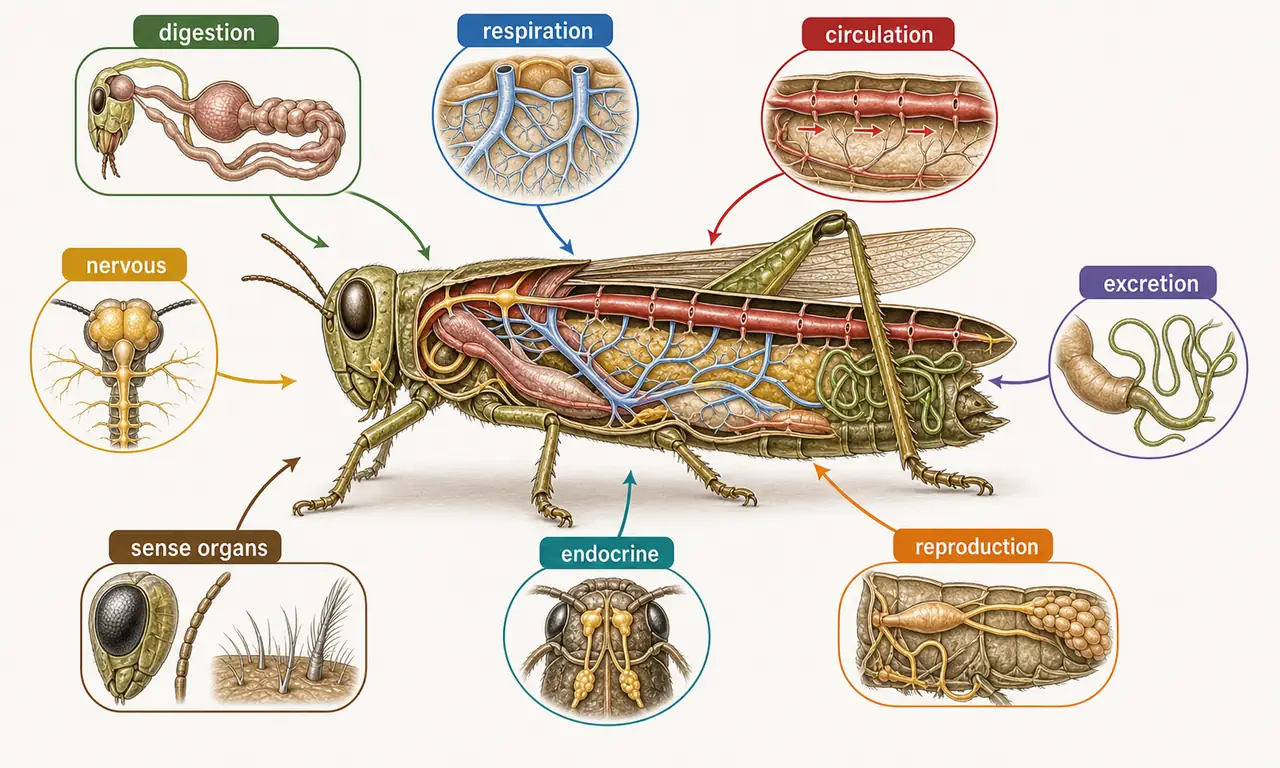
- Insect physiology studies how insect organ systems function, including respiration, digestion, circulation, excretion, nervous coordination, and sensory perception.
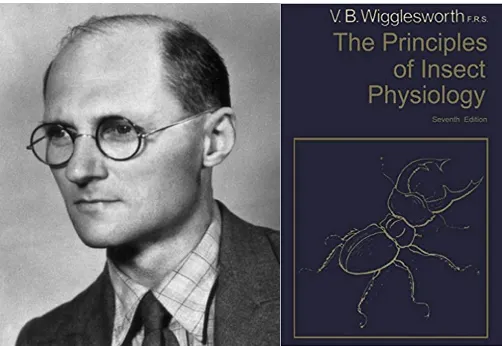
- Father of Insect Physiology: Sir Vincent Brian Wigglesworth (1899--1994). His experiments on Rhodnius prolixus revealed hormonal control of moulting and metamorphosis.
- His classic textbook: "Principles of Insect Physiology" (first published 1939).
Five Types of Sense Organs
Sense organs are distributed across different body parts for maximum environmental awareness.
Pro Content Locked
Upgrade to Pro to access this lesson and all other premium content.
₹99 charged monthly · Cancel anytime
- All Agriculture & Banking Courses
- AI Lesson Questions (100/day)
- AI Doubt Solver (50/day)
- Glows & Grows Feedback (30/day)
- AI Section Quiz (20/day)
- 22-Language Translation (100/day)
- Recall Questions (20/day)
- AI Quiz (15/day)
- AI Quiz Paper Analysis (100/day)
- AI Step-by-Step Explanations (100/day)
- Spaced Repetition Recall (FSRS)
- AI Tutor
- Immersive Text Questions
- Audio Lessons — Hindi & English
- Mock Tests & Previous Year Papers
- Summary & Mind Maps
- XP, Levels, Leaderboard & Badges
- Generate New Classrooms
- Voice AI Teacher (AgriDots Live)
- AI Revision Assistant
- Knowledge Gap Analysis
- Interactive Revision (LangGraph)
🔒 Secure via Razorpay · Cancel anytime · No hidden fees
In the previous lesson, we studied the nervous system -- neurons, impulse conduction, and the CNS-SNS-PNS subdivisions. Now we examine the input side: the sense organs that detect light, sound, chemicals, temperature, and touch.
How does a male silk moth locate a female from 4.5 kilometres away? Through its feathery antennae, which can detect a single molecule of the female's sex pheromone. How does a moth escape a hunting bat? Its tympanal organ detects ultrasonic echolocation calls and triggers evasive flight. Insect sense organs are extraordinarily specialised, and understanding them helps us develop better pest management tools -- from pheromone traps for monitoring moth populations to light traps that exploit phototactic behaviour.
This lesson covers:
- Visual organs -- compound eyes (ommatidia, apposition vs. superposition) and ocelli
- Auditory organs -- tympanum and Johnston's organ
- Chemoreceptors, thermoreceptors, and mechanoreceptors -- smell, taste, temperature, and touch
Insect Physiology -- A Brief Introduction
- Insect physiology studies how insect organ systems function, including respiration, digestion, circulation, excretion, nervous coordination, and sensory perception.
- Father of Insect Physiology: Sir Vincent Brian Wigglesworth (1899--1994). His experiments on Rhodnius prolixus revealed hormonal control of moulting and metamorphosis.
- His classic textbook: "Principles of Insect Physiology" (first published 1939).
Five Types of Sense Organs
Sense organs are distributed across different body parts for maximum environmental awareness.
Smartphone analogy: An insect is equipped with sensors like a modern smartphone -- camera (compound eyes), microphone (tympanal organs), smell sensor (chemoreceptors on antennae), touch screen (mechanoreceptors on body surface), and thermometer (thermoreceptors). The difference? Insect sensors are often far more sensitive than any human technology. A moth's antenna can detect a single pheromone molecule.
| Type | Stimulus Detected | Pest Management Application |
|---|---|---|
| Visual organs (Photoreceptors) | Light | Light traps exploit phototaxis |
| Auditory organs | Sound / vibrations | Ultrasonic deterrents |
| Chemoreceptors | Chemicals (smell and taste) | Pheromone traps, repellents |
| Mechanoreceptors | Touch, pressure, vibration | Sticky traps |
| Thermoreceptors | Temperature | Heat-based disinfestation of stored grain |
1. Visual Organs (Photoreceptors)
I. Compound Eyes
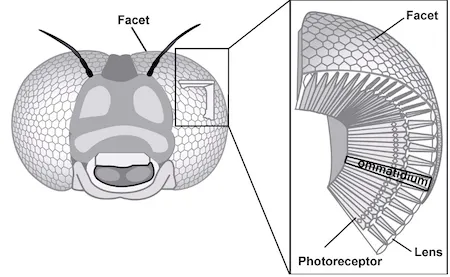
- Present on either side of the head in adults and nymphs of Exopterygota.
- Absent in Protura; reduced in endoparasites and cave-dwellers.
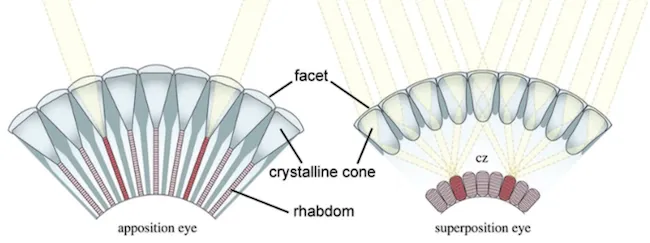
- Composed of individual visual units called ommatidia (singular: ommatidium) -- each with its own lens, photoreceptive cells, and nerve connections.
- Each ommatidium has a hexagonal face called a facet; together they form the compound eye surface (honeycomb pattern).
- Number varies: 1 in worker ant Ponera punctatissima to over 10,000 in dragonflies (aerial predators with nearly 360-degree vision).
Ommatidium Structure
| Part | Components | Function |
|---|---|---|
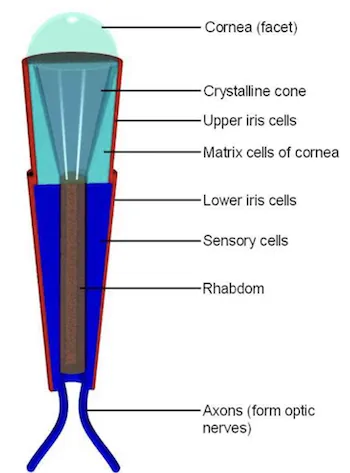
| Optic part (Dioptric apparatus) | Corneal lens (secreted by corneagenous cells) + Crystalline cone + Primary pigment cells | Light gathering and focusing |
| Sensory part | 6--10 retinular cells (covered by secondary pigment cells) secreting a light-sensitive rod (rhabdom) containing rhodopsin (primary visual pigment) | Light detection → nerve impulse |
| Secondary pigment cells | Ring of light-absorbing pigmented cells around each ommatidium | Optical insulation; prevent light leaking between ommatidia |
Rhodopsin is the same type of visual pigment found in vertebrate rod cells. It undergoes chemical change upon absorbing light, triggering the nerve impulse.
Two Types of Ommatidia
| Type | Pigment Cells | Image | Active In | Example |
|---|---|---|---|---|
| Apposition (Light-tight) | Primary pigment cells present → block light between adjacent ommatidia | Distinct mosaic image (each ommatidium sees a tiny portion) | Diurnal (daytime) insects | Butterflies |
| Superposition | Primary pigment cells absent → light passes between adjacent ommatidia | Bright but blurred (wider area focused on fewer rhabdoms) | Nocturnal and crepuscular (twilight) insects | Moths |
Exam trap: "In superposition type, due to presence of primary pigment cells, light cannot enter adjacent cells" is INCORRECT -- superposition type lacks primary pigment cells. That description fits the apposition type.
II. Simple Eyes (Ocelli)
| Type | Found In | Number | Function |
|---|---|---|---|
| Lateral ocelli (Stemmata) | Holometabolous larvae (caterpillars, grubs) | 1--6 per side | Detect form, colour, movement; only visual organs of larvae |
| Dorsal ocelli | Hemimetabolous nymphs and adults | 0--3 | Light-level sensors (not image-forming); maintain diurnal rhythm, stable flight, horizon detection |
2. Auditory Organs
Hearing is critical for mate finding (crickets), predator avoidance (moths detecting bats), and social communication (honeybees).
| Organ | Location | Function | Example |
|---|---|---|---|
| Auditory hairs | Body surface (modified epidermal cells) | Vibrate in response to sound/air currents; trigger nerve impulses | Lepidoptera larvae |
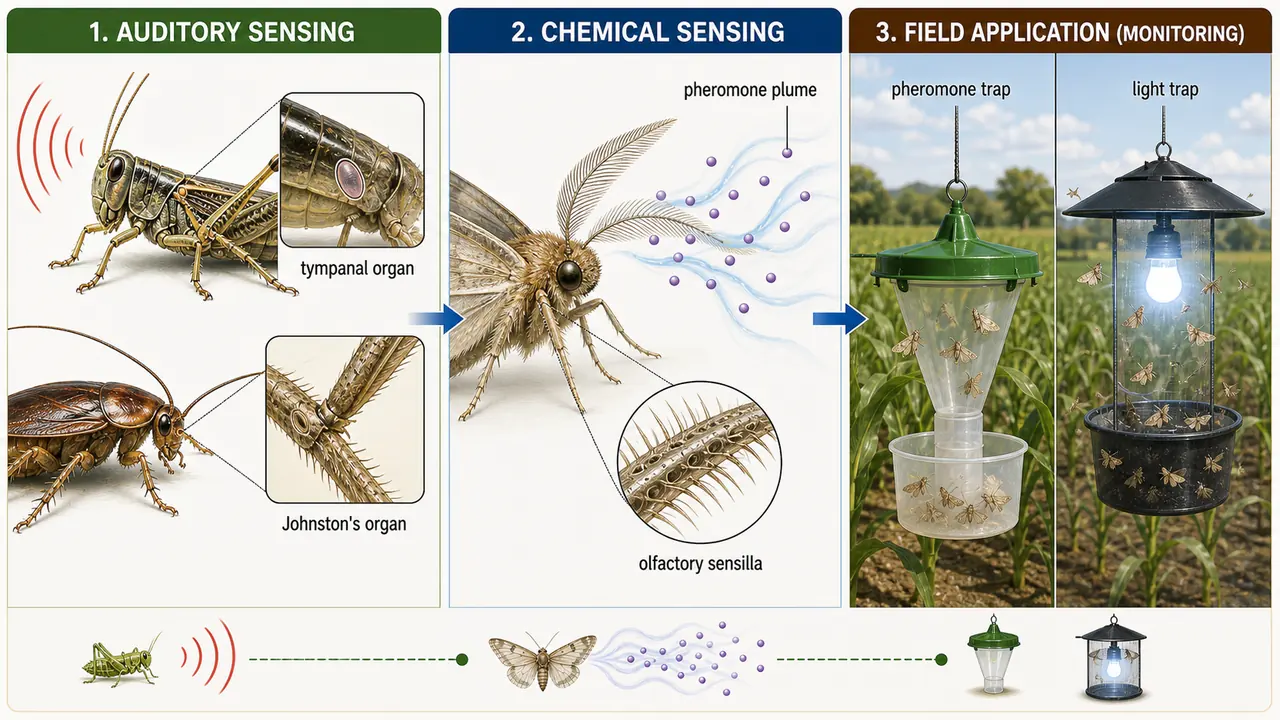
| Tympanal organ | Variable: 1st abdominal segment (short-horned grasshoppers), foretibia base (long-horned grasshoppers, crickets), thorax/abdomen (Lepidoptera) | Tympanal membrane vibrates with sound waves → Muller's organ (chordotonal organ) converts to nerve impulses | Grasshopper, cricket, moths |
| Johnston's organ | Pedicel (2nd antennal segment) | Detects air/water currents; in male mosquitoes, tuned to female wing-beat frequency for mate location | Male mosquito, water strider |
| Pilifer (Sphingid moths) | Head | Detects ultrasonic frequencies | Hawk moths (detects bat echolocation calls → evasive flight) |
Agricultural application: Understanding pest communication through sound has led to acoustic monitoring techniques and mating disruption strategies in some crop systems.
3. Chemoreceptors (Smell and Taste)
| Type | Pore Structure | Stimulus Form | Sense | Location | Example Application |
|---|---|---|---|---|---|
| Gustatory (Taste) | Uniporous (single pore) | Solid/liquid (contact required) | Taste | Mouthparts, tarsi (feet) -- houseflies "taste" food by walking on it | -- |
| Olfactory (Smell) | Multiporous (many pores) | Vapour (at a distance) | Smell | Primarily antennae | Pheromone traps exploit olfactory sensitivity; male moths detect female pheromone from km away |
Agricultural tool: Sex pheromone traps use synthetic female pheromones to attract male moths (e.g., Helicoverpa armigera in cotton/chickpea). The principle exploits the male's olfactory receptors on antennae.
4. Thermoreceptors
- Detect temperature changes in the environment.
- Found in poikilothermic (cold-blooded) insects whose body temperature fluctuates with the environment.
- Bed bugs use thermoreceptors to locate sleeping human hosts by detecting the temperature gradient of body warmth -- even in complete darkness.
5. Mechanoreceptors (Touch, Pressure, Vibration)
| Type | Structure | Stimulus | Location | Key Function |
|---|---|---|---|---|
| Trichoid sensilla | Hair-like; sense cell with seta | Touch | Antennae, mouthparts | Most common and widespread mechanoreceptor |
| Campaniform sensilla (Dome sensilla) | Rod-like end inserted into dome-shaped cuticle | Strain/Pressure | Leg joints, wing bases | Detect wing loading during flight; enable real-time flight adjustments |
| Chordotonal organ | Internal; one-to-many scolopidia (cap cell + scolopale cell + dendrite) | Vibration | Throughout body; attached to body wall at both ends | Detect substrate vibrations, body position (proprioception); form part of tympanal organs for hearing |
The scolopidium is the fundamental sensory unit of chordotonal organs -- a nerve cell enclosed in a specialised capsule (scolopale) that amplifies vibrations.
Comparison of Sense Organ Types
| Sense Organ | Stimulus | Key Structure | Agricultural Relevance |
|---|---|---|---|
| Compound eyes | Light | Ommatidia with rhodopsin | Light traps exploit phototaxis |
| Tympanal organ | Sound | Tympanal membrane + Muller's organ | Acoustic monitoring |
| Johnston's organ | Air/water currents | Chordotonal organ on pedicel | Mate-finding in mosquitoes |
| Olfactory receptors | Volatile chemicals | Multiporous sensilla on antennae | Pheromone traps for pest monitoring |
| Gustatory receptors | Contact chemicals | Uniporous sensilla on tarsi/mouthparts | Host plant selection by pests |
| Thermoreceptors | Temperature | Specialised sensilla | Host-finding (bed bugs) |
| Campaniform sensilla | Mechanical strain | Dome-shaped cuticular sensors | Flight control |
Chemical Communication and Behaviour
| Term | Definition | Example |
|---|---|---|
| Releaser pheromone | Triggers an immediate behavioural response | Sex pheromones of moths — male immediately flies toward female |
| Allelochemicals | Inter-specific semiochemicals — chemical signals between different species | Kairomones, allomones, synomones |
| Apneumone | Substance secreted by dead bodies or non-living material that influences insect behaviour | Volatiles from decomposing matter attracting carrion beetles |
| Trophallaxis | Mutual exchange of food (mouth-to-mouth or anus-to-mouth) among social insects | Ants and termites — cement colony cohesion |
TIP
"Allo = Another species" — Allelochemicals are inter-specific (between different species). Pheromones are intra-specific (same species). This distinction is a frequent MCQ trap.
- Phoresy between ants and aphids = Symbiosis: ants carry aphids to new plants and protect them; ants harvest honeydew from aphids in return.
- Cannibalism is common in Helicoverpa armigera (cotton bollworm/gram pod borer) — larvae consume each other when crowded, which is actually a natural population regulatory mechanism.
- Mole cricket produces sound (churring call) at night by stridulation — used for mate attraction.
- Silverfish (Lepisma saccharina) = nocturnal; order Thysanura.
Exam Tips
Apposition type = diurnal (butterflies). Primary pigment cells present; distinct image. Superposition type = nocturnal (moths). Primary pigment cells absent; bright but blurred.
"In superposition type, primary pigment cells prevent light entering adjacent cells" is INCORRECT. This describes the apposition type.
Visual organs of nymph = DORSAL OCELLI (not lateral). Lateral ocelli (stemmata) are for holometabolous larvae.
Rhodopsin = primary visual pigment in compound eyes. Same as in vertebrate rods.
Johnston's organ on pedicel (2nd antennal segment). In male mosquitoes specifically.
Father of Insect Physiology = V.B. Wigglesworth. Book = "Principles of Insect Physiology."
Gustatory receptors on tarsi -- houseflies taste food by walking on it!
Summary Cheat Sheet
| Concept | Key Detail |
|---|---|
| Compound eyes | Ommatidia with facets; rhodopsin in rhabdom |
| Apposition type | Diurnal; primary pigment present; distinct mosaic image; butterflies |
| Superposition type | Nocturnal; primary pigment absent; bright but blurred; moths |
| Stemmata (lateral ocelli) | Visual organs of holometabolous larvae |
| Dorsal ocelli | Light-level sensors; nymphs and adults; 0--3 |
| Tympanal organ | Sound detection; variable location by order |
| Johnston's organ | Pedicel (2nd antennal segment); hearing/balance; male mosquitoes |
| Pilifer | Hawk moths; detect bat ultrasound |
| Gustatory (taste) | Uniporous; contact; mouthparts + tarsi |
| Olfactory (smell) | Multiporous; distance; antennae |
| Thermoreceptors | Temperature; bed bugs find hosts |
| Trichoid sensilla | Touch; most common mechanoreceptor |
| Campaniform sensilla | Strain/pressure; wing bases, leg joints |
| Chordotonal organ | Vibration; scolopidia; proprioception |
| Father of Insect Physiology | V.B. Wigglesworth |
TIP
Next: The next lesson covers the reproductive system -- the anatomy and seven types of reproduction that drive insect population dynamics.
References
1 source
References
Lesson Doubts
Ask questions, get expert answers