🧚🏻 Insect Dominance -- Why Insects Rule the Animal Kingdom
Measures of insect dominance, structural perfections, developmental characters, and protective adaptations that make insects the most successful animals on Earth
Throughout this course, we have studied insect morphology (exoskeleton, head, mouthparts, legs, wings, abdomen) and physiology (digestion, excretion, respiration, circulation, nerves, senses, reproduction, hormones, metamorphosis). This final lesson asks: why have insects become the most successful animals on Earth? The answer draws on everything we have learned.
In 2020, India faced devastating desert locust swarms -- a single swarm containing over a billion individuals destroyed crops across Rajasthan, Gujarat, and Madhya Pradesh. How can any single group of animals produce numbers so staggering? The answer lies in a suite of structural, developmental, and behavioural advantages that make insects the most dominant animals on Earth. Understanding these factors of dominance also explains why insect pests are so difficult to control.
This lesson covers:
- Measures of dominance -- species diversity, population size, habitat range, geological persistence
- Structural perfections -- 11 morphological advantages from exoskeleton to excretion
- Developmental and protective adaptations -- metamorphosis, reproductive strategies, and defence mechanisms
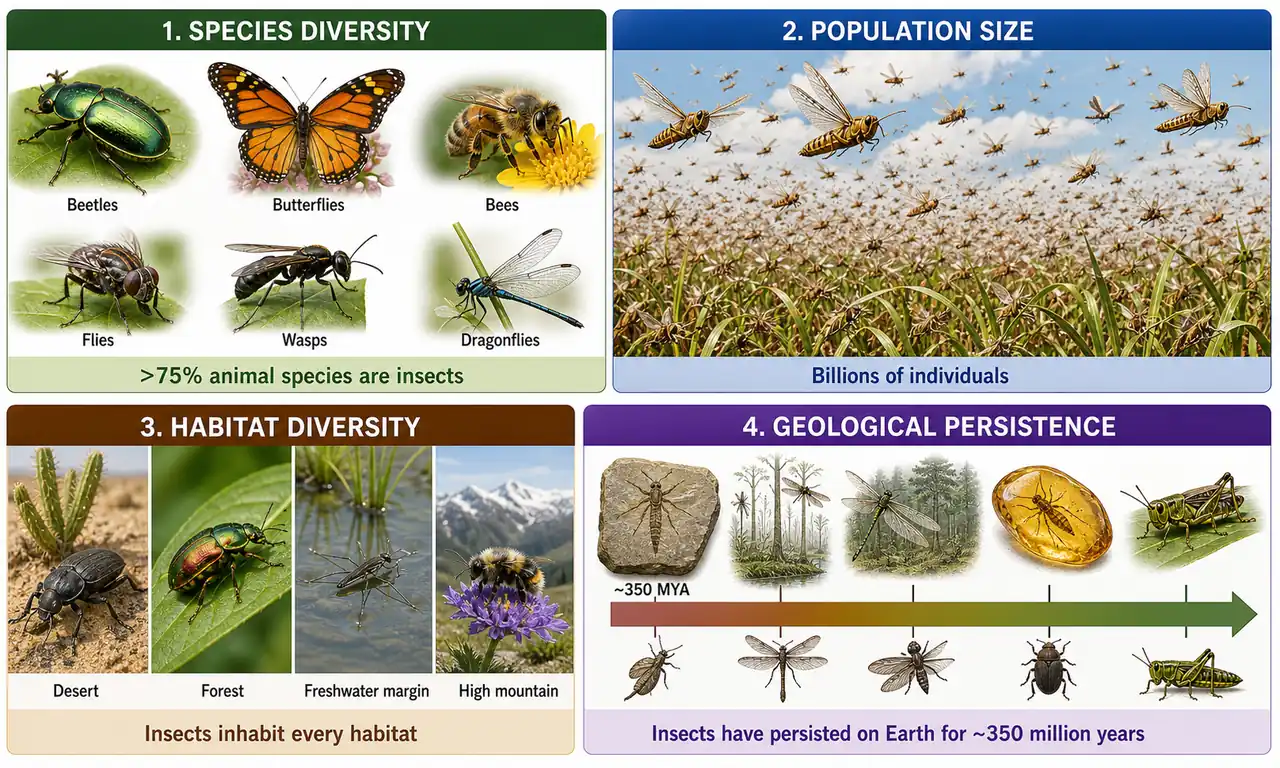
Measures of Dominance
| Measure | Evidence |
|---|---|
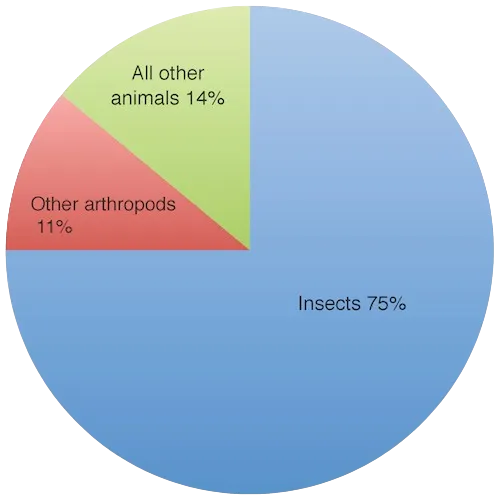
| Species diversity | Over 75% of all animal species are insects; 9--15 lakh species described. Most diverse order: Coleoptera (beetles), followed by Lepidoptera, Hymenoptera, and Diptera. J.B.S. Haldane reportedly quipped that God has "an inordinate fondness for beetles." |
| Population size | A single locust swarm can comprise 10^9 individuals and consume food equivalent to millions of people per day |
| Habitat diversity | From arctic tundra to tropical rainforests, mountain peaks to underground caves, even hot springs and petroleum pools |
| Geological persistence | Present on Earth for over 350 million years (since the Devonian period); survived multiple mass extinctions including the one that wiped out dinosaurs |
Three Categories of Factors Behind Insect Success
I. Structural Perfections
1. Exoskeleton
- Made of chitin -- light in weight yet providing strength, rigidity, and flexibility.
- Chitin is a long-chain polymer of N-acetylglucosamine -- remarkably strong for its weight, similar to what bones do in vertebrates.
- Functions: Protection from desiccation, physical injuries, maintaining body shape, muscle attachment, strengthening appendages.
2. Resistance to Desiccation
Insects minimise water loss through two strategies:
| Strategy | Mechanisms |
|---|---|
| Prevention of water loss | Lipids and polyphenols in epicuticle act as waterproofing; wax layer (< 1 micrometre) forms a hydrophobic barrier; spiracles close to prevent water loss; egg shell protects embryos |
| Conservation of water | Utilise metabolic water (from cellular respiration -- flour beetles derive all water this way); rectal reabsorption of water from faeces; excrete uric acid (water-insoluble) rather than urea |
3. Small Size
Most insects are small, conferring major advantages:
| Advantage | Explanation |
|---|---|
| Exploit different ecological niches | A single grain of wheat can be an entire habitat |
| Less space, food, time, and energy needed | Faster development and sustenance |
| Maximum energy utilisation | High metabolic efficiency |
| Less gravitational effect | Can walk on walls and ceilings |
| Effective muscular action and tracheal respiration | Direct oxygen delivery to tissues |
| Easy escape from enemies | Small targets are harder to catch |
4. Quicker Speciation
- Hard exoskeleton + small size + short life cycle = faster species formation.
- Short generation times (often weeks, not years) mean natural selection acts more rapidly, accelerating evolutionary adaptation.
5. Functional Wings
- Insects are the earliest animals and the only flying invertebrates -- flight evolved ~350 million years ago, at least 150 million years before any other animal.
- Two pairs of wings on meso- and metathoracic segments enable:
- Seeking food, mates, shelter, oviposition sites
- Colonising new habitats
- Escaping enemies
- Long-distance migration (e.g., locusts)
6. Hexapod Locomotion (Tripod Gait)
- Six legs on three thoracic segments provide stability even if a pair is lost.
- Insects use 3 legs at a time during locomotion (one side: 2 legs, other side: 1 leg), forming a stable triangle of support -- called the tripod gait.
7. Compound Eyes
- Many hexagonal units called ommatidia provide a wide field of view (nearly 360 degrees in some species) and excellent motion detection.
- Built-in redundancy: even if some ommatidia are damaged, vision is not lost.
8. Scattered Sense Organs
- Visual, gustatory, and tactile organs distributed across head (antennae, eyes, mouthparts), thorax (legs with claws), and abdomen (tympanum, cerci).
- This distribution prevents all sense organs from being damaged at once.
9. Decentralised Nervous System
- Each ganglion in the ventral nerve cord functions semi-independently.
- A cockroach can continue running even after its head is removed because thoracic ganglia independently control leg movements.
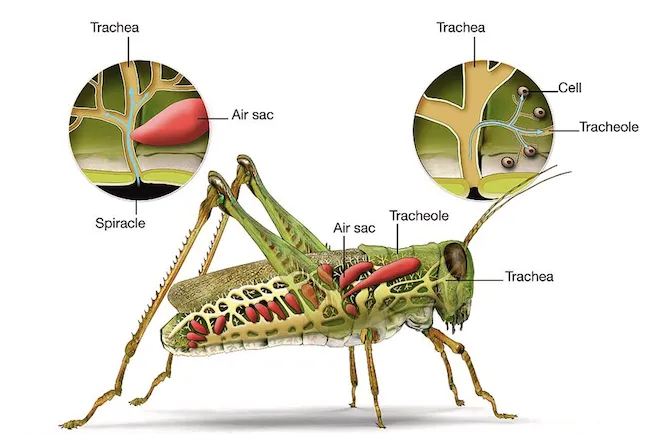
10. Tracheal Respiration
- Thin elastic air tubes (tracheae) open through spiracles on the body surface.
- Delivers oxygen directly to tissues without relying on blood -- far more efficient than circulatory-based oxygen transport in vertebrates.
- Spiracles have closing mechanisms to admit air while restricting water loss.
11. Enteronephric Excretion
- Malpighian tubules open between midgut and hindgut.
- This arrangement allows the hindgut to reclaim water from both faecal and urinary waste before expulsion.
- The term enteronephric means excretory system opens into the gut (entero = intestine, nephric = kidney).
II. Developmental Characters
| Factor | Details | Agricultural Impact |
|---|---|---|
| High fecundity | E.g., queen termite lays 6,000--7,000 eggs/day for 15 years | Rapid population build-up of pests |
| Multiple reproduction methods | Sexual + parthenogenesis (without fertilisation, e.g., aphids) | Aphid populations explode without needing mates |
| Special reproduction types | Polyembryony (many individuals from one egg, e.g., parasitic wasps); Paedogenesis (reproduction by immature stages, e.g., certain flies) | Parasitoid wasps multiply rapidly inside pest hosts |
| Controlled reproduction | In social insects (honeybees, termites), queen pheromones suppress worker reproduction | Colony organisation ensures survival |
| Short life cycle | Corn aphid: 16 nymphs/female, adulthood in 16 days | Faster development of insecticide-resistant strains |
| Parental care | Progressive provisioning (bees), mass provisioning (wasps) | Ensures offspring survival |
| Careful egg selection | Precise oviposition site selection and egg protection | Eggs placed where food is guaranteed |
| Food specificity (niche partitioning) | Different species prefer different food types, reducing interspecific competition | Many pest species can coexist on different parts of same crop |
| Zenith of evolution | Division of labour, polymorphism in social insects | Organised colonies are harder to control |
| Complete metamorphosis | 82% of insects; larva and adult exploit different ecological niches and food sources, effectively doubling the range of environments used | Larval and adult pests may damage different crop parts |
Locust Phase Theory and Population Dynamics
- Phase theory of locust (solitary vs. gregarious phases) was proposed by Uvarov (1921).
- In the solitary phase, locusts are green/cryptic and non-migratory; when crowded, they switch to the gregarious phase — darker coloured, form swarms, and migrate.
- Immigration = inward movement of individuals into an area.
- Emigration = outward movement of individuals from an area.
Ecological Relationships
| Relationship | Description | Example |
|---|---|---|
| Commensalism | One organism benefits; the other is unharmed (neither helped nor harmed) | Certain mites carried on beetles for dispersal |
| Symbiosis (Mutualism) | Both partners benefit | Ants + aphids — ants protect aphids, harvest honeydew |
| Hyper parasitism | A parasitoid attacking another parasitoid (secondary parasitism) | Hyperparasitoid wasps attacking Trichogramma or Cotesia |
III. Protective Adaptations
| Adaptation Type | Mechanism | Example |
|---|---|---|
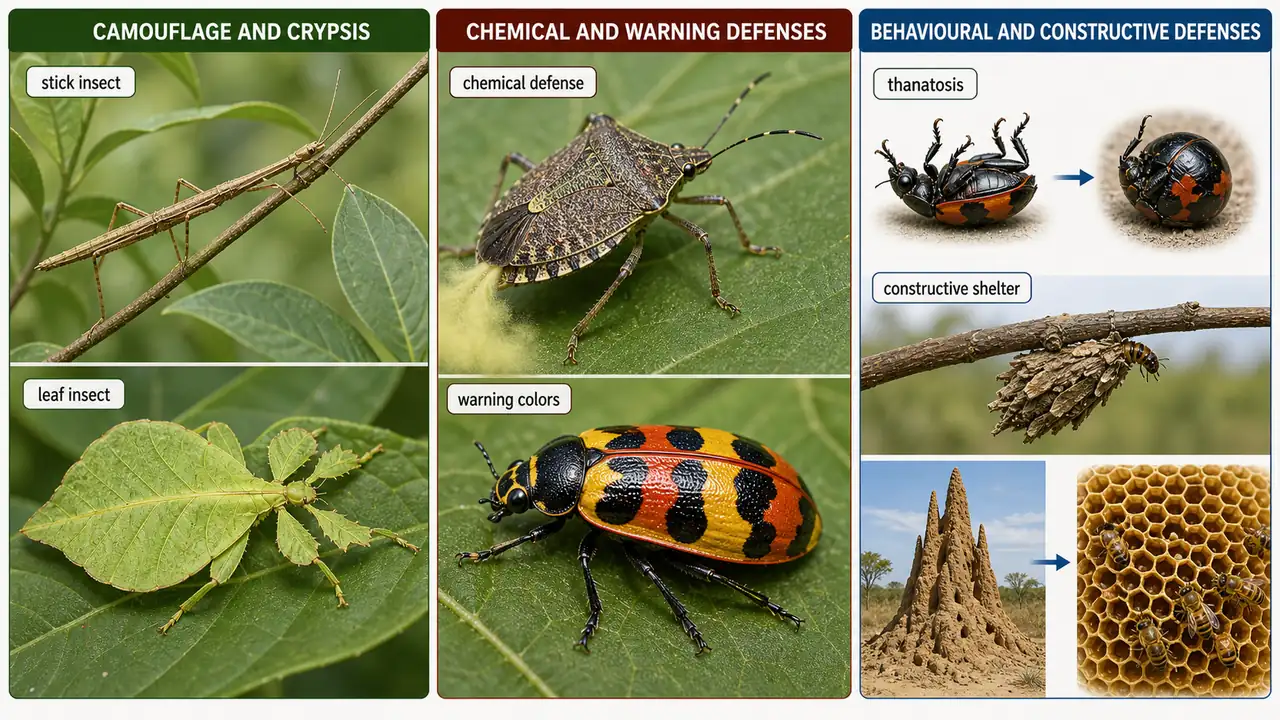
| Morphological (Crypsis/Camouflage) | Body colour and shape mimic surroundings | Stick insects, leaf insects |
| Physiological | Produce/release poisonous or unpleasant substances; warning colouration | Stink bugs (foul hydrocarbons), swallowtail larvae (osmeteria release repellents), blister beetles (cantharidin) |
| Behavioural | Feigning death (thanatosis); mimicry; imitating dangerous insects | Some beetles pretend dead; predators ignore motionless prey |
| Structural | Hardened body parts for physical protection | Beetle elytra protect from bird predation |
| Colourational | Protective colours blend with environment | Stick insects |
| Chemical | Defensive chemicals for deterrence | Bee venom |
| Constructive | Building protective shelters | Cases/bags (bagworms), termitaria (termites -- with ventilation systems), honeycomb (most materially efficient structure in nature) |
Comparison: Structural vs. Developmental vs. Protective Factors
| Category | Focus | Examples |
|---|---|---|
| Structural | Body design advantages | Exoskeleton, flight, tracheal system, compound eyes |
| Developmental | Reproductive and growth advantages | High fecundity, parthenogenesis, complete metamorphosis |
| Protective | Defence against enemies and environment | Camouflage, chemical defence, thanatosis, shelter construction |
Exam Tips
Most species-rich order: Coleoptera (beetles) -- then Lepidoptera, Hymenoptera, Diptera. Remember: "CLHD" in decreasing diversity.
Tripod gait: Insects walk on 3 legs at a time forming a triangle. Unique to hexapods.
82% rule: Over 82% of insects undergo complete metamorphosis (holometabola). A commonly tested statistic.
Enteronephric = excretory system opens into gut. This is a water-conservation adaptation. Remember: "Enteronephric = Entero (gut) + nephric (kidney)."
Queen termite fecundity: 6,000--7,000 eggs/day for 15 years. The most extreme fecundity example in exams.
Summary Cheat Sheet
| Concept | Key Detail |
|---|---|
| Species percentage | >75% of all animal species are insects |
| Most diverse order | Coleoptera (beetles) |
| Geological age | >350 million years (Devonian period) |
| Exoskeleton material | Chitin (N-acetylglucosamine polymer) |
| Waterproofing layer | Epicuticular wax layer |
| Excretory product | Uric acid (water-insoluble -- conserves water) |
| Enteronephric excretion | Malpighian tubules open between midgut and hindgut |
| Tripod gait | 3 legs move at a time; triangle of support |
| Tracheal system | Direct oxygen delivery to tissues via spiracles |
| Flight evolution | ~350 MYA; only flying invertebrates |
| Complete metamorphosis | >82% of insects; larva ≠ adult niche |
| Parthenogenesis | Reproduction without males (aphids) |
| Polyembryony | Many individuals from one egg (parasitic wasps) |
| Thanatosis | Death feigning (some beetles) |
| Physogastry | Queen termite abdominal swelling (6,000--7,000 eggs/day) |
References
1 source
References
Lesson Doubts
Ask questions, get expert answers