🎲 Classification of Nematodes
Taxonomic classification (Secernentea vs Adenophorea) and feeding-habit-based classification (ecto, semi-endo, and endoparasites)
In the previous lesson, we covered physiology -- reproduction, excretion, and the nervous system. Now we organise the diversity of nematodes into a coherent framework using two classification systems.
Walk through any Indian agricultural field -- tomato, wheat, banana, or citrus -- and you will find different nematode species attacking different parts of the plant in different ways. Some feed from outside the root, others burrow deep inside, and a few even parasitise leaves and seeds.
Why classification matters for control: Knowing whether a nematode is an ectoparasite (feeds from outside the root) or endoparasite (enters and lives inside) directly determines your control strategy. Contact nematicides work against ectoparasites (exposed in soil), but endoparasites are protected inside root tissue — you need systemic nematicides or resistant varieties.
Analogy: Think of ectoparasites as mosquitoes (bite from outside, repellents work), semi-endoparasites as ticks (partially embedded, harder to remove), and endoparasites as intestinal worms (fully inside, need systemic medicine).
Pro Content Locked
Upgrade to Pro to access this lesson and all other premium content.
₹99 charged monthly · Cancel anytime
- All Agriculture & Banking Courses
- AI Lesson Questions (100/day)
- AI Doubt Solver (50/day)
- Glows & Grows Feedback (30/day)
- AI Section Quiz (20/day)
- 22-Language Translation (100/day)
- Recall Questions (20/day)
- AI Quiz (15/day)
- AI Quiz Paper Analysis (100/day)
- AI Step-by-Step Explanations (100/day)
- Spaced Repetition Recall (FSRS)
- AI Tutor
- Immersive Text Questions
- Audio Lessons — Hindi & English
- Mock Tests & Previous Year Papers
- Summary & Mind Maps
- XP, Levels, Leaderboard & Badges
- Generate New Classrooms
- Voice AI Teacher (AgriDots Live)
- AI Revision Assistant
- Knowledge Gap Analysis
- Interactive Revision (LangGraph)
🔒 Secure via Razorpay · Cancel anytime · No hidden fees
In the previous lesson, we covered physiology -- reproduction, excretion, and the nervous system. Now we organise the diversity of nematodes into a coherent framework using two classification systems.
Walk through any Indian agricultural field -- tomato, wheat, banana, or citrus -- and you will find different nematode species attacking different parts of the plant in different ways. Some feed from outside the root, others burrow deep inside, and a few even parasitise leaves and seeds.
Why classification matters for control: Knowing whether a nematode is an ectoparasite (feeds from outside the root) or endoparasite (enters and lives inside) directly determines your control strategy. Contact nematicides work against ectoparasites (exposed in soil), but endoparasites are protected inside root tissue — you need systemic nematicides or resistant varieties.
Analogy: Think of ectoparasites as mosquitoes (bite from outside, repellents work), semi-endoparasites as ticks (partially embedded, harder to remove), and endoparasites as intestinal worms (fully inside, need systemic medicine).
This lesson covers:
- Taxonomic classification -- Phylum Nematoda split into Secernentea and Adenophorea, with key orders and families
- Feeding-habit classification -- above-ground vs below-ground feeders, ecto/semi-endo/endoparasites
Part 1: Taxonomic Classification
Nematodes belong to Kingdom Animalia, Phylum Nematoda. The taxonomic framework groups nematodes by evolutionary relationships, while the feeding-habit system (Part 2) groups them by practical, field-relevant behaviour.
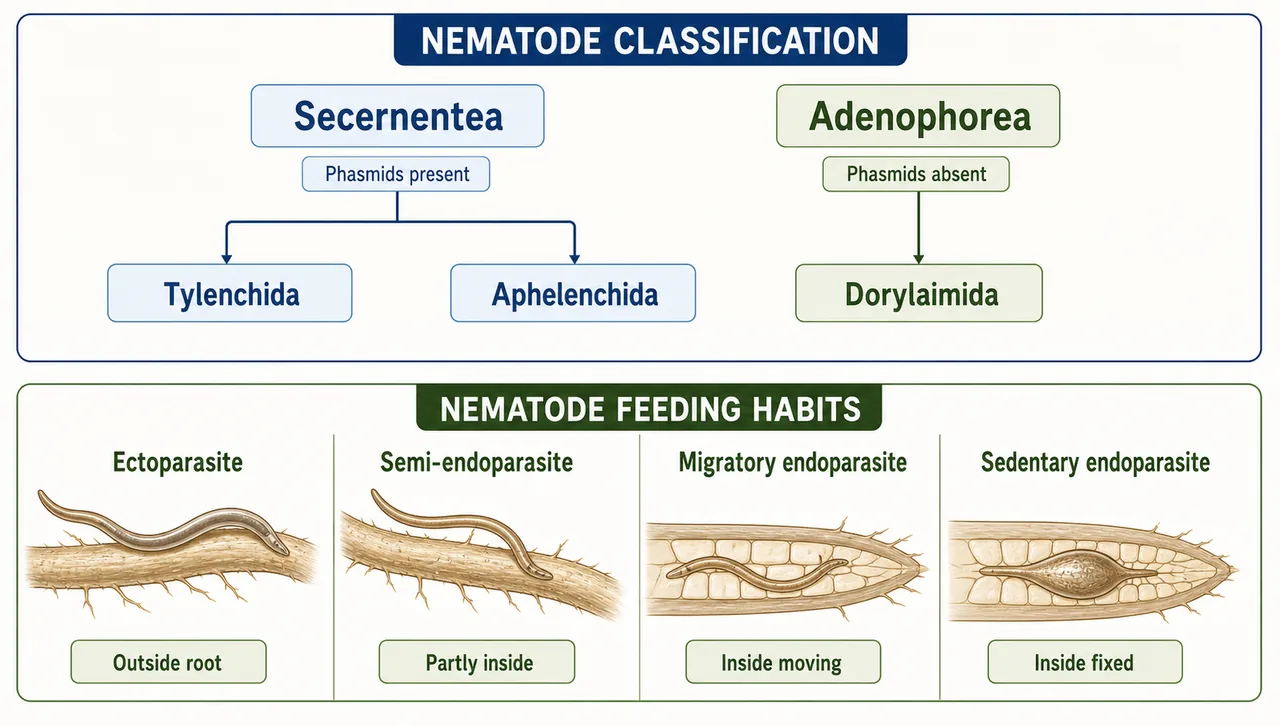
| Rank | Classification |
|---|---|
| Kingdom | Animalia |
| Division | Bilateralia |
| Phylum | Nematoda |
| Class | 1. Secernentea |
| 2. Adenophorea |
The phylum is divided into two classes:
| Feature | Class Secernentea (Phasmida) | Class Adenophorea (Aphasmida) |
|---|---|---|
| Phasmids | Present | Absent |
| Caudal glands | Absent | Present |
| PPN orders | Tylenchida, Aphelenchida | Dorylaimida |
| % of PPNs | >90% | <10% (but includes all virus vectors) |
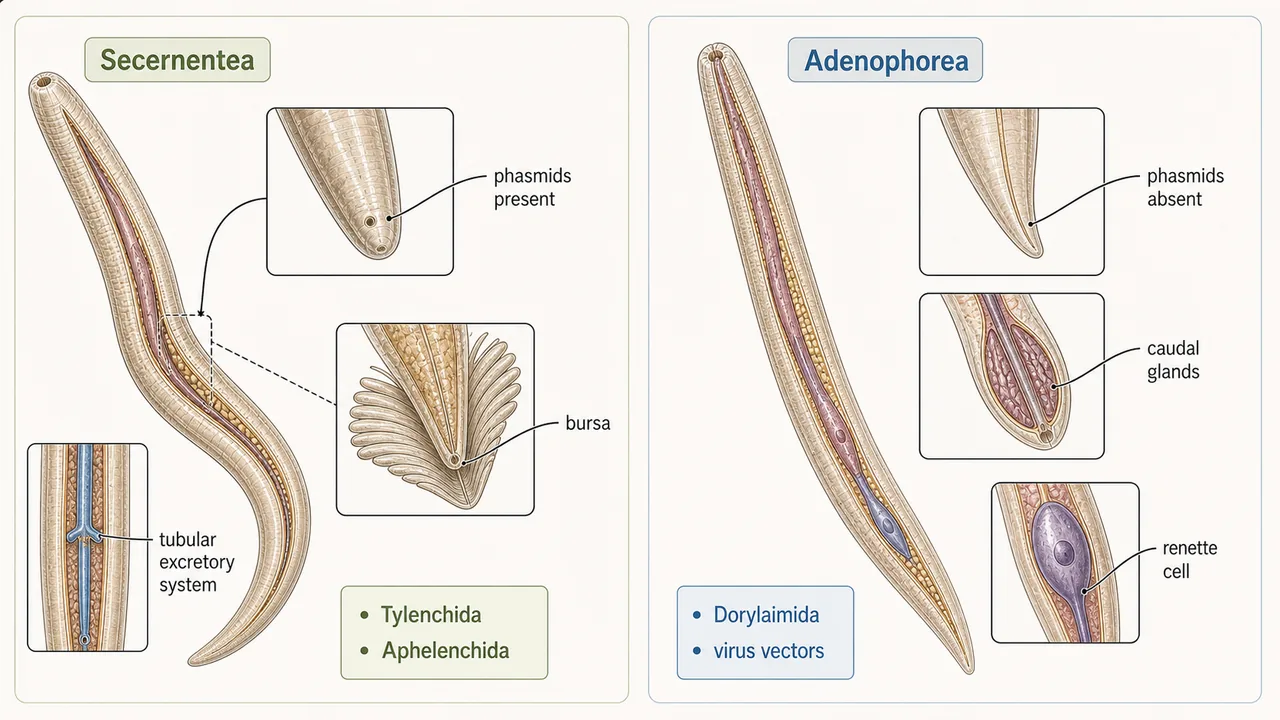
| SECERNENTEA | ADENOPHOREA |
|---|---|
| Phasmids present (Phasmidia) | Phasmids absent (Aphasmidia) |
| Derid present | Derid absent |
| Male tail with bursa (Caudal alae). | Male tail lacks bursa but possess genital Papillae. |
| Caudal glands are absent | Caudal glands are present |
| Amphid labial and opening is generally pore like. Amphidial opening is on the head near the lip region. | Amphid post labial and opening is slit like or variable. Amphids open behind the head i.e., post labial. |
| Lateral canals open into the excretory duct. | Lateral canals and excretory duct end in a cell. |
| Oesophagus is divided into procorpous, median bulb, isthmus, and basal bulb. | Oesophagus is cylindrical with an enlarges glandular base. |
| The mesenterial tissues are less developed | The mesenterial tissues are well developed |
| Excretory system is having tubular associated with secretory glands. | Excretory system is having glandular with renette cell. |
IMPORTANT
More than 90% of plant parasitic nematodes belong to Order Tylenchida (Class Secernentea). However, all virus-vectoring nematodes belong to Order Dorylaimida (Class Adenophorea).
Class Secernentea -- Orders and Families
Order: Tylenchida
The most highly evolved order, containing the majority of economically important plant parasitic nematodes. It includes Sub-order Tylenchina with the following families:
| Sub-order / Superfamily | Family | Example Genera | Common Name |
|---|---|---|---|
| Tylenchina | Tylenchoidea | Tylenchulus | Citrus nematode (slow decline of citrus) |
| Anguinidae | Anguina, Ditylenchus | Seed-gall nematode, Stem & bulb nematode | |
| Tylenchidae | Tylenchorhynchus, Belonomus | Stunt nematode, Sting nematode | |
| Haplolaimoidea | Pratylenchidae | Pratylenchus, Radopholus, Nacobbus | Lesion, Burrowing, False root-knot |
| Hoplolaimidae | Hoplolaimus, Rotylenchulus, Helicotylenchus, Scutellonema | Lance, Reniform, Spiral, Dry rot | |
| Heterodoidea | Heteroderidae | Heterodera, Globodera | Cyst nematode, Golden cyst nematode |
| Meloidogynidae | Meloidogyne | Root-knot nematode (No. 1 PPN worldwide) |
Order: Aphelenchida
| Sub-order | Family | Example Genera | Common Name |
|---|---|---|---|
| Aphelenchina | Aphelenchoididae | Aphelenchoides | Foliar nematode (white tip of rice) |
| Bursaphelenchus | Pine wilt nematode |
Class Adenophorea
Known as Aphasmida (phasmids absent). Caudal glands are present. Contains the virus-vectoring nematodes.
Order: Dorylaimida
| Superfamily | Family | Example Genera | Common Name | Virus Type Transmitted |
|---|---|---|---|---|
| Longidoroidea | Longidoridae | Longidorus, Paralongidorus | Needle nematode | NEPO (polyhedral) |
| Xiphinematidae | Xiphinema | Dagger nematode | NEPO | |
| Trichodoroidea | Trichodoridae | Trichodorus, Paratrichodorus | Stubby-root nematode | NETU (tubular) |
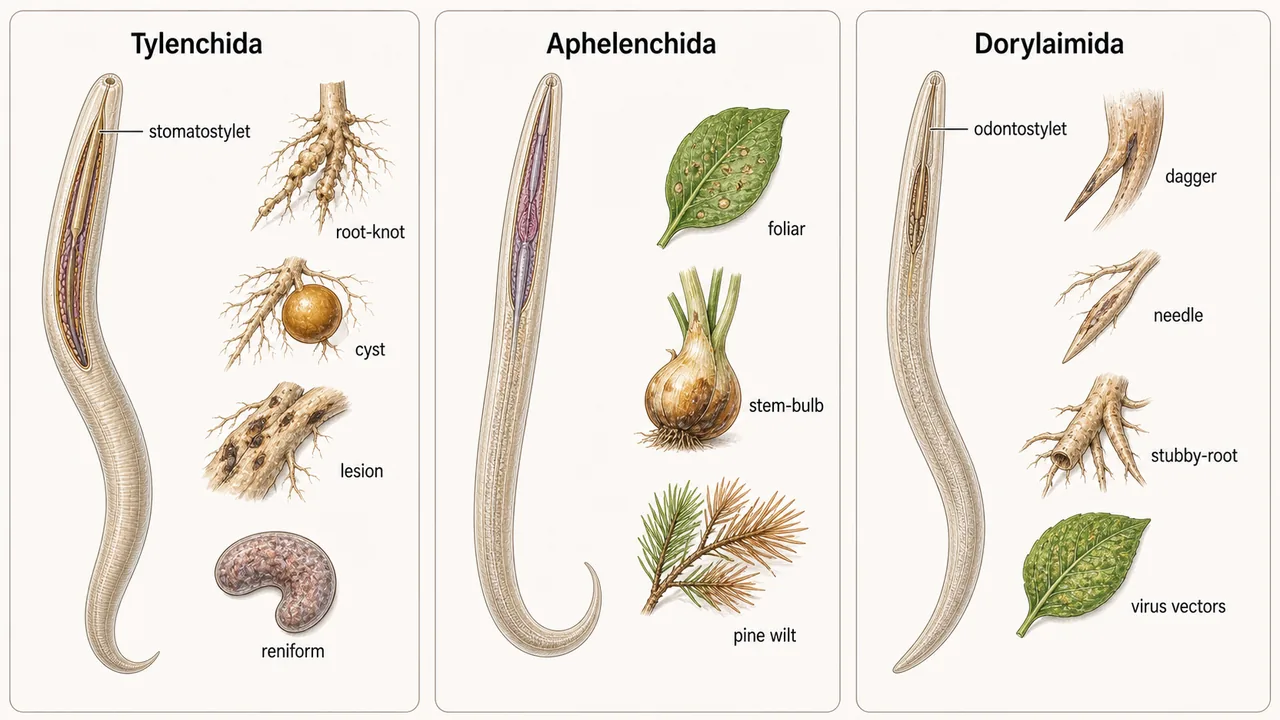
| Tylenchida | Dorylaimida |
|---|---|
| Presence of three parts of oesophagus. | Presence of two part oesophagus. |
| Buccal cavity is known as Stomatostylet. | Buccal Cavity is known as Odeontostylet. |
| Cuticle possess distinct annulations or transverse striations. | Cuticle annulations are not clearly observed. |
Part 2: Classification by Feeding Habits
This practical classification groups nematodes by how and where they feed -- directly determining the type of damage and management strategies needed.
Key Principles
- Plant parasitic nematodes bear a stylet (feeding spear) used like a hypodermic needle to pierce cell walls.
- Many inject digestive enzymes before feeding (extra-oral digestion).
- 90% of PPNs attack roots or below-ground plant parts (tubers, rhizomes, bulbs).
- Two broad categories: Facultative parasites (can survive on other food) and Obligate parasites (depend entirely on living plants).
I. Above-Ground Feeders
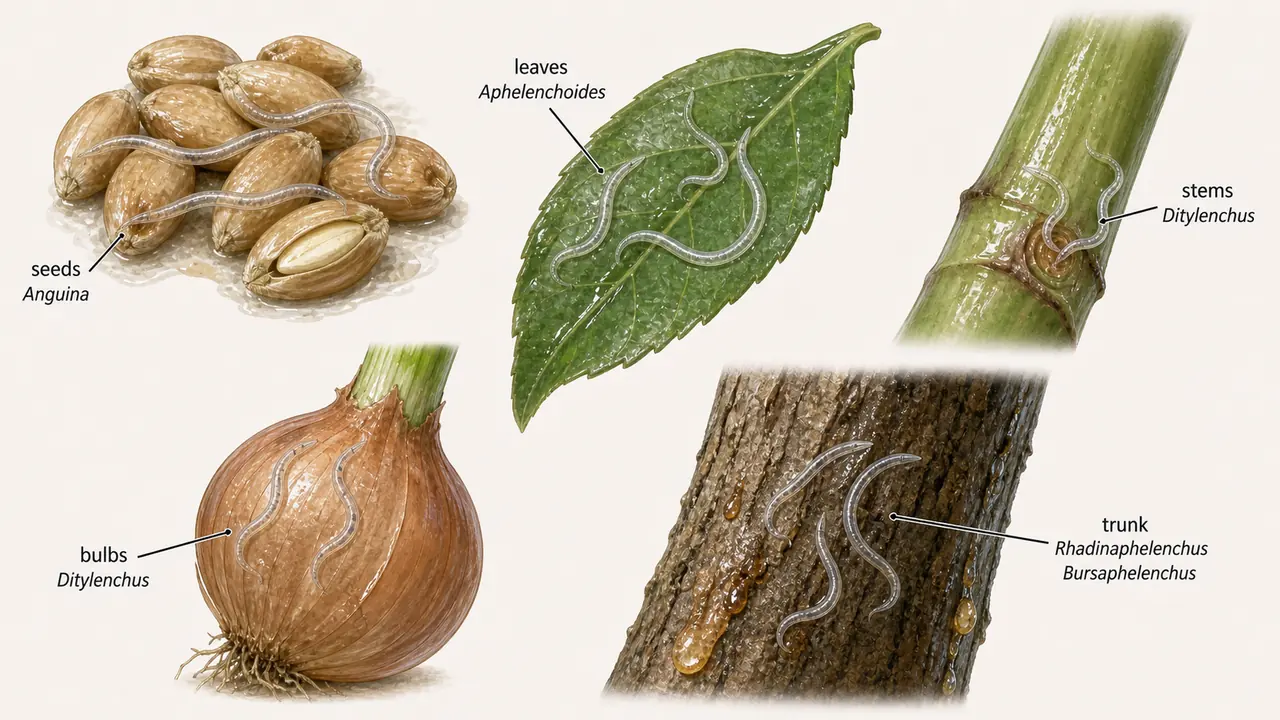
These nematodes feed on stems, leaves, buds, flowers, or seeds. They move on plant surfaces using thin films of moisture. Most are facultative plant parasites and can act as both ecto- and endoparasites.
| Feeding Site | Nematode | Disease/Damage |
|---|---|---|
| Flower buds, seeds | Anguina tritici (Seed-gall) | Earcockle disease of wheat |
| Leaves, buds | Aphelenchoides (Foliar) | White tip of rice |
| Stems, bulbs | Ditylenchus (Stem & bulb) | Ufra disease of rice, onion bloat |
| Tree trunk | Rhadinaphelenchus cocophilus (Red ring) | Red ring disease of coconut |
| Tree trunk | Bursaphelenchus xylophilus (Pine wilt) | Rapid wilting of pine trees |
II. Below-Ground Feeders
These nematodes attack roots and other underground parts. They are obligate parasites that depend entirely on living host plants. Symptoms include leaf discolouration, stunting, reduced root systems, galls, lesions, and wilting.
Based on where the nematode body sits relative to the root, below-ground feeders are further classified:
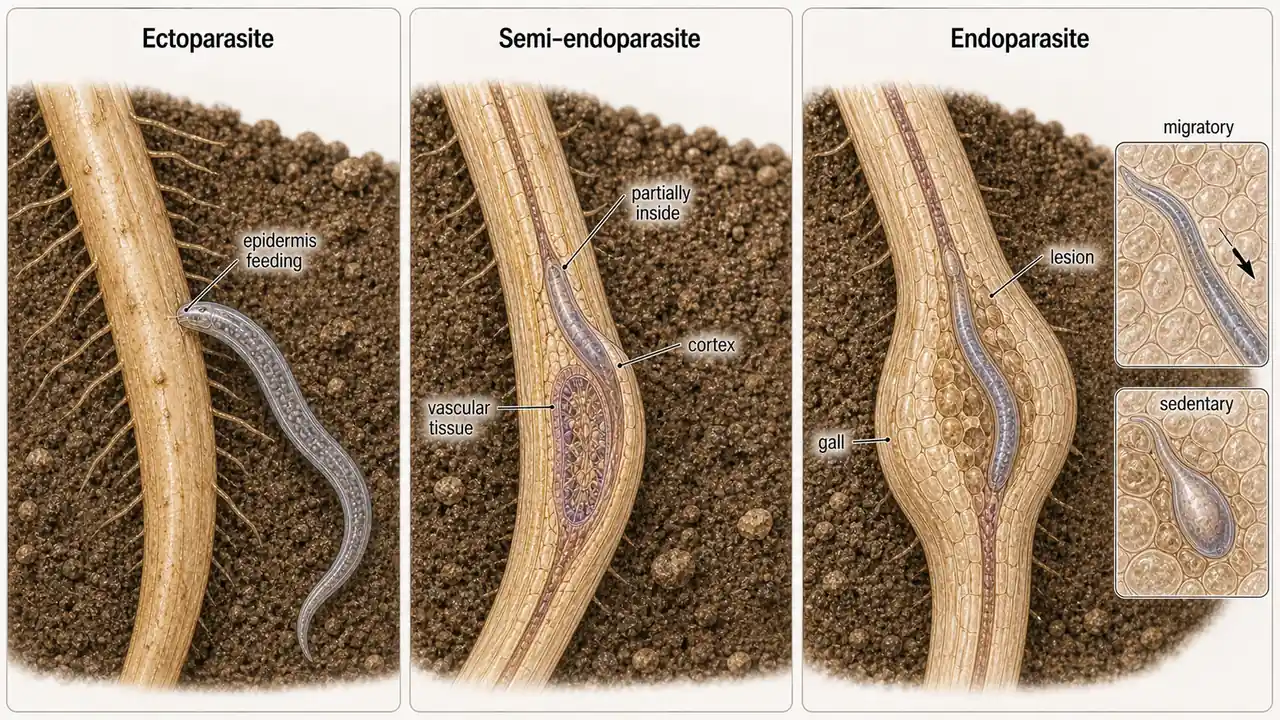
1. Ectoparasites (Body Outside the Root)
The nematode feeds on the root surface but its body remains exposed to soil.
| Type | Behaviour | Examples |
|---|---|---|
| Migratory ectoparasites | Feed on epidermis, move freely, detach when roots are disturbed | Xiphinema, Longidorus, Paratylenchus, Dolichodorus |
| Sedentary ectoparasites | Long stylet buried deep into cortical cells; body hangs in soil; permanently attached | Hemicycliophora arenaria, Cacopaurus pestis |
2. Semi-Endoparasites (Partially Inside the Root)
One-third of the body penetrates the root cortex; the rest hangs in the soil.
| Type | Examples | Crops Affected |
|---|---|---|
| Sedentary | Rotylenchulus reniformis (Reniform), Tylenchulus semipenetrans (Citrus) | Pulses, cotton; Citrus (slow decline) |
| Migratory | Hoplolaimus, Tylenchorhynchus | Various crops |
3. Endoparasites (Entirely Inside the Root)
The nematode is completely confined within the root tissue.
| Type | Behaviour | Examples | Damage |
|---|---|---|---|
| Migratory endoparasites | Move through cortex creating tunnels/cavities; lay eggs inside | Pratylenchus coffeae, Radopholus similis | Necrotic lesions and root rot |
| Sedentary endoparasites | J2 enters root, fixes head on vascular bundles, becomes permanent; feeds via syncytium/giant cells | Meloidogyne incognita, Heterodera cajani, Globodera rostochiensis | Galls (root-knot) or subtle swellings (cyst) |
Comparison: Feeding Habit Types
| Feature | Ectoparasite | Semi-Endoparasite | Endoparasite |
|---|---|---|---|
| Body position | Entirely outside root | Partially inside | Entirely inside root |
| Life cycle completed in | Soil | Soil | Root (sedentary) or soil (migratory) |
| Feeding site | Epidermis, root hairs | Cortex or vascular bundles | Cortex (migratory) or vascular bundles (sedentary) |
| Key examples | Xiphinema, Longidorus | Rotylenchulus, Tylenchulus | Meloidogyne, Heterodera, Pratylenchus |
Summary Table
| Classification Basis | Category | Key Fact |
|---|---|---|
| Phylum | Nematoda | Two classes: Secernentea and Adenophorea |
| Class Secernentea | Phasmida (phasmids present) | Contains >90% of PPNs (Orders Tylenchida, Aphelenchida) |
| Class Adenophorea | Aphasmida (phasmids absent) | Contains all virus-vector nematodes (Order Dorylaimida) |
| Most important order | Tylenchida | Includes root-knot, cyst, lesion, reniform nematodes |
| Above-ground feeders | Facultative parasites | Anguina, Aphelenchoides, Ditylenchus |
| Ectoparasites | Body outside root | Xiphinema, Longidorus, Paratylenchus |
| Semi-endoparasites | Partially inside root | Rotylenchulus (kidney-shaped), Tylenchulus (citrus) |
| Migratory endoparasites | Move through cortex | Pratylenchus (lesions), Radopholus (burrowing) |
| Sedentary endoparasites | Fixed in vascular tissue | Meloidogyne (galls), Heterodera (cysts) |
TIP
Exam mnemonic -- "ESSE" for feeding types (outside to inside): Ectoparasite (outside) --> Semi-endoparasite (half-in) --> Migratory Endoparasite (inside, moving) --> Sedentary Endoparasite (inside, fixed).
References
- https://www.academia.edu/37734248/Lecturer_01_Introduction_History_and_Taxonomy_of_Plant_Parasitic_Nematodes
- Upadhyay, K.D. and Dwivedi, K. Textbook of Plant Nematology. Amam Publishing House, Merrut.
- Walia, R. K and Bajaj, H. K (2014). Textbook of Introductory Plant Nematology. Directorate of Knowledge Management in Agriculture, ICAR, New Delhi.
- Ravichandra, N. G. (2019). Plant Nematology. I. K. International Publishing House Pvt. Ltd., New Delhi.
- Dasgupta, M. K. (1998). Phytonematology. Pilgrims Publishing.
Summary Cheat Sheet
| Concept / Topic | Key Details |
|---|---|
| Phylum | Nematoda — Two classes: Secernentea and Adenophorea |
| Class Secernentea | Phasmida (phasmids present) — Contains >90% of PPNs (Orders Tylenchida, Aphelenchida) |
| Class Adenophorea | Aphasmida (phasmids absent) — Contains all virus-vector nematodes (Order Dorylaimida) |
| Most important order | Tylenchida — Includes root-knot, cyst, lesion, reniform nematodes |
| Above-ground feeders | Facultative parasites — Anguina, Aphelenchoides, Ditylenchus |
| Ectoparasites | Body outside root — Xiphinema, Longidorus, Paratylenchus |
| Semi-endoparasites | Partially inside root — Rotylenchulus (kidney-shaped), Tylenchulus (citrus) |
| Migratory endoparasites | Move through cortex — Pratylenchus (lesions), Radopholus (burrowing) |
| Sedentary endoparasites | Fixed in vascular tissue — Meloidogyne (galls), Heterodera (cysts) |
TIP
Next: Lesson 08 covers biology -- the six-stage life cycle, moulting (ecdysis), hatching triggers, and voltinism (univoltine vs multivoltine).