🪱 Burrowing Nematode (Radopholus similis)
Banana decline, yellows disease of black pepper, spreading decline of citrus, migratory endoparasitic biology, and toppling-over damage
In the previous lesson, we covered the aphelenchid nematodes -- above-ground parasites of rice, mushroom, and coconut. Now we return to a below-ground pest: the burrowing nematode, a migratory endoparasite that devastates tropical plantation crops.
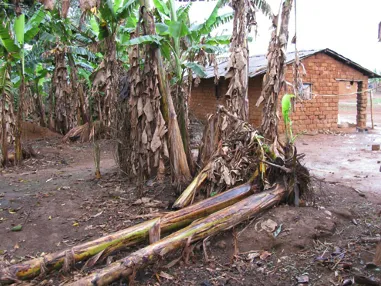
In Kerala's banana plantations, a devastating scenario plays out: fruit-bearing banana plants topple over during high winds because their root systems have been hollowed out by tunnelling nematodes. The culprit is Radopholus similis -- which can reduce banana yields by up to 88--95%.
This lesson covers:
- Biology -- migratory endoparasitic nature, two races
- Banana decline -- root rot, toppling over, Panama wilt complex
- Yellows disease -- black pepper devastation
- Spreading decline -- citrus race (Florida/Hawaii only)
Etymology and Discovery
| Feature | Details |
|---|---|
| Generic name | Radopholus: radix (root) + phelien (loving) = root-loving |
| Common name | Burrowing nematode -- creates extensive tunnels (burrows) in root cortex |
| First observation | Cobb, 1890--91 -- investigating banana disease in Fiji |
| Introduction to India | Believed to have entered Kerala through imported banana suckers |
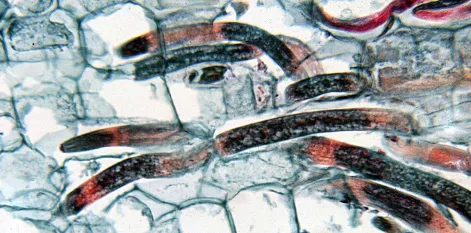
Biology
| Feature | Details |
|---|---|
| Parasitism type | Migratory endoparasite -- constantly moves through root cortex, feeding as it goes |
| Infective stages | Females and ALL juvenile stages (unlike root-knot/cyst where only J2 is infective) |
| Males | Non-parasitic and morphologically degenerate (without stylet) |
| Penetration site | Near the root tip; browning appears within 24 hours |
| Feeding location | Cortical parenchyma (intercellular); does NOT enter the stele (vascular cylinder) |
| Damage mechanism | Creates cavities and tunnels that coalesce, destroying root cortex structure |
Two Races
| Race | Host Range | Distribution |
|---|---|---|
| Banana race (R. similis) | Parasitic on banana but not on citrus | India (Kerala), tropics worldwide |
| Citrus race (R. citrophilus) | Parasitic on both banana and citrus | Restricted to Florida and Hawaii only |
In India, only the banana race (R. similis) is present.
Pro Content Locked
Upgrade to Pro to access this lesson and all other premium content.
₹99 charged monthly · Cancel anytime
- All Agriculture & Banking Courses
- AI Lesson Questions (100/day)
- AI Doubt Solver (50/day)
- Glows & Grows Feedback (30/day)
- AI Section Quiz (20/day)
- 22-Language Translation (100/day)
- Recall Questions (20/day)
- AI Quiz (15/day)
- AI Quiz Paper Analysis (100/day)
- AI Step-by-Step Explanations (100/day)
- Spaced Repetition Recall (FSRS)
- AI Tutor
- Immersive Text Questions
- Audio Lessons — Hindi & English
- Mock Tests & Previous Year Papers
- Summary & Mind Maps
- XP, Levels, Leaderboard & Badges
- Generate New Classrooms
- Voice AI Teacher (AgriDots Live)
- AI Revision Assistant
- Knowledge Gap Analysis
- Interactive Revision (LangGraph)
🔒 Secure via Razorpay · Cancel anytime · No hidden fees
In the previous lesson, we covered the aphelenchid nematodes -- above-ground parasites of rice, mushroom, and coconut. Now we return to a below-ground pest: the burrowing nematode, a migratory endoparasite that devastates tropical plantation crops.
In Kerala's banana plantations, a devastating scenario plays out: fruit-bearing banana plants topple over during high winds because their root systems have been hollowed out by tunnelling nematodes. The culprit is Radopholus similis -- which can reduce banana yields by up to 88--95%.
This lesson covers:
- Biology -- migratory endoparasitic nature, two races
- Banana decline -- root rot, toppling over, Panama wilt complex
- Yellows disease -- black pepper devastation
- Spreading decline -- citrus race (Florida/Hawaii only)
Etymology and Discovery
| Feature | Details |
|---|---|
| Generic name | Radopholus: radix (root) + phelien (loving) = root-loving |
| Common name | Burrowing nematode -- creates extensive tunnels (burrows) in root cortex |
| First observation | Cobb, 1890--91 -- investigating banana disease in Fiji |
| Introduction to India | Believed to have entered Kerala through imported banana suckers |
Biology
| Feature | Details |
|---|---|
| Parasitism type | Migratory endoparasite -- constantly moves through root cortex, feeding as it goes |
| Infective stages | Females and ALL juvenile stages (unlike root-knot/cyst where only J2 is infective) |
| Males | Non-parasitic and morphologically degenerate (without stylet) |
| Penetration site | Near the root tip; browning appears within 24 hours |
| Feeding location | Cortical parenchyma (intercellular); does NOT enter the stele (vascular cylinder) |
| Damage mechanism | Creates cavities and tunnels that coalesce, destroying root cortex structure |
Two Races
| Race | Host Range | Distribution |
|---|---|---|
| Banana race (R. similis) | Parasitic on banana but not on citrus | India (Kerala), tropics worldwide |
| Citrus race (R. citrophilus) | Parasitic on both banana and citrus | Restricted to Florida and Hawaii only |
In India, only the banana race (R. similis) is present.
Host Range
R. similis has a wide host range across tropical plantation and spice crops: banana, black pepper, coffee, tea, cocoa, coconut, areca nut, sugarcane, turmeric, ginger, and others.
Banana -- Decline, Root Rot, and Toppling Over
The disease on banana is known by several names: Banana Blackhead Disease, Banana Decline, Banana Rhizome Rot, and Banana Root Rot.
Disease Complex with Fusarium
R. similis interacts with Fusarium oxysporum f. sp. cubense, causing Panama wilt in banana. The nematode creates wounds that make roots far more susceptible to the fungus. The incidence of wilt is doubled and wilting occurs earlier in nematode-infested plants.
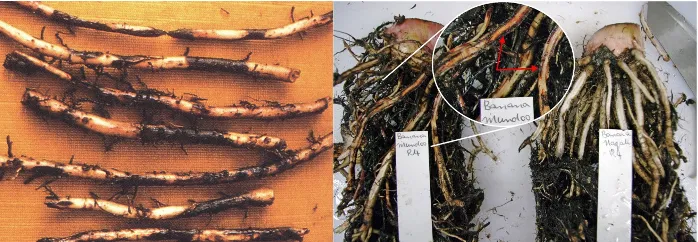
Yield reduction: up to 88--95%.
Symptoms
Above ground: Yellowing of leaves followed by withering and death. Non-specific -- resembles nutrient deficiency.
Below ground (diagnostic):
- Reddish elongated lesions on roots that enlarge and coalesce, leading to rotting
- Root system devoid of laterals; drastically reduced overall
- Rhizome rot extends from roots
- Plants at bearing stage topple over during high winds due to poor root anchorage
Management
Use healthy, nematode-free rhizomes for planting. Rhizomes can be treated with hot water (53--55 degrees C for 10--20 minutes) before planting.
Black Pepper -- Yellows Disease
R. similis causes yellows disease of black pepper.
| Stage | Symptoms |
|---|---|
| Early | Yellowing of a few leaves |
| Progressive | Yellowing extends to entire vine |
| Severe | Complete defoliation, cessation of growth, drastic berry reduction, vine death |
Management
Nematicide Fensulfothion @ 4--8 kg a.i./ha at nursery stage (protects young plants before transplanting).
Citrus -- Spreading Decline
Radopholus citrophilus (citrus race) causes Spreading Decline of Citrus -- found only in Florida and Hawaii (USA).
NOTE
Do not confuse: Slow decline of citrus = Tylenchulus semipenetrans (citrus nematode). Spreading decline of citrus = Radopholus citrophilus (burrowing nematode). "Spreading" refers to the disease progressively moving from tree to tree along rows.
Comparison: Burrowing Nematode Diseases
| Disease | Host | Nematode Species | Region | Key Symptom |
|---|---|---|---|---|
| Banana Decline | Banana | R. similis | Kerala, tropics | Toppling over; 88--95% yield loss |
| Yellows Disease | Black pepper | R. similis | Kerala, tropics | Progressive yellowing, vine death |
| Spreading Decline | Citrus | R. citrophilus | Florida, Hawaii only | Tree-to-tree spread along rows |
| Panama Wilt (complex) | Banana | R. similis + Fusarium | Tropics | Doubled wilt incidence |
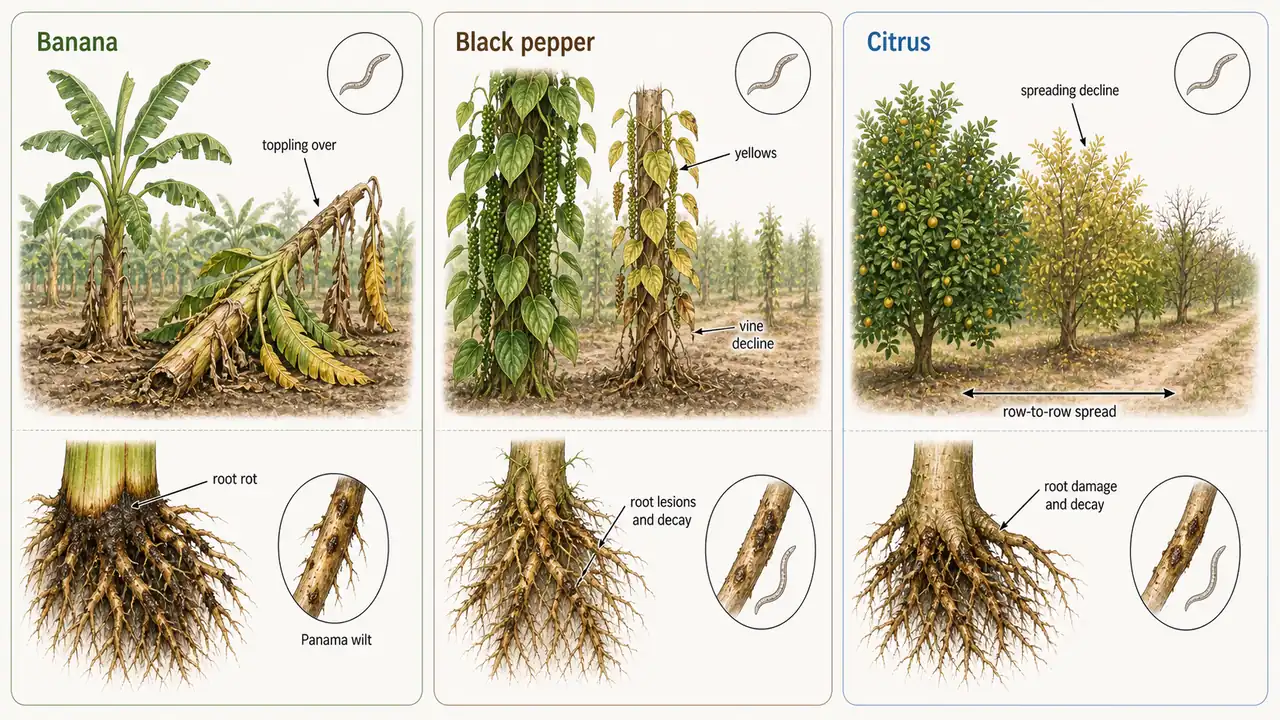
Summary Table
| Feature | Key Fact |
|---|---|
| Scientific name | Radopholus similis (banana race) |
| Parasitism type | Migratory endoparasite |
| Infective stages | Females + all juvenile stages (not just J2) |
| Males | Non-parasitic (no stylet) |
| Feeding location | Root cortex only (not stele) |
| Damage mechanism | Tunnels and cavities in cortex |
| Banana yield loss | 88--95% |
| Banana key symptom | Toppling over of fruit-bearing plants |
| Disease complex | R. similis + Fusarium = Panama wilt (doubled severity) |
| Black pepper disease | Yellows disease |
| Citrus disease | Spreading decline (R. citrophilus, Florida/Hawaii only) |
| Introduction to India | Through imported banana suckers to Kerala |
| Key management | Nematode-free planting material; hot water treatment (53--55 degrees C, 10--20 min) |
TIP
Exam mnemonic -- "BYS" for burrowing nematode diseases: Banana decline (toppling over), Yellows disease (black pepper), Spreading decline (citrus, Florida only).
References
- Dropkin, V.H. 1980. Introduction to plant nematology. John Wiley and sons, INC. New York.
- Singh, R.S and Sitaramaiah, K. 1994. Plant pathogens. The plant parasitic nematodes. Oxford & IBH Pub. Co. Pvt. Ltd. New Delhi.
- Walia, R. K and Bajaj, H. K (2014). Textbook of Introductory Plant Nematology. Directorate of Knowledge Management in Agriculture, ICAR, New Delhi.
- Kumar, V., Khan, M.R. & Walia, R.K. Crop Loss Estimations due to Plant-Parasitic Nematodes in Major Crops in India. Natl. Acad. Sci. Lett. 43, 409-412 (2020).
- Figure 1: Source: A: Maggenti, 1981, B-E: Franklin, 1973
Summary Cheat Sheet
| Concept / Topic | Key Details |
|---|---|
| Scientific name | Radopholus similis (banana race) |
| Parasitism type | Migratory endoparasite |
| Infective stages | Females + all juvenile stages (not just J2) |
| Males | Non-parasitic (no stylet) |
| Feeding location | Root cortex only (not stele) |
| Damage mechanism | Tunnels and cavities in cortex |
| Banana yield loss | 88--95% |
| Banana key symptom | Toppling over of fruit-bearing plants |
| Disease complex | R. similis + Fusarium = Panama wilt (doubled severity) |
| Black pepper disease | Yellows disease |
| Citrus disease | Spreading decline (R. citrophilus, Florida/Hawaii only) |
| Introduction to India | Through imported banana suckers to Kerala |
| Key management | Nematode-free planting material; hot water treatment (53--55 degrees C, 10--20 min) |
TIP
Next: Lesson 07 covers the reniform nematode (Rotylenchulus reniformis) -- the kidney-shaped semi-endoparasite and second most important nematode of vegetables.