🪱 Nematode Diseases — The Invisible Root Destroyers
Plant-parasitic nematodes — classification by feeding habit, major genera, diseases, antagonistic crops, and management strategies with comparison tables and exam mnemonics
From Field to Lab — The Underground Menace
A tomato farmer in Nashik uproots a stunted, wilting plant and notices swollen, knotted roots that look like beads on a string — classic root-knot nematode (Meloidogyne) galls. A banana plantation in Kerala where trees topple over in mild wind despite healthy-looking leaves is under attack from the burrowing nematode (Radopholus similis). A wheat field showing patchy poor growth has cereal cyst nematode (Heterodera avenae) silently feeding inside the roots. These microscopic worms cause estimated losses of 10–15% of crop production globally, yet they remain the most overlooked pest group in Indian agriculture.
Introduction to Nematology
Nematodes are microscopic, unsegmented roundworms that live in soil, water, and plant tissues. Many species are plant-parasitic and cause significant economic losses in agriculture worldwide.
- 1743 — Needham discovered the wheat seed-gall nematode (Anguina tritici), the first plant-parasitic nematode to come to the attention of early investigators.
- Father of Nematology — H.C. Bastian
- Father of American/Modern Nematology — N.A. Cobb
- Nematodes generally undergo four moultings (i.e., they have four larval stages)
- First scale to measure plant diseases — Cobb's scale
TIP
Remember: Needham discovered the first plant nematode, Bastian is the father of nematology, and Cobb is the father of American/modern nematology. Cobb also gave the first disease measurement scale.
Classification by Feeding Habit
Plant-parasitic nematodes are classified based on how and where they feed on host plants.
Ectoparasites
Nematodes that feed on the outer surface of roots without entering the plant tissue. They use their stylet to puncture cells from outside.
- Examples: Dagger nematode (Xiphinema), Sting nematode (Belonolaimus), Needle nematode (Longidorus)
Endoparasites
Nematodes that enter and feed inside plant tissues. They are further divided into:
Sedentary Endoparasites — Enter the root, establish a permanent feeding site, and become immobile.
- Examples: Root-knot nematode (Meloidogyne), Cyst nematode (Heterodera, Globodera)
Migratory Endoparasites — Move freely within root tissues, feeding as they go.
- Examples: Lesion nematode (Pratylenchus), Burrowing nematode (Radopholus)
Semi-endoparasites
Nematodes that partially enter roots — the anterior portion feeds inside while the posterior remains outside.
- Example: Citrus nematode (Tylenchulus semipenetrans), Reniform nematode (Rotylenchulus)
IMPORTANT
For exams, remember that Root-knot and Cyst nematodes are sedentary endoparasites, while Lesion and Burrowing nematodes are migratory endoparasites.
Antagonistic Crops
Certain crops produce chemicals or alkaloids as root exudates that repel or suppress plant-parasitic nematodes. These are called Antagonistic crops.
- Mustard — antagonistic to Cyst nematode
- Marigold — antagonistic to Pratylenchus, Rotylenchulus, and Meloidogyne spp.
- Other examples include neem
NOTE
Marigold is one of the most commonly used antagonistic/trap crops for nematode management in India. It is frequently asked in exams.
Major Nematode Genera and Their Diseases
Complete Table of Plant-Parasitic Nematodes
| Common Name | Scientific Name | Key Facts |
|---|---|---|
| Root-knot nematode | Meloidogyne spp. | Root knots are hard, deep-seated; controlled by Paecilomyces lilacinus |
| Rice root-knot nematode | Meloidogyne graminicola | Hook-like galls on roots; leaf distortion and crinkling; stunting in patches |
| Cyst nematode | Globodera spp. and Heterodera spp. | Female body becomes a cyst filled with eggs |
| Cereal cyst nematode | Heterodera avenae | Affects wheat and barley |
| Potato cyst nematode | Globodera rostochiensis | Major quarantine pest |
| Burrowing nematode | Radopholus similis | Causes toppling disease of banana |
| Citrus nematode | Tylenchulus semipenetrans | Causes slow decline/citrus decline and die-back |
| Reniform nematode | Rotylenchulus spp. | Kidney-shaped females; wide host range |
| Lesion nematode | Pratylenchus spp. | Causes root lesions; migratory endoparasite |
| Root lesion nematode | Pratylenchus sp. | Causes necrotic lesions on roots |
| Lance nematode | Hoplolaimus spp. | Migratory ectoparasite |
| Sting nematode | Belonolaimus | Large ectoparasite |
| Dagger nematode | Xiphinema spp. | Vector of plant viruses |
| Ring nematode | Criconemella spp. | Ectoparasite with cuticular annulations |
| Spiral nematode | Helicotylenchus spp. | Body curved in spiral shape |
| Needle nematode | Longidorus spp. | Sword-like stylet; transmits fan leaf virus of grape |
| Pin nematode | Paratylenchus spp. | Very small ectoparasite |
| Sheath nematode | Hemicycliophora spp. | Has a loose-fitting sheath |
| Stunt nematode | Tylenchorhynchus spp. | Ectoparasite causing stunting |
| Stubby-root nematode | Paratrichodorus and Trichodorus spp. | Causes short, stubby roots |
| Stem nematode of rice | Ditylenchus angustus | Causes Ufra disease of rice; twisting of leaf and leaf sheath |
| Stem and bulb nematode | Ditylenchus dipsaci | Causes onion bloat disease |
| Potato root nematode | Ditylenchus destructor | Causes rots on potato roots |
| Mushroom nematode | Ditylenchus mycelophagus | Feeds on mushroom mycelium |
| Seed-gall nematode | Anguina tritici | Causes wheat ear cockle; conversion of grains into cockles/galls |
| Foliar nematode | Aphelenchoides spp. | Feeds on leaves and buds |
| Rice root nematode | Hirschnynniella sp. | Affects rice roots |
Root-Knot Nematode (Meloidogyne spp.)
The most economically important group of plant-parasitic nematodes worldwide.
- Root knots/galls are hard in consistency and deep-seated
- Sedentary endoparasite — female becomes pear-shaped inside root tissue
- Wide host range — attacks vegetables, pulses, cereals, fruit crops
- Biocontrol agent: Paecilomyces lilacinus (egg parasite)
- Rice root-knot (M. graminicola) causes characteristic hook-like galls on roots, leaf distortion, and stunting in patches
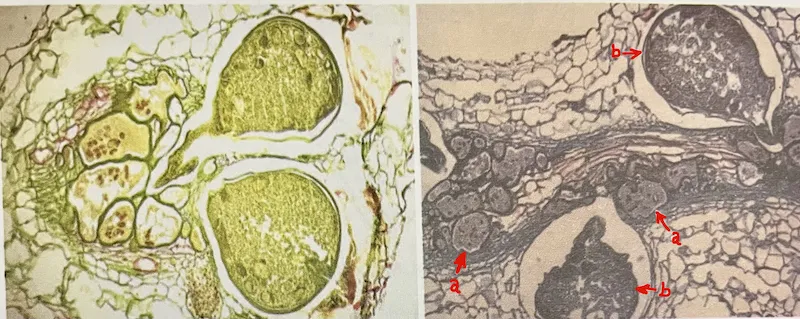
Cyst Nematode (Heterodera and Globodera spp.)
- Cereal cyst nematode — Heterodera avenae (attacks wheat and barley)
- Potato cyst nematode — Globodera rostochiensis (major quarantine pest)
- Sugarcane cyst nematode — Heterodera sacchari
- Dead female body forms a hardened cyst containing eggs that can survive in soil for years
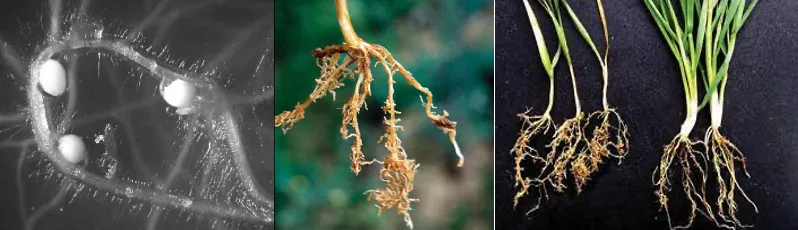
WARNING
Potato cyst nematode is a quarantine pest — potato tubers used as seed material from Nilgiri Hills (Tamil Nadu) have restricted movement to other parts of the country.
Burrowing Nematode (Radopholus similis)
- Causes toppling disease of banana
- Migratory endoparasite — burrows through root cortex causing extensive damage
- Affected banana plants topple over due to weakened root system
Citrus Nematode (Tylenchulus semipenetrans)
- Causes slow decline / citrus decline and die-back
- Semi-endoparasite — female head embedded in root, body outside
- Most important nematode pest of citrus worldwide
Reniform Nematode (Rotylenchulus reniformis)
- Named for the kidney-shaped (reniform) body of mature female
- Semi-endoparasite with very wide host range
- Important pest of cotton, soybean, and vegetables
Seed-Gall Nematode (Anguina tritici)
Causes wheat ear cockle disease — one of the most frequently asked nematode facts in exams.
- Grains are converted into cockles or galls (dark, hard, irregularly shaped)
- Seedling leaves are twisted and crinkled
- Seedlings may be stunted and die
- Shows profuse tillering
- Tundu/Sehu or Yellow ear rot of wheat is caused by Anguina tritici + Clavibacter tritici (nematode-bacterium complex)
IMPORTANT
Tundu disease is a classic example of a disease complex — caused jointly by a nematode (Anguina tritici) and a bacterium (Clavibacter tritici). This is a very high-frequency exam question.
Stem Nematode (Ditylenchus spp.)
| Species | Disease | Host |
|---|---|---|
| D. angustus | Ufra disease | Rice |
| D. dipsaci | Onion bloat | Onion, garlic |
| D. destructor | Root rot | Potato |
| D. mycelophagus | Mycelium feeding | Mushroom |
- Ufra disease of rice — caused by D. angustus; symptoms include twisting of leaf and leaf sheath
Pine Wilt Nematode (Bursaphelenchus xylophilus)
- Causes pine wilt disease — rapid wilting and death of pine trees
- Vectored by longhorn beetles (Monochamus spp.)
- Major quarantine concern for coniferous forests
Foliar Nematode (Aphelenchoides spp.)
- Feeds on leaves and buds (above-ground parts)
- Causes angular leaf spots, leaf distortion, and bud necrosis
- Important on ornamentals like chrysanthemum and fern
Needle Nematode (Longidorus spp.)
- Has a characteristic sword-like stylet
- Transmits fan leaf virus of grape
- Large ectoparasite
Nematode Management
A. Chemical Control
Fumigants:
- DD (mixture of dichloropropane and dichloropropene)
- EDB (ethylene dibromide)
- MBr (methyl bromide)
- Nemagon (DBCP — dibromochloropropane)
Non-fumigant Nematicides:
- Carbamates: Aldicarb, Carbofuran (Furadan), Metham sodium (Vapam)
- Organophosphate: Phorate (Thimet)
TIP
For exams, remember the three key carbamate nematicides: Aldicarb, Carbofuran, Metham sodium (mnemonic: ACM). Phorate is the only organophosphate nematicide commonly asked.
B. Physical Control
- Hot water treatment — 54°C for 10-15 minutes
C. Cultural Control
- Crop rotation with non-host crops
- Use of antagonistic/trap crops (mustard, marigold, neem)
- Flooding — kills nematodes by asphyxiation
- Soil solarization — using transparent polyethylene sheets to raise soil temperature
D. Biological Control
| Biocontrol Agent | Type | Target |
|---|---|---|
| Paecilomyces lilacinus | Fungus | Root-knot nematode eggs |
| Pasteuria penetrans | Bacterium | Root-knot nematode |
| Trichoderma spp. | Fungus | General soil-borne pathogens including nematodes |
NOTE
Paecilomyces lilacinus is the most important biocontrol agent for nematodes — it parasitizes eggs of root-knot nematode. Pasteuria penetrans is a bacterial parasite of nematodes.
E. Regulatory Control
- Adoption of quarantine regulations — e.g., potato tubers used as seed material have restricted movement from Nilgiri Hills (TN) to other parts of the country
- Certification of planting material as nematode-free
Summary Cheat Sheet
| Fact | Answer |
|---|---|
| First plant-parasitic nematode discovered | Anguina tritici — Needham (1743) |
| Father of Nematology | H.C. Bastian |
| Father of American/Modern Nematology | N.A. Cobb |
| First disease measurement scale | Cobb's scale |
| Nematode larval stages | 4 moultings (4 larval stages) |
| Root-knot nematode genus | Meloidogyne spp. — sedentary endoparasite |
| Root knot gall character | Hard, deep-seated galls |
| Biocontrol for root-knot nematode | Paecilomyces lilacinus (egg parasite) |
| Cyst nematode — wheat/barley | Heterodera avenae (cereal cyst nematode) |
| Potato cyst nematode | Globodera rostochiensis — quarantine pest |
| Burrowing nematode disease | Toppling disease of banana (Radopholus similis) |
| Citrus nematode disease | Slow decline / citrus die-back (Tylenchulus semipenetrans) |
| Wheat Ear Cockle disease | Anguina tritici — grains converted into hard galls |
| Tundu / Yellow ear rot | Anguina tritici + Clavibacter tritici — nematode-bacterium complex |
| Ufra disease of rice | Ditylenchus angustus |
| Onion bloat nematode | Ditylenchus dipsaci |
| Antagonistic crop for cyst nematode | Mustard |
| Antagonistic crop for Meloidogyne | Marigold |
| Key fumigant nematicides | DD, EDB (ethylene dibromide), MBr (methyl bromide) |
| Key carbamate nematicides | Aldicarb, Carbofuran, Metham sodium (ACM) |
| Hot water treatment for nematodes | 54°C for 10–15 minutes |
| Dagger nematode | Xiphinema spp. — vector of plant viruses |
| Needle nematode virus vector | Longidorus spp. — transmits fan leaf virus of grape |
Miscellaneous Exam Facts
- Gram staining of bacteria was discovered by H. Grahm (1884)
- Parasitic nature of fungi was proven by Anton De Bary
- Concept of vertical and horizontal resistance — J.E. Vandar Plank
- Green ear disease of bajra first reported by E.J. Butler (1907)
- Crystallization of viruses first done by W.M. Stanley (1935)
- Gelatin plate technique — Robert Koch
- Germ theory — Louis Pasteur
- Oldest known viral disease of plants — Tulip color breaking
- Bordeaux mixture first used in India against leaf spot of groundnut in 1904 by Lawrence
- Solar energy treatment — Luthra & Sattar
- First plant virus whose genome was completely sequenced — Cauliflower mosaic virus
- First systemic fungicide — Carboxin
- Fungi named as weed of laboratory — Aspergillus niger
- "Shepherd crook" symptoms — Fire blight of pears and apple
- Rice fever disease — Blast of rice
From Field to Lab — The Underground Menace
A tomato farmer in Nashik uproots a stunted, wilting plant and notices swollen, knotted roots that look like beads on a string — classic root-knot nematode (Meloidogyne) galls. A banana plantation in Kerala where trees topple over in mild wind despite healthy-looking leaves is under attack from the burrowing nematode (Radopholus similis). A wheat field showing patchy poor growth has cereal cyst nematode (Heterodera avenae) silently feeding inside the roots. These microscopic worms cause estimated losses of 10–15% of crop production globally, yet they remain the most overlooked pest group in Indian agriculture.
Introduction to Nematology
Nematodes are microscopic, unsegmented roundworms that live in soil, water, and plant tissues. Many species are plant-parasitic and cause significant economic losses in agriculture worldwide.
- 1743 — Needham discovered the wheat seed-gall nematode (Anguina tritici), the first plant-parasitic nematode to come to the attention of early investigators.
- Father of Nematology — H.C. Bastian
- Father of American/Modern Nematology — N.A. Cobb
- Nematodes generally undergo four moultings (i.e., they have four larval stages)
- First scale to measure plant diseases — Cobb's scale
TIP
Remember: Needham discovered the first plant nematode, Bastian is the father of nematology, and Cobb is the father of American/modern nematology. Cobb also gave the first disease measurement scale.
Classification by Feeding Habit
Plant-parasitic nematodes are classified based on how and where they feed on host plants.
Ectoparasites
Nematodes that feed on the outer surface of roots without entering the plant tissue. They use their stylet to puncture cells from outside.
- Examples: Dagger nematode (Xiphinema), Sting nematode (Belonolaimus), Needle nematode (Longidorus)
Endoparasites
Nematodes that enter and feed inside plant tissues. They are further divided into:
Sedentary Endoparasites — Enter the root, establish a permanent feeding site, and become immobile.
- Examples: Root-knot nematode (Meloidogyne), Cyst nematode (Heterodera, Globodera)
Migratory Endoparasites — Move freely within root tissues, feeding as they go.
- Examples: Lesion nematode (Pratylenchus), Burrowing nematode (Radopholus)
Semi-endoparasites
Nematodes that partially enter roots — the anterior portion feeds inside while the posterior remains outside.
- Example: Citrus nematode (Tylenchulus semipenetrans), Reniform nematode (Rotylenchulus)
IMPORTANT
For exams, remember that Root-knot and Cyst nematodes are sedentary endoparasites, while Lesion and Burrowing nematodes are migratory endoparasites.
Antagonistic Crops
Certain crops produce chemicals or alkaloids as root exudates that repel or suppress plant-parasitic nematodes. These are called Antagonistic crops.
- Mustard — antagonistic to Cyst nematode
- Marigold — antagonistic to Pratylenchus, Rotylenchulus, and Meloidogyne spp.
- Other examples include neem
NOTE
Marigold is one of the most commonly used antagonistic/trap crops for nematode management in India. It is frequently asked in exams.
Major Nematode Genera and Their Diseases
Complete Table of Plant-Parasitic Nematodes
| Common Name | Scientific Name | Key Facts |
|---|---|---|
| Root-knot nematode | Meloidogyne spp. | Root knots are hard, deep-seated; controlled by Paecilomyces lilacinus |
| Rice root-knot nematode | Meloidogyne graminicola | Hook-like galls on roots; leaf distortion and crinkling; stunting in patches |
| Cyst nematode | Globodera spp. and Heterodera spp. | Female body becomes a cyst filled with eggs |
| Cereal cyst nematode | Heterodera avenae | Affects wheat and barley |
| Potato cyst nematode | Globodera rostochiensis | Major quarantine pest |
| Burrowing nematode | Radopholus similis | Causes toppling disease of banana |
| Citrus nematode | Tylenchulus semipenetrans | Causes slow decline/citrus decline and die-back |
| Reniform nematode | Rotylenchulus spp. | Kidney-shaped females; wide host range |
| Lesion nematode | Pratylenchus spp. | Causes root lesions; migratory endoparasite |
| Root lesion nematode | Pratylenchus sp. | Causes necrotic lesions on roots |
| Lance nematode | Hoplolaimus spp. | Migratory ectoparasite |
| Sting nematode | Belonolaimus | Large ectoparasite |
| Dagger nematode | Xiphinema spp. | Vector of plant viruses |
| Ring nematode | Criconemella spp. | Ectoparasite with cuticular annulations |
| Spiral nematode | Helicotylenchus spp. | Body curved in spiral shape |
| Needle nematode | Longidorus spp. | Sword-like stylet; transmits fan leaf virus of grape |
| Pin nematode | Paratylenchus spp. | Very small ectoparasite |
| Sheath nematode | Hemicycliophora spp. | Has a loose-fitting sheath |
| Stunt nematode | Tylenchorhynchus spp. | Ectoparasite causing stunting |
| Stubby-root nematode | Paratrichodorus and Trichodorus spp. | Causes short, stubby roots |
| Stem nematode of rice | Ditylenchus angustus | Causes Ufra disease of rice; twisting of leaf and leaf sheath |
| Stem and bulb nematode | Ditylenchus dipsaci | Causes onion bloat disease |
| Potato root nematode | Ditylenchus destructor | Causes rots on potato roots |
| Mushroom nematode | Ditylenchus mycelophagus | Feeds on mushroom mycelium |
| Seed-gall nematode | Anguina tritici | Causes wheat ear cockle; conversion of grains into cockles/galls |
| Foliar nematode | Aphelenchoides spp. | Feeds on leaves and buds |
| Rice root nematode | Hirschnynniella sp. | Affects rice roots |
Root-Knot Nematode (Meloidogyne spp.)
The most economically important group of plant-parasitic nematodes worldwide.
- Root knots/galls are hard in consistency and deep-seated
- Sedentary endoparasite — female becomes pear-shaped inside root tissue
- Wide host range — attacks vegetables, pulses, cereals, fruit crops
- Biocontrol agent: Paecilomyces lilacinus (egg parasite)
- Rice root-knot (M. graminicola) causes characteristic hook-like galls on roots, leaf distortion, and stunting in patches
Cyst Nematode (Heterodera and Globodera spp.)
- Cereal cyst nematode — Heterodera avenae (attacks wheat and barley)
- Potato cyst nematode — Globodera rostochiensis (major quarantine pest)
- Sugarcane cyst nematode — Heterodera sacchari
- Dead female body forms a hardened cyst containing eggs that can survive in soil for years
WARNING
Potato cyst nematode is a quarantine pest — potato tubers used as seed material from Nilgiri Hills (Tamil Nadu) have restricted movement to other parts of the country.
Burrowing Nematode (Radopholus similis)
- Causes toppling disease of banana
- Migratory endoparasite — burrows through root cortex causing extensive damage
- Affected banana plants topple over due to weakened root system
Citrus Nematode (Tylenchulus semipenetrans)
- Causes slow decline / citrus decline and die-back
- Semi-endoparasite — female head embedded in root, body outside
- Most important nematode pest of citrus worldwide
Reniform Nematode (Rotylenchulus reniformis)
- Named for the kidney-shaped (reniform) body of mature female
- Semi-endoparasite with very wide host range
- Important pest of cotton, soybean, and vegetables
Seed-Gall Nematode (Anguina tritici)
Causes wheat ear cockle disease — one of the most frequently asked nematode facts in exams.
- Grains are converted into cockles or galls (dark, hard, irregularly shaped)
- Seedling leaves are twisted and crinkled
- Seedlings may be stunted and die
- Shows profuse tillering
- Tundu/Sehu or Yellow ear rot of wheat is caused by Anguina tritici + Clavibacter tritici (nematode-bacterium complex)
IMPORTANT
Tundu disease is a classic example of a disease complex — caused jointly by a nematode (Anguina tritici) and a bacterium (Clavibacter tritici). This is a very high-frequency exam question.
Stem Nematode (Ditylenchus spp.)
| Species | Disease | Host |
|---|---|---|
| D. angustus | Ufra disease | Rice |
| D. dipsaci | Onion bloat | Onion, garlic |
| D. destructor | Root rot | Potato |
| D. mycelophagus | Mycelium feeding | Mushroom |
- Ufra disease of rice — caused by D. angustus; symptoms include twisting of leaf and leaf sheath
Pine Wilt Nematode (Bursaphelenchus xylophilus)
- Causes pine wilt disease — rapid wilting and death of pine trees
- Vectored by longhorn beetles (Monochamus spp.)
- Major quarantine concern for coniferous forests
Foliar Nematode (Aphelenchoides spp.)
- Feeds on leaves and buds (above-ground parts)
- Causes angular leaf spots, leaf distortion, and bud necrosis
- Important on ornamentals like chrysanthemum and fern
Needle Nematode (Longidorus spp.)
- Has a characteristic sword-like stylet
- Transmits fan leaf virus of grape
- Large ectoparasite
Nematode Management
A. Chemical Control
Fumigants:
- DD (mixture of dichloropropane and dichloropropene)
- EDB (ethylene dibromide)
- MBr (methyl bromide)
- Nemagon (DBCP — dibromochloropropane)
Non-fumigant Nematicides:
- Carbamates: Aldicarb, Carbofuran (Furadan), Metham sodium (Vapam)
- Organophosphate: Phorate (Thimet)
TIP
For exams, remember the three key carbamate nematicides: Aldicarb, Carbofuran, Metham sodium (mnemonic: ACM). Phorate is the only organophosphate nematicide commonly asked.
B. Physical Control
- Hot water treatment — 54°C for 10-15 minutes
C. Cultural Control
- Crop rotation with non-host crops
- Use of antagonistic/trap crops (mustard, marigold, neem)
- Flooding — kills nematodes by asphyxiation
- Soil solarization — using transparent polyethylene sheets to raise soil temperature
D. Biological Control
| Biocontrol Agent | Type | Target |
|---|---|---|
| Paecilomyces lilacinus | Fungus | Root-knot nematode eggs |
| Pasteuria penetrans | Bacterium | Root-knot nematode |
| Trichoderma spp. | Fungus | General soil-borne pathogens including nematodes |
NOTE
Paecilomyces lilacinus is the most important biocontrol agent for nematodes — it parasitizes eggs of root-knot nematode. Pasteuria penetrans is a bacterial parasite of nematodes.
E. Regulatory Control
- Adoption of quarantine regulations — e.g., potato tubers used as seed material have restricted movement from Nilgiri Hills (TN) to other parts of the country
- Certification of planting material as nematode-free
Summary Cheat Sheet
| Fact | Answer |
|---|---|
| First plant-parasitic nematode discovered | Anguina tritici — Needham (1743) |
| Father of Nematology | H.C. Bastian |
| Father of American/Modern Nematology | N.A. Cobb |
| First disease measurement scale | Cobb's scale |
| Nematode larval stages | 4 moultings (4 larval stages) |
| Root-knot nematode genus | Meloidogyne spp. — sedentary endoparasite |
| Root knot gall character | Hard, deep-seated galls |
| Biocontrol for root-knot nematode | Paecilomyces lilacinus (egg parasite) |
| Cyst nematode — wheat/barley | Heterodera avenae (cereal cyst nematode) |
| Potato cyst nematode | Globodera rostochiensis — quarantine pest |
| Burrowing nematode disease | Toppling disease of banana (Radopholus similis) |
| Citrus nematode disease | Slow decline / citrus die-back (Tylenchulus semipenetrans) |
| Wheat Ear Cockle disease | Anguina tritici — grains converted into hard galls |
| Tundu / Yellow ear rot | Anguina tritici + Clavibacter tritici — nematode-bacterium complex |
| Ufra disease of rice | Ditylenchus angustus |
| Onion bloat nematode | Ditylenchus dipsaci |
| Antagonistic crop for cyst nematode | Mustard |
| Antagonistic crop for Meloidogyne | Marigold |
| Key fumigant nematicides | DD, EDB (ethylene dibromide), MBr (methyl bromide) |
| Key carbamate nematicides | Aldicarb, Carbofuran, Metham sodium (ACM) |
| Hot water treatment for nematodes | 54°C for 10–15 minutes |
| Dagger nematode | Xiphinema spp. — vector of plant viruses |
| Needle nematode virus vector | Longidorus spp. — transmits fan leaf virus of grape |
Miscellaneous Exam Facts
- Gram staining of bacteria was discovered by H. Grahm (1884)
- Parasitic nature of fungi was proven by Anton De Bary
- Concept of vertical and horizontal resistance — J.E. Vandar Plank
- Green ear disease of bajra first reported by E.J. Butler (1907)
- Crystallization of viruses first done by W.M. Stanley (1935)
- Gelatin plate technique — Robert Koch
- Germ theory — Louis Pasteur
- Oldest known viral disease of plants — Tulip color breaking
- Bordeaux mixture first used in India against leaf spot of groundnut in 1904 by Lawrence
- Solar energy treatment — Luthra & Sattar
- First plant virus whose genome was completely sequenced — Cauliflower mosaic virus
- First systemic fungicide — Carboxin
- Fungi named as weed of laboratory — Aspergillus niger
- "Shepherd crook" symptoms — Fire blight of pears and apple
- Rice fever disease — Blast of rice
Pro Content Locked
Upgrade to Pro to access this lesson and all other premium content.
₹99 charged monthly · Cancel anytime
- All Agriculture & Banking Courses
- AI Lesson Questions (100/day)
- AI Doubt Solver (50/day)
- Glows & Grows Feedback (30/day)
- AI Section Quiz (20/day)
- 22-Language Translation (100/day)
- Recall Questions (20/day)
- AI Quiz (15/day)
- AI Quiz Paper Analysis (100/day)
- AI Step-by-Step Explanations (100/day)
- Spaced Repetition Recall (FSRS)
- AI Tutor
- Immersive Text Questions
- Audio Lessons — Hindi & English
- Mock Tests & Previous Year Papers
- Summary & Mind Maps
- XP, Levels, Leaderboard & Badges
- Generate New Classrooms
- Voice AI Teacher (AgriDots Live)
- AI Revision Assistant
- Knowledge Gap Analysis
- Interactive Revision (LangGraph)
🔒 Secure via Razorpay · Cancel anytime · No hidden fees
Lesson Doubts
Ask questions, get expert answers