🛡️ Bundela Rulers & Regional Kingdoms
Bundela Rajputs of Bundelkhand, Chhatrasal, Orchha kingdom, Ruhela Afghans of Rohilkhand, Bais Rajputs, Chandela influence, and Gaharwar clan in Varanasi for Uttar Pradesh GK preparation.
Bundela Rajputs — Lords of Bundelkhand
While the Mughals and Nawabs dominated northern UP, the southern region of Bundelkhand was shaped for long periods by the Bundela Rajputs — a warrior clan closely associated with resistance to Mughal authority and the rise of regional power centres.
The Bundelas are linked in tradition with the wider Gaharwar Rajput lineage. Their territory stretched across modern-day Jhansi, Jalaun, Hamirpur, Banda, Mahoba, Lalitpur, and Chitrakoot districts of UP, extending into Madhya Pradesh.
Exam Tip: Bundelkhand is a geographical-cultural region spread across both UP and MP. The UP portion includes 7 districts: Jhansi, Jalaun, Hamirpur, Banda, Mahoba, Lalitpur, and Chitrakoot.
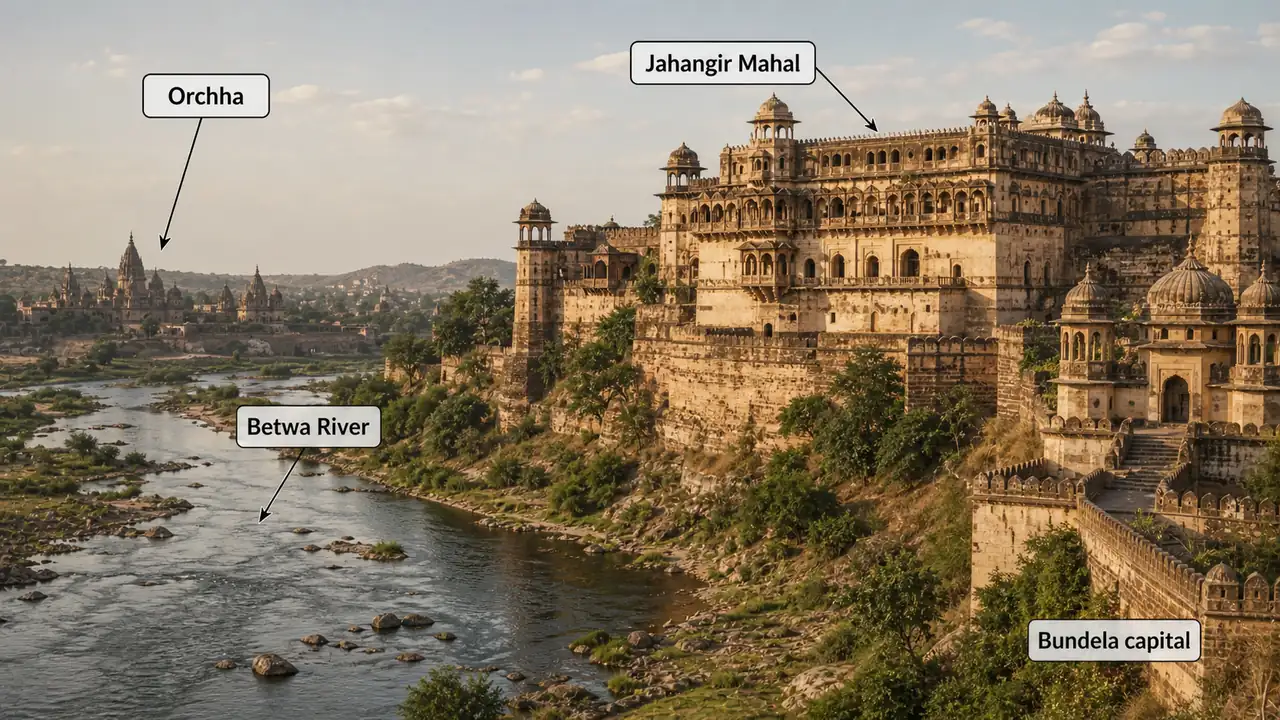
Orchha — The Bundela Capital
Rudra Pratap Singh founded Orchha in 1501 as the capital of the Bundela kingdom. Though Orchha town lies in present-day Madhya Pradesh (Tikamgarh district), the Bundela kingdom's territory covered much of what is now UP's Bundelkhand.
Key Orchha Rulers
| Ruler | Period | Significance |
|---|---|---|
| Rudra Pratap | 1501-1531 | Founded Orchha; built initial fortifications |
| Madhukar Shah | 1554-1592 | Devotee of Krishna; resisted Akbar initially |
| Bir Singh Deo | 1605-1627 | Allied with Prince Salim (Jahangir); built Jahangir Mahal |
| Jujhar Singh | 1627-1635 | Rebelled against Shah Jahan; defeated and killed |
Bir Singh Deo is one of the most prominent Bundela rulers. He assassinated Akbar's historian Abul Fazl in 1602 on Prince Salim's orders. When Salim became Emperor Jahangir, Bir Singh was rewarded with the Orchha kingdom and rose greatly in power and prestige.
He built the magnificent Jahangir Mahal at Orchha to welcome Emperor Jahangir, and also constructed the Bir Singh Palace at Datia — one of the finest examples of Bundela architecture.
Chhatrasal — The Bundela Hero
Maharaja Chhatrasal (1649-1731) is the best-known Bundela hero and a figure of major importance in Bundelkhand history. Born in Kachar Kachnar (Tikamgarh), he grew up amid conflict between local chiefs and Mughal power.
Revolt Against the Mughals
After briefly serving in Aurangzeb's army, Chhatrasal was inspired by Shivaji's example and launched a rebellion against Mughal authority in Bundelkhand in 1671. Over the next decades, he liberated vast territories:
- Broke Mughal control across large parts of Bundelkhand
- Established his capital at Panna (famous for diamond mines)
- Extended control over Mahoba, Banda, Kalinjar, and Jhansi regions
- Patronized art, literature, and the famous poet Bhushan, who composed heroic ballads (veer ras kavya) praising both Shivaji and Chhatrasal
Alliance with the Marathas
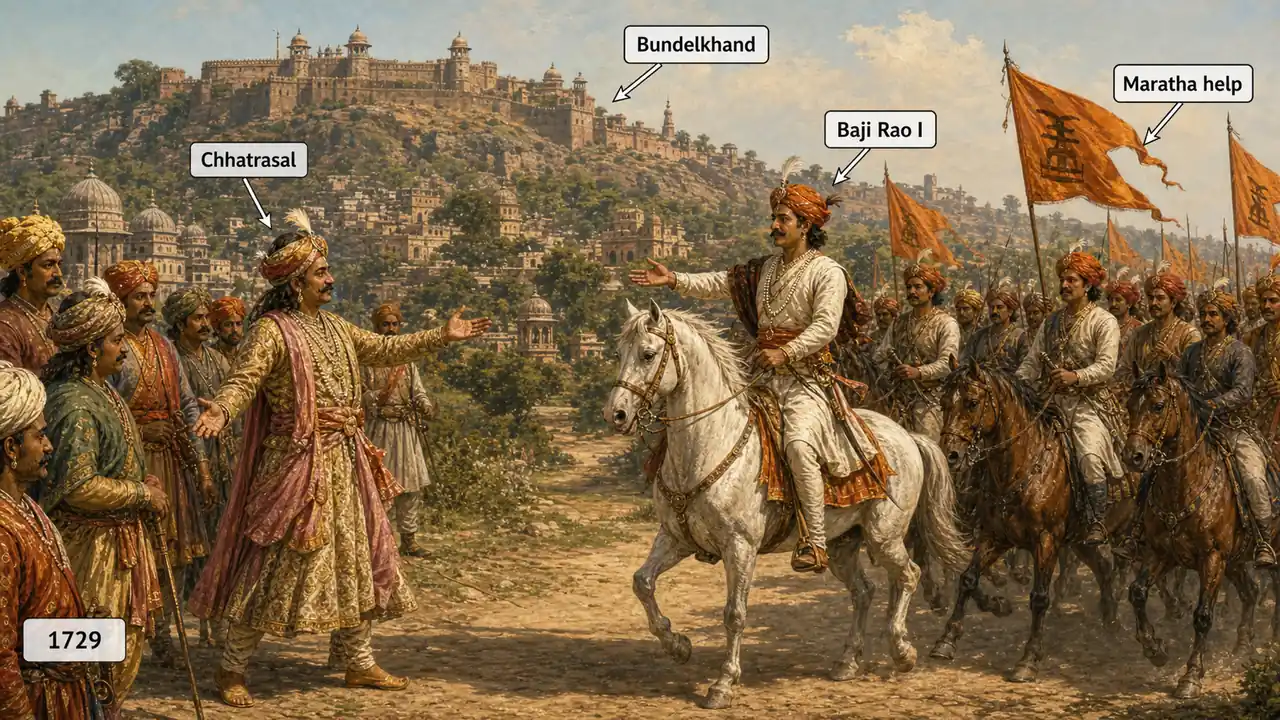
In his old age, when attacked by Muhammad Khan Bangash (Mughal governor of Allahabad) in 1729, Chhatrasal appealed to the Maratha Peshwa. Baji Rao I personally led a Maratha army to rescue Chhatrasal.
In gratitude, Chhatrasal granted one-third of his kingdom to the Marathas. This is one of the major historical reasons why Jhansi later came under Maratha influence and control.
| Event | Year | Significance |
|---|---|---|
| Chhatrasal's revolt begins | 1671 | Independence from Mughal control |
| Capital established | Panna | Diamond mines funded the kingdom |
| Bangash invasion | 1729 | Chhatrasal calls Maratha help |
| Baji Rao I rescues Chhatrasal | 1729 | One-third of Bundelkhand given to Marathas |
| Chhatrasal's death | 1731 | Kingdom divided among sons & Marathas |
Exam Tip: Chhatrasal's alliance with Baji Rao I is the key historical link between Bundelkhand and the Marathas. This helps explain how Jhansi later became a Maratha-governed territory before the British period.
Ruhela Afghans of Rohilkhand
The Rohilkhand region of western UP (modern Bareilly, Moradabad, Rampur, Bijnor, Shahjahanpur, Budaun, and Pilibhit) takes its name from the Ruhela (Rohilla) Afghans who established dominance there in the 18th century.
Key Facts
- Ali Muhammad Khan was the founder of Ruhela power in Rohilkhand (early 18th century)
- The Ruhelas were Pashtun (Afghan) settlers who came to India as soldiers and administrators
- Hafiz Rahmat Khan was the most prominent Ruhela chief, known for his justice and administration
- He was killed in the Battle of Miranpur Katra (1774) when Shuja-ud-Daula of Awadh, aided by the British, invaded Rohilkhand
| Fact | Detail |
|---|---|
| Region | Rohilkhand (western UP) |
| Ethnic origin | Pashtun / Afghan |
| Founder | Ali Muhammad Khan |
| Greatest chief | Hafiz Rahmat Khan |
| Fall of Ruhela power | 1774 (Battle of Miranpur Katra) |
| Modern legacy | Rampur Nawabs (continued as British feudatory) |
The Rampur Nawabs survived as a princely state under British protection. Rampur's Raza Library, associated with the Nawabi legacy, contains one of India's major collections of Islamic manuscripts, miniature paintings, and rare historical documents.
Bais Rajputs & Other Clans
Several Rajput clans controlled pockets of territory across UP during the medieval period:
Bais Rajputs
The Bais clan dominated parts of Awadh, particularly the Rae Bareli, Unnao, and Sultanpur areas. They were among the oldest Rajput clans of UP, claiming descent from the Suryavanshi (Solar) lineage. Their stronghold was Daundia Khera in Unnao district.
Bhar Rulers
The Bhars were a pre-medieval ruling community who controlled parts of eastern UP (Jaunpur, Azamgarh, Ghazipur) before the Turkish invasions. Archaeological evidence of Bhar fortifications (garhi) can be found across eastern UP. They were displaced by the Sultanate rulers in the 13th-14th centuries.
Gaharwar (Rathore) Clan
The Gaharwar Rajputs are associated with Varanasi and adjoining regions in medieval tradition. Their most famous ruler in this broad historical memory is Jayachandra (defeated by Muhammad Ghori in 1194).
| Clan | Region | Key Fact |
|---|---|---|
| Bais | Rae Bareli, Unnao, Sultanpur | Suryavanshi lineage; Daundia Khera stronghold |
| Bhar | Eastern UP (Jaunpur, Azamgarh) | Pre-medieval rulers; displaced by Sultanate |
| Gaharwar | Varanasi | Jayachandra defeated at Chandawar (1194) |
| Chandela | Mahoba, Kalinjar | Khajuraho builders; influence extended into UP |
Chandela Influence in UP
The Chandela dynasty is primarily associated with Madhya Pradesh (Khajuraho temples), but their influence extended significantly into UP. The Chandela forts at Kalinjar (Banda district) and Mahoba (Mahoba district) are in present-day UP.
Kalinjar Fort is one of the most ancient and strategically important forts in north India. It was contested by many major powers of the region — from the Chandelas to the Mughals. Sher Shah Suri died during the siege of Kalinjar in 1545.
Alha-Udal — the legendary Chandela warriors of Mahoba — are celebrated in the folk epic "Alha Khand", which is one of the most popular oral traditions of Bundelkhand and UP. Their story of valour against Prithviraj Chauhan is recited in villages to this day.
Summary Cheat Sheet
| Fact | Answer |
|---|---|
| Orchha founder | Rudra Pratap Singh (1501) |
| Most prominent Orchha ruler | Bir Singh Deo |
| Chhatrasal's revolt | 1671 against Mughals |
| Chhatrasal's capital | Panna |
| Chhatrasal's poet | Bhushan |
| Maratha alliance | 1729, Baji Rao I |
| Jhansi-Maratha link | Chhatrasal's post-1729 alliance and territorial grant |
| Ruhela founder | Ali Muhammad Khan |
| Ruhela fall | Battle of Miranpur Katra (1774) |
| Rampur legacy | Raza Library (Islamic manuscripts) |
| Kalinjar Fort district | Banda |
| Sher Shah died at | Siege of Kalinjar (1545) |
Lesson Doubts
Ask questions, get expert answers