🪵 Wood Carving, Inlay & Stone Craft
Explore Saharanpur's wood carving, Agra's Pietra Dura stone inlay, Mainpuri's Tarkashi, Aligarh's locks, and Meerut's sports goods — UP's diverse craft traditions.
Introduction
Uttar Pradesh is home to a remarkable diversity of wood, stone, and mixed-material crafts. From Saharanpur's carved sheesham wood to Agra's Pietra Dura linked with the Taj Mahal, these traditions blend Mughal-era artistry with local innovation. The lesson is best studied as a district-craft mapping exercise.
Saharanpur — India's Wood Carving Capital
History
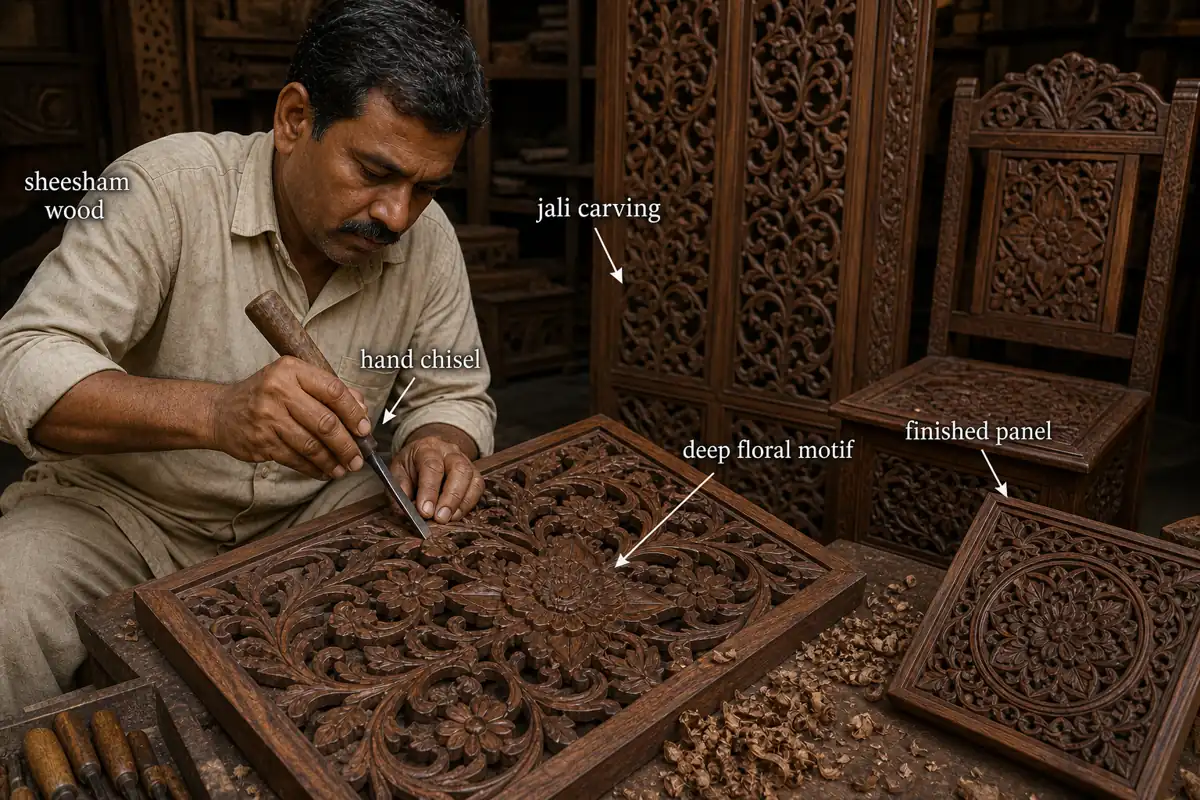
Saharanpur is one of India's best-known centres of wood carving, with a tradition linked to the Mughal period. The craft is associated with artisans who carved wooden screens (jali) and furniture for elite and religious settings. Under British rule, the craft expanded further as a commercial export industry.
Material & Technique
The primary wood used is Sheesham (Indian Rosewood / Dalbergia sissoo) — prized for its dark grain, durability, and ease of carving.
| Technique | Description |
|---|---|
| Deep carving (Khudai) | Three-dimensional floral and geometric motifs carved into solid wood |
| Lattice work (Jali) | Intricate perforated screens with geometric or floral patterns |
| Inlay | Brass wire or bone pieces set into carved channels |
| Lathe turning | Rounded shapes for table legs, bed posts, decorative pillars |
| Lacquer finishing | Polishing with natural or synthetic lacquer for shine |
Products
- Furniture: folding tables, screens, bookshelves, cabinets, bed frames
- Decorative: wall panels, mirror frames, jewellery boxes
- Architectural: doors, window frames, partitions
- Religious: temple mandaps, mosque mihrab screens
Economic Impact
| Parameter | Detail |
|---|---|
| Units | Large cluster of wood carving workshops |
| Employment | Large artisan workforce |
| Annual output | Major craft-industry output |
| Exports | USA, Europe, Middle East, Japan |
| GI status | Saharanpur Wood Carving is GI tagged |
| ODOP | Identified as Saharanpur's One District One Product |
Nagina — Ebony & Horn Craft
Nagina in Bijnor district is known for crafting decorative items from ebony wood, buffalo horn, and bone.
- Products: walking sticks, knife handles, chess sets, decorative animals, buttons
- Horn items are made by heating, flattening, and moulding buffalo horn into shapes
- The craft has long been associated with specialist artisan communities
- Small-scale but culturally significant industry
Agra — Pietra Dura / Parchin Kari
The Taj Mahal Technique
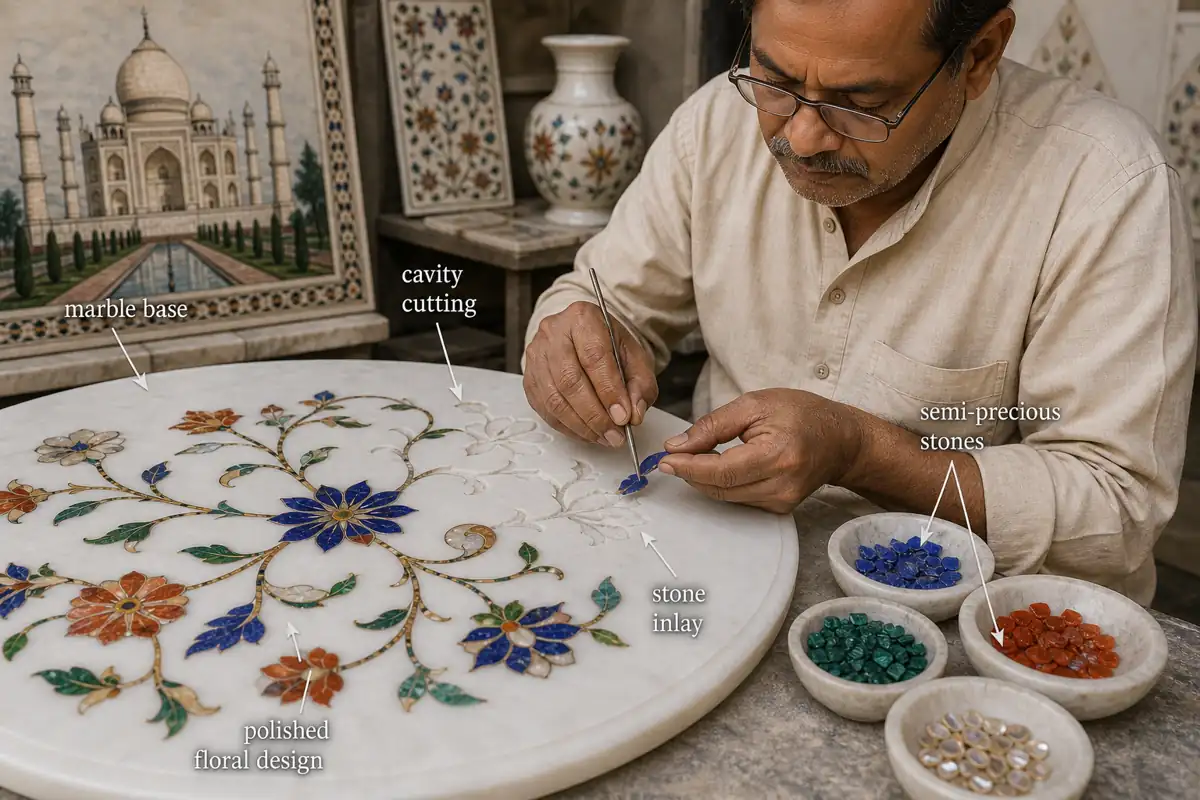
Agra is the living centre of Pietra Dura (Italian: "hard stone") or Parchin Kari — the art of inlaying semi-precious stones into marble to create intricate floral and geometric designs.
This technique reached its peak during the construction of the Taj Mahal (1632-1653) under Shah Jahan. Italian and Central Asian artisans worked alongside Indian craftsmen to develop this uniquely Mughal art form.
Process
- Design — pattern drawn on marble surface
- Cavity cutting — marble chiselled to create precise recesses for each stone piece
- Stone shaping — semi-precious stones (lapis lazuli, cornelian, malachite, jasper, mother-of-pearl, onyx) cut and ground to exact shapes
- Inlaying — stone pieces fitted into cavities with natural adhesive
- Polishing — surface polished to seamless finish
Stones Used
| Stone | Colour |
|---|---|
| Lapis Lazuli | Deep blue |
| Cornelian (Carnelian) | Orange-red |
| Malachite | Green |
| Jasper | Red-brown |
| Mother of Pearl | Iridescent white |
| Onyx | Black |
| Turquoise | Blue-green |
Modern Industry
- Agra continues to have a substantial cluster of Parchin Kari workshops, especially in areas linked with the Taj tourism economy
- Products: marble tabletops, plates, boxes, coasters, chess boards, wall panels
- Major buyer market: tourists (domestic and international)
- Export market growing through e-commerce and trade fairs
- Artisan families have practiced the craft for 15-20 generations
Mainpuri — Tarkashi (Wire Inlay on Wood)
Mainpuri district is the best-known centre for Tarkashi — the delicate art of inlaying thin brass or copper wire into sheesham wood to create geometric and floral patterns.
Technique
- Sheesham wood base is shaped and smoothed
- Fine grooves are carved into the wood surface following the design
- Thin brass or copper wire is hammered into the grooves
- Surface is sanded and polished until wire sits flush with wood
Products & Status
- Jewellery boxes, trays, coasters, pen stands, decorative plates
- Extremely intricate — a small box can take weeks to complete
- Mainpuri Tarkashi has received GI recognition
- Few artisan families remain; the craft is endangered
- Government and NGO efforts underway for revival
Other Notable Crafts
Aligarh — Lock Manufacturing (Tala Nagari)
Aligarh is strongly associated with lock manufacturing, as covered in the metalware lesson. The industry also intersects with hardware craft — decorative locks, antique-style locks, and custom security solutions.
Meerut — Sports Goods & Scissors
Meerut is one of India's major sports goods manufacturing centres, producing:
| Product | Detail |
|---|---|
| Cricket bats | Willow and poplar wood, supplied nationwide |
| Hockey sticks | Mulberry wood, composite materials |
| Boxing gloves | Leather and synthetic |
| Scissors | "Meerut Scissors" — a GI-tagged product |
| Other | Footballs, volleyball nets, gym equipment |
The sports goods industry in Meerut supports a large manufacturing workforce. Meerut Scissors received a GI tag, recognising the city's long tradition of blade-making.
Mirzapur — Stone Crafts
- Sandstone quarrying and carving tradition
- Products: pillars, statues, garden furniture, building stone
- Connected to the region's historical fort and temple architecture
District-Craft Mapping (Quick Reference)
| District | Craft | Nickname/Tag |
|---|---|---|
| Saharanpur | Wood carving (sheesham) | GI Tagged |
| Nagina (Bijnor) | Ebony, horn, bone craft | — |
| Agra | Pietra Dura / Parchin Kari | Taj Mahal technique |
| Mainpuri | Tarkashi (wire inlay) | GI Tagged |
| Aligarh | Lock manufacturing | Tala Nagari |
| Meerut | Sports goods, scissors | GI (scissors) |
| Mirzapur | Sandstone carving | — |
Summary Cheat Sheet
| Craft Centre | Product | Key Fact |
|---|---|---|
| Saharanpur | Wood carving | Sheesham wood, GI tagged |
| Nagina | Ebony/horn craft | Bijnor district, decorative items |
| Agra | Pietra Dura | Semi-precious stone inlay on marble |
| Mainpuri | Tarkashi | Brass wire inlay on wood, GI tagged |
| Aligarh | Locks | Tala Nagari; major lock-manufacturing centre |
| Meerut | Sports goods + scissors | Scissors GI tagged |
Lesson Doubts
Ask questions, get expert answers