🎭 Nautanki, Charkula & Swang
Nautanki folk theater styles of Hathras and Kanpur, Charkula lamp dance of Braj, and Swang satirical drama — essential UP folk arts for Uttar Pradesh GK.
Nautanki — The People's Theater
Nautanki is one of the most popular folk theater forms of Uttar Pradesh and one of the most celebrated folk performance traditions of North India. It combines music, dialogue, drama, and dance to tell stories drawn from romance, history, and legend.
The name "Nautanki" is commonly linked in popular tradition to Princess Nautanki of Multan, whose love story with Phool Singh became one of the best-known tales in the tradition.
Origins and Spread
Nautanki emerged in the 18th–19th century from the Bhagat and Swang traditions of western UP. It became the dominant entertainment form in rural and semi-urban areas before cinema arrived. Even today, Nautanki troupes perform at fairs, weddings, and festivals across UP and neighboring states.
Two Styles of Nautanki
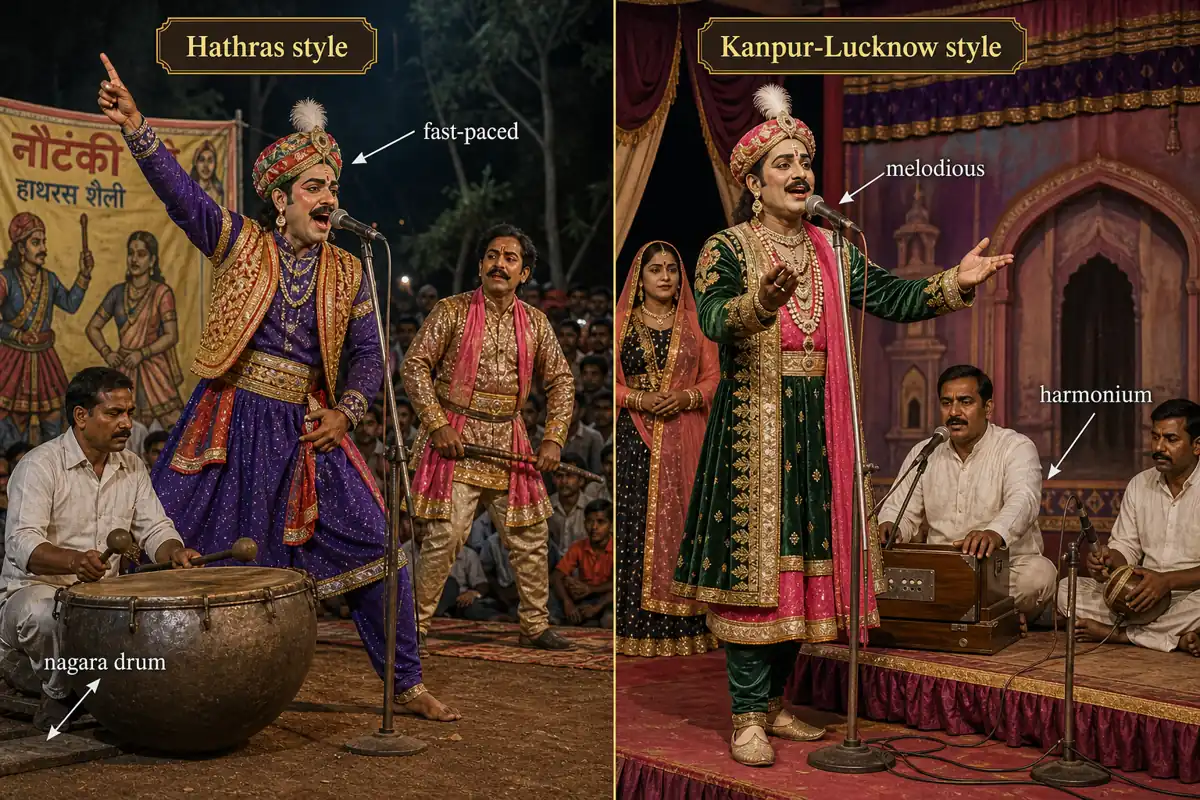
Nautanki developed two distinct regional styles, each with its own artistic identity:
Hathras Style
| Feature | Detail |
|---|---|
| Region | Hathras |
| Character | Fast-paced, percussion-driven, energetic |
| Music | Dominated by nagara drum (large kettledrum) |
| Singing | High-pitched, powerful vocals |
| Pioneer | Inderaman of Hathras (19th century) |
| Stage | Open-air, minimal props, audience on all sides |
Kanpur/Lucknow Style
| Feature | Detail |
|---|---|
| Region | Kanpur and Lucknow |
| Character | Melodious, nuanced, theatrical |
| Music | Harmonium-led, softer instrumentation |
| Singing | Tuneful, closer to semi-classical style |
| Pioneer line | Sri Krishna Pahalwan and later Natharam Sharma Gaur are strongly associated with this tradition |
| Stage | Raised platform, more elaborate staging |
Exam Tip: Hathras = Nagara drum + Fast. Kanpur = Harmonium + Melodious. Two styles, one art form.
Famous Nautanki Stories
Nautanki performances draw from a rich repertoire of romantic legends, heroic tales, and moral stories:
| Story | Theme |
|---|---|
| Laila-Majnu | Tragic love |
| Shirin-Farhad | Devotion and sacrifice |
| Amar Singh Rathore | Rajput valor and honor |
| Harishchandra | Truth and righteousness |
| Sultana Daku | Bandit legend of the Chambal |
| Syah Posh | Adventure and romance |
| Nautanki-Phool Singh | The original Nautanki love story |
Performance Elements
- Ranga — the opening invocation song
- Doha/Chaubola — poetic verses recited between scenes
- Lavani — rhythmic sung couplets that advance the narrative
- Nagara — the signature kettledrum whose beats punctuate every scene transition
- Vidushak — the comic character who provides satire and audience engagement
Charkula — The Dance of 108 Lamps
Charkula is a striking folk dance associated with the Braj region of western UP. It is remembered in UP GK as one of the most visually distinctive dances of the region.
What Makes Charkula Unique
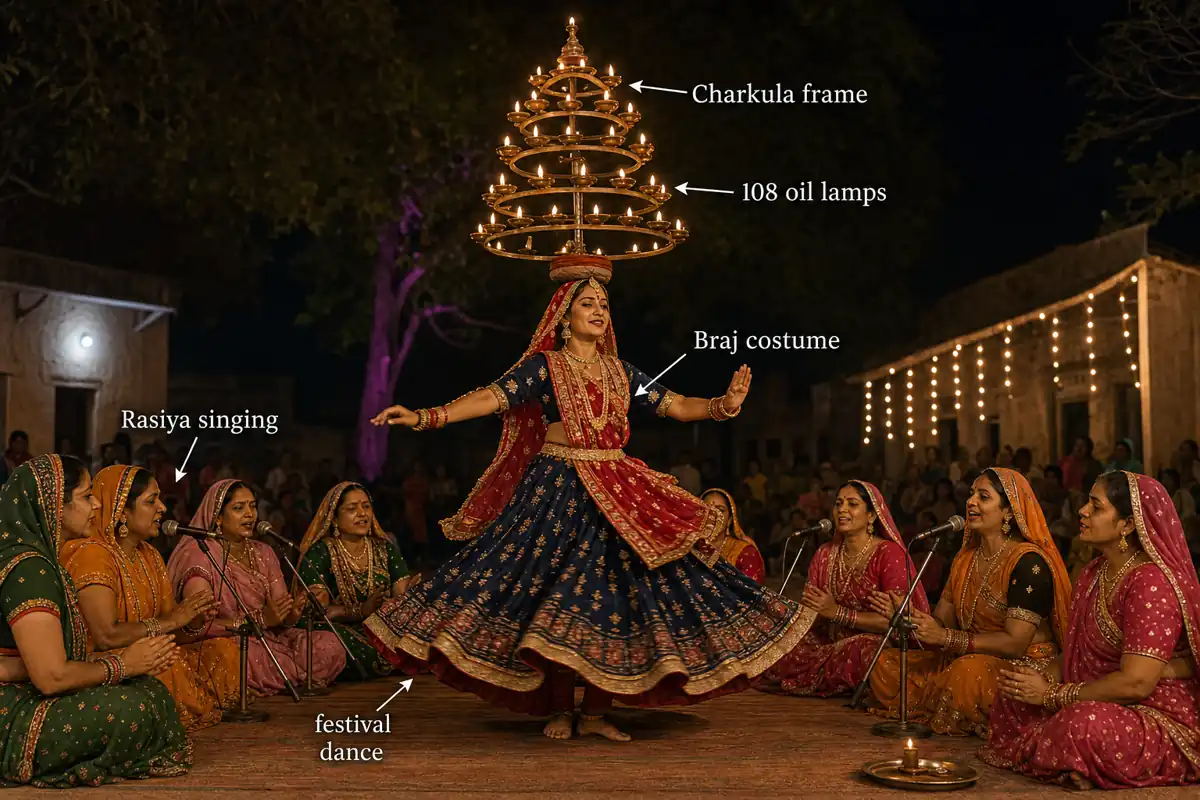
A woman dancer balances a multi-tiered brass or wooden pyramid frame (charkula) holding 108 oil lamps on her head while performing graceful dance movements. The total weight can exceed 30–40 kilograms.
| Aspect | Detail |
|---|---|
| Region | Braj (Mathura, Agra, Hathras) |
| Occasion | Festival calendar of Braj, especially around Holi-related celebrations |
| Performers | Women of the Braj community |
| Music | Rasiya songs in Braj Bhasha |
| Lamps | 108 oil lamps arranged on tiered frame |
| Symbolism | Devotional celebration, light, festivity, and Braj cultural identity |
Exam Tip: Charkula = 108 lamps + Braj + Holi-season festival setting. The "108" number is a frequent exam question.
Performance Style
The dancer moves in slow, swaying circles while the Charkula frame stays balanced. Other women surround her, singing Rasiya folk songs about Radha-Krishna. The illuminated lamp structure is one reason the dance is often associated with evening or night performance settings.
Swang — The Satirical Folk Drama
Swang (also spelled Svang) is a folk dramatic form combining music, dialogue, and mimicry to deliver social commentary through humor and satire.
Key Features
| Aspect | Detail |
|---|---|
| Region | Western UP (Hathras, Aligarh, Agra) and Haryana |
| Purpose | Social satire, moral instruction, entertainment |
| Language | Local dialects — Braj Bhasha, Khariboli |
| Style | Exaggerated acting, mimicry, comic timing |
| Themes | Caste hypocrisy, corrupt officials, moral tales |
| Relation to Nautanki | Swang is considered a parent form from which Nautanki evolved |
Swang vs Nautanki
| Parameter | Swang | Nautanki |
|---|---|---|
| Age | Older tradition | Evolved from Swang |
| Focus | Social satire | Romance and heroism |
| Music | Simpler, conversational | Elaborate musical scores |
| Scale | Smaller, informal | Large productions with troupes |
| Popularity | Declining | Still performed widely |
Swang was closely tied to community gatherings, local fairs, and performance-based social commentary in north Indian rural culture.
Decline and Revival Efforts
All three art forms have faced decline due to cinema, television, and urbanization. However, revival initiatives include:
- Sangeet Natak Akademi — awards and documentation of folk artists
- UP government cultural festivals — Lucknow Mahotsav, Taj Mahotsav feature Nautanki
- University departments — BHU and Agra University document and archive performances
- NGO initiatives — training new generations in Charkula and Nautanki
Summary Cheat Sheet
| Fact | Answer |
|---|---|
| Major folk theater of UP | Nautanki |
| Nautanki name link | Popularly linked with Princess Nautanki of Multan |
| Hathras style instrument | Nagara (kettledrum) |
| Kanpur style character | Melodious, harmonium-based |
| Hathras Nautanki pioneer | Inderaman |
| Charkula region | Braj (Mathura) |
| Charkula lamps count | 108 oil lamps |
| Charkula setting | Braj festival tradition, often linked with Holi-season celebration |
| Swang region | Western UP (Hathras, Aligarh) |
| Swang relation to Nautanki | Parent/ancestor form |
Lesson Doubts
Ask questions, get expert answers