🎶 Folk Songs of UP
Kajri, Birha, Rasiya, Chaiti, Sohar, Aalha, Thumri, and Qawwali — complete guide to folk song traditions of Uttar Pradesh for Uttar Pradesh GK.
The Folk Song Heritage of UP
Uttar Pradesh has a highly diverse folk song tradition. Each region, season, and life event has its own musical expression. These songs are not merely entertainment; they also preserve community memory, emotion, and cultural identity.
Kajri / Kajari — Songs of the Rains
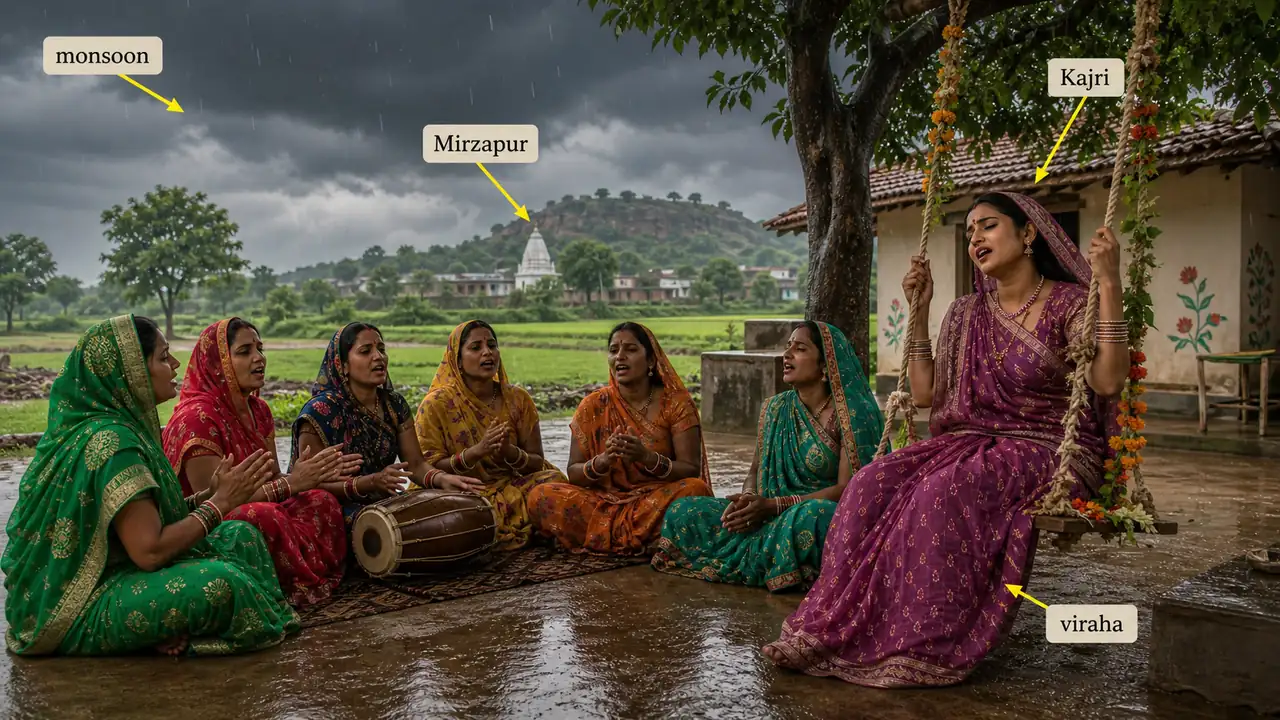
Kajri (Kajari) is one of the best-known folk song genres of UP, strongly associated with the Mirzapur region. It is a monsoon song expressing a woman's longing for her beloved during the rainy season.
| Aspect | Detail |
|---|---|
| Region | Mirzapur, Varanasi, Prayagraj |
| Season | Sawan-Bhadon (monsoon, July-September) |
| Theme | Separation (viraha), monsoon beauty, longing |
| Performers | Primarily women; also competitive male groups |
| Raga connection | Often set to Raga Des or Tilak Kamod |
Kajri comes in two forms:
- Bandish Kajri — structured, semi-classical, performed on stage
- Desi Kajri — spontaneous, sung in fields and homes during monsoon
Mirzapur holds an annual Kajri competition that draws singers from across eastern UP. The Kajri tradition has influenced Thumri and other light classical forms.
Exam Tip: Kajri = Mirzapur + Monsoon + Women's viraha songs. The most-asked folk song in exams.
Birha — Songs of Separation
Birha is a powerful folk singing tradition of eastern UP (Purvanchal), expressing deep sorrow, separation, and philosophical reflection.
| Aspect | Detail |
|---|---|
| Region | Eastern UP (Varanasi, Azamgarh, Jaunpur, Ballia) |
| Theme | Separation (biraha), sorrow, social commentary |
| Style | Solo singing with competitive element |
| Format | Akhara (competitive singing bouts) — two singers face off |
| Music | Dholak, harmonium, clarinet |
| Famous exponent | Hiranath Mishra "Sujan" |
Birha is unique because of its competitive format (dangal/akhara) — singers challenge each other with improvised verses, judged by the audience's response. Topics range from mythological tales to contemporary social issues.
Rasiya — The Love Songs of Braj
Rasiya is the signature folk song of the Braj region (Mathura, Agra, Hathras), celebrating the eternal love of Radha and Krishna.
| Aspect | Detail |
|---|---|
| Region | Braj (Mathura, Vrindavan, Agra, Hathras) |
| Season | Holi season (also year-round) |
| Theme | Radha-Krishna love, playful romance, Holi colors |
| Language | Braj Bhasha |
| Performance | Group singing with dancing, Charkula accompaniment |
Rasiya songs form the musical backbone of Braj festivals — no Holi celebration in Mathura-Vrindavan is complete without Rasiya. The songs are characterized by their playful, teasing tone and call-and-response format.
Chaiti — Spring Devotional Songs
Chaiti is sung during the month of Chaitra (March-April), marking the arrival of spring and the Hindu new year (Chaitra Shukla Pratipada).
| Aspect | Detail |
|---|---|
| Region | Eastern UP, Awadh |
| Season | Chaitra month (March-April) |
| Theme | Spring, devotion, seasonal change |
| Style | Melodious, devotional, often addressed to Ram or Hanuman |
| Raga | Often uses Raga Chaiti or allied ragas |
Chaiti has a semi-classical variant that has been adopted by Thumri singers of the Banaras tradition.
Sohar — Songs of Childbirth
Sohar is a celebration song sung at the birth of a child, especially a son, in families across UP.
| Aspect | Detail |
|---|---|
| Region | Pan-UP (all regions) |
| Occasion | Childbirth celebrations |
| Performers | Women of the family and neighborhood |
| Theme | Joy of new life, blessings, reference to Krishna's birth |
| Instruments | Dholak, thali (plate used as percussion) |
Sohar songs often draw parallels between the newborn and infant Krishna — "Nand ke anand bhayo, jai Kanhaiya Lal ki" is a classic Sohar line referencing Krishna's birth at Mathura.
Hori — Songs of Holi
Hori songs are specifically composed for the Holi festival, celebrating colors, spring, and Radha-Krishna's playful interactions.
| Aspect | Detail |
|---|---|
| Region | Pan-UP, especially Braj and Awadh |
| Season | Phalgun (February-March), Holi |
| Theme | Colors, playful love, spring revelry |
| Style | Lively, rhythmic, group singing |
| Classical form | Hori is also a recognized light classical genre in Hindustani music |
Aalha / Alha — Heroic Ballads
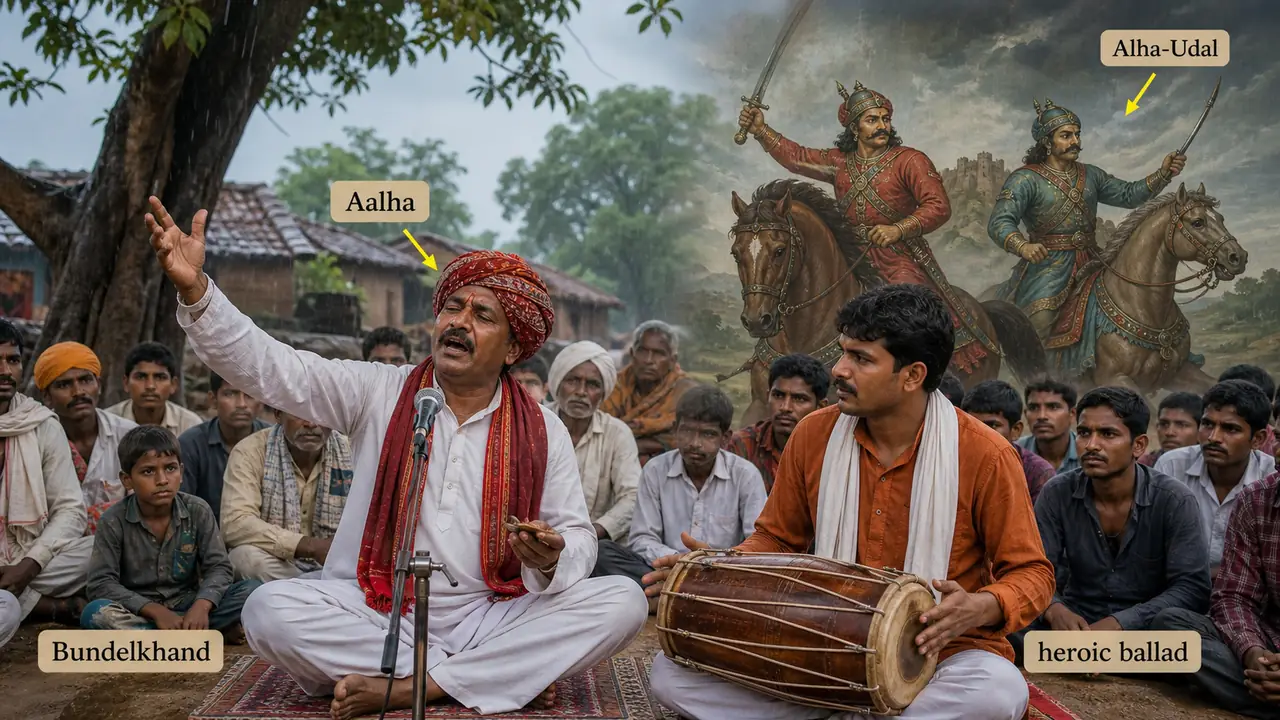
Aalha (Alha) is one of the most important heroic ballad traditions associated with Bundelkhand.
| Aspect | Detail |
|---|---|
| Region | Bundelkhand (Mahoba, Jhansi, Banda) |
| Season | Monsoon (Sawan) — especially associated with the rainy season |
| Theme | Heroic exploits of Alha and Udal, warrior brothers of Mahoba |
| Source | Alha-Khand from the epic Parmal Raso by Jagnik (12th century) |
| Patron | Parmal (Paramardideva), Chandela king of Mahoba |
| Style | Vigorous, dramatic, martial rhythm |
Alha and Udal were generals of King Parmal who fought against Prithviraj Chauhan. The ballad is often described as having 52 episodes (ladaiyaan/battles), each celebrating a different military campaign. Aalha singing is known for its martial energy, and colonial authorities were at times wary of traditions that could stir collective enthusiasm.
Exam Tip: Aalha = Bundelkhand + Alha-Udal warriors + Monsoon singing + 52 battles.
Thumri — The Semi-Classical Gem
Thumri is a semi-classical vocal form strongly developed in Lucknow under the patronage of Nawab Wajid Ali Shah, and later flourished prominently in Banaras as well.
| Aspect | Detail |
|---|---|
| Origin | Lucknow (Nawabi patronage) |
| Theme | Romantic love, often Radha-Krishna or nayika-bhava |
| Style | Emotive, ornamental, lighter than Khayal |
| Patron | Nawab Wajid Ali Shah |
| Famous exponents | Begum Akhtar, Girija Devi (Banaras), Siddheshwari Devi |
Two styles exist: Lucknow (bol-banao Thumri, slow, expressive) and Banaras (bandish Thumri, rhythmic, structured).
Qawwali — The Sufi Tradition
Qawwali has deep roots in UP through the Sufi tradition, especially at the Deva Sharif dargah (Barabanki).
| Aspect | Detail |
|---|---|
| Tradition | Sufi devotional music |
| Key center | Deva Sharif (Barabanki) — shrine of Haji Waris Ali Shah |
| Style | Call-and-response group singing with clapping |
| Instruments | Harmonium, tabla, dholak |
| Function | Spiritual ecstasy (wajd) through repetitive devotional phrases |
Master Reference Table
| Folk Song | Region | Season/Occasion | Theme |
|---|---|---|---|
| Kajri | Mirzapur | Monsoon (Sawan) | Separation, rain |
| Birha | Eastern UP | Year-round | Sorrow, competition |
| Rasiya | Braj | Holi | Radha-Krishna love |
| Chaiti | Eastern UP | Chaitra (spring) | Devotion, spring |
| Sohar | Pan-UP | Childbirth | Joy, blessings |
| Hori | Pan-UP | Holi (Phalgun) | Colors, spring |
| Aalha | Bundelkhand | Monsoon | Heroic ballad |
| Thumri | Lucknow | Year-round | Romantic expression |
| Qawwali | Awadh | Year-round | Sufi devotion |
Summary Cheat Sheet
| Fact | Answer |
|---|---|
| Best-known UP folk song | Kajri |
| Kajri strong association | Mirzapur |
| Kajri season | Sawan (monsoon) |
| Birha format | Competitive akhara singing |
| Rasiya region | Braj (Mathura) |
| Aalha warriors | Alha and Udal of Mahoba |
| Aalha battles count | 52 episodes |
| Thumri patron | Nawab Wajid Ali Shah |
| Sohar occasion | Childbirth |
| Qawwali center in UP | Deva Sharif (Barabanki) |
Lesson Doubts
Ask questions, get expert answers