🙏 Kumbh Mela & Magh Mela
Maha Kumbh at Prayagraj, Ardh Kumbh, Magh Mela, Shahi Snan dates, Akharas, UNESCO Heritage status — complete guide for Uttar Pradesh GK.
Kumbh Mela — The Largest Human Gathering on Earth
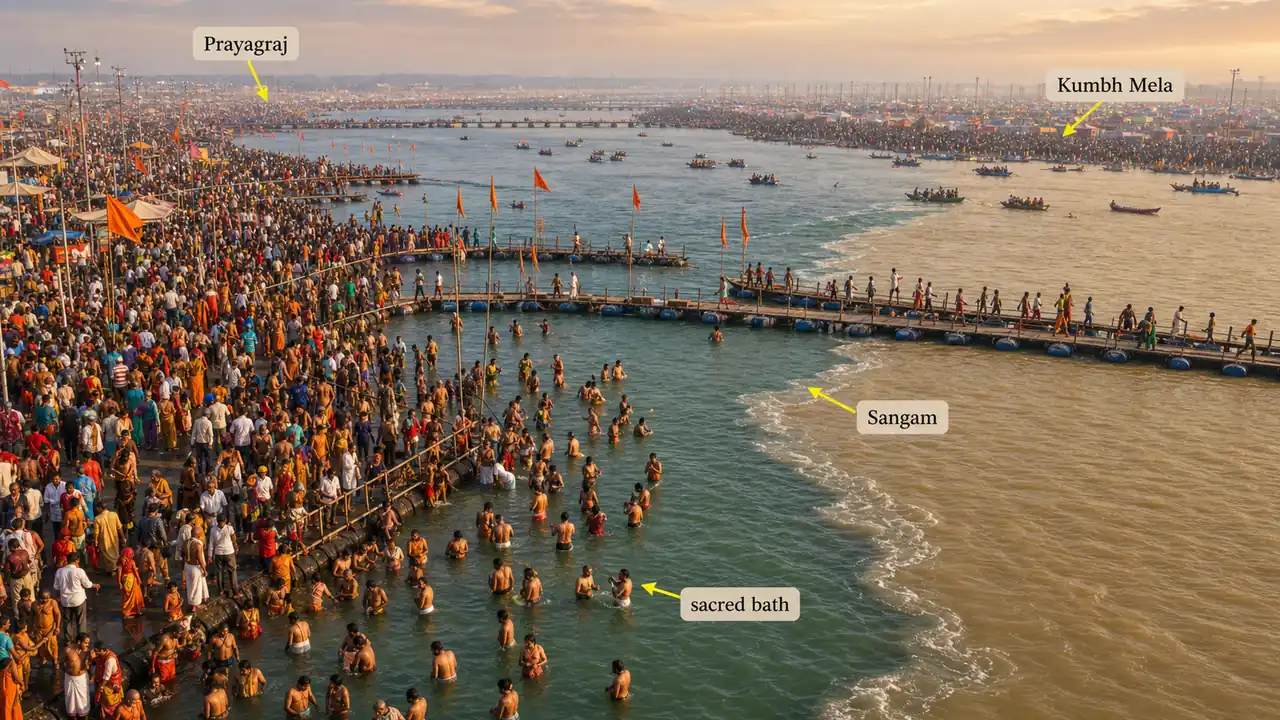
Kumbh Mela is one of the world's largest religious gatherings, held at the Sangam in Prayagraj — the sacred confluence of the Ganga, Yamuna, and the revered Saraswati tradition. It is a pilgrimage of faith, ritual bathing, and spiritual discourse that draws very large numbers of devotees.
UNESCO Recognition
Kumbh Mela was inscribed on UNESCO's Representative List of Intangible Cultural Heritage of Humanity in 2017. UNESCO described it as the "largest peaceful congregation of pilgrims on earth."
The Mythology — Samudra Manthan
The origin of Kumbh Mela lies in the Samudra Manthan (Churning of the Ocean) mythology from the Puranas.
During the churning, a Kumbh (pot) of Amrit (nectar of immortality) emerged. The Devas and Asuras fought over it. As Dhanvantari and Jayanta (or Garuda in some versions) carried the pot across the sky, drops of Amrit fell at four locations on earth — these became the four Kumbh sites.
The Four Kumbh Sites
| Site | River | State |
|---|---|---|
| Prayagraj | Ganga-Yamuna-Saraswati (Sangam) | Uttar Pradesh |
| Haridwar | Ganga | Uttarakhand |
| Ujjain | Kshipra | Madhya Pradesh |
| Nashik-Trimbakeshwar | Godavari | Maharashtra |
Exam Tip: Four Kumbh sites = Prayagraj, Haridwar, Ujjain, Nashik. Only Prayagraj and Haridwar are in the Ganga basin.
The Kumbh Cycle
The Kumbh Mela follows a 12-year astronomical cycle based on the positions of Jupiter (Brihaspati) and the Sun. The rotation among the four sites means each site hosts Kumbh once every 12 years.
| Type of Mela | Frequency | Scale |
|---|---|---|
| Maha Kumbh | Every 12 years at each site | Largest — tens of millions attend |
| Ardh Kumbh | Every 6 years (held only at Prayagraj and Haridwar) | Large — millions attend |
| Magh Mela | Annual (at Prayagraj) | Significant — lakhs attend |
Astronomical Conditions for Prayagraj Kumbh
Traditional astronomical reckoning for the Prayagraj Kumbh is described through combinations involving:
- Jupiter (Brihaspati) is in Vrishabha (Taurus) rashi
- Sun and Moon are in Makar (Capricorn) rashi
Kumbh 2019 — Record-Breaking Numbers
The 2019 Kumbh at Prayagraj (officially called "Kumbh" by the UP government, though astronomically an Ardh Kumbh) set extraordinary records:
| Statistic | Figure |
|---|---|
| Total visitors | Officially reported around 240 million (24 crore) over 49 days |
| Peak single day | Officially reported around 50 million on Mauni Amavasya |
| Area of tent city | ~3,200 hectares |
| Temporary pontoon bridges | 22 |
| Toilets installed | 1,22,000+ |
| LED lights | 40,000+ |
| Visible from space | Yes — NASA satellite imagery confirmed the tent city's scale |
Exam Tip: 2019 Prayagraj Kumbh is widely remembered for the official figure of about 24 crore visitors.
Shahi Snan — The Royal Bathing Dates
Shahi Snan (Royal Bath) days are the most auspicious bathing dates during Kumbh. On these days, the Akharas lead grand processions to the Sangam.
Key Shahi Snan Dates
| Snan | Occasion | Significance |
|---|---|---|
| Makar Sankranti | First Shahi Snan | Sun enters Capricorn — opening of Kumbh |
| Mauni Amavasya | Most important Snan | Largest crowd, most auspicious day |
| Basant Panchami | Third Shahi Snan | Arrival of spring |
| Maghi Purnima | Fourth Snan | Full moon of Magh |
| Maha Shivaratri | Closing Snan | Last major bathing date |
The traditional belief is that bathing at the Sangam on these dates brings great spiritual merit and purification.
Akharas — The Monastic Orders
Akharas are organized monastic orders of Hindu ascetics (sadhus) who lead the Kumbh processions. There are 13 recognized Akharas divided into three main groups:
| Group | Deity | Number of Akharas |
|---|---|---|
| Shaiva | Shiva | 7 akharas |
| Vaishnava | Vishnu | 3 akharas |
| Udasin | Founded by Guru Nanak's son Sri Chand | 3 akharas |
Notable Akharas
| Akhara | Type | Special Feature |
|---|---|---|
| Juna Akhara | Shaiva | Largest akhara, most Naga sadhus |
| Niranjani Akhara | Shaiva | Ancient lineage |
| Mahanirvani Akhara | Shaiva | Known for scholarship |
| Digambar Ani Akhara | Vaishnava | Vishnu devotees |
The Akharas get the privilege of the first bath (Peshwai) on Shahi Snan days. The procession order is strictly determined by tradition and has historically been a matter of great prestige.
Magh Mela — The Annual Gathering
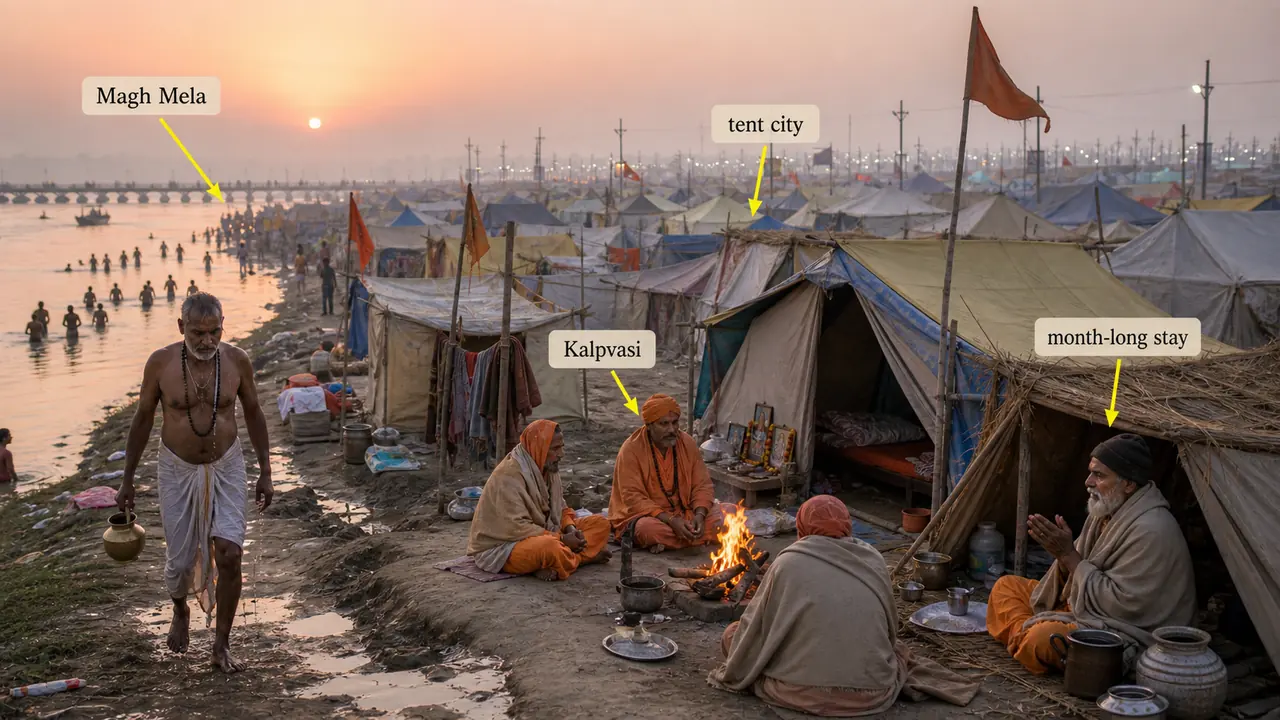
Magh Mela is an annual fair held at Prayagraj during the month of Magh (January-February). In years when neither Kumbh nor Ardh Kumbh falls, Magh Mela serves as the annual continuation of the bathing tradition.
Kalpvasis
A unique feature of Magh Mela is the Kalpvas tradition. Kalpvasis are devotees who camp at the Sangam for the entire month of Magh, living an austere life of:
- Daily bathing in the Sangam at dawn
- Eating only once a day
- Sleeping on the ground
- Attending religious discourses (pravachan)
- Performing charity (daan)
The number of Kalpvasis ranges from several lakhs annually. The UP government builds a temporary tent city for them every year.
Infrastructure — A Modern Marvel
Managing Kumbh Mela is one of the world's greatest logistical challenges:
| Infrastructure | Scale |
|---|---|
| Temporary city | Built and dismantled in weeks |
| Pontoon bridges | 20+ bridges over Ganga and Yamuna |
| Water supply | Temporary pipelines for millions |
| Sanitation | Over 1 lakh temporary toilets |
| Healthcare | Temporary hospitals and ambulance network |
| Security | Thousands of police, CCTV, drone surveillance |
| Lost-and-found | Dedicated centers (especially for elderly and children) |
The Kumbh Mela administration is handled by a specially constituted Mela Adhikari (Fair Officer) of IAS rank appointed by the UP government.
Summary Cheat Sheet
| Fact | Answer |
|---|---|
| Kumbh UNESCO year | 2017 |
| Sangam rivers | Ganga, Yamuna, Saraswati |
| Maha Kumbh cycle | Every 12 years |
| Ardh Kumbh cycle | Every 6 years |
| Four Kumbh sites | Prayagraj, Haridwar, Ujjain, Nashik |
| 2019 Kumbh visitors | Officially reported around 240 million |
| Most auspicious Snan | Mauni Amavasya |
| Total Akharas | 13 |
| Largest Akhara | Juna Akhara |
| Kalpvas duration | Entire month of Magh |
| Kumbh mythology | Samudra Manthan — drops of Amrit |
Lesson Doubts
Ask questions, get expert answers