🗣️ Languages & Dialects of UP
Six major dialects of Uttar Pradesh — Awadhi, Bhojpuri, Braj Bhasha, Bundeli, Khari Boli, Kannauji — their regions, literary heritage, and Urdu's second-official-language status for Uttar Pradesh GK.
Hindi, Urdu, and the Dialect Landscape
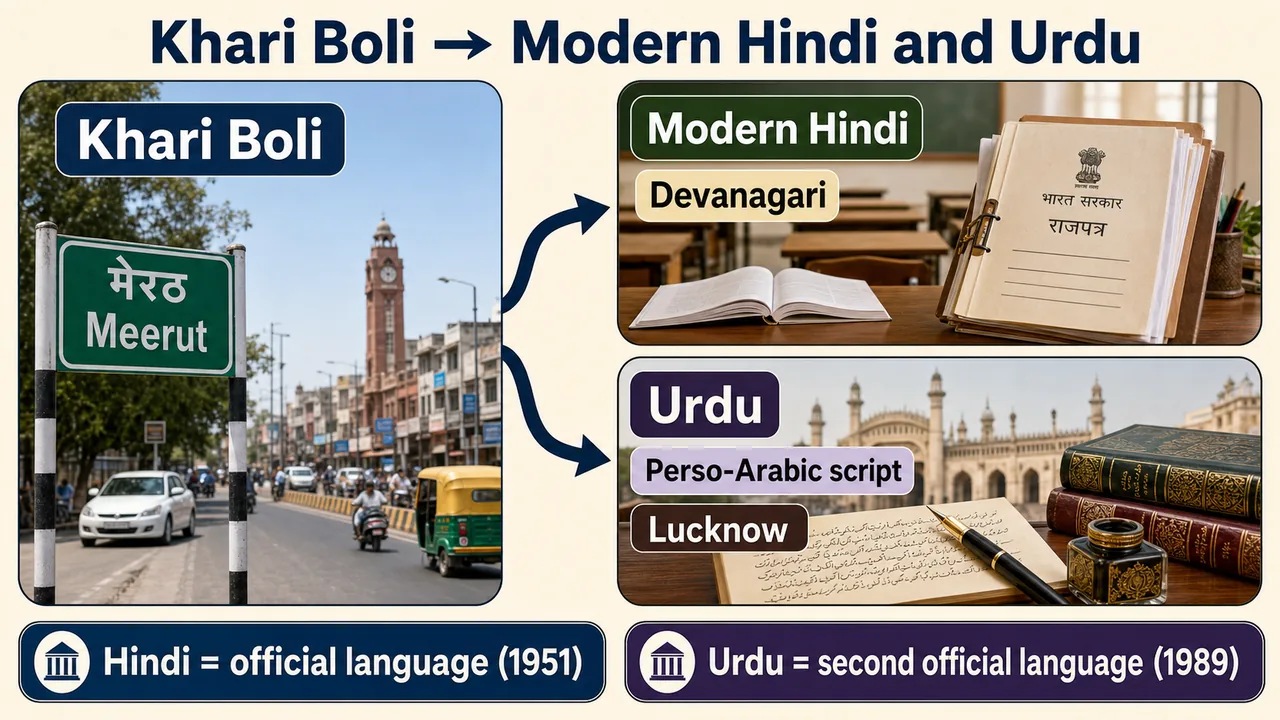
Hindi is the official language of Uttar Pradesh under the UP Official Language Act, 1951. Written in the Devanagari script, it serves as the main language of administration, education, and public communication across the state.
But exam questions on language in UP usually go beyond standard Hindi. The state is best understood as a Hindi-speaking region with many strong regional dialect traditions. In everyday life, a person may say they speak "Hindi" officially, while actually speaking Awadhi, Bhojpuri, Braj, Bundeli, Khari Boli, or Kannauji at home.
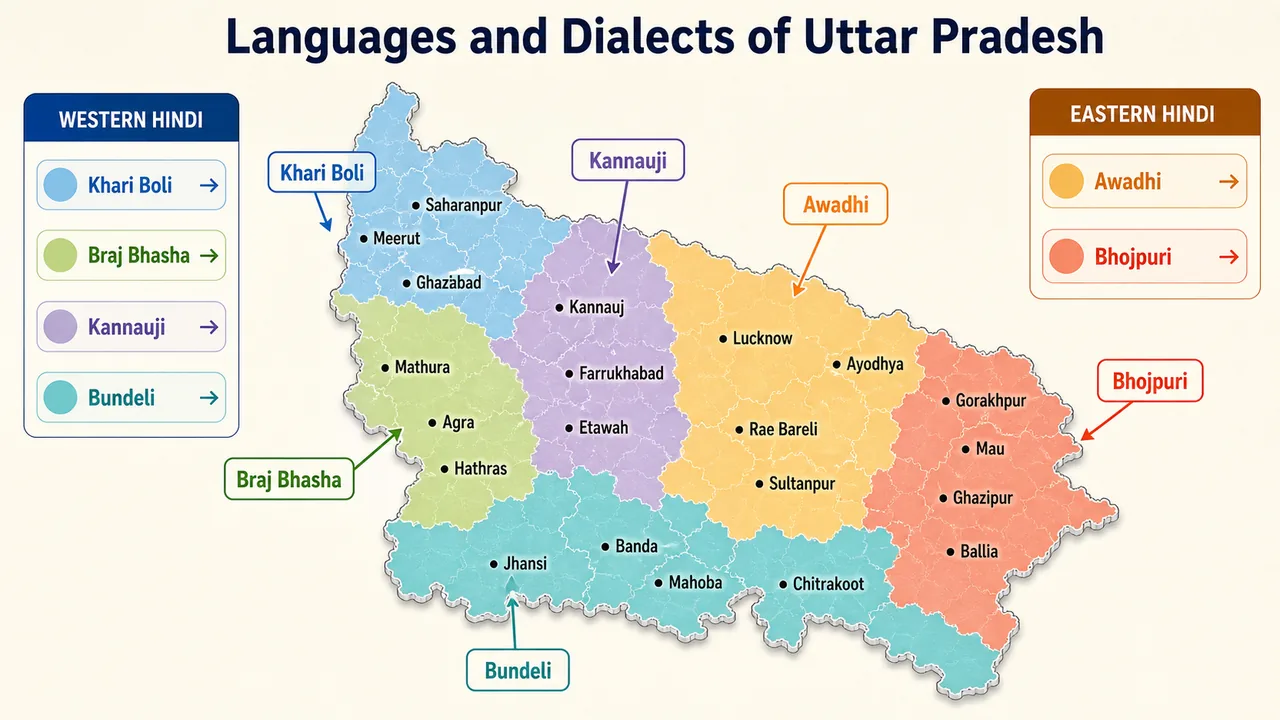
The Linguistic Survey of India, first conducted by George Abraham Grierson (1898-1928), classified Hindi dialects into two broad sub-groups: Western Hindi (Khari Boli, Braj Bhasha, Kannauji, Bundeli) and Eastern Hindi (Awadhi, Bhojpuri). This classification remains the standard reference for competitive examinations.
The Six Major Dialects
1. Awadhi
Awadhi is the dialect of the Awadh region, spoken across Lucknow, Ayodhya, Rae Bareli, Sultanpur, Barabanki, and Pratapgarh. It belongs to the Eastern Hindi group and is one of the most culturally influential dialects of north India.
- Greatest work: Ramcharitmanas by Tulsidas — composed in Awadhi, it remains the most widely recited Hindi-language text in India.
- Other notable work: Padmavat by Malik Muhammad Jayasi — a Sufi allegorical poem also in Awadhi.
- Awadhi is strongly associated with Ramlila recitation, bhakti poetry, and oral storytelling traditions.
Awadhi matters in exams because it links language + religion + literature in a single cluster: Tulsidas, Ramcharitmanas, Awadh region.
2. Bhojpuri
Bhojpuri is spoken in eastern UP — Ballia, Ghazipur, Mau, Azamgarh, Deoria, Gorakhpur, and nearby districts — and extends into Bihar and adjoining regions. In UP GK, it is usually remembered as one of the most widely spoken eastern dialects.
- Bhojpuri has a thriving film, music, and folk-performance culture.
- There is a long-standing demand for inclusion in the Eighth Schedule of the Constitution, but it has not been included as of June 3, 2026.
- The dialect has rich folk traditions — Biraha, Chaita, and Kajri songs originate from the Bhojpuri belt.
| Feature | Detail |
|---|---|
| Region | Eastern UP, Western Bihar |
| Script | Devanagari (historically Kaithi) |
| Key cities | Varanasi, Gorakhpur, Azamgarh |
| Eighth Schedule status | Not yet included |
3. Braj Bhasha
Braj Bhasha is the language of the Braj region — Mathura, Vrindavan, Agra, Hathras, and nearby districts. It was one of the most important literary languages of north Indian devotional poetry for several centuries.
- Surdas composed the Sur Sagar in Braj Bhasha — celebrating Krishna's childhood and Radha-Krishna devotion.
- The Ashtachhap poets (eight poets designated by Vallabhacharya and Vitthalnath) all wrote in Braj Bhasha.
- For a long period, Braj Bhasha enjoyed high prestige in bhakti poetry, music, and courtly literary culture.
Braj Bhasha is easy to remember if students connect it with Krishna bhakti, Surdas, and the Mathura-Vrindavan cultural zone.
4. Bundeli
Bundeli (also called Bundelkhandi) is the dialect of the Bundelkhand region — Jhansi, Banda, Hamirpur, Mahoba, Lalitpur, and Chitrakoot. It bridges UP and Madhya Pradesh and carries the flavour of a rugged warrior-folk culture.
- Famous folk traditions include Alha-Udal ballads celebrating the Chandel warriors.
- Bundeli has a distinctive vocabulary shaped by long contact with neighbouring dialects and central Indian speech forms.
For exams, Bundeli is most often paired with Alha-Udal, Bundelkhand, and heroic oral tradition.
5. Khari Boli
Khari Boli is spoken in western UP — Meerut, Muzaffarnagar, Saharanpur, Baghpat, Ghaziabad, and the Delhi region. It holds a unique place in language history:
- It is the basis of Modern Standard Hindi and Urdu.
- The standardisation of Khari Boli into formal Hindi and Urdu took shape especially in the 19th century through education, print culture, and administrative use.
- Bharatendu Harishchandra championed Khari Boli as the standard for modern Hindi prose.
This is one of the highest-yield ideas in the lesson: local spoken form -> Khari Boli -> modern standard Hindi and Urdu.
6. Kannauji
Kannauji is spoken in the central Doab region — Kannauj, Farrukhabad, Etawah, Mainpuri, Hardoi, and nearby areas. It is often described as a transitional dialect between Braj Bhasha and Awadhi.
- Kannauj was historically associated with political and cultural prestige, which gives the dialect regional importance in UP GK.
- Kannauji receives less literary attention in exam material than Awadhi, Braj, or Bhojpuri, but it remains important as the central transitional speech zone.
Dialect Region Map (Summary Table)
| Dialect | Group | Core Districts | Famous For |
|---|---|---|---|
| Awadhi | Eastern Hindi | Lucknow, Ayodhya, Rae Bareli | Ramcharitmanas, Padmavat |
| Bhojpuri | Eastern Hindi | Ballia, Ghazipur, Mau, Azamgarh | Major eastern dialect, Biraha folk |
| Braj Bhasha | Western Hindi | Mathura, Agra, Aligarh | Sur Sagar, Ashtachhap poets |
| Bundeli | Western Hindi | Jhansi, Banda, Mahoba | Alha-Udal ballads |
| Khari Boli | Western Hindi | Meerut, Saharanpur | Basis of modern Hindi & Urdu |
| Kannauji | Western Hindi | Kannauj, Farrukhabad | Transitional dialect |
Urdu in Uttar Pradesh
Urdu is recognised as the second official language of Uttar Pradesh under the 1989 amendment to the UP Official Language law. In practice, its official use applies for notified purposes of the state government, so students should remember both parts together:
- Hindi = official language
- Urdu = second official language
UP has a major place in Urdu literary history. Lucknow became one of the great centres of Urdu poetry, prose, and refined court culture. The UP Urdu Academy supports the language through publications, awards, and cultural promotion.
Summary Cheat Sheet
| Exam Fact | Answer |
|---|---|
| Official language of UP | Hindi (Devanagari script) |
| Second official language of UP | Urdu |
| Widely remembered eastern dialect | Bhojpuri |
| Basis of standard Hindi/Urdu | Khari Boli |
| Ramcharitmanas dialect | Awadhi |
| Sur Sagar dialect | Braj Bhasha |
| Alha-Udal ballads dialect | Bundeli |
| Linguistic Survey of India | George Abraham Grierson |
| Transitional central dialect | Kannauji |
Lesson Doubts
Ask questions, get expert answers