🌾 Agriculture — Backbone of UP Economy
Agricultural production, major crops, research institutes, mandis, and farm income in Uttar Pradesh for Uttar Pradesh GK.
Introduction
Agriculture is the single most important economic activity in Uttar Pradesh. While its share in GSDP is around 27%, it still supports a very large share of the state's population and remains central to rural life, employment, and politics.
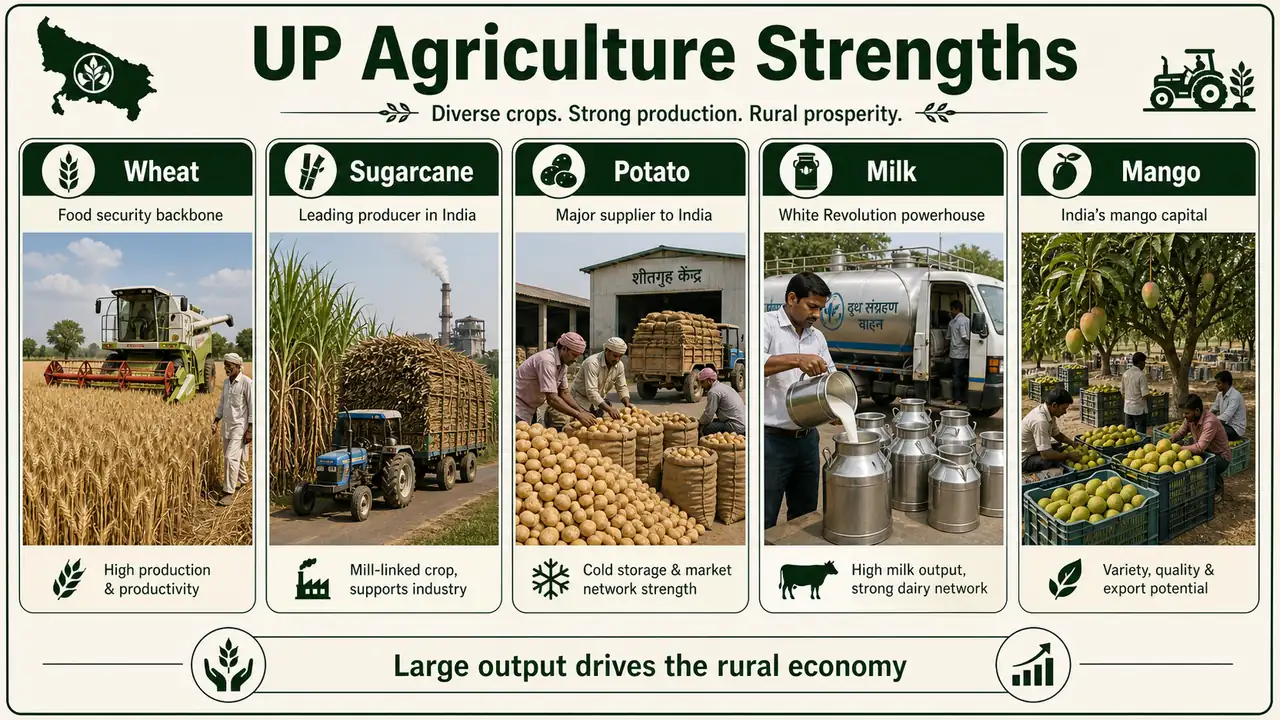
The safest way to remember UP agriculture is through its broad identity:
- major foodgrain producer
- very strong in wheat and sugarcane
- major potato, milk, and mango producer
- large output, but low farm incomes for many cultivators
Production Profile
Annual production totals change often, so students should focus more on stable crop strengths and broad rank patterns than on one-year exact numbers.
| Parameter | Value | National Rank |
|---|---|---|
| Foodgrain production | Very high | Among the top in India |
| Wheat | Major Rabi crop | Top-ranking state |
| Rice | Major Kharif crop | Among leading states |
| Sugarcane | Major cash crop | Top-ranking state |
| Potato | Major horticulture crop | Top-ranking state |
| Milk | Strong livestock output | Leading producer |
| Mango | Major fruit crop | Leading producer |
UP is especially associated in exam material with wheat, sugarcane, potato, milk, and mango. These are the most durable agricultural recall points.
Crop Pattern and Land Use
The state has a very large cultivated area, high cropping intensity, and extensive irrigation compared with many other states. This helps explain why UP remains a giant in foodgrain and sugarcane output.
Major Crops by Season
| Season | Key Crops |
|---|---|
| Kharif (June-Oct) | Rice, maize, bajra, arhar, sugarcane, soybean |
| Rabi (Nov-Mar) | Wheat, mustard, gram, pea, potato, barley, lentil |
| Zaid (Mar-Jun) | Watermelon, muskmelon, cucumber, moong |
Agricultural Marketing Infrastructure
UP has an extensive network of Agricultural Produce Market Committees (APMCs) regulating trade in farm produce.
- Over 250 principal mandis and 400+ sub-mandis across the state
- e-NAM (electronic National Agriculture Market) integration ongoing in UP mandis
- Major wholesale mandis: Lucknow Fruit Mandi, Kanpur Anaj Mandi, Hapur Mandi (one of Asia's largest grain markets)
- Mandi fees and middlemen remain significant concerns for farmer income
This section is easier to understand if students separate:
- production strength from
- marketing weakness
UP may produce huge volumes, but farmer income still depends on storage, transport, mandi access, pricing, and processing.
Agricultural Research Institutes in UP
Uttar Pradesh hosts several premier agricultural universities and research centres that drive crop improvement and extension services.
| Institute | Location | Established | Speciality |
|---|---|---|---|
| CSAUA&T | Kanpur | 1975 | Crop science, soil science |
| SVPUA&T | Meerut | 2000 | Veterinary, animal sciences |
| NDUA&T (Acharya Narendra Deva) | Ayodhya (Kumarganj) | 1974 | Rice, pulses research |
| BUA&T | Banda | 2010 | Dryland agriculture, Bundelkhand crops |
| SHUATS (formerly Allahabad Agri Institute) | Prayagraj | 1910 | Oldest agri institute, deemed university |
| IARI Regional Station | Kalyanpur (Kanpur) | — | Wheat, mustard trials |
| Indian Institute of Sugarcane Research | Lucknow | 1952 | Sugarcane varieties |
SHUATS (Sam Higginbottom University) in Prayagraj is one of the older agricultural-education institutions associated with the state and is a useful factual recall point in UP GK.
Agricultural Credit and Insurance
| Aspect | Details |
|---|---|
| Kisan Credit Cards (KCC) | Very large KCC coverage in the state |
| Agricultural credit | Large annual credit flow through banks and cooperatives |
| PM Fasal Bima Yojana | Crop insurance coverage exists, but farmer penetration remains uneven |
| Crop loan interest | Subsidized at 4% for timely repayment under central scheme |
Farm Income Challenges
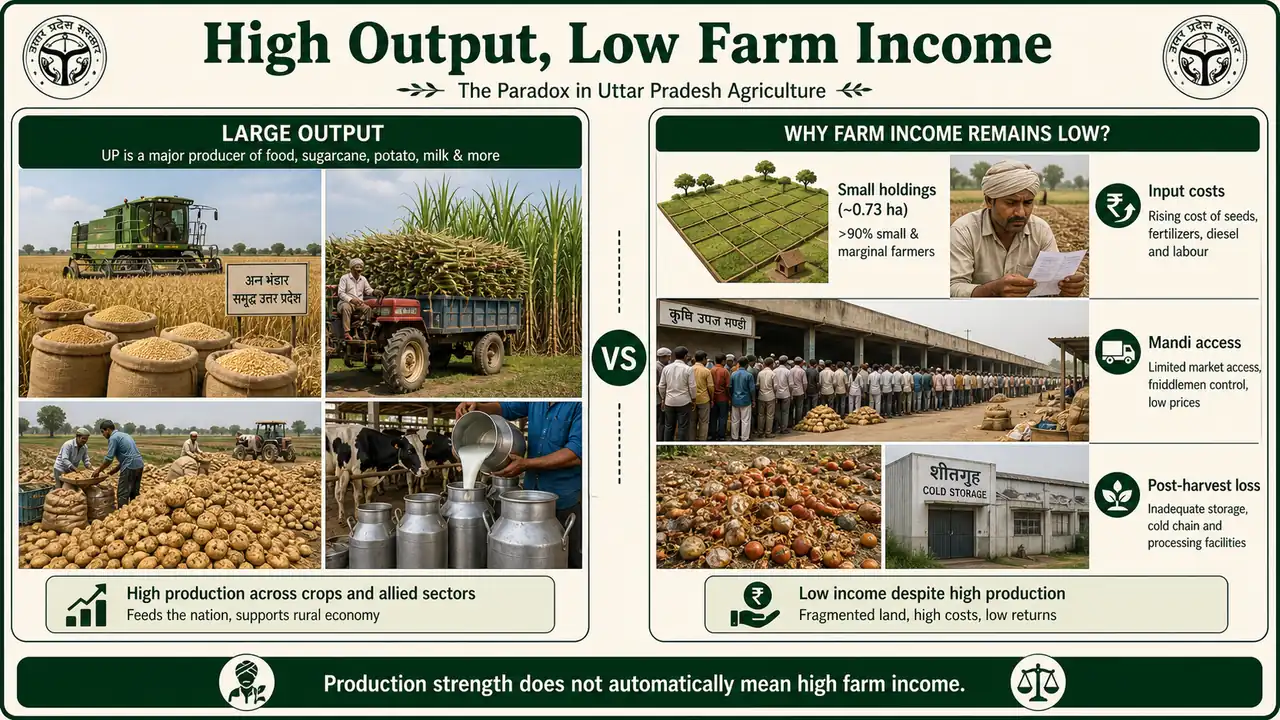
Despite being the largest food producer, UP's farmers face persistent income challenges.
- Average farm income in UP is below the national average
- Small and marginal farmers (holding < 2 hectares) constitute over 90% of all farmers in UP
- Average landholding: ~0.73 hectares (among the smallest in India)
- High input costs (fertilizer, diesel, labour) squeeze margins
- Post-harvest losses due to inadequate cold storage and processing
This is the core economic contradiction of UP agriculture:
- output is huge
- holdings are tiny
- incomes remain weak for many farmers
Agro-Processing and Industrial Infrastructure
UP is rapidly building an agro-industrial base to add value to its massive agricultural output.
- Agro-food parks, food-processing units, and sugar mills are meant to add value beyond raw crop production
- Sugarcane SAP (State Advised Price) was raised in the 2026-27 budget cycle, which is a time-sensitive current-affairs point
Summary Cheat Sheet
| Fact | Answer |
|---|---|
| Agriculture in UP | Backbone of rural economy |
| Foodgrain status | Among India's biggest producers |
| Wheat in UP | Top-ranking crop |
| Sugarcane in UP | Top-ranking cash crop |
| Potato in UP | Major horticulture strength |
| Milk in UP | Leading livestock product |
| Cropping intensity | High |
| Irrigation coverage | Extensive |
| Oldest agri institute in UP | SHUATS, Prayagraj (1910) |
| Average farm holding | ~0.73 hectares |
| Small & marginal farmers share | >90% |
| Asia's largest grain mandi | Hapur |
| Sugarcane research institute | IISR, Lucknow (1952) |
Lesson Doubts
Ask questions, get expert answers