⚡ Energy & Power Sector
UP power sector — thermal, nuclear, hydro, solar energy, DISCOMs, rural electrification, and energy policy for Uttar Pradesh GK.
Power Sector Overview
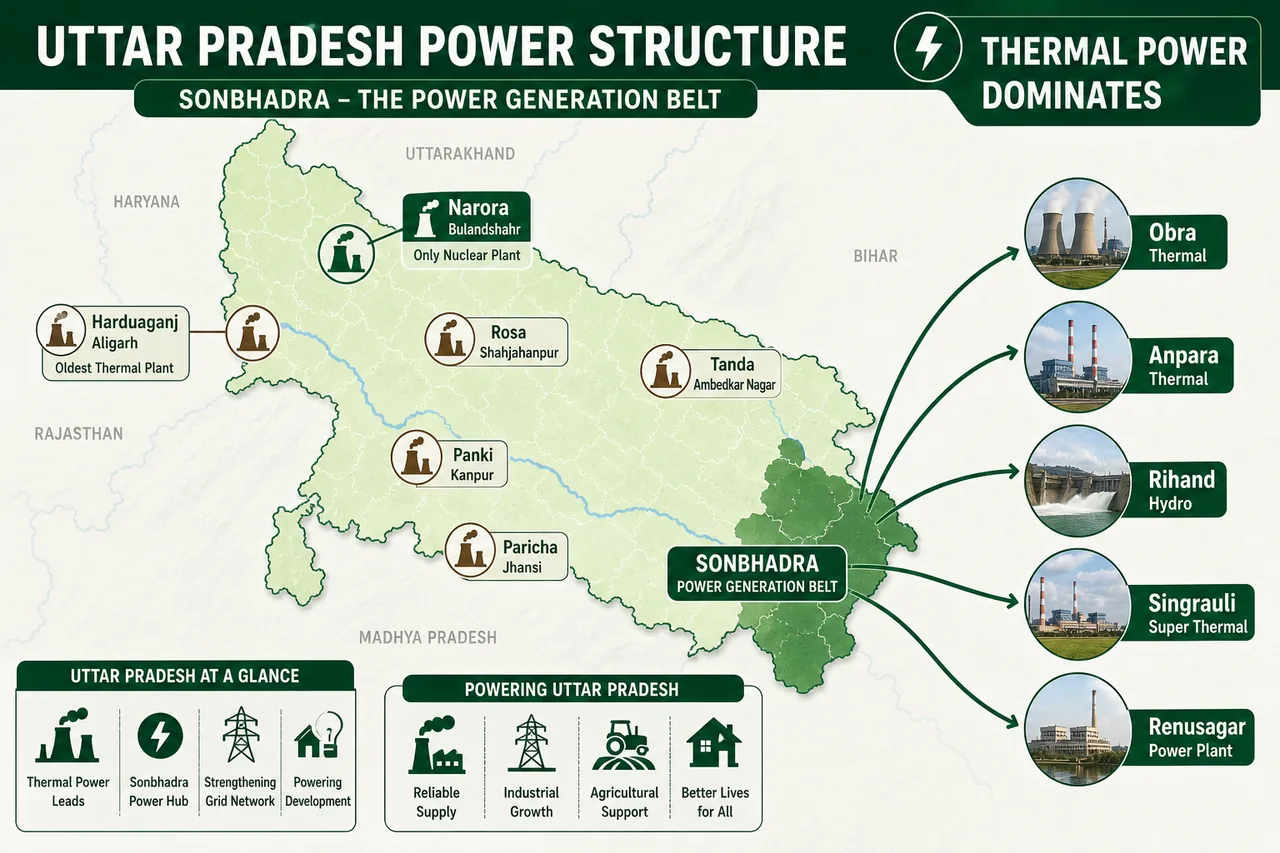
Uttar Pradesh has one of India's largest electricity systems because of its huge population, large agriculture sector, expanding industry, and fast-growing cities. For exam purposes, the most important pattern is simple: thermal power dominates, Sonbhadra is the main power belt, Narora is the only nuclear plant, and solar energy is growing fastest in Bundelkhand and other open-land regions.
Thermal Power — The Backbone
Thermal power plants generate the majority of UP's electricity. Key thermal plants:
| Plant | Location | Key Fact |
|---|---|---|
| Harduaganj | Aligarh | Oldest operational thermal plant in UP (1942) |
| Obra | Sonbhadra | One of largest state-owned plants |
| Anpara | Sonbhadra | Anpara A, B, C, D units |
| Rosa | Shahjahanpur | Private sector (Reliance Power) |
| Tanda | Ambedkar Nagar | NTPC operated |
| Paricha | Jhansi | Bundelkhand region power supply |
| Panki | Kanpur | Supplies industrial Kanpur |
Sonbhadra — The Energy Capital
Sonbhadra district is called the "Energy Capital of UP" because it hosts:
- Obra Thermal Power Station
- Anpara Thermal Power Station (multiple units)
- Rihand Hydroelectric Project
- Singrauli Super Thermal Power Station (NTPC)
- Renusagar Power Plant (Hindalco)
The district is important because many of UP's major large-scale generation units are concentrated here. In UP GK, remember Sonbhadra as the state's most important thermal-plus-hydro energy zone.
NTPC Super Thermal Plants
NTPC is one of the most important power-sector institutions operating in Uttar Pradesh. Instead of memorizing every unit size, it is better to remember the plant-location link and its regional importance.
| Plant | Location | Significance |
|---|---|---|
| Singrauli STPS | Sonbhadra | Major NTPC thermal plant linked with the Sonbhadra-Singrauli power belt |
| Rihand STPS | Sonbhadra | Another major NTPC station in the same energy corridor |
| Tanda TPS | Ambedkar Nagar | Important for eastern UP supply |
| Dadri STPS | Gautam Buddha Nagar | Important for the NCR-side power system |
This cluster-based approach is more useful in exams than trying to memorize exact installed capacity figures, which can change with renovation, retirement, or expansion.
Nuclear Power
Narora Atomic Power Station (NAPS)
| Feature | Detail |
|---|---|
| Location | Narora, Bulandshahr |
| Operator | NPCIL (Nuclear Power Corporation of India Ltd.) |
| Type | Pressurized Heavy Water Reactor (PHWR) |
| Capacity | 2 x 220 MW = 440 MW |
| Commissioned | 1991 (Unit 1), 1992 (Unit 2) |
| Significance | Only nuclear power plant in UP |
- Located on the banks of River Ganga
- Uses natural uranium as fuel and heavy water as moderator
- In UP GK, the key recall is: Narora, Bulandshahr, NPCIL, only nuclear plant in UP
Hydroelectric Power
Rihand Dam / Govind Ballabh Pant Sagar
| Feature | Detail |
|---|---|
| Location | Sonbhadra (on Rihand River) |
| Dam Type | Concrete gravity dam |
| Reservoir | Govind Ballabh Pant Sagar — largest artificial lake in India |
| Capacity | 300 MW |
| Commissioned | 1962 |
- UP has limited hydroelectric potential compared to Himalayan states
- Other small hydro projects on canals and barrages across the state
- Sharda Canal hydro project and other small stations supplement supply
Solar Energy — The Growing Frontier
UP is gradually expanding solar power under state and national policy support. This is an important emerging topic because solar energy helps the state reduce dependence on thermal generation and supports farm and household power access.
| Initiative | Detail |
|---|---|
| UP Solar Energy Policy | Encourages utility-scale and rooftop solar adoption |
| Chitrakoot Solar Park | Bundelkhand region |
| Bundelkhand Solar Parks | Multiple locations in Jhansi, Lalitpur |
| Rooftop Solar | PM Surya Ghar Yojana — support for household rooftop solar |
| Solar Pump Scheme | PM-KUSUM — solar pumps for farmers |
- Bundelkhand region has the highest solar irradiance in UP
- PM-KUSUM is important for agriculture because it reduces diesel dependence and supports solar-powered irrigation
- For exams, remember solar as UP's growing frontier, especially in the drier, open-land Bundelkhand belt
Wind Energy
- UP has limited wind energy potential — the Gangetic plain lacks consistent high-speed winds
- Small wind-solar hybrid installations in some districts
- Not a significant contributor to UP's energy mix
Power Distribution — DISCOMs
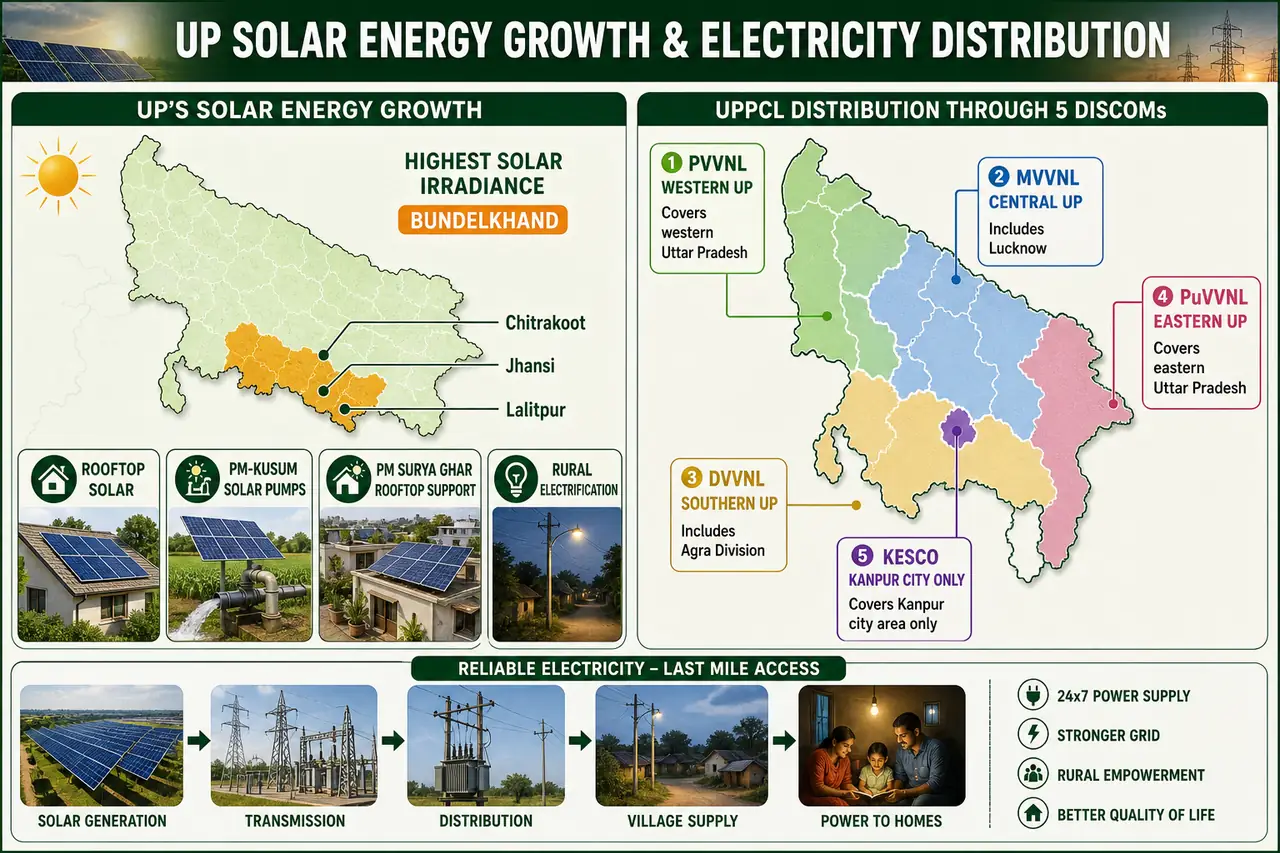
UP's electricity distribution is managed by UPPCL (Uttar Pradesh Power Corporation Limited) through five DISCOMs:
| DISCOM | Full Name | Area |
|---|---|---|
| PVVNL | Pashchimanchal Vidyut Vitran Nigam Ltd. | Western UP |
| MVVNL | Madhyanchal Vidyut Vitran Nigam Ltd. | Central UP (incl. Lucknow) |
| DVVNL | Dakshinanchal Vidyut Vitran Nigam Ltd. | Southern UP (Agra) |
| PuVVNL | Purvanchal Vidyut Vitran Nigam Ltd. | Eastern UP |
| KESCO | Kanpur Electricity Supply Company | Kanpur city only |
Rural Electrification
Saubhagya Scheme (Pradhan Mantri Sahaj Bijli Har Ghar Yojana)
- Launched 2017 with the goal of expanding household electricity access
- Helped extend connections to many previously unelectrified households
- Free connections were provided to eligible poor households
- Important mainly as a last-mile rural electrification programme
Summary Cheat Sheet
| Source | Key Plant/Project | Location |
|---|---|---|
| Thermal (oldest) | Harduaganj | Aligarh (1942) |
| Thermal (NTPC) | Singrauli STPS | Sonbhadra |
| Nuclear | Narora (NAPS) | Bulandshahr (440 MW) |
| Hydro | Rihand Dam | Sonbhadra |
| Solar | Bundelkhand Parks | Chitrakoot, Jhansi |
| Distribution | 5 DISCOMs | UPPCL umbrella |
- Thermal power is the backbone of UP's electricity system.
- Sonbhadra is called the Energy Capital because major thermal and hydro projects are concentrated there.
- Narora Atomic Power Station in Bulandshahr is the only nuclear power plant in UP.
- Solar energy is expanding, especially in Bundelkhand and through rooftop and solar-pump schemes.
- UPPCL distributes power through 5 DISCOMs: PVVNL, MVVNL, DVVNL, PuVVNL, and KESCO.
Lesson Doubts
Ask questions, get expert answers