👥 UP Population Policy 2026-2026
Uttar Pradesh Population Policy goals, incentives, disincentives, demographic data, TFR targets, and population stabilization for Uttar Pradesh GK.
The Population Challenge
Uttar Pradesh is India's most populous state. Managing this very large population while improving education, health, employment, and resource use is one of the state's biggest governance challenges. For exam preparation, this topic should be understood in two layers: basic demographic facts and the UP Population Policy 2021-2030, which focuses on stabilization through health, awareness, and family-planning goals.
UP Population — Key Data
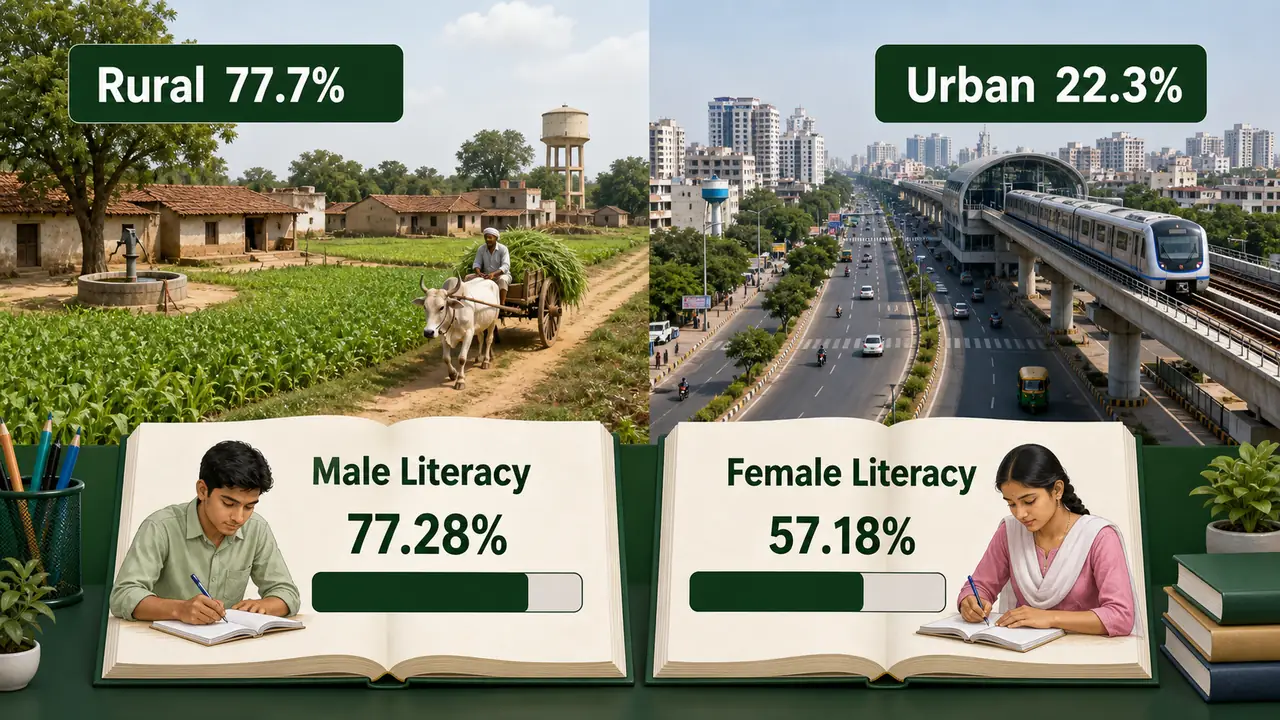
| Parameter | Data |
|---|---|
| Population (Census 2011) | 19.98 crore (199.8 million) |
| Rank | 1st in India (most populous state) |
| Density | 829 persons/sq km (one of highest) |
| Decadal Growth (2001-2011) | 20.23% |
| Sex Ratio | 912 females per 1000 males (Census 2011) |
| Literacy Rate | 67.68% (2011) |
| Urban Population | ~22.3% |
Total Fertility Rate (TFR)
TFR measures the average number of children born to a woman during her lifetime.
| Parameter | Rate |
|---|---|
| UP TFR (NFHS-5, 2019-21) | about 2.4 |
| National TFR | 2.0 |
| Replacement Level | 2.1 (population stabilizes at this level) |
| Target (UP Policy) | Bring TFR close to replacement level and support long-term stabilization |
District-wise TFR Variation
A critical pattern for exam preparation:
| Region | TFR Range | Observation |
|---|---|---|
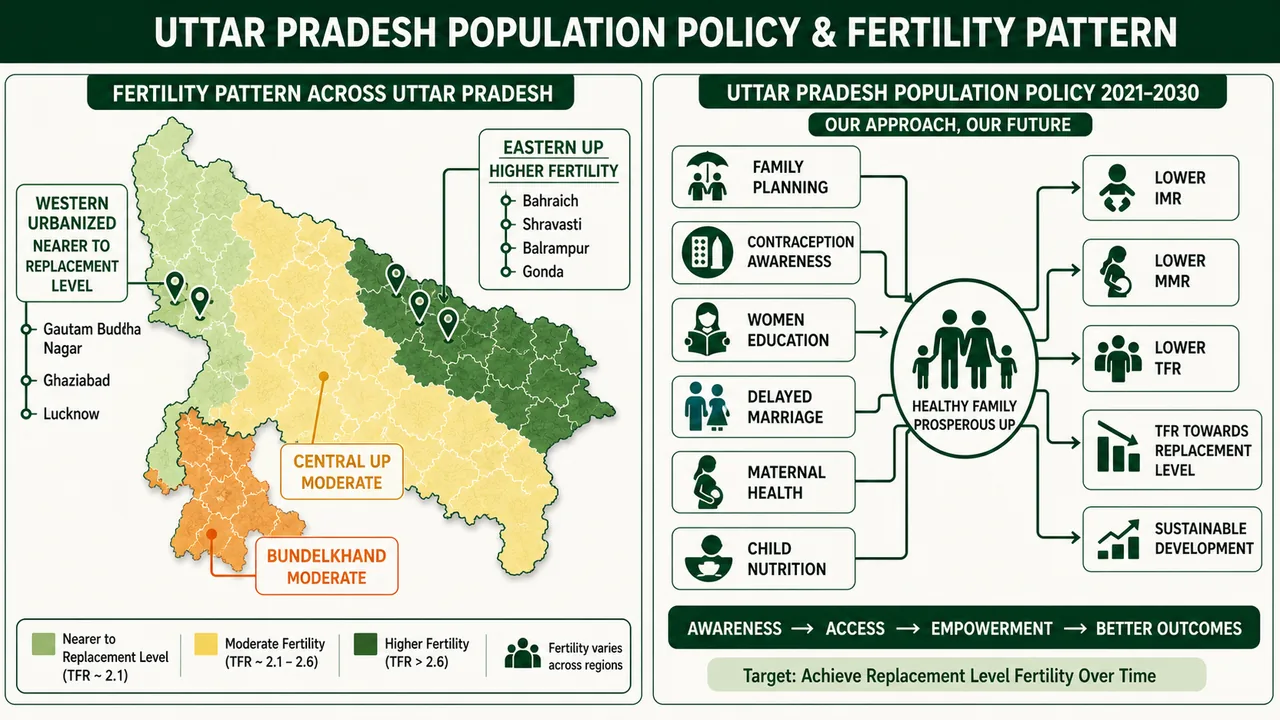
| Eastern UP | Higher | Generally higher fertility than the state average |
| Central UP | Moderate | Mixed pattern |
| Western UP | Lower | Nearer to replacement level in more urbanized districts |
| Bundelkhand | Moderate | Influenced by poverty, migration, and service gaps |
- Eastern UP districts (Bahraich, Shravasti, Balrampur, Gonda) have the highest fertility
- Western UP districts (Lucknow, Gautam Buddha Nagar, Ghaziabad) are already near replacement
UP Population Policy 2021-2030
Core Goals
- Bring TFR to 2.1 (replacement level) by 2026
- Support population stabilization in the longer term
- Improve maternal and child health indicators
- Increase contraceptive prevalence rate to 65%
- Reduce Infant Mortality Rate (IMR) to below 25 per 1000
- Reduce Maternal Mortality Rate (MMR) to below 100 per lakh
Policy Approach
The most important thing to remember is that the population policy emphasized:
- better access to family planning services
- higher contraceptive awareness and use
- lower infant and maternal mortality
- stronger women's health, education, and nutrition
- reduction in early marriage and early childbearing
Draft Two-Child Norm Debate
Around the same time, a separate draft bill discussion on a two-child norm received public attention. Students should be careful not to confuse every debated proposal with settled law.
Commonly discussed draft proposals included:
| Draft Proposal Theme | Example Often Mentioned |
|---|---|
| Electoral restriction | Bar from contesting some local body elections |
| Government-service impact | Job or promotion-related restrictions |
| Welfare linkage | Limits on selected benefits for larger families |
| Incentives | Extra benefits for those adopting a two-child norm |
- These ideas generated significant public debate
- For exam safety, treat them as draft proposals associated with the population-control debate, not as simple timeless facts automatically implemented in full
Health Infrastructure Focus
The population policy emphasizes strengthening health infrastructure:
| Initiative | Target |
|---|---|
| PHCs (Primary Health Centres) | Strengthen access and service quality |
| CHCs (Community Health Centres) | Upgrade and expand |
| Adolescent Health | Rashtriya Kishor Swasthya Karyakram expansion |
| Family Planning | Voluntary sterilization incentives, free contraceptives |
| Institutional Delivery | Improve safe childbirth coverage |
| Nutrition | Poshan Abhiyaan integration |
Key Health Indicators
| Indicator | UP (NFHS-5) | India (NFHS-5) |
|---|---|---|
| IMR (Infant Mortality) | Higher than national average | Better than older levels but still a concern |
| MMR (Maternal Mortality) | Higher than national average | Lower than UP |
| Contraceptive Prevalence | 53.2% | 66.7% |
| Institutional Delivery | 83.4% | 88.6% |
| Child Malnutrition (Stunting) | 39.7% | 35.5% |
- UP lags behind the national average on most health indicators
- Eastern UP has the worst health statistics within the state
Demographic Dividend vs. Demographic Burden
The Opportunity (Dividend)
- A very large share of UP's population is in the working-age group
- If properly skilled and employed, this can drive massive economic growth
- Young workforce advantage over aging populations in South India
The Risk (Burden)
- Without adequate education, skills, and employment, a large young population becomes a liability
- High unemployment among youth is a serious concern
- Pressure on resources: water, land, food, healthcare
Comparison with National Family Planning
| Parameter | UP | India | Kerala |
|---|---|---|---|
| TFR | about 2.4 | 2.0 | below replacement level |
| Contraceptive Use | 53.2% | 66.7% | 57.5% |
| Female Literacy | 59.3% | 65.5% | 92% |
| Age at Marriage (Female) | Low in rural areas | Increasing | High |
- Female education is one of the strongest predictors of lower fertility
- States with higher female literacy consistently have lower TFR
Why the Policy Matters
- A large population increases pressure on schools, hospitals, jobs, land, water, and urban services
- At the same time, a healthier and better-educated young population can become a major development advantage
- That is why population policy is linked not only to family size, but also to women's education, public health, nutrition, and employment
Summary Cheat Sheet
| Parameter | Key Data |
|---|---|
| Population (2011) | 19.98 crore (1st in India) |
| Density | 829/sq km |
| TFR (NFHS-5) | About 2.4 |
| Sex Ratio | 912/1000 |
| Literacy | 67.68% |
| Policy Goal | Stabilize population by 2050 |
| Highest TFR | Eastern UP districts |
| Key Policy Focus | Family planning + maternal-child health |
- Do not confuse the population policy with every draft two-child bill proposal.
- Eastern UP generally has higher fertility, while many western and urban districts are closer to replacement level.
- Female education, delayed marriage, contraception access, maternal health, and nutrition are the real long-term drivers of population stabilization.
- Population policy is linked to demographic dividend: a large young population can be either an opportunity or a burden depending on health, education, and jobs.
Lesson Doubts
Ask questions, get expert answers