🪱 Cyst Nematodes (Heterodera and Globodera)
Molya disease, potato cyst nematode, syncytium formation, host-specific hatching, and management with resistant varieties
In the previous lesson, we covered the root-knot nematode -- the No. 1 PPN worldwide. Now we examine the second major sedentary endoparasite group: cyst nematodes, which survive for years in soil through a unique protective mechanism.
In the wheat fields of Rajasthan and Haryana, farmers have long known "Molya" -- irregular yellow patches of stunted wheat that persist year after year despite replanting. The culprit is the cereal cyst nematode (Heterodera avenae), whose dead female body hardens into a protective cyst containing eggs that can survive in soil for 3--4 years.
This lesson covers:
- What makes cyst nematodes special -- quinone tanning and cyst biology
- Important species -- H. avenae, H. schachtii, G. rostochiensis, and others
- Life cycle -- syncytium formation, host-specific hatching
- Molya disease -- symptoms and management on wheat/barley
- Potato cyst nematode -- quarantine status and resistant varieties
What Makes Cyst Nematodes Special?
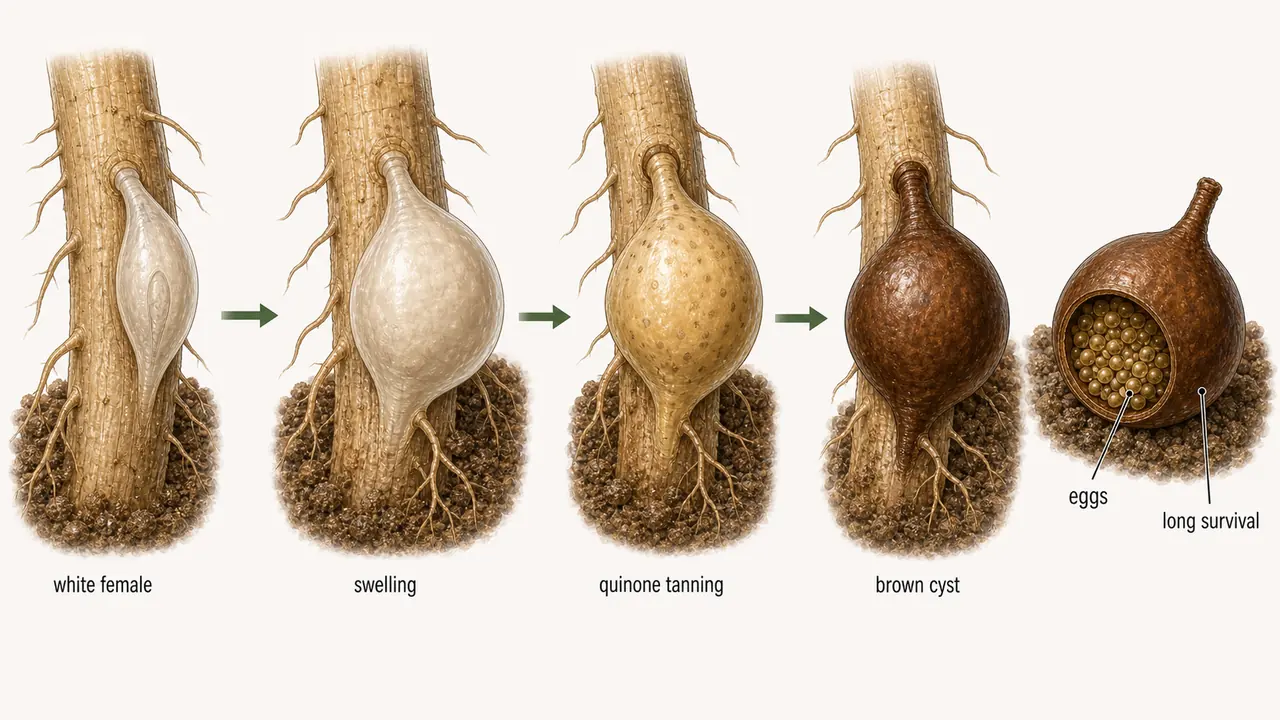
The defining feature: the mature female's body wall hardens after death into a brown or black cyst through quinone tanning (the same biochemical process that hardens insect cuticle). This cyst acts as a durable container protecting hundreds of eggs for years.
Pro Content Locked
Upgrade to Pro to access this lesson and all other premium content.
₹99 charged monthly · Cancel anytime
- All Agriculture & Banking Courses
- AI Lesson Questions (100/day)
- AI Doubt Solver (50/day)
- Glows & Grows Feedback (30/day)
- AI Section Quiz (20/day)
- 22-Language Translation (100/day)
- Recall Questions (20/day)
- AI Quiz (15/day)
- AI Quiz Paper Analysis (100/day)
- AI Step-by-Step Explanations (100/day)
- Spaced Repetition Recall (FSRS)
- AI Tutor
- Immersive Text Questions
- Audio Lessons — Hindi & English
- Mock Tests & Previous Year Papers
- Summary & Mind Maps
- XP, Levels, Leaderboard & Badges
- Generate New Classrooms
- Voice AI Teacher (AgriDots Live)
- AI Revision Assistant
- Knowledge Gap Analysis
- Interactive Revision (LangGraph)
🔒 Secure via Razorpay · Cancel anytime · No hidden fees
In the previous lesson, we covered the root-knot nematode -- the No. 1 PPN worldwide. Now we examine the second major sedentary endoparasite group: cyst nematodes, which survive for years in soil through a unique protective mechanism.
In the wheat fields of Rajasthan and Haryana, farmers have long known "Molya" -- irregular yellow patches of stunted wheat that persist year after year despite replanting. The culprit is the cereal cyst nematode (Heterodera avenae), whose dead female body hardens into a protective cyst containing eggs that can survive in soil for 3--4 years.
This lesson covers:
- What makes cyst nematodes special -- quinone tanning and cyst biology
- Important species -- H. avenae, H. schachtii, G. rostochiensis, and others
- Life cycle -- syncytium formation, host-specific hatching
- Molya disease -- symptoms and management on wheat/barley
- Potato cyst nematode -- quarantine status and resistant varieties
What Makes Cyst Nematodes Special?
The defining feature: the mature female's body wall hardens after death into a brown or black cyst through quinone tanning (the same biochemical process that hardens insect cuticle). This cyst acts as a durable container protecting hundreds of eggs for years.
Etymology
- Heterodera: heteros (different) + deras (skin/body wall) = different type of body wall (hard cyst vs. soft transparent body of other nematodes)
- Globodera: globus (globe/round) + deras (body wall) = rounded/spherical cysts
Important Species
Cyst nematodes are very host-specific and are named after their hosts:
Cyst Nematode Species and Their Hosts
| Species | Common Name | Host Crop | Special Note |
|---|---|---|---|
| H. avenae | Cereal Cyst Nematode | Wheat, barley | Causes Molya disease in India |
| H. schachtii | Sugarbeet Cyst Nematode | Sugarbeet | First discovered cyst nematode (1859) |
| H. glycines | Soybean Cyst Nematode | Soybean | Causes yellow dwarf disease |
| H. cajani | Pigeon Pea Cyst Nematode | Pulses | Important in Indian agriculture |
| H. oryzicola | Paddy Cyst Nematode | Rice (upland) | Kerala, Odisha, Haryana |
| H. zeae | Maize Cyst Nematode | Maize | -- |
| G. rostochiensis | Golden Cyst Nematode | Potato | Under quarantine in India |
Life Cycle
| Stage | Details |
|---|---|
| Infective stage | J2 larvae penetrate root behind the growing point |
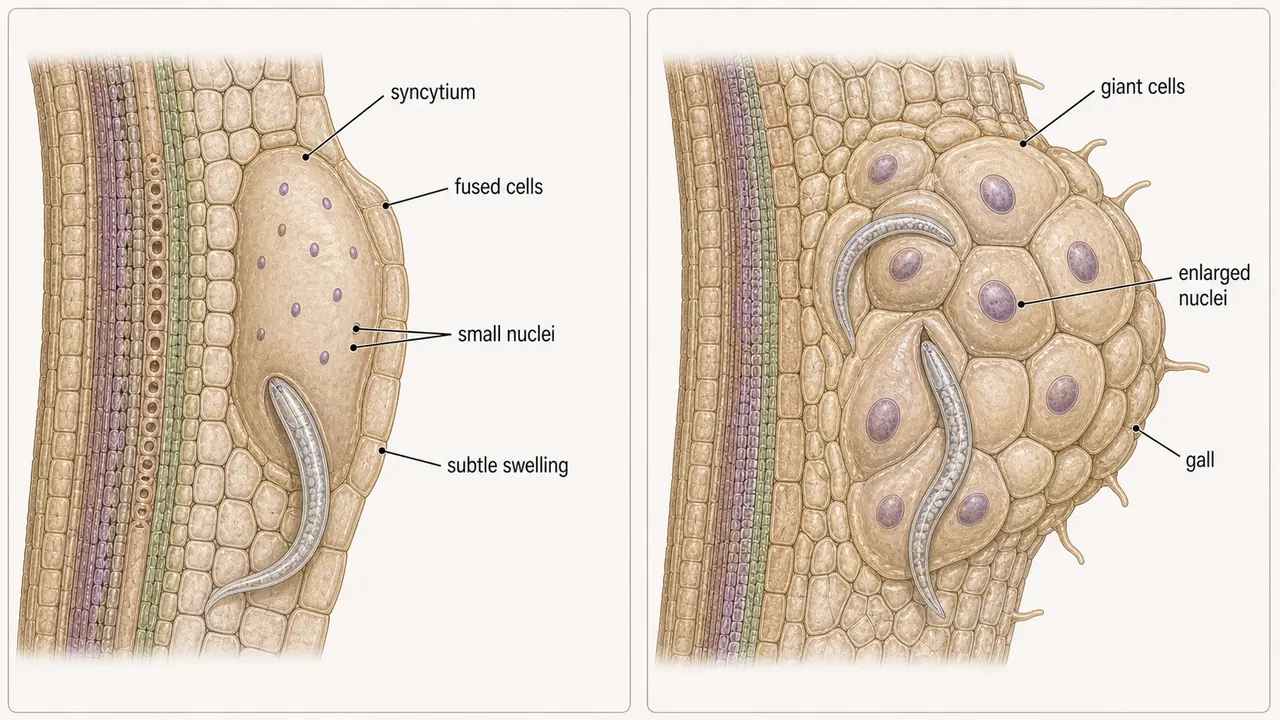
| Feeding site | Multinucleate syncytium (not giant cells -- key difference from root-knot) |
| Female development | Grows, swells; white cyst protrudes from root surface in 5--6 weeks |
| Cyst formation | Dead female body wall hardens by quinone tanning into brown cyst |
| Egg release | Cysts release eggs over 3--4 years at 50% viable eggs per year |
| Hatching trigger | Requires root exudates from host plant (unlike root-knot nematode) |
| Optimal hatching temp | 20--22 degrees C (India) |
| Generations per year | One (univoltine) |
Syncytium vs Giant Cells
| Feature | Cyst Nematode (Syncytium) | Root-Knot Nematode (Giant Cells) |
|---|---|---|
| Nuclei size | Relatively small | Enlarged |
| Gall formation | Not distinct (subtle swellings) | Conspicuous galls/knots |
| Nematodes per feeding site | One | One or more |
| Formation mechanism | Cell wall dissolution and fusion | Karyokinesis without cytokinesis |
Heterodera avenae -- Molya Disease
The most economically important cyst nematode in India, H. avenae causes severe yield losses in wheat and barley across the Indo-Gangetic plain.
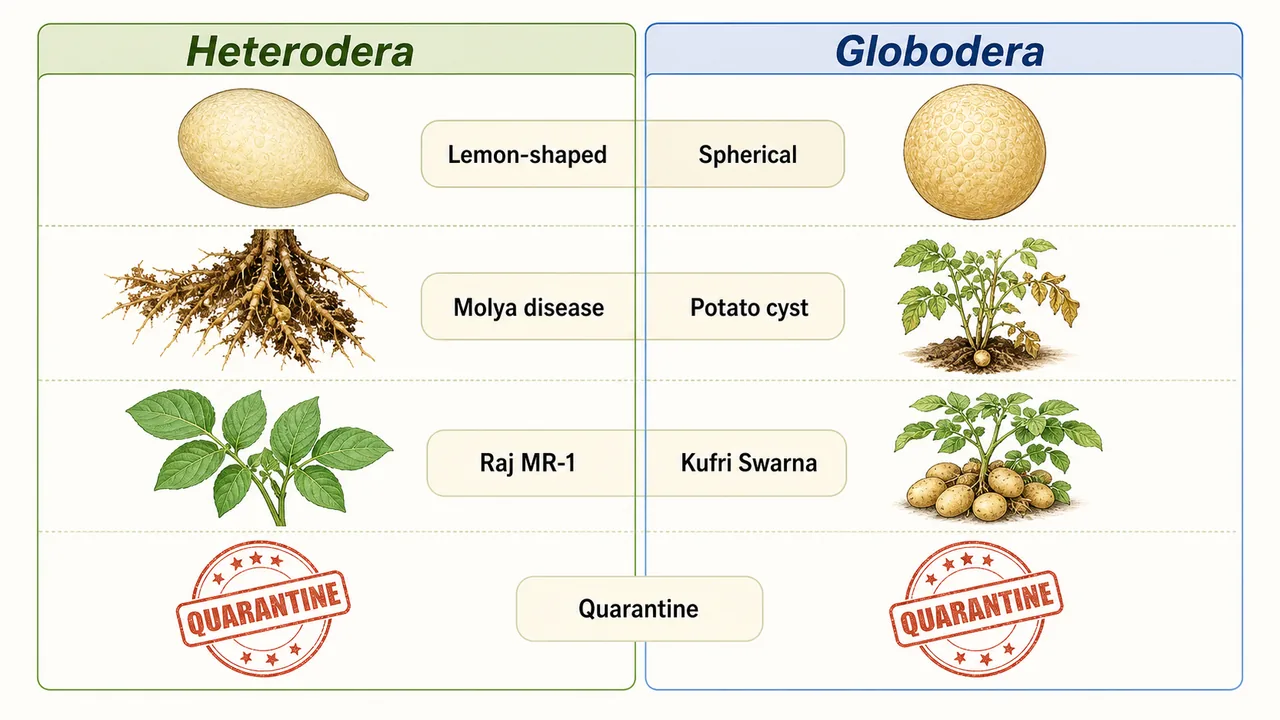
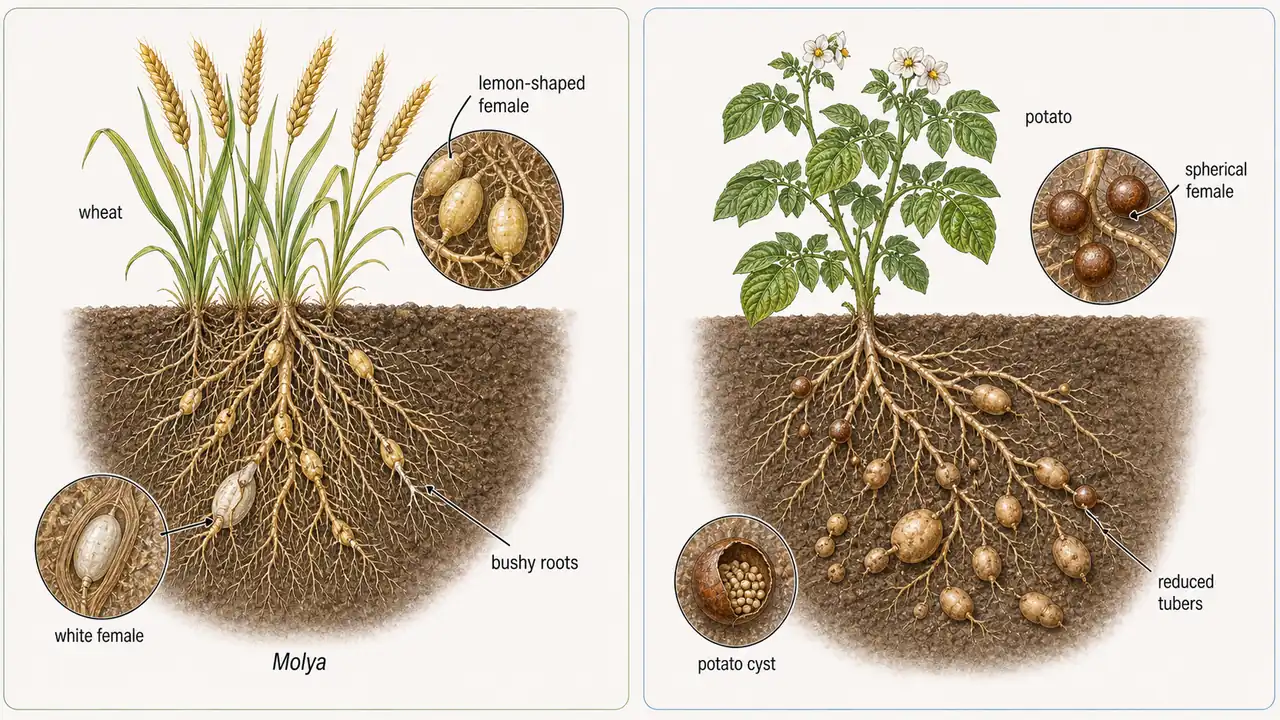
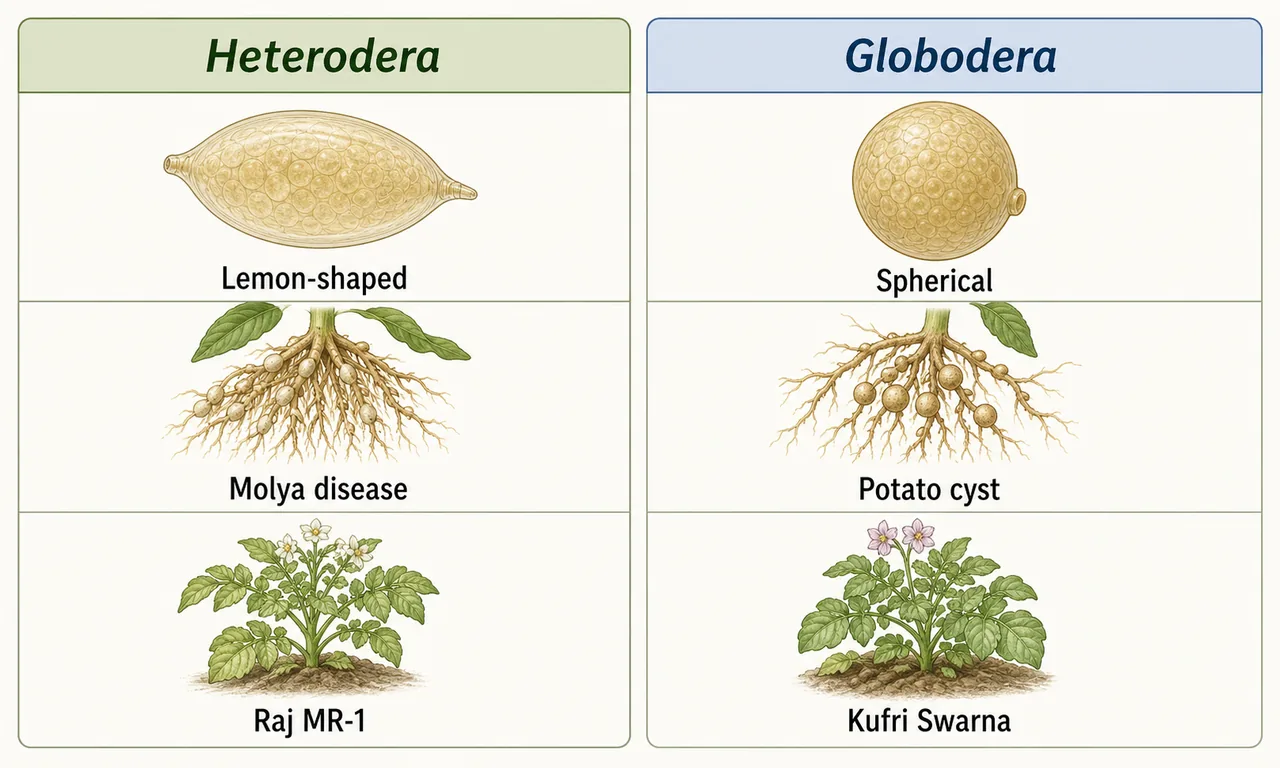
- Female is lemon-shaped (vs. spherical in Globodera).
- Main hosts: wheat and barley in India.
- Causes "Molya" disease in Rajasthan and Haryana.
Symptoms
Above ground: Patches of stunted, chlorotic plants appear 1--2 months after sowing -- irregular yellow patches contrasting with healthy surroundings.
Below ground:
- Roots become bushy with slight swellings (excessive lateral root proliferation).
- White glistening females visible on roots during January/February -- definitive naked-eye field diagnosis.
Management of Molya Disease
| Method | Details |
|---|---|
| Crop rotation | With mustard or gram -- most effective (nematode is highly host-specific) |
| Early sowing | Crop establishes before nematode juveniles become active |
| Chemical | Carbofuran @ 2 kg a.i./ha |
| Deep ploughing | Exposes cysts to desiccation and UV |
| Resistant varieties | Wheat: Raj MR-1; Barley: RD 2052, RD-2035, Rajkiran |
Globodera rostochiensis -- Potato Cyst Nematode
- First recorded in India by Jones (1961) from Nilgiri Hills, Tamil Nadu.
- Female is spherical and golden-coloured (hence "Golden Cyst Nematode").
Symptoms
- Foliage shows wilting, poorly developed root system, drastically reduced tuber number and size.
- Spherical white females (pin-head size) easily visible on roots; plants uproot easily due to weakened root system.
Management
| Method | Details |
|---|---|
| Legislative (quarantine) | Domestic quarantine under Destructive Insect Pests Act (1971); potato movement from Nilgiri Hills is banned for use as seed |
| Resistant variety | Kufri Swarna -- released in 1985; covers up to 40% area under potato cultivation in Nilgiri Hills |
Comparison: Heterodera vs Globodera
| Feature | Heterodera | Globodera |
|---|---|---|
| Cyst shape | Lemon-shaped | Spherical |
| Colour | Brown/black | Golden/yellow to brown |
| Key Indian species | H. avenae (wheat/barley) | G. rostochiensis (potato) |
| Disease name | Molya disease | Potato cyst disease |
| Distribution | Rajasthan, Haryana, Punjab | Nilgiri Hills, Tamil Nadu |
| Quarantine status | No | Yes (Destructive Insect Pests Act, 1971) |
Summary Table
| Feature | Key Fact |
|---|---|
| Defining character | Dead female body → hardened cyst (quinone tanning) |
| First cyst nematode | H. schachtii (sugarbeet, 1859, Germany) |
| Hatching trigger | Root exudates from host (unlike root-knot) |
| Feeding site | Syncytium (not giant cells) |
| Egg survival | 3--4 years in cyst at 50% viable eggs/year |
| Generations/year | One (univoltine) |
| Molya disease | H. avenae on wheat/barley; Rajasthan and Haryana |
| Molya resistant wheat | Raj MR-1 |
| Potato cyst nematode | G. rostochiensis; Nilgiri Hills |
| Potato resistant variety | Kufri Swarna (1985) |
| Quarantine nematodes (India) | Globodera rostochiensis and Rhadinaphelenchus cocophilus |
TIP
Exam mnemonic -- "LEMON vs GLOBE": Lemon-shaped = Heterodera (Molya disease of wheat), Globe-shaped = Globodera (potato cyst, quarantine pest, Kufri Swarna).
References
- Dropkin, V.H. 1980. Introduction to plant nematology. John Wiley and sons, INC. New York.
- Singh, R.S and Sitaramaiah, K. 1994. Plant pathogens. The plant parasitic nematodes. Oxford & IBH Pub. Co. Pvt. Ltd. New Delhi.
- Walia, R. K and Bajaj, H. K (2014). Textbook of Introductory Plant Nematology. Directorate of Knowledge Management in Agriculture, ICAR, New Delhi.
- Kumar, V., Khan, M.R. & Walia, R.K. Crop Loss Estimations due to Plant-Parasitic Nematodes in Major Crops in India. Natl. Acad. Sci. Lett. 43, 409-412 (2020).
- Figure 1: Source: A: Maggenti, 1981, B-E: Franklin, 1973
Summary Cheat Sheet
| Concept / Topic | Key Details |
|---|---|
| Defining character | Dead female body → hardened cyst (quinone tanning) |
| First cyst nematode | H. schachtii (sugarbeet, 1859, Germany) |
| Hatching trigger | Root exudates from host (unlike root-knot) |
| Feeding site | Syncytium (not giant cells) |
| Egg survival | 3--4 years in cyst at 50% viable eggs/year |
| Generations/year | One (univoltine) |
| Molya disease | H. avenae on wheat/barley; Rajasthan and Haryana |
| Molya resistant wheat | Raj MR-1 |
| Potato cyst nematode | G. rostochiensis; Nilgiri Hills |
| Potato resistant variety | Kufri Swarna (1985) |
| Quarantine nematodes (India) | Globodera rostochiensis and Rhadinaphelenchus cocophilus |
TIP
Next: Lesson 03 covers the seed-gall nematode (Anguina tritici) -- the first PPN ever discovered, earcockle and Tundu diseases of wheat.