🪱 Ditylenchus Nematodes -- Stem, Bulb, and Mushroom Parasites
Ufra disease of rice, onion bloat, potato rot, and mushroom nematode -- above-ground nematode parasites of stems and bulbs
In the previous lesson, we covered the reniform nematode -- a semi-endoparasite of cotton and vegetables. Now we examine a genus that breaks the underground rule: Ditylenchus nematodes attack stems, bulbs, and leaves rather than roots.
In the deep-water paddy fields of Assam and West Bengal, rice farmers sometimes find plants with twisted leaves, distorted earheads, and white cottony masses near the crown -- a condition known as Ufra disease. In onion fields of temperate regions, growers discover soft, bloated, rotting bulbs that are unmarketable.
This lesson covers:
- Ufra disease of rice -- D. angustus, nema wool, deep-water paddy
- Stem and bulb nematode -- D. dipsaci, onion bloat, 23-year survival
- Potato rot nematode -- D. destructor, temperate tuber damage
- Mushroom nematode -- D. myceliophagus, mycophagous feeding
Overview
Unlike the root-feeding nematodes covered in earlier lessons, Ditylenchus species are primarily stem and bulb parasites. Their biology and management are therefore quite distinct from root-infecting nematodes.
Pro Content Locked
Upgrade to Pro to access this lesson and all other premium content.
₹99 charged monthly · Cancel anytime
- All Agriculture & Banking Courses
- AI Lesson Questions (100/day)
- AI Doubt Solver (50/day)
- Glows & Grows Feedback (30/day)
- AI Section Quiz (20/day)
- 22-Language Translation (100/day)
- Recall Questions (20/day)
- AI Quiz (15/day)
- AI Quiz Paper Analysis (100/day)
- AI Step-by-Step Explanations (100/day)
- Spaced Repetition Recall (FSRS)
- AI Tutor
- Immersive Text Questions
- Audio Lessons — Hindi & English
- Mock Tests & Previous Year Papers
- Summary & Mind Maps
- XP, Levels, Leaderboard & Badges
- Generate New Classrooms
- Voice AI Teacher (AgriDots Live)
- AI Revision Assistant
- Knowledge Gap Analysis
- Interactive Revision (LangGraph)
🔒 Secure via Razorpay · Cancel anytime · No hidden fees
In the previous lesson, we covered the reniform nematode -- a semi-endoparasite of cotton and vegetables. Now we examine a genus that breaks the underground rule: Ditylenchus nematodes attack stems, bulbs, and leaves rather than roots.
In the deep-water paddy fields of Assam and West Bengal, rice farmers sometimes find plants with twisted leaves, distorted earheads, and white cottony masses near the crown -- a condition known as Ufra disease. In onion fields of temperate regions, growers discover soft, bloated, rotting bulbs that are unmarketable.
This lesson covers:
- Ufra disease of rice -- D. angustus, nema wool, deep-water paddy
- Stem and bulb nematode -- D. dipsaci, onion bloat, 23-year survival
- Potato rot nematode -- D. destructor, temperate tuber damage
- Mushroom nematode -- D. myceliophagus, mycophagous feeding
Overview
Unlike the root-feeding nematodes covered in earlier lessons, Ditylenchus species are primarily stem and bulb parasites. Their biology and management are therefore quite distinct from root-infecting nematodes.
Ufra Disease of Rice -- Ditylenchus angustus
Discovery
- Butler (1913) first reported D. angustus from East Bengal (now Bangladesh).
- Disease named "Ufra" in honour of Butler's assistant Uftar Rahman, who first brought diseased specimens to him.
- In India, prevalent in eastern states: Assam, West Bengal, Bihar, and parts of Uttar Pradesh -- regions with high rainfall and waterlogged conditions.
Biology
| Feature | Details |
|---|---|
| Main host | Rice |
| Feeding type | Ectoparasite of above-ground plant parts (growing point, leaf sheaths) |
| Survival mechanism | Pre-adult J4 juveniles form cottony masses called nema wool when the crop matures |
| Preferred conditions | Deep-water paddy -- standing water allows nematodes to swim from plant to plant |
NOTE
Nema wool = thousands of quiescent J4 nematodes aggregating into white, cotton-like masses that survive adverse conditions until the next crop season.
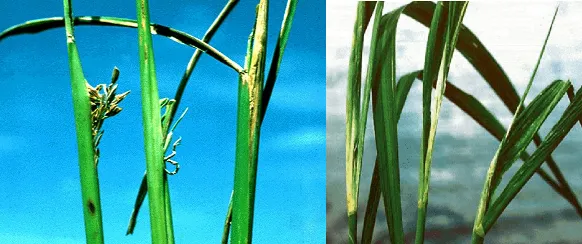
Symptoms
First symptoms appear when the crop is 2--3 months old as chlorosis and yellow streaks on upper leaves. Later, two forms manifest:
| Form | Description |
|---|---|
| Swollen Ufra | Panicles fail to emerge; stalks branch abnormally; earheads remain trapped inside flag leaf sheath |
| Ripe Ufra | Panicles emerge but are distorted and sterile (empty, unfilled grains) |
| Leaf twisting | Characteristic spiralling of leaves and sheaths from uneven nematode feeding |
Stem and Bulb Nematode -- Ditylenchus dipsaci
One of the most polyphagous nematode species, with over 450 recorded host plants including onion, garlic, alfalfa, celery, oats, rye, and many ornamentals. Primarily a problem in temperate regions.
Key Features
| Feature | Details |
|---|---|
| Survival | Undergoes quiescence forming nema wool; can survive up to 23 years |
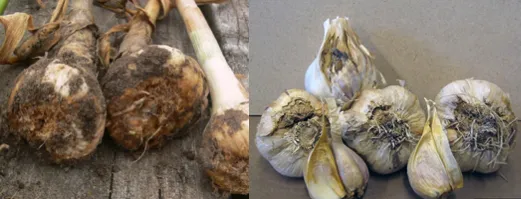
| Main disease in India | "Onion bloat" disease -- swelling and distortion of bulb scales |
| Onion symptoms | Bulbs become soft, spongy, and eventually rot -- unmarketable |
Potato Rot Nematode -- Ditylenchus destructor
| Feature | Details |
|---|---|
| Distribution | Temperate regions of Europe and North America |
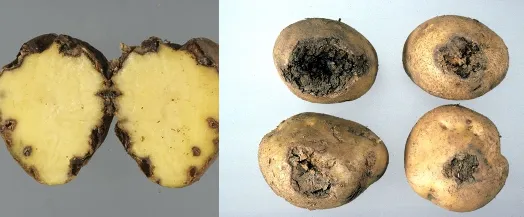
| Disease | Root rot of potato tubers |
| Damage | Enters tubers; creates dry, granular rot; cracked/discoloured skin |
| Secondary infections | Damaged tubers become susceptible to fungal and bacterial decay |
| Species name | destructor reflects its highly destructive nature |
Mushroom Nematode -- Ditylenchus myceliophagus
| Feature | Details |
|---|---|
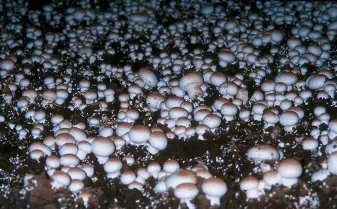
| Feeding type | Mycophagous (mycelium-eating) -- feeds on fungal hyphae |
| Host | Button mushroom (Agaricus bisporus) |
| Damage | Destroys fungal mycelium needed for fruiting body formation |
| Co-occurrence | Often found together with Aphelenchoides composticola in the same compost |
| Combined impact | Both species cause rapid decline in mushroom yields |
| India presence | Reported from Indian mushroom production |
Comparison: Ditylenchus Species
| Species | Common Name | Main Host | Disease | Key Feature |
|---|---|---|---|---|
| D. angustus | Rice stem nematode | Rice | Ufra (swollen and ripe forms) | J4 forms nema wool; deep-water paddy |
| D. dipsaci | Stem & bulb nematode | Onion, garlic, ornamentals | Onion bloat | 450+ hosts; survives 23 years as nema wool |
| D. destructor | Potato rot nematode | Potato | Potato tuber rot | Temperate; dry granular rot |
| D. myceliophagus | Mushroom nematode | Agaricus bisporus | Mycelium destruction | Mycophagous; co-occurs with A. composticola |
Summary Table
| Feature | Key Fact |
|---|---|
| Genus characteristic | Parasitises above-ground parts (stems, bulbs, leaves) -- NOT roots |
| Ufra disease | D. angustus; rice; first reported by Butler, 1913, Bengal |
| Ufra name origin | Named after assistant Uftar Rahman |
| Nema wool | Cottony masses of quiescent J4 nematodes -- survival mechanism |
| Ufra conditions | Deep-water paddy (standing water allows nematode movement) |
| Ufra forms | Swollen Ufra (trapped panicles) and Ripe Ufra (sterile panicles) |
| Onion bloat | D. dipsaci; bulbs become soft, spongy, unmarketable |
| D. dipsaci survival | Up to 23 years in quiescent state |
| Potato rot | D. destructor; temperate regions; dry granular tuber rot |
| Mushroom nematode | D. myceliophagus; mycophagous; often co-occurs with A. composticola |
TIP
Exam mnemonic -- "UOPS" for Ditylenchus species: Ufra (D. angustus -- rice, nema wool), Onion bloat (D. dipsaci -- 23 years survival), Potato rot (D. destructor -- temperate), muShroom (D. myceliophagus -- mycophagous).
References
- Dropkin, V.H. 1980. Introduction to plant nematology. John Wiley and sons, INC. New York.
- Singh, R.S and Sitaramaiah, K. 1994. Plant pathogens. The plant parasitic nematodes. Oxford & IBH Pub. Co. Pvt. Ltd. New Delhi.
- Walia, R. K and Bajaj, H. K (2014). Textbook of Introductory Plant Nematology. Directorate of Knowledge Management in Agriculture, ICAR, New Delhi.
- Kumar, V., Khan, M.R. & Walia, R.K. Crop Loss Estimations due to Plant-Parasitic Nematodes in Major Crops in India. Natl. Acad. Sci. Lett. 43, 409-412 (2020).
Summary Cheat Sheet
| Concept / Topic | Key Details |
|---|---|
| Genus characteristic | Parasitises above-ground parts (stems, bulbs, leaves) -- NOT roots |
| Ufra disease | D. angustus; rice; first reported by Butler, 1913, Bengal |
| Ufra name origin | Named after assistant Uftar Rahman |
| Nema wool | Cottony masses of quiescent J4 nematodes -- survival mechanism |
| Ufra conditions | Deep-water paddy (standing water allows nematode movement) |
| Ufra forms | Swollen Ufra (trapped panicles) and Ripe Ufra (sterile panicles) |
| Onion bloat | D. dipsaci; bulbs become soft, spongy, unmarketable |
| D. dipsaci survival | Up to 23 years in quiescent state |
| Potato rot | D. destructor; temperate regions; dry granular tuber rot |
| Mushroom nematode | D. myceliophagus; mycophagous; often co-occurs with A. composticola |
TIP
Next: The final lesson covers other important PPNs -- lesion, rice root, spiral, lance, stunt, dagger, needle, and stubby-root nematodes.