🕰️ Evolution & Generations of Computers
History from Abacus to AI — five generations of computers, key inventors (Pascal, Babbage, Turing), ENIAC, UNIVAC, Von Neumann concept, and classification by type and size.
The Journey of Computing
Humans have always needed tools to count and calculate. The journey from the ancient Abacus to today's AI-powered supercomputers spans thousands of years. Understanding this evolution helps us appreciate how each breakthrough built upon the previous one.
Early Computing Devices
Before electricity existed, humans built mechanical devices to assist with calculations:
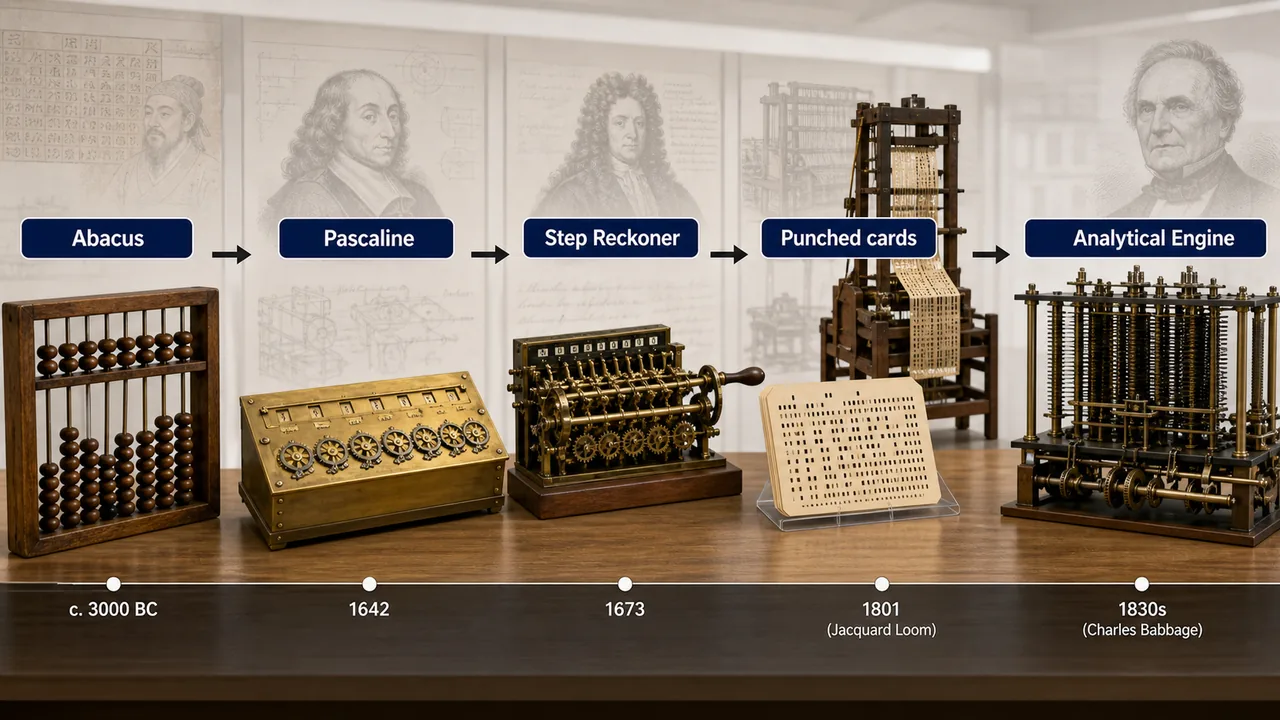
Abacus (3000 BC)
The Abacus is the oldest known computing device, developed in China about 5000 years ago. It is a simple wooden frame with parallel wires holding movable beads. By sliding beads, users could perform addition, subtraction, multiplication, and division.
The Abacus was so effective that it spread from China to Japan, Russia, and the Middle East. Some shopkeepers in Asia still use it today!
Pascal's Calculator (1642)
French mathematician Blaise Pascal invented the first real mechanical calculator around 1642. Called the Pascaline, it could perform addition and subtraction using a series of interlocking gears and wheels.
Pascal built it to help his father, a tax commissioner, with tedious calculations.
Leibniz's Calculator (1694)
German mathematician Gottfried Wilhelm Leibniz improved Pascal's machine to also perform multiplication and division. This was called the Step Reckoner.
Jacquard's Loom (1801)
Joseph Marie Jacquard created an automatic weaving loom that used punched cards to control weaving patterns. This concept of using cards to give instructions to a machine later influenced computer programming.
Charles Babbage — The Father of Computers
Charles Babbage is known as the "Father of Computers". He designed two groundbreaking machines:
| Machine | Year | Significance |
|---|---|---|
| Difference Engine | 1822 | First automatic mechanical calculator — could compute mathematical tables |
| Analytical Engine | 1837 | First design for a general-purpose computer — had memory, processor, input, and output |
The Analytical Engine had all the basic components of a modern computer:
- Mill (equivalent to today's CPU)
- Store (equivalent to today's memory/RAM)
- Input (punched cards)
- Output (printed results)
Babbage could never complete the Analytical Engine due to funding problems and limitations of 19th-century technology.
Ada Lovelace — The First Programmer
Ada Lovelace, a mathematician who worked with Babbage, wrote the first computer program — instructions for the Analytical Engine to compute a mathematical sequence. She is considered the world's first computer programmer.
The Electronic Era
MARK-I (1944)
Howard Aiken (Harvard University) built the MARK-I with IBM's help — the world's first program-controlled calculator and an early form of digital computer.
ENIAC (1946)
ENIAC (Electronic Numerical Integrator and Computer) was built by John Mauchly and J. Presper Eckert at the University of Pennsylvania. It is regarded as the first successful general-purpose electronic digital computer.
- Weighed 30 tons, occupied 1,800 square feet
- Used 18,000 vacuum tubes
- Could perform 5,000 additions per second
Von Neumann's Stored Program Concept
John Von Neumann proposed a revolutionary idea: both the program instructions and the data should be stored inside the computer's memory. This allowed computers to modify their own programs during execution.
This concept was first implemented in EDSAC (Electronic Delay Storage Automatic Computer) at Cambridge University.
Whirlwind and Early High-Speed Memory
The Whirlwind computer is an important early machine linked with high-speed stored-program computing and the development of fast internal memory systems. It helps bridge the story from basic electronic computers to later improvements in RAM and processing speed.
UNIVAC-I (1951)
UNIVAC-I (Universal Automatic Computer) became the first commercially available computer in 1951. It marked the beginning of computers being sold as products.
Early Internet and Web Milestones
- ARPANET was an early packet-switching network and the first major network to implement the TCP/IP protocol suite.
- The first web browser created by Tim Berners-Lee was called WorldWideWeb and was later renamed Nexus.
- SixDegrees is remembered as one of the earliest social networking or social media websites.
Five Generations of Computers
Each generation represents a major technological leap:
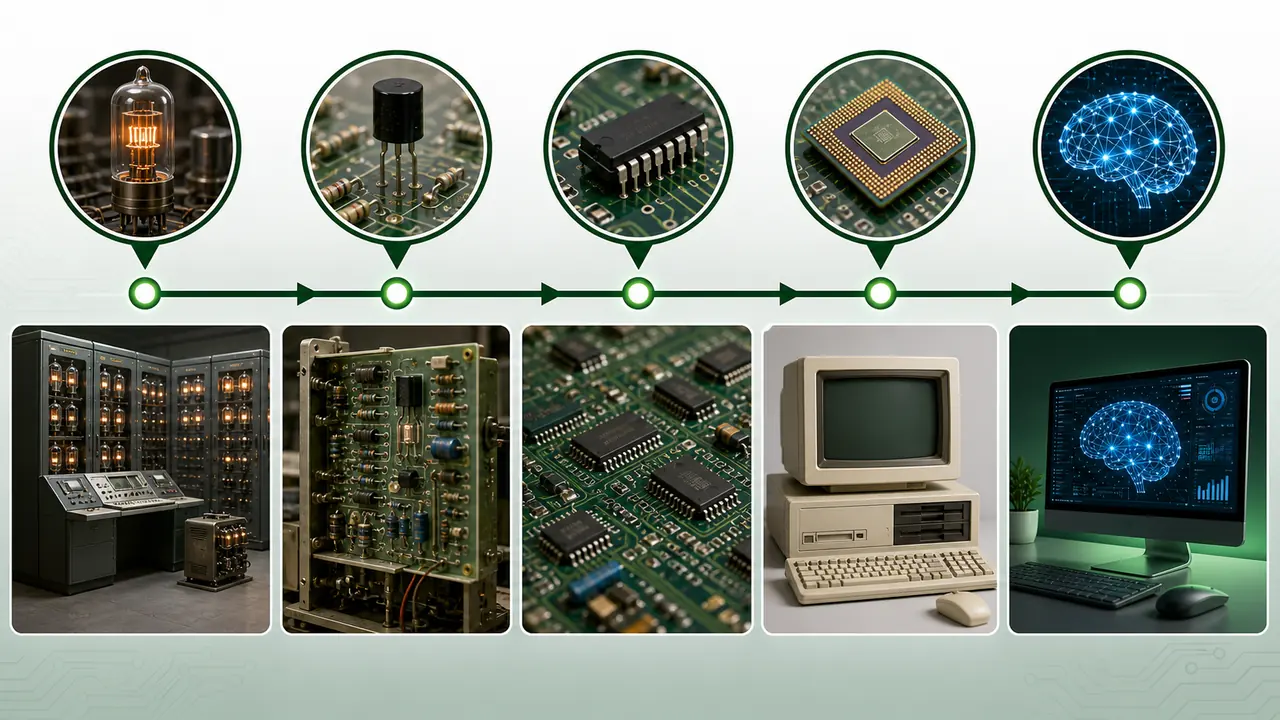
First Generation (1940–1956) — Vacuum Tubes
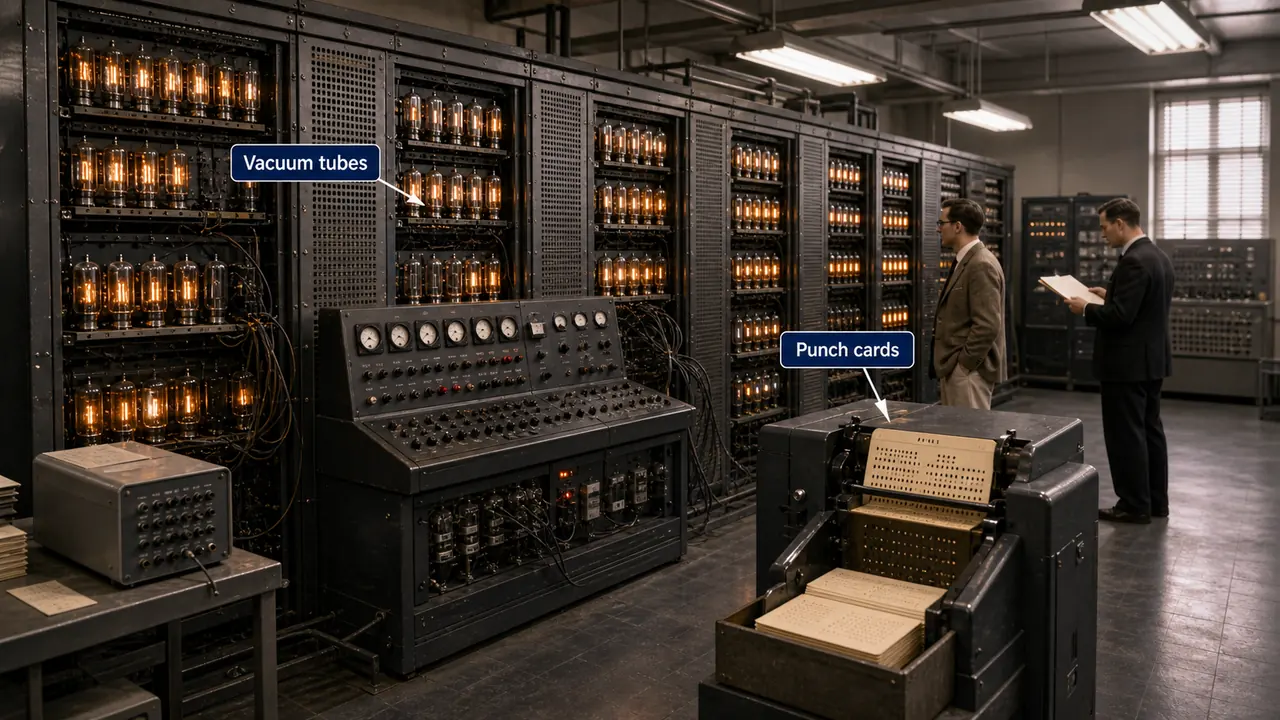
| Feature | Detail |
|---|---|
| Technology | Vacuum Tubes |
| Language | Machine Language (binary: 0s and 1s) |
| Memory | Magnetic Drums |
| Size | Very large — filled entire rooms |
| Speed | Slow (milliseconds) |
| Examples | ENIAC, UNIVAC-I, IBM 701 |
| Limitations | Huge size, expensive, unreliable, generated excessive heat, high power consumption |
Second Generation (1956–1963) — Transistors
| Feature | Detail |
|---|---|
| Technology | Transistors (replaced vacuum tubes) |
| Language | Assembly Language |
| Memory | Magnetic Core |
| Size | Smaller than 1st generation |
| Speed | Faster (microseconds) |
| Examples | IBM 1401, IBM 7094, CDC 3600 |
| Advantages | Smaller, cheaper, more reliable, less heat |
Third Generation (1964–1971) — Integrated Circuits
| Feature | Detail |
|---|---|
| Technology | Integrated Circuits (ICs) — many transistors on one silicon chip |
| Language | High-level languages (FORTRAN, COBOL, BASIC) |
| Memory | Semiconductor memory |
| Size | Even smaller and more compact |
| Speed | Nanoseconds |
| Examples | IBM 360 series, PDP-8, ICL 2900 |
| Advantages | Reliable, low power, keyboard & monitor introduced |
Who invented the IC? Jack Kilby (Texas Instruments, 1958) — he won the Nobel Prize in Physics for this invention.
Fourth Generation (1971–Present) — Microprocessors
| Feature | Detail |
|---|---|
| Technology | Microprocessors — entire CPU on a single chip (VLSI) |
| Language | C, C++, Java, Python and other modern languages |
| Memory | Semiconductor (RAM, ROM), Hard Disks |
| Size | Desktop, Laptop, Palmtop — personal use |
| Speed | Picoseconds |
| Examples | IBM PC, Apple Macintosh, modern laptops |
| Key Innovation | GUI (Graphical User Interface), Mouse, Internet |
First Microprocessor: Intel 4004 (1971) — designed by Intel, it was the first commercial microprocessor.
Fifth Generation (Present & Beyond) — Artificial Intelligence
| Feature | Detail |
|---|---|
| Technology | AI (Artificial Intelligence), ULSI chips |
| Focus | Machines that can think, learn, and reason |
| Key Technologies | Machine Learning, Deep Learning, Natural Language Processing, Robotics |
| Examples | IBM Watson, Google AI, ChatGPT, Self-driving cars |
| Goal | Create computers with human-like intelligence |
Quick Comparison Table
| Generation | Period | Technology | Speed | Language | Example |
|---|---|---|---|---|---|
| 1st | 1940-56 | Vacuum Tubes | ms | Machine | ENIAC |
| 2nd | 1956-63 | Transistors | µs | Assembly | IBM 1401 |
| 3rd | 1964-71 | ICs | ns | FORTRAN, COBOL | IBM 360 |
| 4th | 1971-now | Microprocessors | ps | C, Java, Python | IBM PC |
| 5th | Present+ | AI/ULSI | Beyond ps | AI/NLP | Watson |
Classification of Computers
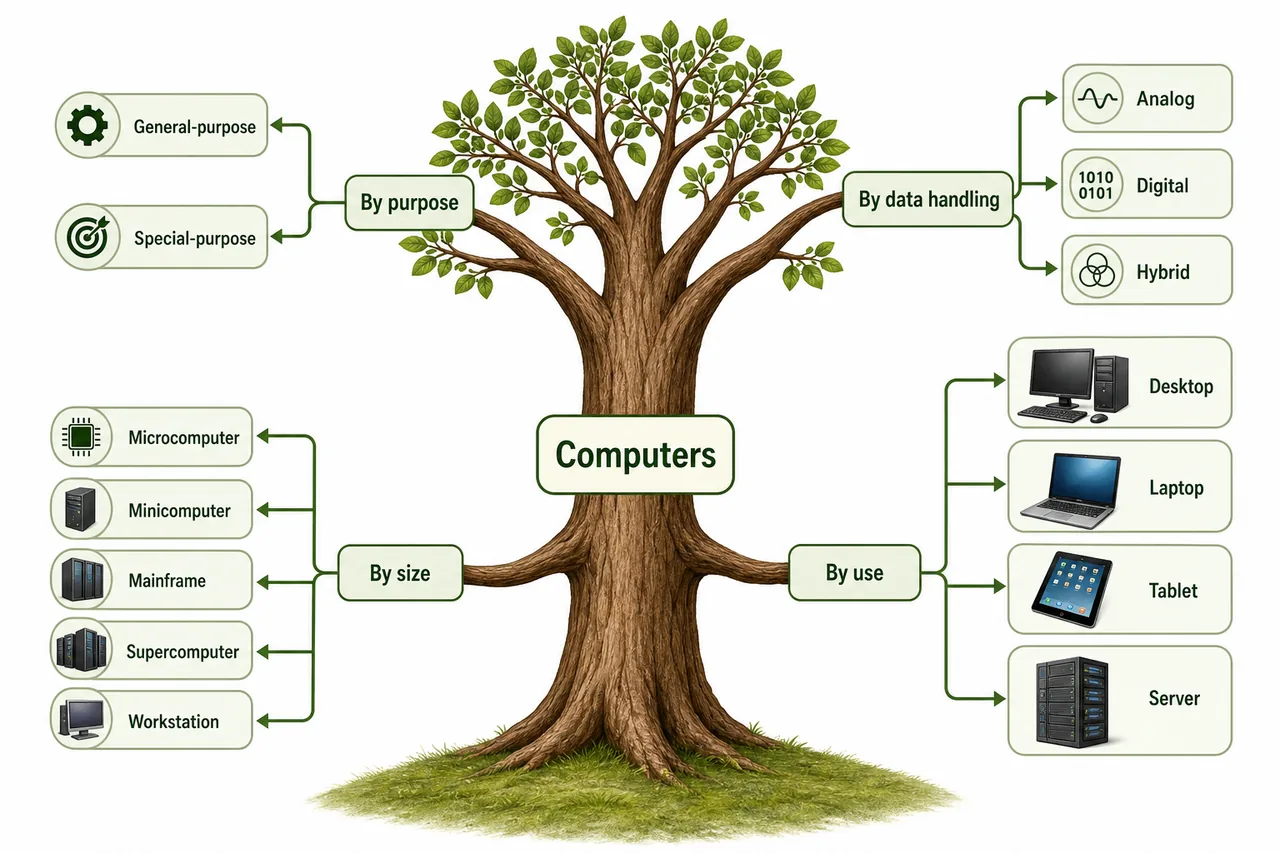
By Purpose
| Type | Description | Example |
|---|---|---|
| General Purpose | Can perform many different tasks | Desktop PC, Laptop |
| Special Purpose | Designed for one specific task | Traffic signal controller, ATM |
An embedded system is a practical form of special-purpose computing placed inside another device, such as a car controller, washing machine panel, smart meter, thermostat, printer, or ATM controller. An information appliance is a user-friendly device built mainly for one dedicated service such as communication, reading, media, or a specific digital utility.
By Data Handling
| Type | Description | Example |
|---|---|---|
| Analog Computer | Processes continuous data (temperature, pressure) | Speedometer, Thermometer |
| Digital Computer | Processes discrete data (0s and 1s) | Laptop, Mobile phone |
| Hybrid Computer | Combination of analog and digital | Hospital ICU monitors, Petrol pump meters |
By Size and Capacity
| Type | Users | Speed | Cost | Example |
|---|---|---|---|---|
| Supercomputer | Thousands | Fastest | Most expensive | PARAM Siddhi (India) |
| Mainframe | Hundreds | Very fast | Expensive | IBM Z Series |
| Minicomputer | 10-100 | Fast | Moderate | PDP-11 |
| Microcomputer | 1 (personal) | Good | Affordable | Desktop, Laptop, Tablet |
| Workstation | 1 (professional) | High | Moderate-High | CAD/Design stations |
Important Inventors and Milestones
Key Personalities
| Person | Contribution |
|---|---|
| Charles Babbage | "Father of Computer" — designed the Analytical Engine |
| Ada Lovelace | First computer programmer — wrote programs for Analytical Engine |
| John Bardeen, William Shockley, Walter Brattain | Invented the Transistor at Bell Labs (1947) — Nobel Prize 1956 |
| Jack Kilby | Invented the Integrated Circuit (IC) at Texas Instruments (1958) — Nobel Prize in Physics 2000 |
| John Von Neumann | Proposed the stored program concept (EDVAC) |
| John Mauchly & J. Presper Eckert | Built ENIAC and UNIVAC |
| Alan Turing | Father of Theoretical Computer Science — Turing Machine concept |
| Howard Aiken | Built Harvard Mark I with IBM |
Additional Pioneer References Often Asked in MCQs
| Person / Team | Contribution |
|---|---|
| Herman Hollerith | Built the tabulating machine using punched cards; his company later became part of IBM |
| Vannevar Bush | Built the Differential Analyzer, an important early analog computer |
| Konrad Zuse | Associated with the early programmable Z series computers in Germany |
| John Vincent Atanasoff & Clifford Berry | Built the ABC computer — an important early electronic digital computing milestone |
| Joseph Marie Jacquard | Introduced punched-card control through the Jacquard Loom |
| James Russell | Associated with the development of the CD-ROM concept |
Landmark Machines — Quick Reference
| Machine | Year | Significance |
|---|---|---|
| Abacus | ~3000 BC | Earliest calculating device — originated in China |
| Pascaline | 1642 | First mechanical calculator (Blaise Pascal) |
| Tabulating Machine | 1890 | Herman Hollerith's punched-card census-processing machine |
| Differential Analyzer | 1930 | Vannevar Bush's analog computing machine |
| Mark I | 1944 | Harvard's electromechanical computer — 51 feet long, used relays |
| ABC Computer | 1940s | Atanasoff & Berry early electronic digital computing milestone |
| ENIAC | 1945-46 | First general-purpose electronic computer — 30 tons, 18,000 vacuum tubes, consumed 174,000 watts |
| EDVAC | 1949 | First computer based on Von Neumann stored-program concept |
| UNIVAC | 1951 | First commercial computer — delivered to US Census Bureau |
| Intel 4004 | 1971 | First microprocessor — 2,300 transistors on a single chip |
India's Supercomputers
| Supercomputer | Year | Developed By | Significance |
|---|---|---|---|
| PARAM 8000 | 1991 | C-DAC (Centre for Development of Advanced Computing) | India's first supercomputer |
| PARAM Siddhi AI | 2020 | C-DAC + NVIDIA | AI-focused supercomputer, ranked in Top 500 |
| PARAM Pravega | 2022 | IISc Bangalore + C-DAC | India's fastest academic supercomputer |
| Shastra T | Modern academic HPC era | Indian academic supercomputing ecosystem | One of India's notable high-performance academic supercomputers |
World's Fastest Supercomputers
| Supercomputer | Country | Note |
|---|---|---|
| CDC 6600 | USA | Historically remembered as the first successful supercomputer |
| Fugaku | Japan | Was world's fastest supercomputer (2020-2022), developed by RIKEN & Fujitsu |
| Frontier | USA (Oak Ridge) | Currently among the fastest (exascale computing) |
A few milestones are especially worth remembering together: the PARAM series is associated with C-DAC in India, Fugaku is associated with Japan, Intel 4004 is remembered as the first microprocessor, and Jack Kilby is known for the integrated circuit.
Summary Points
| Concept | Key Details |
|---|---|
| Abacus | Oldest computing device, China, ~3000 BC |
| Pascal's Calculator | First mechanical calculator, Blaise Pascal, 1642 |
| Leibniz Step Reckoner | Added multiplication & division, 1694 |
| Jacquard's Loom | Used punched cards for weaving patterns, 1801 |
| Father of Computers | Charles Babbage — Difference Engine (1822) + Analytical Engine (1837) |
| Analytical Engine | Mill (CPU), Store (memory), Input (punched cards), Output (print) |
| First Programmer | Ada Lovelace — wrote algorithm for Analytical Engine |
| Alan Turing | Father of Theoretical Computer Science — Turing Machine |
| Mark I | Harvard electromechanical computer, Howard Aiken + IBM, 1944 |
| ENIAC | First electronic digital computer, Mauchly & Eckert, 1945-46, 30 tons, 18,000 vacuum tubes |
| Von Neumann | Stored program concept — program + data in memory (EDVAC, 1949) |
| UNIVAC-I | First commercial computer, 1951, US Census Bureau |
| 1st Gen (1940-56) | Vacuum Tubes, Machine Language, milliseconds, ENIAC |
| 2nd Gen (1956-63) | Transistors, Assembly Language, microseconds, IBM 1401 |
| 3rd Gen (1964-71) | ICs (Jack Kilby), High-level Languages, nanoseconds, IBM 360 |
| 4th Gen (1971-now) | Microprocessors (Intel 4004), GUI, picoseconds, Personal Computers |
| 5th Gen (Present+) | AI, ULSI, Machine Learning, IBM Watson |
| Transistor | Bardeen, Shockley, Brattain — Bell Labs, 1947 — Nobel Prize 1956 |
| IC (Integrated Circuit) | Jack Kilby, Texas Instruments, 1958 — Nobel Prize in Physics 2000 |
| Intel 4004 | First microprocessor, 1971, 2,300 transistors on single chip |
| Analog | Continuous data — Speedometer, Thermometer |
| Digital | Discrete data (0/1) — Laptop, Mobile |
| Hybrid | Both analog + digital — ICU monitors, petrol pump meters |
| PARAM 8000 | India's first supercomputer — C-DAC, 1991 |
| PARAM Siddhi AI | AI-focused supercomputer — C-DAC + NVIDIA, 2020 |
| Fugaku | Japan's supercomputer (RIKEN & Fujitsu) — was world's fastest (2020-22) |
| Frontier | USA (Oak Ridge) — exascale computing |
| Supercomputer | Fastest type — thousands of users |
| Microcomputer | Personal use — Desktop, Laptop, Tablet |
Lesson Doubts
Ask questions, get expert answers