☁️ IoT, Cloud Computing & Emerging Tech
Internet of Things, IIoT, RFID, AWS IoT, cloud services (IaaS, PaaS, SaaS), robotics, blockchain for UPSSSC AGTA.
Internet of Things (IoT)
Internet of Things (IoT) refers to the network of physical devices — sensors, appliances, vehicles, machines — that are connected to the internet, collect data, and communicate with each other without human intervention.
The idea is simple: everyday objects become "smart" by connecting to the internet. A soil moisture sensor in a farm field sends data to your phone — that is IoT in action.
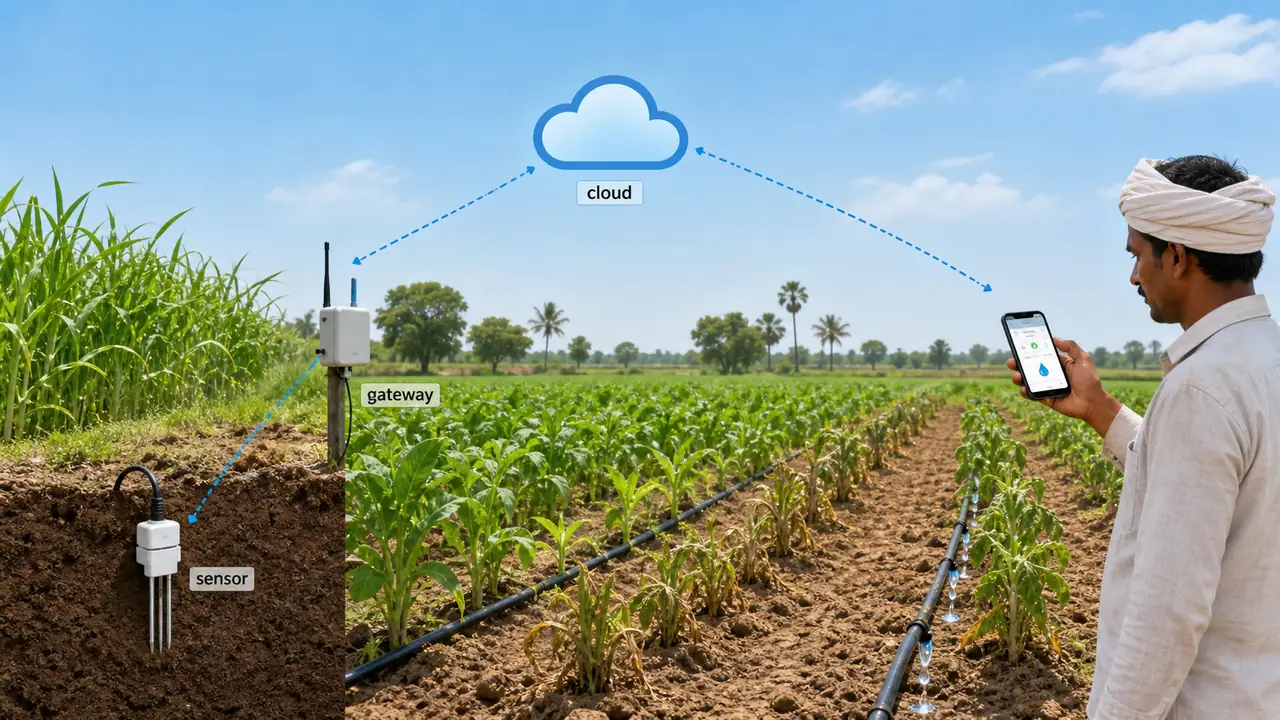
IoT Architecture
IoT systems are built in layers:
| Layer | Function | Examples |
|---|---|---|
| Perception Layer | Collects data from the physical world using sensors and actuators | Temperature sensor, humidity sensor, camera, GPS |
| Network Layer | Transmits data from sensors to the cloud/server | WiFi, Bluetooth, 4G/5G, LoRaWAN, Zigbee |
| Application Layer | Processes data and provides services to users | Smart irrigation dashboard, health monitoring app |
IoT Protocols
| Protocol | Full Form | Use |
|---|---|---|
| MQTT | Message Queuing Telemetry Transport | Lightweight messaging for IoT devices (low bandwidth) |
| CoAP | Constrained Application Protocol | For resource-constrained IoT devices |
| LoRaWAN | Long Range Wide Area Network | Long-range, low-power communication (ideal for agriculture) |
| Zigbee | — | Short-range, low-power mesh networking (smart home) |
| Bluetooth | — | Short-range device communication |
| NFC | Near Field Communication | Very short range (contactless payments) |
RFID — Radio Frequency Identification
RFID uses radio waves to automatically identify and track objects. An RFID system has:
| Component | Role |
|---|---|
| RFID Tag | Attached to object — contains a microchip and antenna storing identification data |
| RFID Reader | Sends radio signals and reads data from tags |
| Middleware | Processes the data received from readers |
Types of RFID tags:
- Passive — no battery, powered by reader's radio signal (cheaper, shorter range)
- Active — has own battery (more expensive, longer range — up to 100m)
Applications: inventory tracking, library books, FASTag toll collection, livestock tagging, supply chain management, passport chips
IoT Sensors
| Sensor Type | Measures | IoT Application |
|---|---|---|
| Temperature | Heat/cold | Weather stations, cold chain monitoring |
| Humidity | Moisture in air | Greenhouse control, warehouse storage |
| Soil Moisture | Water content in soil | Smart irrigation |
| Pressure | Atmospheric/fluid pressure | Weather forecasting, industrial monitoring |
| Motion/PIR | Movement detection | Security systems, automatic lights |
| GPS | Location coordinates | Vehicle tracking, drone navigation |
| Accelerometer | Acceleration/vibration | Mobile phones, fitness trackers |
| Gyroscope | Orientation/rotation | Drone stabilization, mobile gaming |
IoT in Agriculture (Smart Agriculture)
| Application | How It Works |
|---|---|
| Smart Irrigation | Soil moisture sensors trigger irrigation only when needed — saves water |
| Drone Monitoring | Drones with cameras survey crops for disease, pest damage, growth patterns |
| Precision Farming | GPS-guided tractors, variable-rate fertilizer/pesticide application |
| Livestock Monitoring | RFID tags + sensors track animal health, location, feeding |
| Weather Stations | IoT sensors monitor temperature, humidity, rainfall in real-time |
| Cold Chain | Temperature sensors ensure proper storage during transport of perishables |
IoT Cloud Platforms
| Platform | Provider |
|---|---|
| AWS IoT Core | Amazon Web Services |
| Azure IoT Hub | Microsoft |
| Google Cloud IoT |
IIoT — Industrial Internet of Things
IIoT (Industrial IoT) applies IoT specifically to industrial settings — manufacturing, energy, transportation, and agriculture at scale.
- Predictive maintenance — sensors detect equipment wear before breakdown
- Supply chain optimization — real-time tracking of goods
- Quality control — automated inspection using IoT sensors and cameras
Smart Home Devices
| Device | Function |
|---|---|
| Amazon Alexa | Voice assistant — controls smart home devices |
| Google Home | Voice assistant by Google |
| Smart Thermostat | Automatically adjusts room temperature (e.g., Nest) |
| Smart Lock | Keyless entry using phone/fingerprint |
| Smart Bulb | Control brightness/color remotely |
Cloud Computing
Cloud Computing is the delivery of computing services — servers, storage, databases, networking, software — over the internet ("the cloud") on a pay-as-you-go basis, instead of owning and maintaining physical hardware.
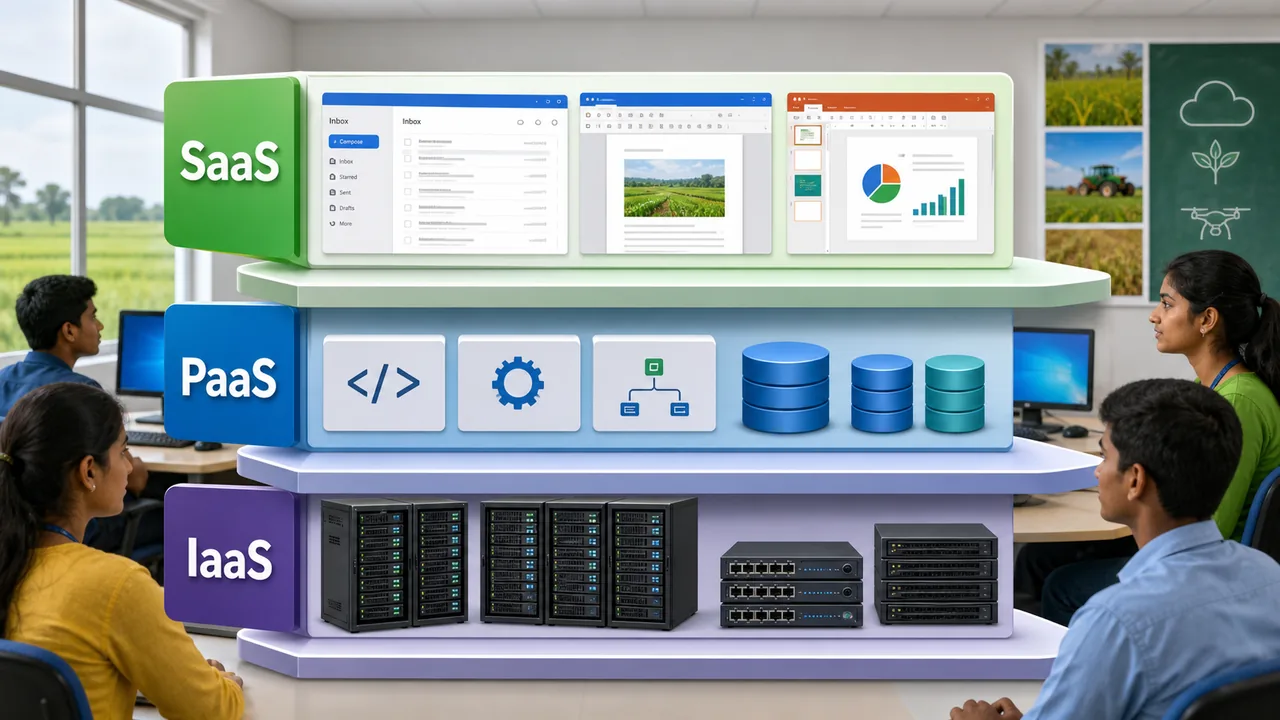
Cloud Service Models
| Model | Full Form | What is Provided | User Manages | Example |
|---|---|---|---|---|
| IaaS | Infrastructure as a Service | Servers, storage, networking | OS, apps, data | AWS EC2, Azure VMs |
| PaaS | Platform as a Service | Runtime, middleware, OS | Applications, data | Google App Engine, Heroku |
| SaaS | Software as a Service | Complete application | Nothing (just use it) | Gmail, Office 365, Google Docs |
Easy way to remember: IaaS = you build the house on rented land; PaaS = you furnish a rented apartment; SaaS = you stay in a hotel (everything ready).
Cloud Deployment Models
| Model | Description |
|---|---|
| Public Cloud | Services available to everyone over internet (AWS, Google Cloud) |
| Private Cloud | Exclusively for one organization — more control and security |
| Hybrid Cloud | Combination of public + private cloud |
| Community Cloud | Shared by organizations with common goals (government departments) |
Major Cloud Providers
| Provider | Key Service |
|---|---|
| AWS (Amazon Web Services) | Largest cloud provider globally |
| Microsoft Azure | Strong enterprise integration |
| Google Cloud Platform | Strong in AI/ML services |
Benefits of Cloud Computing
- Scalability — increase/decrease resources as needed
- Cost-effective — pay only for what you use (no upfront hardware cost)
- Accessibility — access from anywhere with internet
- No maintenance — provider handles hardware maintenance
- Disaster recovery — data backed up across multiple locations
MeghRaj — Indian Government Cloud
MeghRaj (GI Cloud) is the Indian Government's cloud computing initiative to provide cloud services to all government departments, reducing IT costs and improving efficiency.
- Launched by Ministry of Electronics and IT (MeitY)
- National Cloud hosted at NIC (National Informatics Centre)
Robotics
A robot is a programmable machine capable of carrying out tasks automatically. Robots can be guided by external control, or the control may be embedded within.
Components of a Robot
| Component | Function |
|---|---|
| Sensors | Perceive the environment (camera, touch, proximity) |
| Actuators | Create movement (motors, pistons, servos) |
| Controller | The "brain" — processes sensor data and decides actions (microprocessor) |
| Power Supply | Battery or electrical connection |
| End Effector | Tool at the end of robot arm (gripper, welder, sprayer) |
Types of Robots
| Type | Use |
|---|---|
| Industrial | Manufacturing, assembly lines, welding |
| Medical | Surgery (Da Vinci surgical robot), rehabilitation |
| Military | Bomb disposal, surveillance drones |
| Agricultural | Drone spraying, autonomous harvesting, weeding robots |
| Domestic | Vacuum cleaners (Roomba), lawn mowers |
Asimov's Three Laws of Robotics
Isaac Asimov (science fiction writer) proposed three laws:
- A robot may NOT injure a human or allow a human to come to harm
- A robot must OBEY human orders (unless it conflicts with Law 1)
- A robot must PROTECT its own existence (unless it conflicts with Laws 1 or 2)
Robotics in Agriculture
- Drone spraying — pesticide/fertilizer application over large areas
- Harvesting robots — pick fruits/vegetables without damaging them
- Weeding robots — identify and remove weeds using computer vision
- Autonomous tractors — GPS-guided, driverless operation
Blockchain Technology
Blockchain is a distributed ledger technology where data is stored in blocks that are linked together in a chain using cryptographic hashing. Once recorded, data cannot be altered — making it immutable and transparent.
How Blockchain Works
- A transaction occurs (e.g., land record transfer)
- Transaction is broadcast to a network of computers (nodes)
- Nodes validate the transaction using consensus algorithms
- Validated transaction is added to a block
- Block is linked to the previous block using a cryptographic hash
- The chain becomes permanent and tamper-proof
Key Features
| Feature | Description |
|---|---|
| Decentralized | No single authority controls it — distributed across many computers |
| Immutable | Once recorded, data cannot be changed or deleted |
| Transparent | All participants can view the ledger |
| Secure | Cryptographic hashing protects data integrity |
Cryptocurrency
| Currency | Details |
|---|---|
| Bitcoin | First cryptocurrency (2009), created by Satoshi Nakamoto (pseudonym) |
| Ethereum | Supports Smart Contracts — self-executing agreements |
Smart Contracts
Smart Contracts are self-executing contracts where the terms are written directly in code. When conditions are met, the contract automatically executes without intermediaries.
Blockchain Applications
| Application | How Blockchain Helps |
|---|---|
| Supply Chain | Track product from farm to consumer — verify authenticity |
| Land Records | Tamper-proof property ownership records |
| Digital Identity | Secure, verifiable identity without central authority |
| Banking | Faster cross-border payments, reduced fraud |
| Healthcare | Secure sharing of medical records |
| Voting | Transparent, tamper-proof electronic voting |
Digital Finance & CBDC
| Term | Description |
|---|---|
| CBDC | Central Bank Digital Currency — digital form of fiat money issued by central bank |
| e-Rupee (e₹) | India's CBDC launched by RBI (pilot started December 2022) |
| Cryptocurrency | Decentralized digital currency (Bitcoin, Ethereum) — NOT issued by any government |
Key difference: CBDC is government-backed and regulated; cryptocurrency is decentralized and unregulated.
IoT in Smart Agriculture — Example Flow
A typical smart agriculture IoT workflow:
Soil moisture sensor (perception layer) → data sent via LoRaWAN/WiFi (network layer) → Cloud platform processes data → Alert sent to farmer's phone: "Field 3 needs irrigation" → Farmer activates smart pump remotely
Edge Computing & Fog Computing
| Concept | Description | Example |
|---|---|---|
| Edge Computing | Processes data near the source (on the IoT device itself or nearby) instead of sending everything to the cloud | A drone processes crop images locally and only sends alerts to cloud |
| Fog Computing | An intermediate layer between edge devices and the cloud — processes, filters, and aggregates data before sending to cloud | A local gateway collects data from 100 soil sensors, pre-processes it, then uploads summary to cloud |
Exam tip: Edge = at the device; Fog = between device and cloud; Cloud = centralized.
MQTT — IoT Messaging Protocol
MQTT (Message Queuing Telemetry Transport) is the most widely used IoT messaging protocol.
| Feature | Details |
|---|---|
| Model | Publish-Subscribe (not request-response) |
| How It Works | Devices publish messages to a topic; other devices subscribe to that topic and receive messages |
| Key Advantage | Extremely lightweight — ideal for low-bandwidth, unreliable networks |
| Broker | Central server that routes messages between publishers and subscribers (e.g., Mosquitto, HiveMQ) |
| Use Cases | Smart agriculture sensors, smart home devices, industrial monitoring |
Smart City Mission India
India's Smart Cities Mission (launched June 2015) selected 100 cities for smart urban development.
| Smart City Feature | Technology Used |
|---|---|
| Smart Traffic | AI-controlled traffic signals, adaptive routing |
| Smart Waste Management | IoT sensors on bins, optimized collection routes |
| Smart Surveillance | AI-powered CCTV, facial recognition |
| Smart Lighting | IoT-enabled LED streetlights that adjust based on activity |
| Smart Water | Leak detection sensors, automated supply management |
| Command Centre | Integrated Control and Command Centre (ICCC) in each smart city |
Cloud Computing — Additional Concepts
AWS (Amazon Web Services)
AWS is the largest cloud provider globally (over 30% market share), offering 200+ services.
| Service | Purpose |
|---|---|
| EC2 | Virtual servers (IaaS) |
| S3 | Object storage |
| Lambda | Serverless computing |
| RDS | Managed databases |
GovCloud / MeghRaj
MeghRaj (GI Cloud) is India's government cloud initiative.
- Hosted at NIC (National Informatics Centre)
- Provides cloud services to all government departments
- Reduces IT costs; promotes data sovereignty
Serverless Computing
Serverless Computing allows running code without managing or provisioning servers.
| Feature | Details |
|---|---|
| How | Developer writes functions; cloud provider handles all infrastructure |
| Billing | Pay only for execution time (not idle time) |
| Examples | AWS Lambda, Google Cloud Functions, Azure Functions |
| Use | Event-driven tasks — image processing, API backends, IoT data processing |
Emerging Technologies
NFT (Non-Fungible Token)
NFT is a unique digital ownership certificate stored on a blockchain.
| Feature | Details |
|---|---|
| Fungible vs Non-fungible | ₹100 note is fungible (interchangeable); a painting is non-fungible (unique) |
| What it certifies | Ownership of digital art, music, videos, virtual land |
| Blockchain | Mostly on Ethereum blockchain |
| Key Point | Proves authenticity and ownership of digital assets |
Web 3.0
Web 3.0 is the next evolution of the internet — decentralized, powered by blockchain, AI, and semantic web.
| Generation | Characteristic | Example |
|---|---|---|
| Web 1.0 | Read-only (static websites) | Early websites, news portals |
| Web 2.0 | Read-write (user-generated content) | Facebook, YouTube, Wikipedia |
| Web 3.0 | Read-write-own (decentralized, user-owned data) | Blockchain apps (DApps), cryptocurrency, NFTs |
Metaverse
Metaverse is a collective virtual shared space created by the convergence of VR + AR + Blockchain + AI.
- Users interact as avatars in 3D virtual worlds
- Applications: virtual offices, gaming, education, virtual commerce
- Meta (Facebook) rebranded to focus on Metaverse (October 2021)
Digital Twin
Digital Twin is a virtual replica of a physical system that simulates real-world behavior in real-time.
| Feature | Details |
|---|---|
| What | Software model that mirrors a physical object, process, or system |
| Data Source | IoT sensors feed real-time data to the digital twin |
| Use Cases | Smart factory monitoring, urban planning, agriculture (simulate crop growth), aircraft engine testing |
| Benefit | Test changes virtually before implementing physically — reduces cost and risk |
Summary Points
| Concept | Key Details |
|---|---|
| IoT | Physical devices connected via internet, collecting and sharing data |
| Perception Layer | Sensors and actuators — collects data |
| Network Layer | Transmits data (WiFi, 4G, LoRaWAN) |
| Application Layer | Processes data, provides user services |
| MQTT | Lightweight IoT messaging protocol |
| LoRaWAN | Long-range, low-power — ideal for agriculture |
| Zigbee | Short-range mesh networking (smart home) |
| RFID | Radio wave identification — tags + readers |
| IIoT | Industrial IoT — predictive maintenance, supply chain |
| Smart Irrigation | Soil moisture sensors trigger watering |
| AWS IoT Core | Amazon's IoT cloud platform |
| IaaS | Infrastructure — AWS EC2, Azure VMs |
| PaaS | Platform — Google App Engine, Heroku |
| SaaS | Software — Gmail, Office 365 |
| Public Cloud | Available to everyone (AWS, Google Cloud) |
| Private Cloud | Exclusive to one organization |
| Hybrid Cloud | Public + Private combined |
| MeghRaj | Indian Government Cloud (GI Cloud) by MeitY |
| Robot Components | Sensors, Actuators, Controller, Power, End Effector |
| Asimov's Laws | 1. Don't harm humans 2. Obey humans 3. Self-preserve |
| Blockchain | Distributed, immutable, transparent ledger |
| Cryptographic Hash | Links blocks together, ensures tamper-proof |
| Decentralized | No single authority controls the network |
| Bitcoin | First cryptocurrency (2009) by Satoshi Nakamoto |
| Ethereum | Supports Smart Contracts |
| Smart Contracts | Self-executing code-based agreements |
| CBDC | Central Bank Digital Currency — government-backed |
| e-Rupee (e₹) | India's CBDC by RBI (pilot 2022) |
| Edge Computing | Process data near the source (on/near the device) |
| Fog Computing | Intermediate layer between edge devices and cloud |
| MQTT | Publish-subscribe IoT messaging, lightweight, low-bandwidth |
| Smart City Mission | 100 cities (June 2015) — smart traffic, waste, surveillance |
| AWS | Largest cloud provider globally (30%+ market share) |
| MeghRaj/GovCloud | Indian Government Cloud at NIC, by MeitY |
| Serverless | AWS Lambda, Google Cloud Functions — pay per execution |
| NFT | Unique digital ownership certificate on blockchain |
| Web 3.0 | Decentralized internet — read-write-own (blockchain + AI) |
| Metaverse | Virtual shared space — VR + AR + Blockchain + AI |
| Digital Twin | Virtual replica of physical system using real-time IoT data |
Lesson Doubts
Ask questions, get expert answers