🏰 Medieval Monuments of UP
Complete guide to UP's medieval monuments — Taj Mahal, Agra Fort, Fatehpur Sikri (UNESCO), Bara Imambara, Jaunpur mosques, Kashi Vishwanath Temple, Sarnath, Allahabad Fort for Uttar Pradesh GK.
UNESCO World Heritage Sites in UP
Uttar Pradesh is home to 3 UNESCO World Heritage Sites, all dating to the medieval period. These are among the most visited monuments in India and are frequently asked about in competitive exams.
| Site | Year Inscribed | Builder | Period |
|---|---|---|---|
| Taj Mahal | 1983 | Shah Jahan | 1632-1653 |
| Agra Fort | 1983 | Akbar (begun), Shah Jahan (additions) | 1565 onwards |
| Fatehpur Sikri | 1986 | Akbar | 1571-1585 |
Exam Tip: All three UNESCO heritage sites of UP are located in Agra district. No other district in UP has a UNESCO World Heritage Site.
Taj Mahal — Crown of Palaces
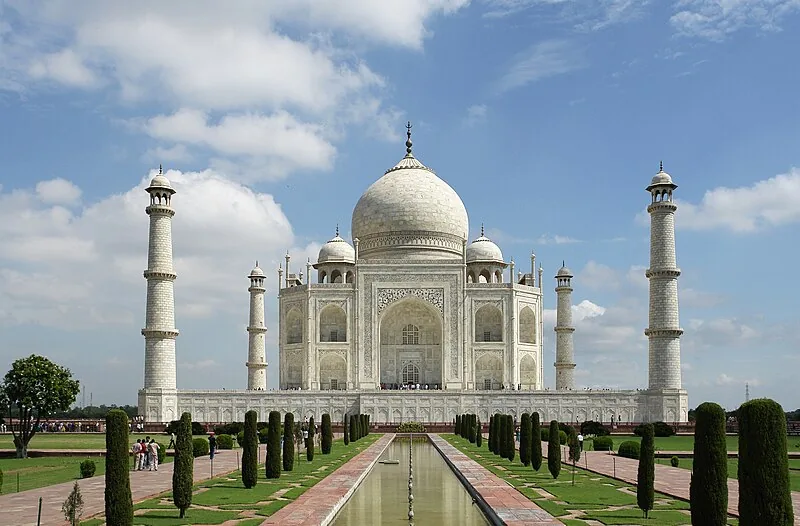
The Taj Mahal is one of the most celebrated monuments in the world and one of the finest examples of Mughal architecture. It was built by Shah Jahan between 1632 and 1653 as a mausoleum for his wife Mumtaz Mahal, who died during childbirth in Burhanpur.
Architectural Details
| Feature | Detail |
|---|---|
| Location | South bank of Yamuna, Agra |
| Material | White Makrana marble (Rajasthan) |
| Base platform | Red sandstone |
| Chief architect | Ustad Ahmad Lahori |
| Calligrapher | Amanat Khan Shirazi |
| Garden design | Char-bagh (four-fold Persian garden) |
| Main dome height | 73 metres (from ground to finial) |
| Minarets | 4, each 40 metres tall, slightly tilted outward |
| Workforce | ~20,000 artisans over 21 years |
The Taj Mahal exemplifies perfect bilateral symmetry — the mosque on the west is mirrored by the mehman khana (guest house) on the east. The only asymmetric element is Shah Jahan's cenotaph, placed beside Mumtaz's on the main floor.
Decorative Techniques
- Pietra dura — Semi-precious stone inlay (jasper, jade, lapis lazuli, turquoise, carnelian) forming floral patterns
- Jali work — Perforated marble screens surrounding the cenotaphs
- Calligraphy — Quranic verses inscribed in black marble, designed by Amanat Khan
- Optical illusion — Letters at the top of the gateway are larger than those at the bottom, so they appear uniform when viewed from ground level
Agra Fort — Red Sandstone to White Marble
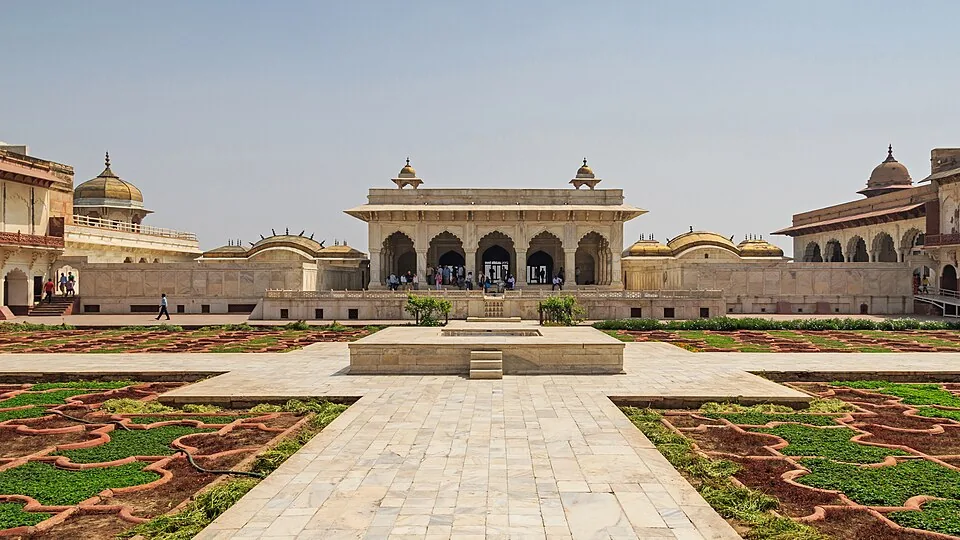
Agra Fort is a massive fortification on the banks of the Yamuna, serving as the Mughal imperial residence for generations.
Akbar began construction in 1565 using red sandstone from Rajasthan. The fort's walls stretch 2.5 km in circumference and rise 21 metres high. Akbar built the military and administrative structures.
Shah Jahan later replaced many red sandstone structures with white marble buildings, transforming the fort from a military garrison into a palatial complex.
Key Structures Inside Agra Fort
| Structure | Builder | Material | Purpose |
|---|---|---|---|
| Jahangiri Mahal | Akbar | Red sandstone | Palace for Jahangir; Hindu-Islamic fusion |
| Diwan-i-Am | Shah Jahan | Red sandstone + marble | Public audience hall |
| Diwan-i-Khas | Shah Jahan | White marble | Private audience; housed Peacock Throne |
| Moti Masjid | Shah Jahan | White marble | Royal mosque ("Pearl Mosque") |
| Musamman Burj | Shah Jahan | White marble | Octagonal tower; Shah Jahan's prison |
| Nagina Masjid | Shah Jahan | White marble | Ladies' mosque |
| Sheesh Mahal | Shah Jahan | Mirror-work | Royal bath with mirror-inlaid walls |
Shah Jahan spent his last 8 years (1658-1666) imprisoned in Musamman Burj by his son Aurangzeb. From this octagonal tower, he could gaze at the Taj Mahal across the Yamuna — the tomb of his beloved wife.
Fatehpur Sikri — The Abandoned Capital
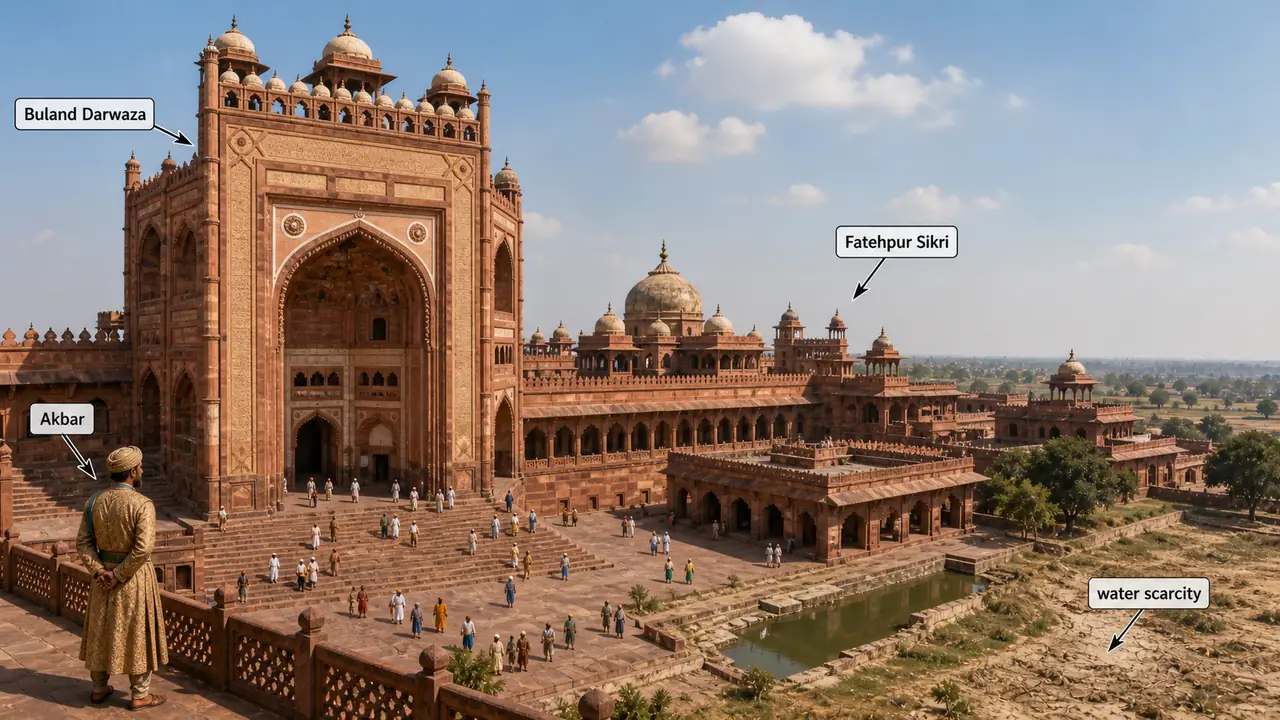
Fatehpur Sikri is Akbar's magnificent planned city, built 37 km from Agra. It served as the Mughal capital from 1571 to 1585 before being abandoned — most likely due to inadequate water supply.
Major Structures
| Structure | Special Feature |
|---|---|
| Buland Darwaza | Monumental gateway about 54 m high; built to celebrate Gujarat victory (1573) |
| Tomb of Sheikh Salim Chishti | White marble; exquisite jali screens; built over the saint's grave |
| Panch Mahal | Five-storey palatial structure with 176 columns; no two columns alike |
| Diwan-i-Khas | Central pillar with 4 walkways; Akbar's private audience hall |
| Ibadat Khana | House of Worship; where Akbar held inter-faith debates |
| Hiran Minar | Tower studded with elephant tusks; possibly a game tower |
| Jodha Bai Palace | Largest palace in the complex; Hindu architectural elements |
Exam Tip: The Buland Darwaza at Fatehpur Sikri is about 54 metres high. It was built to celebrate Akbar's Gujarat victory — not the founding of the city itself.
Lucknow's Nawabi Monuments
Lucknow's architectural heritage dates primarily to the Nawabi period (18th-19th century) and represents a unique blend of Mughal, European, and indigenous styles.
Bara Imambara (1784)
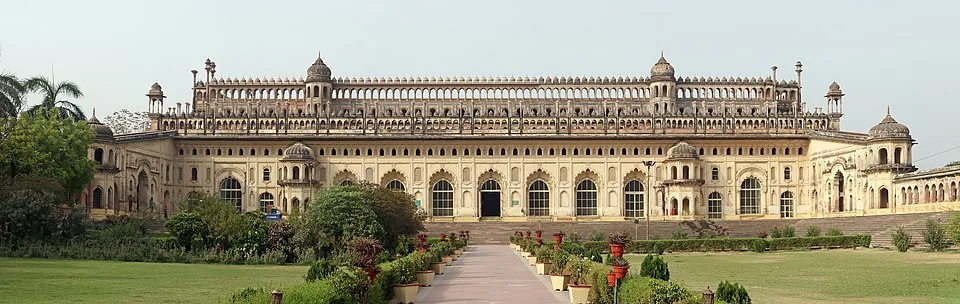
Built by Nawab Asaf-ud-Daula as a famine relief project.
| Feature | Detail |
|---|---|
| Full name | Asafi Imambara |
| Year | 1784 |
| Special feature | Very large arched hall with no visible supporting beams |
| Roofing technique | Interlocking brick construction (lakhauri) |
| Upper floor | Bhulbhulaiya — labyrinth of 489 identical doorways |
| Stepwell | Shahi Baoli — multi-level underground well |
Chhota Imambara (1838)
Also known as the Hussainabad Imambara or "Palace of Lights." Built by Nawab Muhammad Ali Shah. It is lavishly decorated with chandeliers from Belgium, gilt-edged mirrors, and calligraphy. The tombs of Muhammad Ali Shah and his mother are housed here.
Rumi Darwaza
Built by Asaf-ud-Daula in 1784, the Rumi Darwaza is an imposing 18-metre gateway inspired by Ottoman-style gateways associated with Constantinople (Istanbul). It has become one of the main symbols of Lucknow.
Other Lucknow Monuments
- La Martiniere — Built by French adventurer Major General Claude Martin (1795). A unique European-Nawabi hybrid. Functions as a school to this day.
- The Residency — British Residency complex (1800), site of the famous Siege of Lucknow during the 1857 Revolt. Maintained as ruins, a protected national monument.
- Kaiserbagh Palace — Last great Nawabi palace, built by Wajid Ali Shah (1848-1850).
Jaunpur — Sharqi Architecture
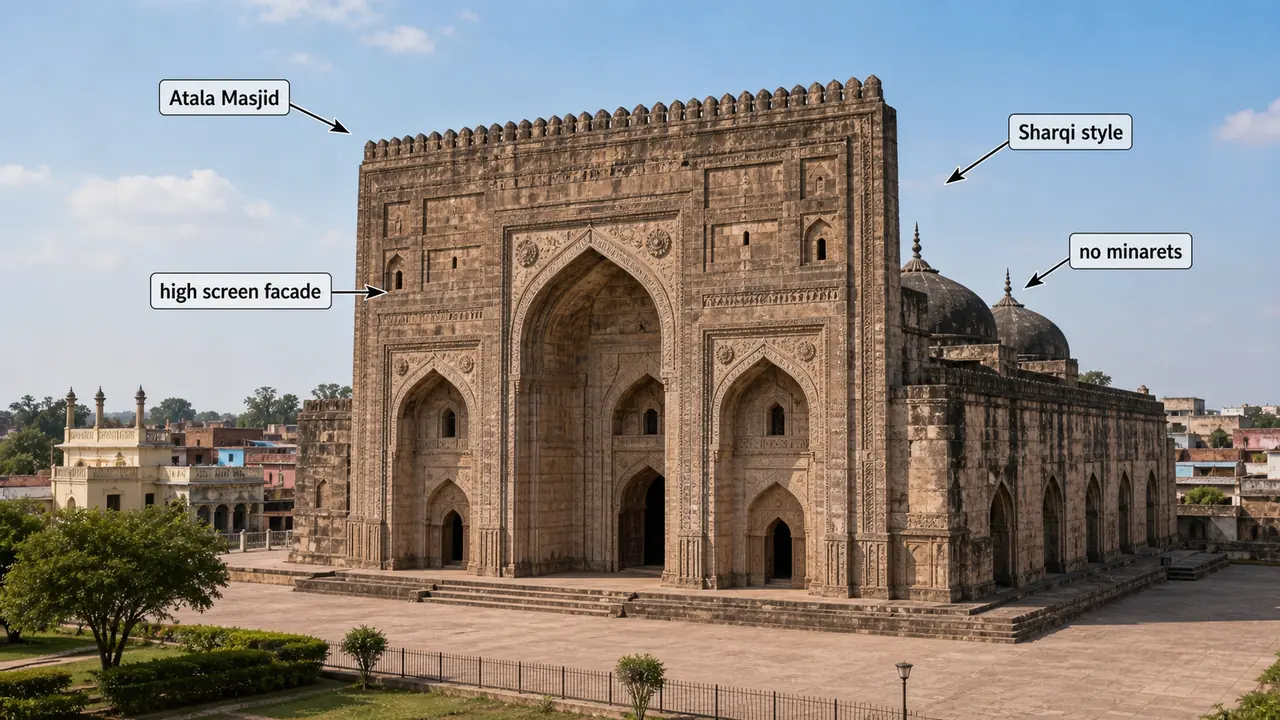
Jaunpur's monuments represent the distinctive Sharqi architectural style — characterized by massive arched screen facades (propylon), absence of minarets, and the integration of Hindu architectural elements.
| Monument | Builder | Year | Special Feature |
|---|---|---|---|
| Atala Masjid | Ibrahim Shah | 1408 | 23m arched screen; finest Sharqi example |
| Jama Masjid | Hussain Shah | 1470 | Largest Jaunpur mosque; high platform |
| Lal Darwaza Masjid | Sharqi period | ~1450 | Named for red gateway |
| Jhanjhari Masjid | Sharqi period | 15th c. | Lattice screen (jali) work |
| Shahi Bridge | Mughal | 1564-1568 | Akbar-era bridge over Gomti river |
Exam Tip: Jaunpur's Sharqi mosques have NO minarets — this is the defining feature that distinguishes them from contemporary Sultanate and Mughal mosques.
Varanasi — Kashi Vishwanath & Sarnath
Kashi Vishwanath Temple
The original Kashi Vishwanath Temple (dedicated to Lord Shiva) was demolished by Aurangzeb in 1669, and the Gyanvapi Mosque was built partially on its site. The current Kashi Vishwanath Temple was rebuilt by Ahilyabai Holkar (queen of Indore) in 1780. Maharaja Ranjit Singh donated gold plating for the dome in 1839, giving it the name "Golden Temple of Varanasi."
| Fact | Detail |
|---|---|
| Original temple demolished | 1669 by Aurangzeb |
| Mosque built on site | Gyanvapi Mosque |
| Current temple built by | Ahilyabai Holkar (1780) |
| Gold dome donated by | Maharaja Ranjit Singh (1839) |
| Kashi Vishwanath Corridor | Inaugurated by PM Modi (2021) |
Sarnath Monuments
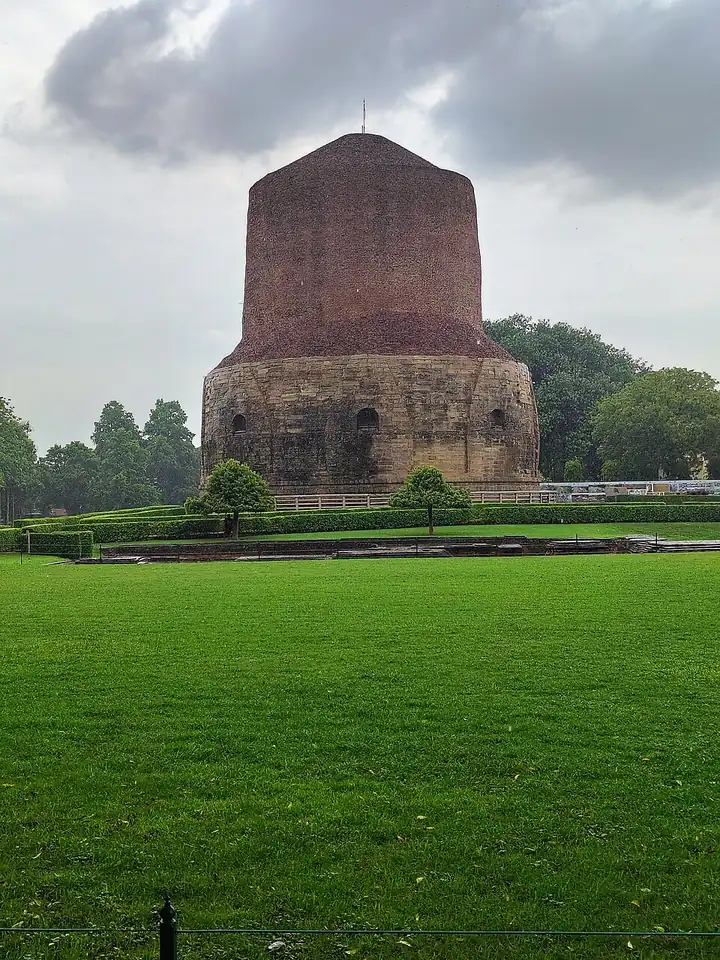
Dhamekh Stupa at Sarnath — Originally built by Emperor Ashoka (3rd century BCE), this cylindrical stupa stands 128 feet (39 metres) tall and marks the spot where Buddha delivered his first sermon (Dhammachakkappavattana Sutta). The site also contains the Ashoka Pillar, Mulagandha Kuti Vihar (modern temple, 1931), and ruins of ancient monasteries.
Other Important Monuments and Heritage Sites
| Monument | Location | Builder | Year | Special Feature |
|---|---|---|---|---|
| Allahabad Fort | Prayagraj | Akbar | 1583 | Houses Ashoka Pillar & Akshayavat tradition |
| Jama Masjid | Agra | Shah Jahan | 1648 | One of largest mosques in India |
| Chini ka Rauza | Agra | Unknown | 1635 | Glazed tile decoration (Persian style) |
| Itimad-ud-Daulah | Agra | Nur Jahan | 1628 | First Mughal structure entirely in marble; "Baby Taj" |
| Kushinagar Stupa | Kushinagar | Ancient/medieval | Various | Buddha's Mahaparinirvana site |
| Ram Janmabhoomi complex | Ayodhya | Various | Various | Important religious-historical site; modern temple phase inaugurated 2024 |
Summary Cheat Sheet
| Monument | Builder | Year | Location |
|---|---|---|---|
| Taj Mahal | Shah Jahan | 1632-1653 | Agra |
| Agra Fort | Akbar / Shah Jahan | 1565+ | Agra |
| Fatehpur Sikri | Akbar | 1571-1585 | Agra |
| Buland Darwaza | Akbar | 1573 | Fatehpur Sikri |
| Bara Imambara | Asaf-ud-Daula | 1784 | Lucknow |
| Chhota Imambara | Muhammad Ali Shah | 1838 | Lucknow |
| Rumi Darwaza | Asaf-ud-Daula | 1784 | Lucknow |
| Atala Masjid | Ibrahim Shah | 1408 | Jaunpur |
| Kashi Vishwanath | Ahilyabai Holkar | 1780 | Varanasi |
| Dhamekh Stupa | Ashoka (original) | 3rd c. BCE | Sarnath |
| Allahabad Fort | Akbar | 1583 | Prayagraj |
| Itimad-ud-Daulah | Nur Jahan | 1628 | Agra |
Lesson Doubts
Ask questions, get expert answers